
Most creators do not have a monetization problem. They have a trust problem wearing a monetization hat.
They start using AI for editing, repurposing, clipping, summarizing, caption writing, carousel drafting, email adaptation, and all the other workflow shortcuts. That part is fine. Smart, even. Then they try to make money from it by slapping offers onto every post, overselling what the tool did, or quietly turning their content into an assembly line of polished nothing.
That is where things go sideways.
How to Monetize Creator AI Editing and Repurposing Without Wrecking Trust is really a question about restraint, positioning, and honesty. People are not allergic to AI-assisted creation. They are allergic to feeling manipulated, flooded with low-effort content, or sold a shortcut by someone who clearly outsourced their judgment along with their drafts.
So if you want to earn from AI editing and repurposing without sounding like a content vending machine with Wi-Fi, here is the better approach: use AI to increase usefulness, consistency, and delivery speed, then monetize the results through offers that actually fit the trust level you have earned.
This article will show you how to do that. We will cover what to sell, what not to sell, where trust gets damaged, how to build simple funnels around repurposed content, and how to talk about AI in a way that does not make people feel like they just bought canned soup labeled “thought leadership.”
For the main guide behind this topic, visit the parent guide.
First: AI editing and repurposing are not the product. The outcome is.
This is the mistake a lot of creators make early on. They position the tool or process as the main thing people are paying for.
But clients, subscribers, and buyers rarely care that you used AI to turn one podcast into twelve short posts, three emails, two threads, and a lead magnet outline. They care that the content is clearer, sharper, faster to publish, and more useful to the right audience.
AI editing and repurposing are production methods. They can support your offer. They should not become your whole personality.
That distinction matters because trust breaks when creators start selling “AI-powered content systems” before they have shown any evidence that the output is good, strategic, or worth reading. Fancy process, weak result. People notice.
- Weak positioning: “I use AI to create massive amounts of content for your brand.”
- Better positioning: “I help founders turn one strong idea into a week of platform-ready content without losing their voice.”
One sounds like volume for volume’s sake. The other sounds like an outcome with taste involved. Guess which one people trust more.
If you want a stronger foundation for the workflow side of this, it helps to build from the broader AI writing tools and workflows category and the more specific creator AI editing and repurposing hub. Those pieces support this one because monetization only works cleanly when the actual workflow is worth monetizing in the first place.
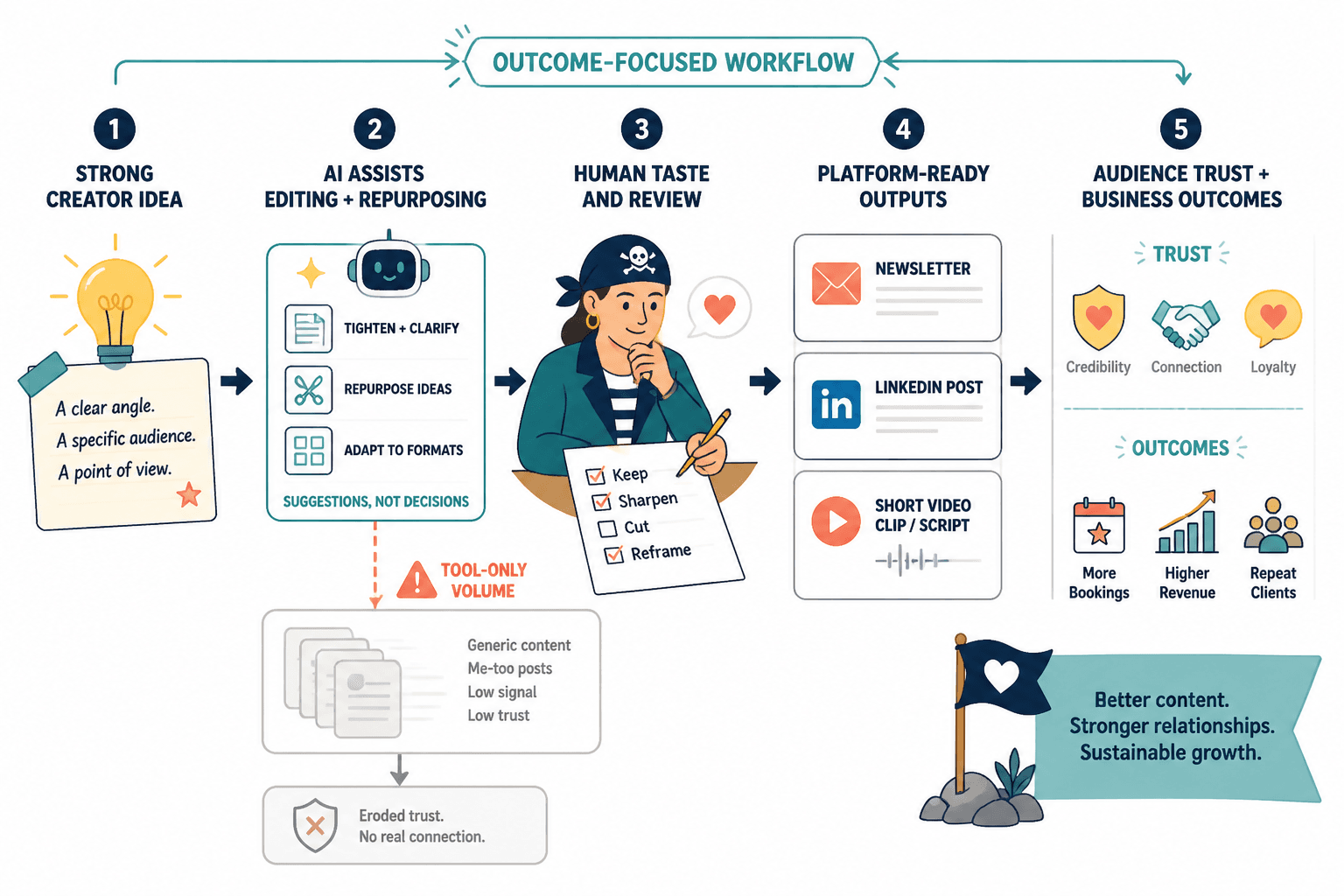
What wrecks trust when creators monetize AI-assisted content
Before talking about offers, it is worth being very clear about what makes people back away.
1. Pretending the output is more human than it is
If your posts suddenly all sound smoother, emptier, and weirdly interchangeable, people may not say “this is AI,” but they will feel the drop in texture. Your content gets less specific. Your phrasing gets more generic. Your voice starts sounding like a consultant avatar generated inside a beige conference room.
You do not have to announce every AI assist like a food allergy warning. But you do need to maintain editorial control. If the writing no longer sounds like you, trust starts leaking.
2. Selling speed as if speed automatically means value
“We can turn one recording into 50 assets in 24 hours” sounds impressive for about six seconds. After that, people start wondering whether any of those 50 assets are good.
Fast is useful. Fast alone is not persuasive. The value is in relevance, fit, quality control, and distribution logic.
3. Flooding every platform with slightly altered copies
Repurposing does not mean copy-pasting the same bland paragraph onto LinkedIn, X, Facebook, and email, then calling it omnichannel strategy. That is not strategy. That is duplication with ambition.
Trust goes down when people feel like they are watching one recycled idea get squeezed through six formats with no adaptation.
4. Pitching too early
A lot of creators learn AI workflows, immediately package them into a service, and start posting hard offers before they have built any public proof. No examples. No before-and-after. No demonstration of judgment. Just “DM me if you want help.”
You can do that. You can also enjoy the sound of crickets.
5. Acting like AI removes the need for strategy
Tools can draft. They can reformat. They can summarize and remix. They cannot decide which idea is worth leading with, what your audience is tired of hearing, or which proof point actually reduces buying friction. That is still your job.
If you want your content to feel more natural before you ever try to monetize it, read how to write creator AI editing and repurposing without sounding salesy or robotic. It solves the style problem that often causes the trust problem.
The safest monetization rule: sell the transformation, show the process, do not worship the tool
People trust creators who know what the tool is for and what it is not for.
That means your offer should center on transformation, your content should demonstrate process, and your messaging should avoid tool worship. AI is part of the engine room. It is not the mascot.
- Transformation: What changes for the client, subscriber, or buyer?
- Process: How do you get there in a way that feels credible?
- Tool restraint: Where does AI help, and where does human judgment still matter?
Here is a simple way to frame your work:
“I use AI to speed up editing and repurposing, but the strategy, message, voice, and final quality control are handled deliberately. The point is not more content. The point is more useful content from ideas you already have.”
That kind of framing does two important things. It reduces fear around low-quality automation, and it signals that you understand where value actually comes from. Not from pressing a button. From making decisions.
What you can actually monetize without turning your brand into a trust bonfire
You have more options than “sell a course about prompts” or “offer ghost content packages to everyone with a pulse.” Some are cleaner, more credible, and easier to sustain.
1. Done-for-you repurposing services
This works well if you already understand content structure, platform adaptation, and audience positioning.
What people are really buying is not repurposing. They are buying consistency, format translation, reduced workload, and a better chance that their existing ideas get seen.
- Podcast to LinkedIn/X/email packages
- Webinar to lead magnet and nurture content
- Newsletter to social clips and short-form posts
- Long-form article to platform-specific content calendar
Trust stays intact when you are honest about the workflow, show examples, and make it clear that the output is edited for quality, not mass-produced and dumped.
2. Done-with-you content systems
This is often the better offer for creators, coaches, and consultants who do not want to become an agency. You help clients build a repeatable workflow for recording, extracting ideas, editing, repurposing, and distributing content with AI support.
That can include:
- capture process setup
- prompt libraries
- voice guidance
- editing checklists
- repurposing maps by platform
- approval workflows
- simple KPI tracking
The trust advantage here is that you are not promising a miracle. You are helping them create a sustainable operating system.
3. Templates and workflow products
If your audience is DIY-friendly, sell the system instead of the service. That can mean:
- repurposing checklists
- prompt packs with real examples
- content adaptation templates
- review frameworks for AI drafts
- creator workflow SOPs
- Notion or spreadsheet systems for managing outputs
This works best when the templates are clearly grounded in real usage and not just 87 prompts stuffed into a PDF with suspicious confidence.
4. Memberships or retainers tied to editorial support
You can package AI-assisted editing and repurposing as ongoing support, especially if your audience needs regular content but does not need a full agency relationship.
For example:
- monthly content refinement and repurposing
- weekly idea extraction from calls, podcasts, or live sessions
- editorial review plus AI-assisted adaptation into platform formats
- content QA retainer for teams using AI internally
Retainers stay healthy when clients understand what your judgment adds beyond the tool. If they think they are just paying you to press buttons, churn is coming.
5. Education tied to implementation
Courses, workshops, mini-trainings, and audits can work too, but only if they help people apply the process to their actual content. Generic “AI for creators” material is crowded, and most of it is not very good.
Better angle: teach one clear outcome.
- Turn one podcast into a week of client-attracting content
- Build a repurposing workflow that still sounds like you
- Create an AI-assisted editorial pipeline without publishing robotic sludge
- Use AI to edit faster without flattening your ideas
Simple monetization models that fit trust instead of crushing it
Not every audience wants the same next step. A decent rule is this: the colder the audience, the lighter the ask.
| Audience trust level | Better monetization move | Usually a bad move |
|---|---|---|
| Cold readers | Free resource, newsletter, low-friction checklist | Hard consultation pitch in every post |
| Warm followers | Workshop, template pack, mini-audit | Expensive offer with no proof |
| Engaged subscribers | Group program, advisory, productized service | Overcomplicated funnel with fake urgency |
| Existing clients or buyers | Retainer, upsell, workflow expansion | Random unrelated offers |
This is where creators get tripped up. They assume monetization means making the pitch louder. Usually it means making the path cleaner.
If you need help mapping the business side of this, how to turn creator AI editing and repurposing into more leads or sales pairs well with this article. One is about trust-safe monetization; that one is more directly about demand flow.
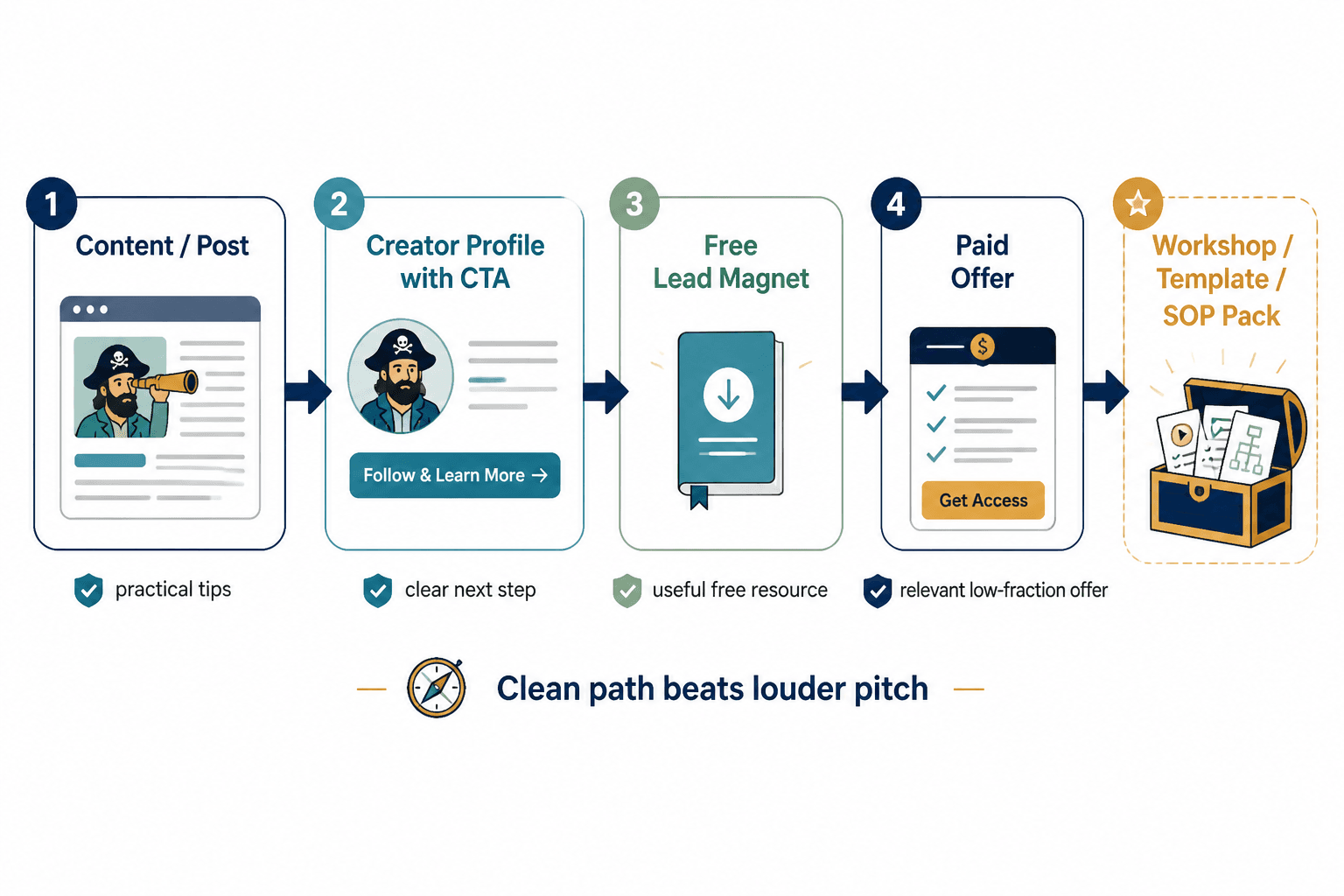
Best funnel paths for AI editing and repurposing offers
You do not need a majestic funnel with twelve emails, three countdown timers, and a checkout page that sounds like it was written by a nervous hypnotist. You need a path that matches the trust level of the reader and the complexity of what you sell.
Path 1: Post → profile → lead magnet → workshop or template
Good for creators teaching AI editing and repurposing to peers.
- Post practical content about editing, content reuse, or workflow mistakes
- Profile CTA points to a useful free resource
- Email nurture shows examples and practical wins
- Paid offer is a workshop, SOP pack, or template system
Path 2: Case-study post → booking page → audit or strategy call
Good for service providers.
- Share before-and-after examples
- Explain what changed and why
- Offer a focused audit or paid strategy session
- Convert strong-fit buyers into implementation clients or retainers
Path 3: Long-form article → related offer
Good for authority-building creators who sell higher-trust services or systems.
If someone reads 1,500 to 3,000 words from you and finds it genuinely useful, they are far more likely to trust a relevant next step than someone who just skimmed one social post and liked your use of line breaks.
For more options, see best funnel ideas to pair with creator AI editing and repurposing. It is useful if you already know what you sell but need a less awkward route from content to buyer.
How to talk about your AI-assisted workflow without sounding shady or smug
You do not need to over-disclose. You do need to be clear enough that people understand the value is not fake.
A good rule: describe your process in a way that highlights judgment, refinement, and audience fit.
Bad messaging
- “I automate all your content creation with AI.”
- “We make endless content from one video.”
- “AI writes your posts so you never have to think again.”
Better messaging
- “I help you turn strong source material into platform-ready content faster, with AI supporting the draft and human editing protecting the quality.”
- “We repurpose your best ideas into formats your audience will actually read, without flattening your voice.”
- “The workflow is faster because AI handles the heavy lifting. The strategy and final decisions are still deliberate.”
The second set sounds trustworthy because it recognizes a basic fact: AI can assist execution, but trust still comes from discernment.
Use proof, not hype
If you want to monetize this work cleanly, show what improved. Not just what was produced.
Useful proof can include:
- before-and-after rewrites
- raw transcript to polished post examples
- one idea adapted well across multiple platforms
- client time saved with quality preserved
- improved consistency or publishing frequency
- better response quality, not just more output
The strongest proof usually combines process and result. For example: “We turned a 22-minute client video into six posts, one email, and one lead magnet draft, but the real win was that the client finally had a repeatable weekly system and started getting consultation inquiries from content that actually sounded like them.”
That is much more convincing than “50 assets in 24 hours.” Again, volume is not a business model. It is often just a mess with a dashboard.
What to charge for, specifically
If pricing feels slippery here, that is because many creators are charging for labor when they should be charging for scoped outcomes and editorial responsibility.
You can structure offers around:
- Per asset bundle: one source piece turned into a defined content package
- Per month: ongoing editing and repurposing support with deliverables
- Per workflow build: setup of a creator’s system, templates, and prompt stack
- Per audit: review of content process, AI usage, and trust gaps
- Per training: workshop or implementation session for teams or creators
What you should not quietly do is charge premium strategic rates for glorified copy cleanup unless there is actual strategy involved. Clients can forgive many things. They are less forgiving when they realize they paid expert pricing for a polished version of “run prompt, paste output, invoice sent.”
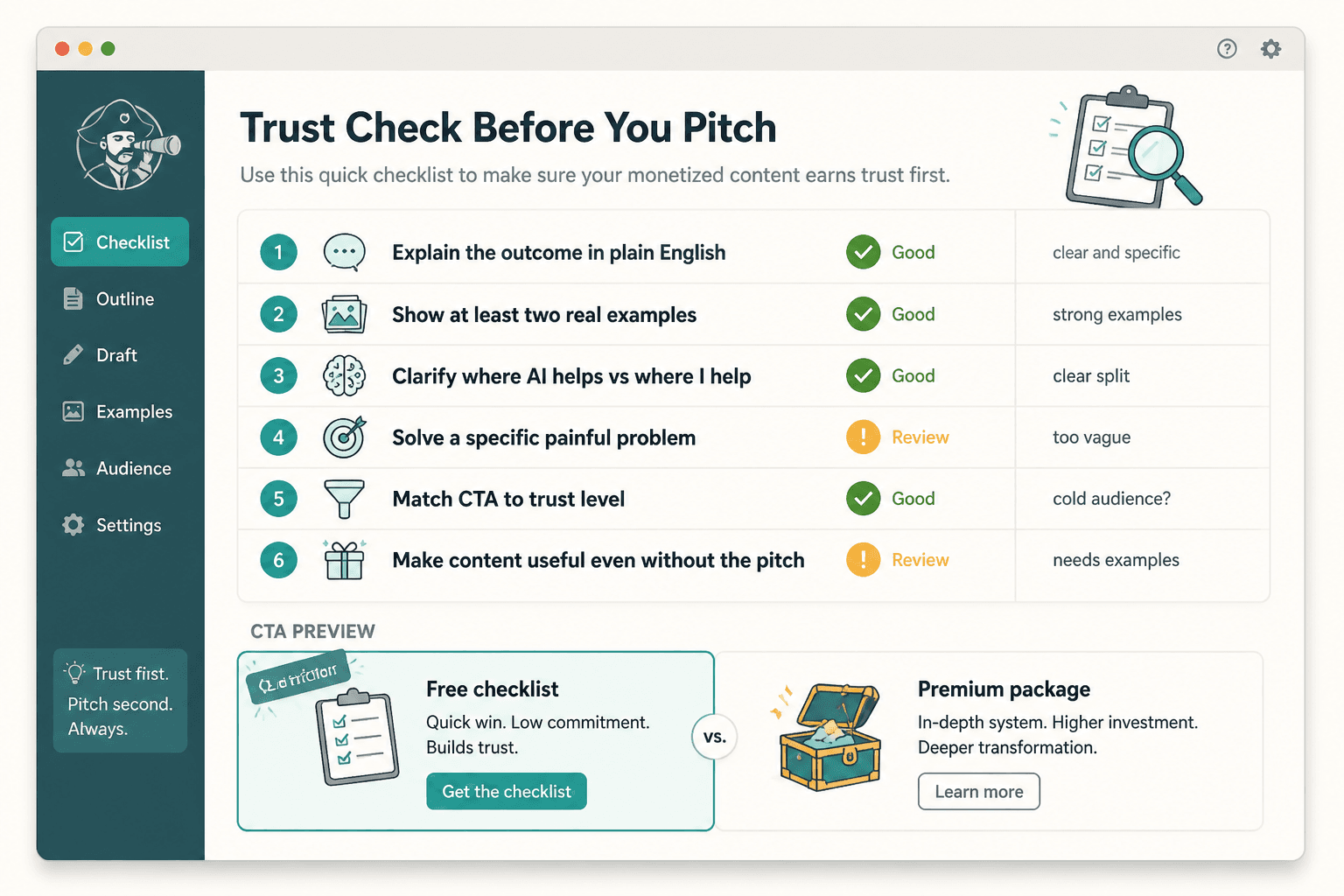
A practical trust check before you monetize
Before putting an offer in front of your audience, run it through this filter.
- Can I explain the outcome in plain English?
If not, the offer is probably fuzzy. - Can I show at least two real examples?
If not, get more reps before pushing harder. - Does my audience understand where AI helps and where I help?
If not, trust may wobble. - Does the offer solve a painful, specific problem?
Faster content alone is usually not enough. - Is the CTA matched to trust level?
Cold readers rarely want your premium package today. - Does the content leading into the offer feel useful on its own?
If every post exists only to funnel people into a pitch, people feel it.
A cleaner content-to-offer example
Here is a simple trust-safe sequence for a creator selling AI-assisted repurposing support.
- Post 1: Break down why most repurposed content feels dead on arrival
- Post 2: Show a before-and-after example from transcript to platform-ready post
- Post 3: Explain your editing criteria: voice, specificity, relevance, structure
- CTA: Offer a free checklist or short guide on building a smarter repurposing workflow
- Email follow-up: Share one case study and one common mistake
- Offer: Paid audit, workshop, or done-for-you package depending on audience fit
Notice what is missing: fake urgency, dramatic “spots are filling” language, and that odd internet habit of pretending a simple service is a revolution. You do not need any of that if the content is useful and the offer is clear.
When to mention AI directly, and when not to
This depends on your positioning.
If you are selling to creators who specifically want AI workflow help, mention it directly. It is part of the value. If you are selling a broader content outcome and AI is just part of the backend process, mention it where relevant but do not make it the headline every time.
Put differently: if AI is the reason they are buying, foreground it. If AI is just one tool helping you deliver, keep the spotlight on the result.
This is similar to how you might position adjacent offers, like in how to monetize AI image use cases without wrecking trust. The same principle holds: no one minds sensible tool use nearly as much as they mind vague promises and low-integrity packaging.
FAQ
Should I disclose that I use AI in client or creator content work?
Usually yes, at least at a practical level. You do not need dramatic disclosures on every asset, but clients should understand your process and what human review is involved.
The bigger point is simple: clearer structure and clearer writing make the piece more useful. That is usually what makes the ending land better too.