
Most homepage CTAs for personal brands are either too vague to act on or too aggressive to trust.
You get the classics: “Work With Me,” “Let’s Connect,” “Get Started,” “Book Now.” Clean? Sure. Effective? Not always. Those buttons often ask for commitment before the page has earned it, or they say so little that the visitor has to do the mental work you should have done for them.
If you want better homepage CTAs for personal brands, the fix is not making the button louder. It is making the next step clearer, lower-friction, and more obviously relevant to the person landing on the page.
This is where a lot of personal brand sites quietly lose people. Not because the design is ugly. Not because the founder is not credible. Because the CTA feels generic, premature, or disconnected from what the visitor actually wants right now.
Here’s how to write homepage CTAs that fit your offer, your audience, and the real decision someone is making when they land on your site.
For the main guide behind this topic, visit the parent guide.
What a homepage CTA is actually supposed to do
A homepage CTA is not there to sound polished. It is there to move the right person into the right next step.
That sounds obvious, yet plenty of personal brands treat the CTA like decorative copy. A button gets dropped in because homepages are supposed to have one, and that is how you end up with “Learn More” sitting under a punchy personal-brand headline like a nervous intern.
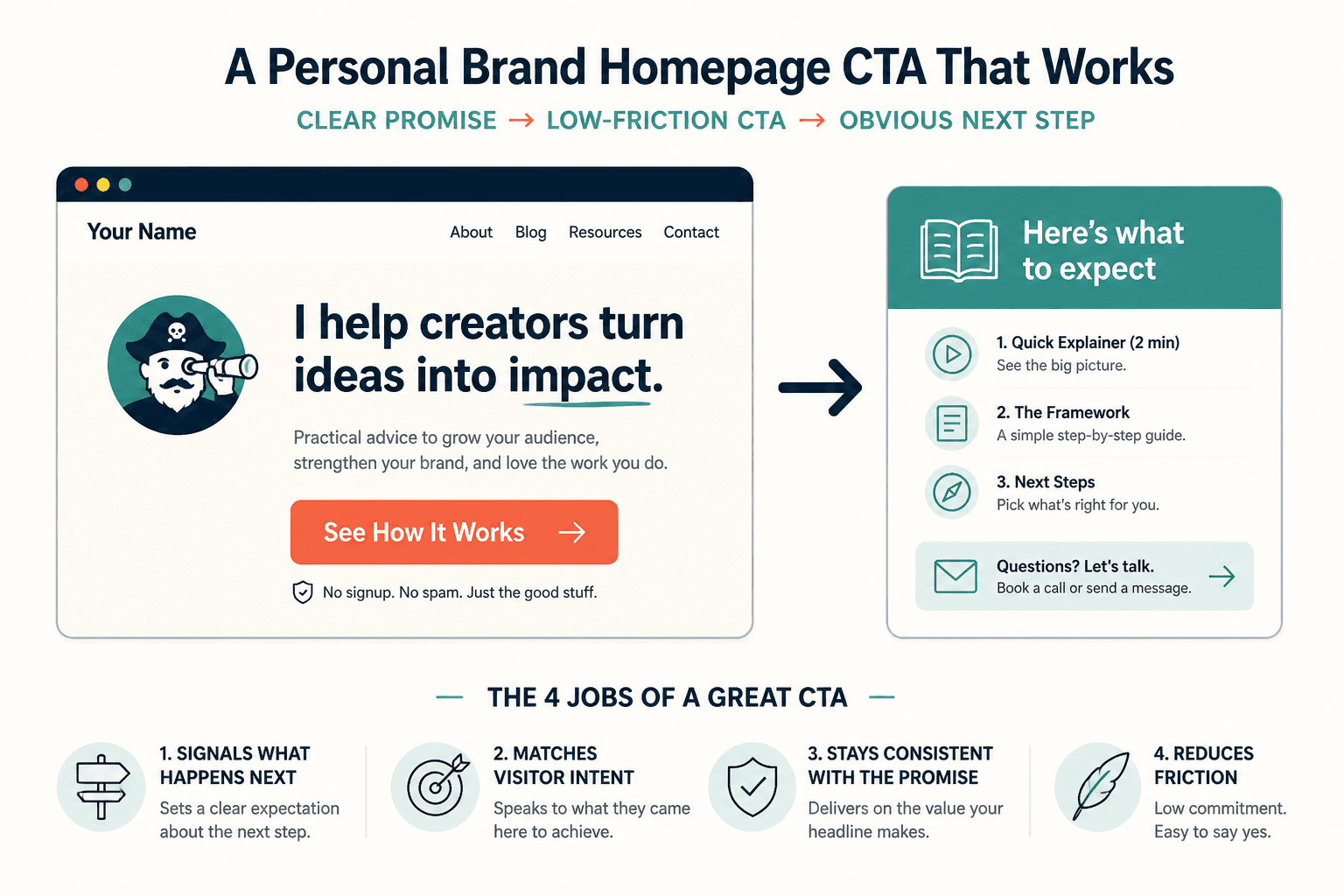
A strong CTA does four things:
- Signals what happens next
- Matches the visitor’s level of intent
- Feels consistent with the promise on the page
- Reduces friction instead of adding more of it
If your homepage says you help founders clarify their messaging, and your CTA says “Book a Discovery Call,” you have skipped a step for cold visitors. Some people might take it. A lot will not. They do not know what the call is for, whether they are a fit, what they will get, or why now.
Good CTA copy closes that gap. It makes the next move feel sensible.
Why most personal brand homepage CTAs underperform
Usually, it comes down to one of five problems.
1. The CTA is too generic
“Work With Me” tells me almost nothing. Services? Consulting? Coaching? Fractional work? A course? A retained engagement? It assumes I am already sold and already understand your business.
2. The CTA asks too much, too soon
If a stranger lands on your homepage from search, social, or a podcast mention, “Book Now” may be a ridiculous first ask. Not always. But often. Cold traffic needs context and trust before commitment.
3. The CTA does not match the offer
A strategist, ghostwriter, coach, consultant, and course creator should not all be using the same button language. Different business models need different next steps.
4. The CTA is clear to you, not to the visitor
Internal language is sneaky like that. “See the framework” might make perfect sense to you because you have named your process. The visitor sees a mysterious button and keeps scrolling.
5. The CTA has no supporting copy
A button does not need to do all the work by itself. Sometimes one short line above or below it is what makes it click. Without that support, the CTA can feel abrupt or empty.
Start with the visitor’s intent, not your preferred action
This is the part people skip because they are too busy deciding whether the button should be blue.
Your ideal CTA depends on what kind of visitor is arriving and what they are realistically ready to do. Homepage CTA strategy gets much better when you stop asking, “What do I want them to click?” and start asking, “What is the most natural next step for someone at this stage?”
For personal brands, homepage visitors usually fall into a few buckets:
- They want to understand what you do
- They want to see if you are credible
- They want to know if your offer fits them
- They want a lower-risk way to engage first
- They are ready to talk or buy now
Your homepage should not force all of them into the same action.
That is why many of the best homepages for creators, coaches, and consultants use a primary CTA and a secondary CTA. One for high intent. One for people who need a bit more proof or warming up.
If you need help tightening the whole page around that journey, this homepage copy resource is a strong place to start, and you may also want this homepage copy guide for creators who want better results.
The 5 best types of homepage CTAs for personal brands
Not best in some universal, eternal sense. Best as in useful, proven, and less likely to make your homepage feel like a pushy brochure.
1. The clarity CTA
Use this when visitors need to understand your offer before they are likely to act.
Examples:
- See How I Help
- Explore Services
- View Offer Details
- See What Working Together Looks Like
This works well for consultants, strategists, and service providers whose homepage needs to explain the shape of the engagement before asking for a call.
2. The trust-building CTA
Use this when proof matters before conversion.
Examples:
- Read Case Studies
- See Client Results
- Browse Examples
- See My Process in Action
This is especially useful for higher-ticket offers, done-for-you services, and anything where people want evidence that you are not just good at writing nice sentences about yourself.
3. The low-friction lead CTA
Use this when your homepage is serving colder traffic and you want a softer first conversion.
Examples:
- Get the Free Guide
- Download the Template
- Grab the Checklist
- Get Weekly Insights
Good for creators, educators, personal brands with newsletters, and service businesses that need more nurturing before the sale.
4. The fit-check CTA
Use this when your audience needs to self-qualify.
Examples:
- See If We’re a Fit
- Find the Right Option
- Choose Your Best Next Step
- See Which Offer Fits
This works nicely when you have more than one offer, or when you serve a specific type of client and want to reduce bad inquiries.
5. The direct conversion CTA
Use this when the visitor is likely to be warm, referred, or already aware of what you do.
Examples:
- Book a Consultation
- Apply to Work Together
- Schedule a Strategy Call
- Start Your Project
This is the one people rush to by default. Sometimes it is right. Sometimes it is just hopeful.
How to write a better homepage CTA
If you want better homepage CTAs for personal brands, use this simple structure:
- Identify the visitor’s likely stage of awareness
- Choose the next step that makes sense for that stage
- Name the action clearly
- Add context if the button alone feels thin
- Make sure the destination page fulfills the promise
That last point matters more than people think. A strong CTA can still fail if the page it leads to is confusing, bloated, or not aligned with what the click suggested.
A simple formula
Verb + specific outcome or destination
For example:
- View Services
- Read Client Results
- Get the Homepage Guide
- Book a Strategy Call
- See Pricing and Options
Specific beats clever here. You are not naming a cocktail. You are helping someone make a decision.
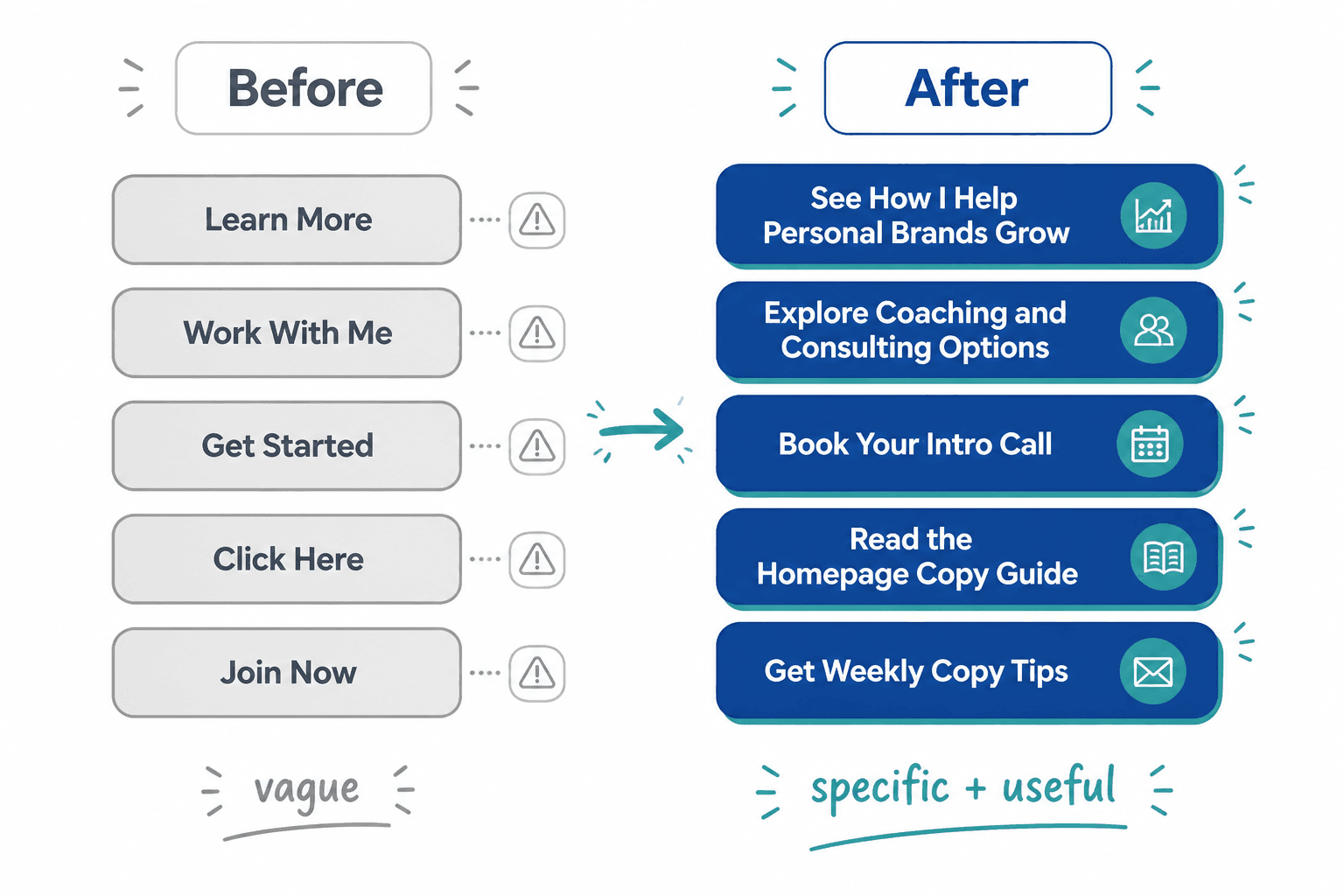
Weak CTA vs stronger CTA examples
| Weak CTA | Why it underperforms | Stronger option |
|---|---|---|
| Learn More | Too vague, no reason to click | See How I Help Personal Brands Grow |
| Work With Me | Assumes too much understanding | Explore Coaching and Consulting Options |
| Get Started | Started with what, exactly? | Book Your Intro Call |
| Click Here | Function without meaning | Read the Homepage Copy Guide |
| Join Now | Sounds abrupt and generic | Get Weekly Copy Tips |
Notice the pattern. The stronger versions reduce ambiguity. They tell the visitor what they are clicking into and why it might matter.
And no, every CTA does not need to be long. It just needs to be clear enough to earn the click.
Primary CTA and secondary CTA: what to pair together
For many personal brand homepages, one CTA is not enough. But two is usually plenty.
A smart pairing gives different visitors different ways forward without turning the homepage into a menu of confusion.
Good CTA pairings
- Book a Consultation + Read Case Studies
- Explore Services + Get the Free Guide
- Apply to Work Together + See If We’re a Fit
- Join the Newsletter + Browse Popular Articles
- View Offer Details + See Results and Testimonials
This works because people do not all arrive at the same temperature. Some are ready to act. Some need proof. Some just need a better explanation of what you actually do.
If your homepage feels busy or scattered, your CTA issue may not be a button issue at all. It may be a structure issue. In that case, read homepage copy section order mistakes that hurt performance.
Where homepage CTAs usually belong
You do not need one lonely button in the hero and then radio silence for the rest of the page.
CTAs often work best when repeated at sensible moments, with slightly different framing based on what the visitor has just seen.
- Hero section: the main next step
- After services overview: move people into offer details or inquiry
- After proof or testimonials: invite the higher-intent action
- Near the footer: give a final clear next step
Same destination is fine. Same exact wording every time is not always necessary. Context can sharpen the ask.
For example, a hero CTA might say Explore Services, while the CTA after testimonials says Book a Consultation. By that point, trust has been built. The ask can be stronger.
CTA copy examples by personal brand type
For coaches
- See Coaching Options
- Book a Clarity Call
- Find the Right Coaching Path
- Read Client Wins
For consultants
- Explore Consulting Services
- See How I Solve This
- Book a Strategy Call
- View Case Studies
For creators and educators
- Get the Free Resource
- Join the Newsletter
- Browse Guides and Articles
- See My Best Content
For freelancers and service providers
- View Services and Rates
- See Recent Work
- Start Your Project
- Ask About Availability
If you want more real-world page inspiration, this piece on homepage copy examples for coaches, consultants, and personal brands should help.
Small changes that make CTAs work harder
Sometimes the button text is fine. The surrounding copy is what is failing it.
Add a short line of context
Example:
The bigger point is simple: clearer structure and clearer writing make the piece more useful. That is usually what makes the ending land better too.
Homepage copy works best when the core promise is clearer and the next step is easier to understand. Simpler, sharper messaging usually does more work.