Most creator bios are not too short. They are too crowded.
People keep stuffing their profile copy with every credential, every identity, every niche-adjacent buzzword, and one brave little CTA gasping for oxygen at the end. Then they wonder why nobody remembers them.
When Short Creator Bios & Profile Copy Beat Long Ones comes down to one thing: speed of understanding. If someone lands on your profile, they should not need to decode your personality, business model, and existential journey before figuring out what you do.
Short bios win when clarity matters more than completeness. They work especially well when you already know who you help, what result you offer, and what next step you want people to take. A tighter bio can make you look sharper, more confident, and easier to trust. A longer one can help too, but only if it earns the extra space.
Here’s how to tell when short profile copy is the smarter move, what a short bio still needs to do, and how to cut yours down without making it bland, cryptic, or weirdly corporate.
For the full path around this topic, head to the parent guide.
Why short bios often work better than long ones
A good bio is not a mini memoir. It is a positioning tool.
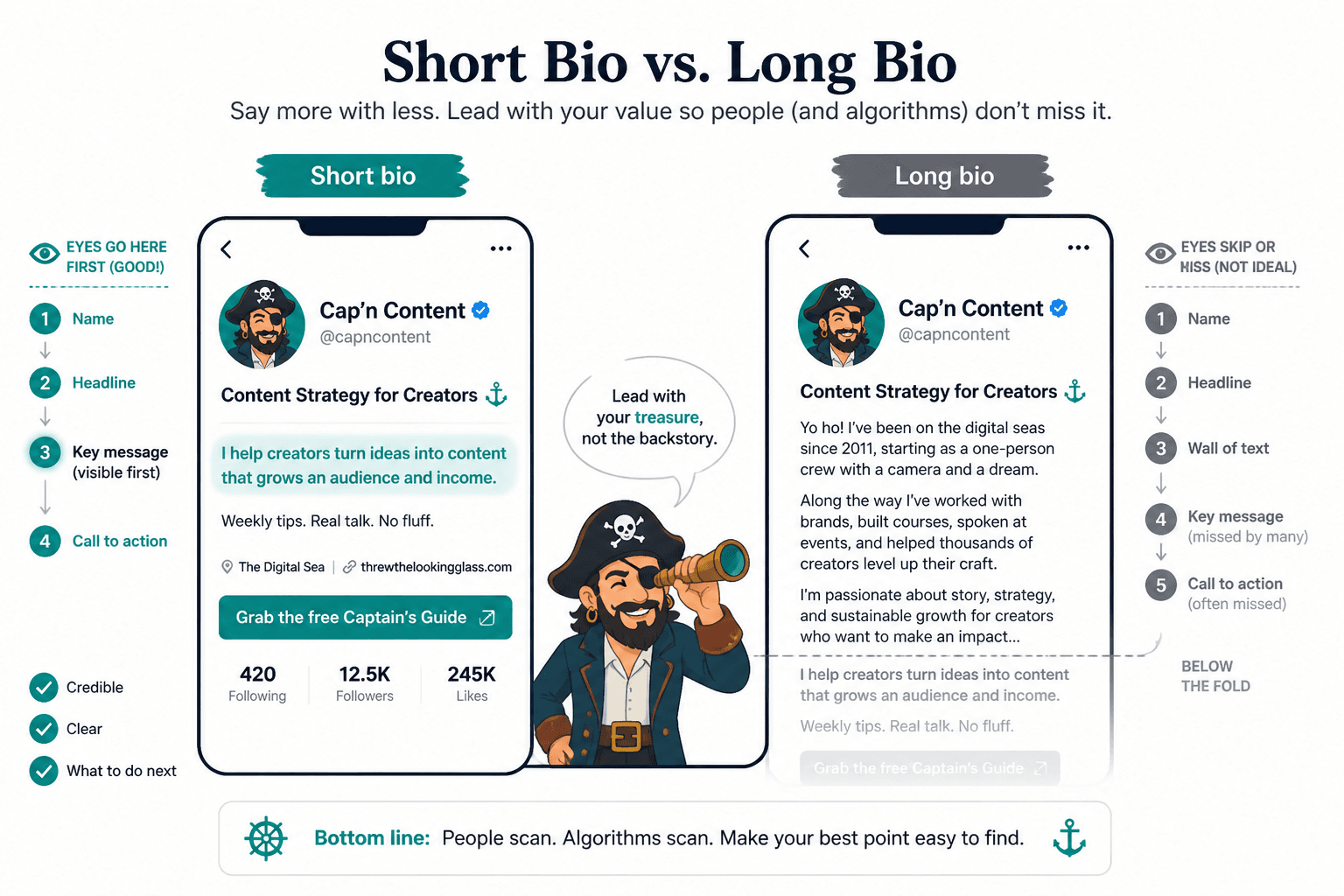
That matters because most people do not read profiles the way writers wish they did. They scan. Fast. They look for signs that say:
- This is relevant to me
- This person knows what they are doing
- This feels credible
- I know what to do next
If your bio answers those questions in one clean pass, shorter usually beats longer.
Short copy also tends to sound more confident. Not because fewer words are magically smarter, but because strong positioning rarely needs six lines of throat-clearing. When someone says exactly who they help and how, it lands. When they keep adding qualifiers, side quests, and identity clutter, the whole thing softens.
There is also a platform reality here. On many social profiles, people see your name, headline, first line, and maybe a clipped preview. If the strongest part of your bio is buried in line five, congratulations, it is now decorative.
When short creator bios and profile copy beat long ones
Not always. But often enough that creators should stop assuming “more detail” automatically means “better profile.”
1. When your offer is simple and clear
If you help one audience get one clear result, a short bio is usually your best option.
Example:
I help consultants turn their expertise into content that brings in leads.
That already does a lot. Audience. outcome. positioning. No need to add “speaker, thinker, lifelong learner, systems nerd, coffee enthusiast, helping purpose-driven brands unlock authentic growth.” That kind of pile-up does not add clarity. It adds fog.
2. When people are finding you cold
If someone discovers you through a comment, share, search, podcast mention, or social post, they are making a quick trust decision. Short bios help cold visitors orient themselves fast.
Cold traffic needs clear signals, not a paragraph that reads like an awkward conference intro written by your nicest colleague.
3. When your profile has limited visible space
This sounds obvious, but people still write bios as if every platform displays them fully and generously. Many do not. Some show only a line or two before the cut. Others bury your longer About section below the fold.
In those cases, your short version is not the teaser. It is the main event.
4. When you have too many roles
Short bios are brutally useful when you are trying to say five things at once. They force you to choose.
That’s a feature, not a punishment.
If your current bio says you are a writer, strategist, coach, consultant, founder, speaker, creator, host, advisor, and community builder, a shorter format can save you from yourself. Pick the role that best matches the result people hire you for. The rest can show up elsewhere in your content.
5. When your goal is more replies, clicks, or profile actions
Long bios can increase understanding. Short bios often increase action.
Why? Because they reduce friction. The reader gets the point faster and sees the next step faster. That matters if your profile is meant to move people toward a newsletter, booking page, lead magnet, or DMs.
What a short bio still needs to do
Short does not mean vague. It does not mean “mysterious personal brand sentence fragment.” It definitely does not mean writing something like:
Building at the intersection of truth, creativity, and freedom.
That sounds meaningful until you remember it could describe 40,000 people and at least six questionable Substacks.
A short bio still needs four core ingredients:
- Audience: Who you help
- Outcome: What you help them do
- Credibility: Why they should believe you
- Next step: What they should do now
You do not always need all four in one sentence. But your profile as a whole should cover them quickly.
For a deeper look at how these pieces work together, the parent guide on creator bios and profile copy is worth bookmarking.
Short vs long: what each one is actually good at
| Format | Best for | Risk |
|---|---|---|
| Short bio | Fast clarity, profile conversions, simple positioning, cold visitors | Can become vague or too minimal |
| Long bio | Nuance, story, authority, layered expertise, warmer audiences | Can become bloated, confusing, or self-indulgent |
This is why the argument should not be “short good, long bad.” That’s lazy. The real question is what job your profile copy is doing.
If the job is fast orientation, short wins. If the job is deeper trust-building after interest already exists, a longer About section might help. Plenty of strong profiles use both: a tight headline or top bio, followed by a fuller supporting section underneath.
If you are still unsure about length, this related piece on how long creator bios and profile copy should be can help you choose based on platform and goal instead of vibes.
Signs your long bio should probably be shorter
- You list multiple audiences with no priority
- You mention values more clearly than services
- Your CTA is buried at the end
- The first line is generic and the useful part shows up later
- You use broad identity terms instead of concrete outcomes
- Your bio sounds polished but does not actually say much
- You are trying to sound impressive instead of easy to understand
One of the cleanest tests is this: could a stranger explain what you do after reading your bio once?
If not, your issue is probably not lack of words. It is weak positioning inside too many words.
How to cut a long bio down without ruining it
Editing profile copy is not just deleting random adjectives until the sentence looks skinny. You want tighter copy, not an underfed bio with no personality left.
Use this process.
1. Find the main job of the bio
Ask what this profile needs to do first:
- Explain what you do
- Attract the right audience
- Build authority
- Drive clicks
- Start conversations
You can do more than one, but one goal usually leads. If you do not know the goal, you will keep stuffing the bio with backup material “just in case.”
2. Circle the sentence that actually matters
In most long bios, one sentence carries the real value. Everything else is support, fluff, or identity garnish.
Find the sentence that most clearly answers: who is this for, and why should they care?
That sentence is your starting point.
3. Cut broad labels and vague virtues
Words like “passionate,” “purpose-driven,” “empowering,” “multi-passionate,” and “authentic” usually do not help. They sound nice. They explain almost nothing.
Replace them with specifics:
- Who you help
- What result you help them get
- What type of work you do
- Proof if you have it
4. Keep one proof point, not your whole career history
Short bios do not need your entire résumé. They need one useful trust signal.
That could be:
- Worked with 100+ clients
- Former in-house content lead
- Helped founders generate leads from LinkedIn
- Writer for B2B brands and experts
One sharp proof point beats a cluttered trophy shelf.
5. End with a next step if action matters
If your profile should lead somewhere, say where.
Examples:
- Get the free guide below
- Book a strategy call
- Read the newsletter
- DM me “bio” for the template
Not every platform bio needs a CTA, but many creators miss obvious opportunities by ending on a generic identity statement instead.
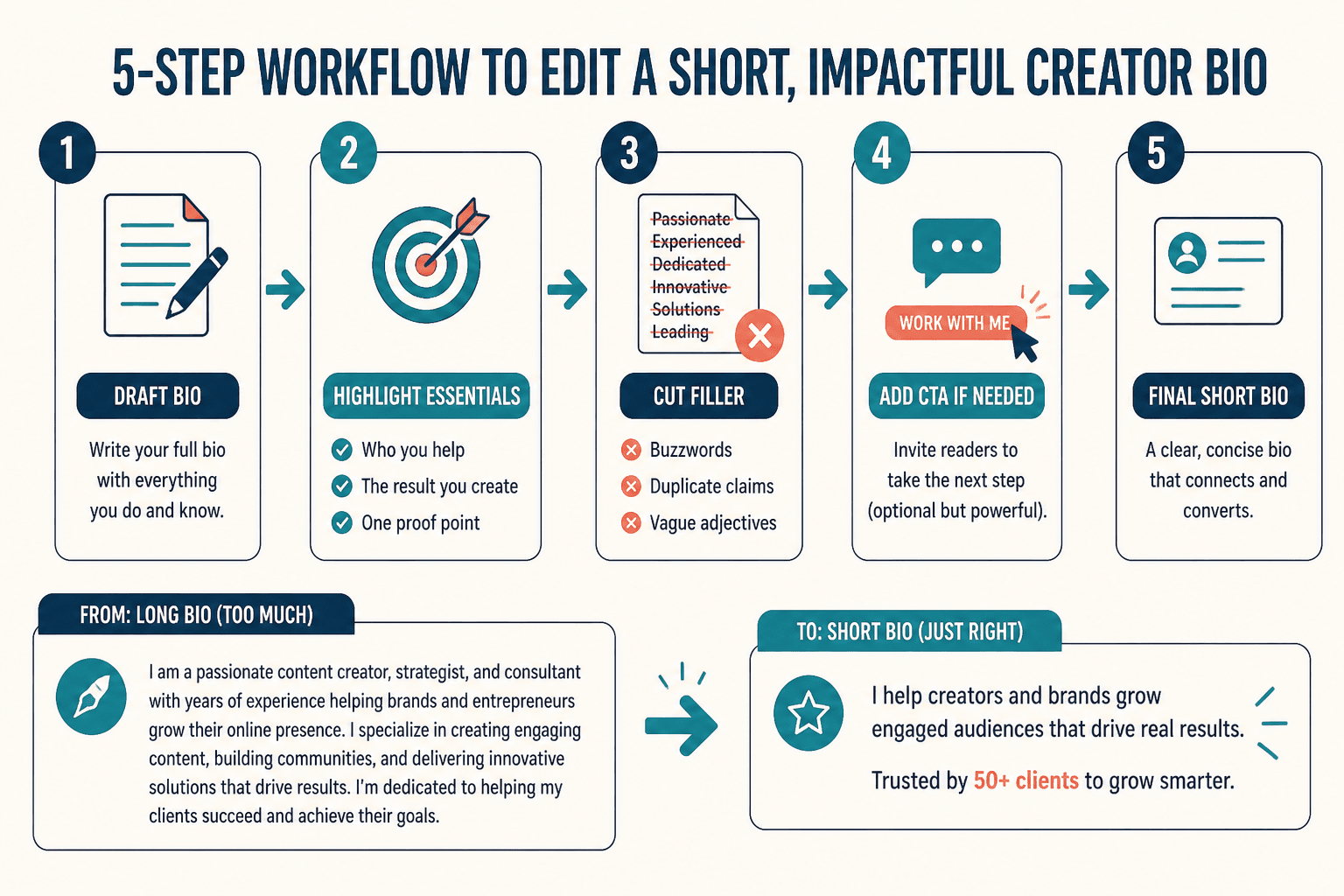
Before-and-after examples
Example 1: consultant
Before:
Helping ambitious founders, creatives, and impact-driven entrepreneurs unlock aligned messaging, magnetic content, and authentic visibility through storytelling, strategy, and thought leadership.
After:
I help founders clarify their messaging and turn it into content that attracts clients.
The second one is shorter, clearer, and much easier to remember. It drops the buzzword soufflé and keeps the actual offer.
Example 2: coach
Before:
Confidence coach, speaker, community leader, and guide for women ready to step into their fullest expression and live with more freedom, purpose, and self-trust.
After:
I help women speak more confidently at work without sounding rehearsed or shrinking themselves.
The rewrite gives the reader an actual problem and outcome. Much better than “fullest expression,” which sounds expensive and hard to measure.
Example 3: creator-writer
Before:
Writer sharing ideas on creativity, business, systems, identity, the internet, and building a life that feels like yours.
After:
I write about content, positioning, and online business for solo creators who want sharper words and better clients.
The short version narrows the audience and makes the content promise concrete.
If you want more swipeable structures, rewrites, and patterns, see these creator bios and profile copy examples.
When a longer bio is still the better choice
Short bios are strong. They are not universally superior.
A longer bio can make more sense when:
The bigger point is simple: clearer structure and clearer writing make the piece more useful. That is usually what makes the ending land better too.