
Most creator bios are trying way too hard to sound credible and not nearly hard enough to be clear.
They pile up job titles, vague promises, and polished fluff until the whole thing reads like a committee wrote it in a panic. “Helping purpose-driven leaders elevate their impact” is not a bio. It is wallpaper.
If you want better Creator Bios & Profile Copy Examples for Coaches, Consultants, and Personal Brands, the fix is not making your bio sound fancier. It is making it easier for the right person to instantly get three things: who you help, what you help them do, and why they should trust you.
This is where a lot of smart people sabotage themselves. They know their work. They can explain their process in a call. They can close in a conversation. But their profile copy still sounds like they swallowed a branding worksheet.
Here’s how to write a profile that feels sharp, human, and useful, plus plenty of examples you can steal, tweak, and improve without sounding like a motivational fridge magnet.
For the broader learning path, visit our parent guide.
What good profile copy actually needs to do
A good bio is not a tiny autobiography. It is not your full philosophy. It is not a place to prove you contain multitudes.
It has one job: help the right person decide, fast, that you are relevant to them.
That usually means your profile copy should answer four questions:
- Who are you for?
- What do you help them do?
- Why should they trust you?
- What should they do next?
If one of those is missing, the profile usually feels weak. If two are missing, it starts sounding like vague personal branding soup.
For more foundational guidance, this broader hub on creator bios and profile copy is worth keeping open in another tab.
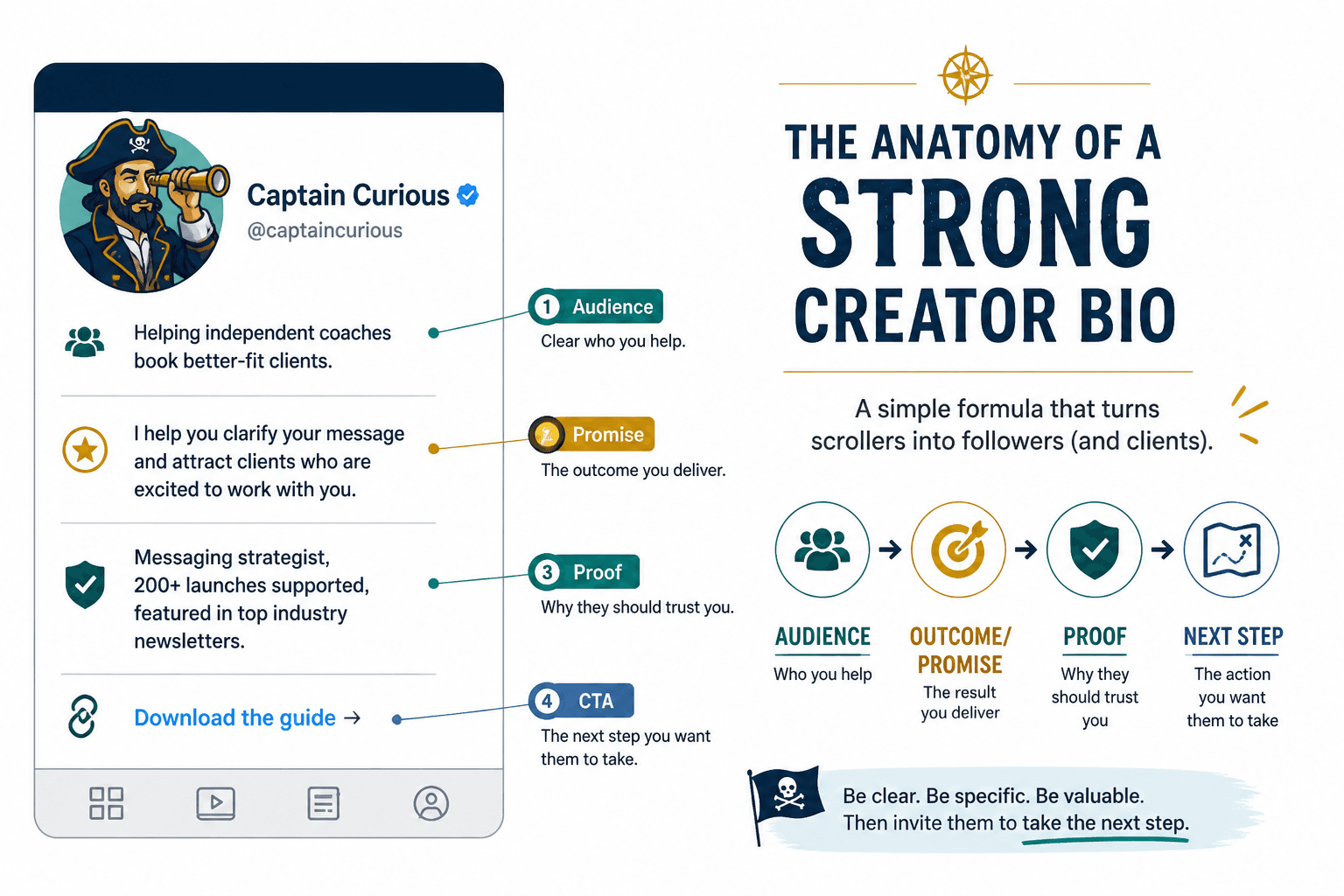
The simple formula behind strong creator bios
You do not need a mystical brand essence sentence. You need a structure that keeps you from wandering into nonsense.
A reliable formula looks like this:
I help [specific audience] do [specific outcome] through [method, angle, or category]. [Proof, credibility, or differentiator]. [Clear next step].
That is not the only way to write a bio, but it is a very good way to stop writing bad ones.
The point is not to copy the template word for word. The point is to make sure your profile does not force strangers to decode what you do like they are working an escape room.
What each part is doing
- Specific audience: not “business owners” if you really mean first-time coaches, B2B consultants, course creators, or founders.
- Specific outcome: what changes because of your work.
- Method or angle: your lane, process, platform, or specialty.
- Proof: experience, results, recognizable context, or a clear reason to believe you.
- Next step: what people should click, read, message, or download.
Miss the audience and you sound broad. Miss the outcome and you sound fuzzy. Miss the proof and you sound self-appointed. Miss the CTA and your profile just sits there looking professional and unemployed.
The biggest mistakes in creator bios and profile copy
1. Listing roles instead of making a point
“Coach | Consultant | Speaker | Writer | Founder | Advisor” tells me almost nothing. Congratulations on having several tabs open in your life. What do you actually help with?
Multiple roles are fine. Leading with all of them usually is not. Lead with relevance, not your internal org chart.
2. Writing for peers instead of buyers
A lot of bios are built to impress other creators, not to help a potential client understand the offer. The result is clever wording that performs nicely in your own head and poorly in public.
3. Sounding “professional” instead of understandable
People use foggy language because they think it sounds elevated. Usually it just sounds evasive. Clear beats polished. Specific beats lofty. Plain English beats “transformational ecosystems” every time.
4. Having no proof at all
If your profile makes a big promise and offers nothing to support it, people quietly move on. Proof does not have to mean giant numbers. It can be years of work, type of clients, recognizable outcomes, niche expertise, or a clear body of content.
5. Forgetting the next step
Your profile should direct attention somewhere. A newsletter. A free resource. A booking page. A pinned post. A message prompt. Without that, you are making people guess how to continue.
If this is the part you usually skip, read better profile CTAs for personal brands after this.
Before-and-after bio rewrites
Sometimes the easiest way to see the problem is to watch a vague bio get dragged into clarity.
Example 1: The vague business coach
Before:
Helping ambitious entrepreneurs unlock alignment, scale with purpose, and create the life they deserve.
After:
I help new coaches and service providers turn messy expertise into clear offers, sharper content, and simpler client acquisition. Business coach. Ex-agency strategist. Start with the free offer audit below.
Why it works better: the audience is clearer, the outcomes are practical, the credibility is grounded, and there is a next step.
Example 2: The consultant with too many labels
Before:
Consultant | Strategist | Speaker | Thought Leader | Founder | Brand Builder
After:
I help B2B consultants tighten their positioning and turn scattered expertise into content that attracts better-fit clients. 12+ years in messaging and brand strategy. DM “positioning” for details.
Why it works better: instead of a pile of titles, it gives a clear service and audience. Much less chest puffing, much more use.
Example 3: The personal brand with no proof
Before:
I share insights on mindset, success, growth, and building your dream life.
After:
I write practical content for solo founders who want sharper messaging, stronger authority, and less fluffy marketing. Weekly breakdowns, bio rewrites, and content strategy. Trusted by service businesses and creator-led brands.
Why it works better: “mindset, success, growth” could mean almost anything. The rewrite gives the audience, content category, benefit, and some light credibility.
For more rewrite-style inspiration, this piece on creator bio ideas and examples for creators should help.
Creator bios & profile copy examples for different kinds of personal brands
Here is where we get practical. These are not meant to be copied blindly. They are meant to show the structure, level of specificity, and kind of clarity that makes a profile pull its weight.
For coaches
- Career coach: I help mid-career professionals reposition themselves for better roles, better pay, and less soul-death on Sundays. Resume strategy, LinkedIn messaging, and job search clarity.
- Business coach: I help new coaches build clearer offers, better content, and a client acquisition system that does not rely on posting into the void.
- Health coach: I help busy professionals build realistic nutrition and training habits they can actually maintain. No detox drama. No fake perfection.
- Mindset coach: I help high-performing creatives stop overthinking every move and build a calmer, more consistent work rhythm. Coaching, tools, and practical resets.
For consultants
- Marketing consultant: I help service businesses fix weak messaging, sharpen content strategy, and turn attention into qualified leads. Consultant, writer, and conversion-focused pain in bad copy’s neck.
- Operations consultant: I help growing agencies clean up delivery, reduce bottlenecks, and stop running on heroic last-minute nonsense.
- HR consultant: I help small companies build hiring, onboarding, and people systems that scale without making everything feel corporate and dead-eyed.
- Sales consultant: I help founders improve outbound messaging, tighten sales calls, and close without sounding like they learned human interaction from a funnel bro.
For writers, creators, and personal brands
- Content strategist: I help experts turn messy ideas into content people actually read, remember, and hire from. Hooks, positioning, articles, and profile copy.
- Ghostwriter: I write LinkedIn content for founders and consultants who have useful ideas but no time to package them properly.
- Newsletter creator: I write weekly about audience growth, sharper messaging, and better content systems for solo businesses. Read if you are tired of generic content advice.
- Personal brand educator: I teach coaches and creators how to build a credible online presence without sounding inflated, thirsty, or weirdly robotic.
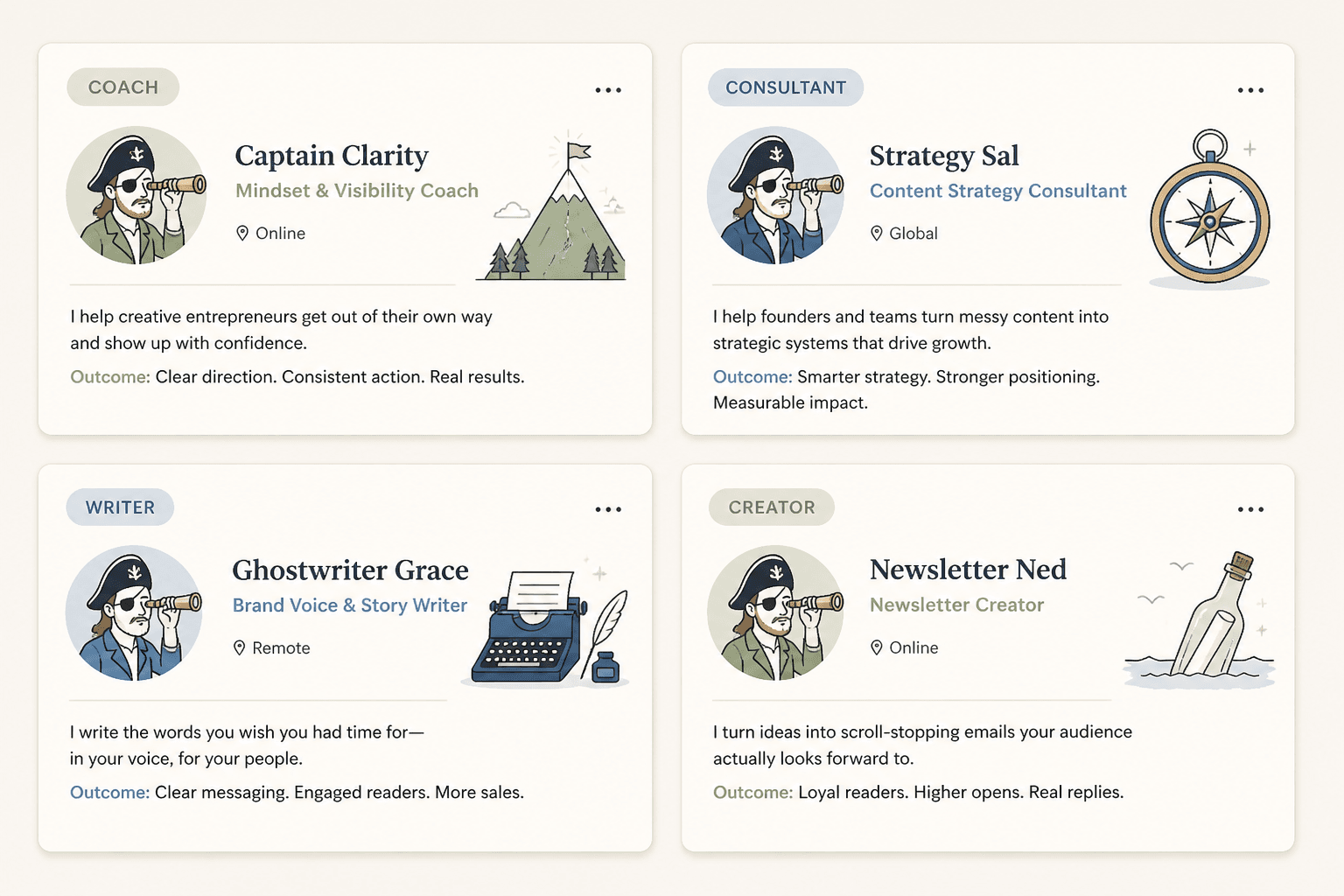
How to make your profile copy stronger without making it longer
A weak bio does not usually need more words. It needs better choices.
Use narrower audience language
“Founders” is broad. “B2B SaaS founders” is narrower. “First-time SaaS founders struggling to explain their product clearly” is sharper. You do not always need to go ultra-niche, but you usually need to stop pretending everyone is your reader.
Swap abstract outcomes for visible ones
Instead of “build confidence,” maybe it is “speak more clearly on sales calls.” Instead of “grow your brand,” maybe it is “turn profile visits into newsletter signups.” Concrete outcomes are easier to trust.
Add one believable proof point
You do not need to turn the bio into a resume dump. Just add one proof signal:
- Years of experience
- Type of clients served
- Notable result category
- Past role or relevant background
- Size of audience, if it is actually relevant
- Volume of work completed
One good proof point is more useful than five vague status words.
Give people a next move
Your CTA should match your business model and your audience’s readiness. A cold profile visitor may not want to book a call immediately. They might be more willing to read a guide, join a newsletter, or DM a keyword.
That matters because the profile is often not the conversion moment. It is the bridge. Treat it like one.
A simple bio builder you can use in 10 minutes
If you are staring at a blinking cursor and regretting every word you have ever written, use this process.
- Write down your actual audience in one line.
- Write the top one or two outcomes you help them get.
- Add the method, platform, specialty, or category you use.
- Add one proof point.
- Choose one next action.
- Cut anything that sounds inflated, generic, or suspiciously workshop-born.
Example draft:
I help independent consultants turn unclear positioning into sharp messaging, stronger content, and better-fit inbound leads. Brand strategist with 10 years in B2B messaging. Read the pinned post for examples.
That is not flashy. Good. Bios do not need applause. They need to do their job.
Profile sections people forget to optimize
The short bio gets all the attention, but your profile copy is usually doing more than one thing across multiple sections.
The bigger point is simple: clearer structure and clearer writing make the piece more useful. That is usually what makes the ending land better too.