
Most profile CTAs are either painfully vague or weirdly aggressive.
You get the classics: “DM me to learn more.” “Book a call.” “Click below.” “Let’s connect.” None of these are technically wrong. They are just lazy, context-free, and usually doing absolutely nothing to help a stranger decide why they should take the next step.
A better profile CTA for personal brands does one simple job: it reduces hesitation. It tells the right person what to do next, why that next step is worth it, and what kind of value or outcome they can expect. Not with hype. Not with funnel fumes. Just with clarity.
If your profile gets views but not clicks, replies, leads, or conversations, your CTA is probably part of the problem. Here’s how to make it better, sharper, and much more useful without sounding like a thirsty internet salesperson in a blazer.
For the full path around this topic, head to the parent guide.
What a profile CTA is actually supposed to do
Your profile CTA is not there to “close” people. It is there to guide them.
That matters because most people landing on your profile are still early. They might know your post was useful. They might vaguely understand what you do. They might be curious. But they are not all ready to book, buy, or jump on a call with a stranger from the internet.
A strong CTA bridges that gap. It helps people move from interest to action with less friction.
In practical terms, a good profile CTA should answer at least one of these:
- What should I do next?
- What will I get if I do?
- Who is this for?
- Why this step instead of leaving?
That is why “Follow for more” is often weak on its own. More what? Advice? Stories? Tools? Rants about positioning? You are asking people to commit to an unclear future. Unsurprisingly, many do not.
Why most personal brand profile CTAs underperform
The problem usually is not the button, the link, or the platform. It is the message around the action.
Most weak CTAs fail for one of five reasons:
- They are too generic. “Let’s connect” says almost nothing.
- They ask too much too soon. A cold profile visitor often is not ready to book a sales call.
- They have no audience fit. A CTA for everyone usually persuades no one.
- They offer no reason. “Download my guide” is not compelling if the benefit is missing.
- They sound like copy paste funnel sludge. People can smell automation through the screen.
And there is another issue people miss: the CTA cannot rescue a fuzzy profile. If your positioning is vague, your CTA has to work much harder. “Work with me” is not persuasive when your bio still sounds like you help “purpose-driven leaders amplify impact.” That could mean almost anything, which is exactly the problem.
If your broader profile needs work too, it helps to start with a stronger foundation in creator bios and profile copy, then tighten the CTA once the positioning is clear.
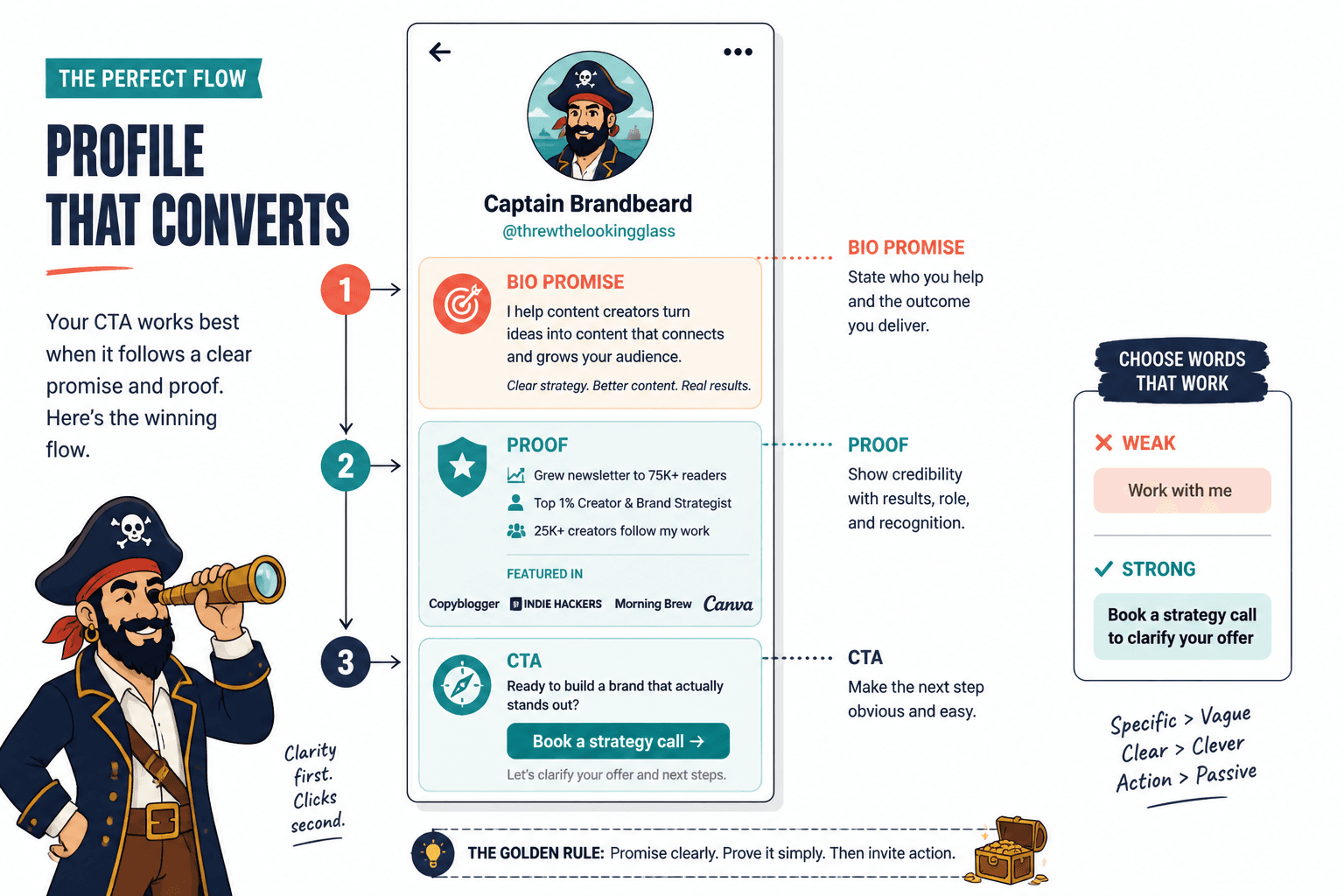
What better profile CTAs for personal brands usually have in common
The best profile CTAs are not always clever. Usually, they are just specific.
They tend to include a few clear ingredients:
- A next step the reader can actually take
- A reason to care tied to a real outcome
- Low friction so it feels easy, not costly
- Relevance for the right audience
- Consistency with the profile promise
Here is the basic formula:
Action + benefit + audience or context
For example:
- Get the weekly email on writing sharper LinkedIn posts that sound like a human
- Grab the free messaging worksheet if your bio still sounds too vague
- Book a strategy call if you want clearer positioning before your next launch
- Follow for practical content systems for solo consultants with small teams
None of these are magical. They are just easier to understand, easier to trust, and easier to act on.
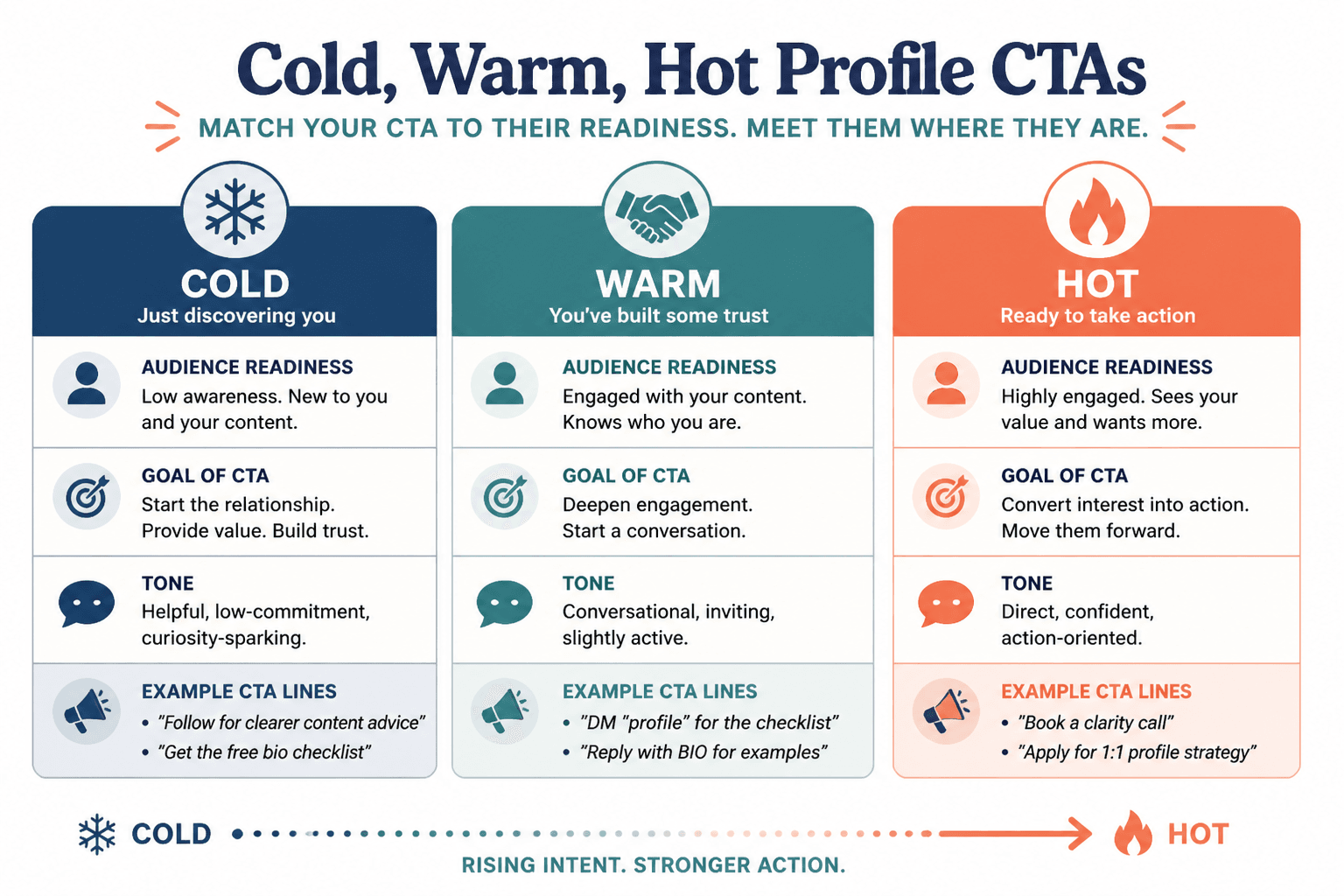
Choose the right CTA for the stage your audience is in
One reason people use bad CTAs is that they jump straight to the hardest ask.
If someone has just discovered you from a post, a direct sales CTA may be premature. Not always. But often. Better Creator Bios & Profile Copy Profile Ctas for Personal Brands work best when they match audience temperature instead of acting like every profile visitor is one sip away from a sales call.
Cold audience CTAs
Use these when people are still learning who you are and whether your ideas are worth paying attention to.
- Follow for practical posts on turning expertise into better content
- Get the free guide to writing a clearer creator bio
- Join the newsletter for weekly positioning and content fixes
- Read the full guide if your profile is not pulling its weight
Warm audience CTAs
Use these when people already know your content and just need a clean next step.
- Download the messaging template I use with consultants and coaches
- Reply with “bio” and I’ll send the profile checklist
- See examples of stronger creator bios and profile copy
- Apply for a profile audit if you want sharper positioning
Hotter audience CTAs
Use these when trust is already built and the offer is clear.
- Book a strategy call to fix your profile and funnel message
- Apply to work together on your positioning and content system
- Start here if you want help turning profile traffic into leads
This sounds obvious, but people skip it all the time. They write one CTA as if every visitor has followed their work for six months. Most have not.
How to write a better profile CTA step by step
1. Decide the one next step that matters most
Your profile CTA should not try to do five jobs at once.
If you ask people to subscribe, book, follow, download, browse your offers, and join your community all from the same tiny profile area, you are not giving options. You are creating static.
Pick one primary action:
- Follow
- Click the link
- Join the list
- Download a free resource
- Book a call
- Send a DM with a keyword
Then support that one action properly.
2. Add the benefit, not just the instruction
“Download my free guide” is instruction. “Download the free guide to tighten your LinkedIn bio in 15 minutes” is a reason.
The difference is not subtle. One creates work. The other suggests payoff.
Good CTA benefits often focus on:
- Saving time
- Getting clarity
- Fixing a specific problem
- Improving a visible result
- Avoiding a common mistake
3. Make it specific enough to qualify the right people
You do not need everyone to click. You need the right people to click.
That means specificity is useful, not limiting.
Compare these:
- Weak: Book a call to learn more
- Better: Book a strategy call if you are a consultant who needs clearer positioning before publishing more content
The second version repels the wrong people and attracts better-fit ones. That is not a bug. That is the job.
4. Keep the language human
A surprising amount of profile copy sounds like it was assembled by a committee that fears plain speech.
Avoid phrases like:
- Let’s synergize
- Discover how to elevate your brand
- Transform your visibility
- Unlock your next level
Just say what happens.
- Get the checklist
- Read the guide
- Book a call
- Reply with a keyword
- Follow for clearer content advice
Simple wins more often than clever because simple gets understood faster.
5. Match the CTA to the platform
A profile CTA on LinkedIn, Instagram, X, and Facebook does not always need the same tone or destination.
On LinkedIn, a CTA can lean more professional and utility-driven. On X, shorter and sharper usually works better. On Instagram, the CTA often has to carry more of the profile conversion load because the bio space is doing a lot of work in very little room.
So do not copy the same line everywhere and call it strategy.
Weak profile CTAs vs better ones
Here are some before-and-after rewrites. This is usually where the issue becomes painfully obvious.
Example 1
- Weak: DM me for more info
- Better: DM “profile” if you want the checklist I use to tighten bios and About sections
Why it works better: there is a clear reason to send the DM, and the ask feels easier.
Example 2
- Weak: Book a call
- Better: Book a clarity call if your profile gets views but not leads
Why it works better: the CTA names the pain point, not just the action.
Example 3
- Weak: Follow for more
- Better: Follow for practical advice on bios, hooks, and profile copy that actually converts profile visits
Why it works better: now the reader knows what “more” means.
Example 4
- Weak: Check out my free resource
- Better: Grab the free one-liner templates if writing your bio still feels harder than it should
Why it works better: it connects the resource to a real problem and makes it feel immediately relevant.
Profile CTA templates you can actually use
These are simple on purpose. You can adapt them without sounding like a template escaped into the wild.
For lead magnets
- Get the free [resource] to help you [specific outcome]
- Grab the [checklist/template/guide] if you want to [specific result]
- Download the [resource] for [audience] who need [specific fix]
Example: Get the free bio worksheet to clarify what you do, who you help, and why people should care.
For newsletter growth
- Join the weekly email for [specific kind of value]
- Get [topic] tips every week without the motivational fluff
- Subscribe for practical ideas on [specific problem]
Example: Join the weekly email for sharper content strategy, better profile copy, and fewer vague internet opinions.
For calls or services
- Book a [type of call] if you need help with [specific issue]
- Apply to work together if you want [specific outcome]
- Start with a [call/audit/session] if [pain point]
The bigger point is simple: clearer structure and clearer writing make the piece more useful. That is usually what makes the ending land better too.