Most creator bios are not bad because they are too short or too long.
They are bad because they waste space.
That is the real question behind How Long Should Creator Bios & Profile Copy Be in 2026? Not “what is the perfect character count?” but “how much copy do I need to make a stranger understand who I help, why I’m credible, and what they should do next?”
In 2026, profile space still matters. Attention is still short. Scanning is still how most people read online. And vague bios are still clogging the internet with phrases like “helping ambitious founders thrive” as if that means anything to an actual person.
Here’s the useful answer: your bio should be as short as possible, but long enough to do four jobs clearly. It should tell people who you help, what you help them do, why they should trust you, and what to do next.
If it can do that in one line, great. If it needs three short sections, also fine. What you do not need is a puffy mini-essay trying to sound impressive in front of people who are deciding in five seconds whether to follow you, message you, or leave.
This guide will show you how to judge the right length for creator bios and profile copy, where people usually overdo it, when a short bio wins, when longer profile copy earns its keep, and how to tighten yours without stripping out the useful bits.
Want the broader roadmap? Start with the parent guide.
There is no magic length, but there is a practical range
If you came here hoping for one universal number, annoying news: there isn’t one.
The right length depends on the platform, the amount of built-in profile real estate, what people are trying to decide when they land on your profile, and how much proof they need before taking the next step.
Still, some ranges are useful.
| Profile element | Useful length guideline | What it needs to do |
|---|---|---|
| Main bio line | 8–25 words | Say who you help and the outcome |
| Expanded profile summary | 30–80 words | Add context, proof, or personality |
| Longer “about” section | 80–180 words | Explain positioning, credibility, and next step |
| Profile CTA | 5–15 words | Tell people what to click, read, or do next |
Those are not laws. They are guardrails.
If your one-line bio is vague, making it shorter will not fix it. If your “about” section is stuffed with every career identity you’ve ever had since 2014, making it longer will not help either. Better copy beats more copy. Always.
What your profile copy actually needs to do
Before you decide length, decide function.
A creator bio is not there to recite your résumé in a tiny box. It is not there to impress random peers. It is not there to sound “professional” in that flat, bloodless way people use when they’re afraid to be clear.
Your profile copy should answer four fast questions:
- Who is this for?
- What do they help with?
- Why should I trust them?
- What should I do next?
If your profile answers those clearly, the length is probably fine. If it does not, then your problem is not length. It is positioning.
This is why some short bios convert beautifully while some long ones flop. A short bio with sharp positioning beats a long bio full of abstract fluff every single time. If you want help tightening the fundamentals first, this guide on how to write better creator bios and profile copy is a good next read.
How Long Should Creator Bios & Profile Copy Be in 2026? The real answer by profile type
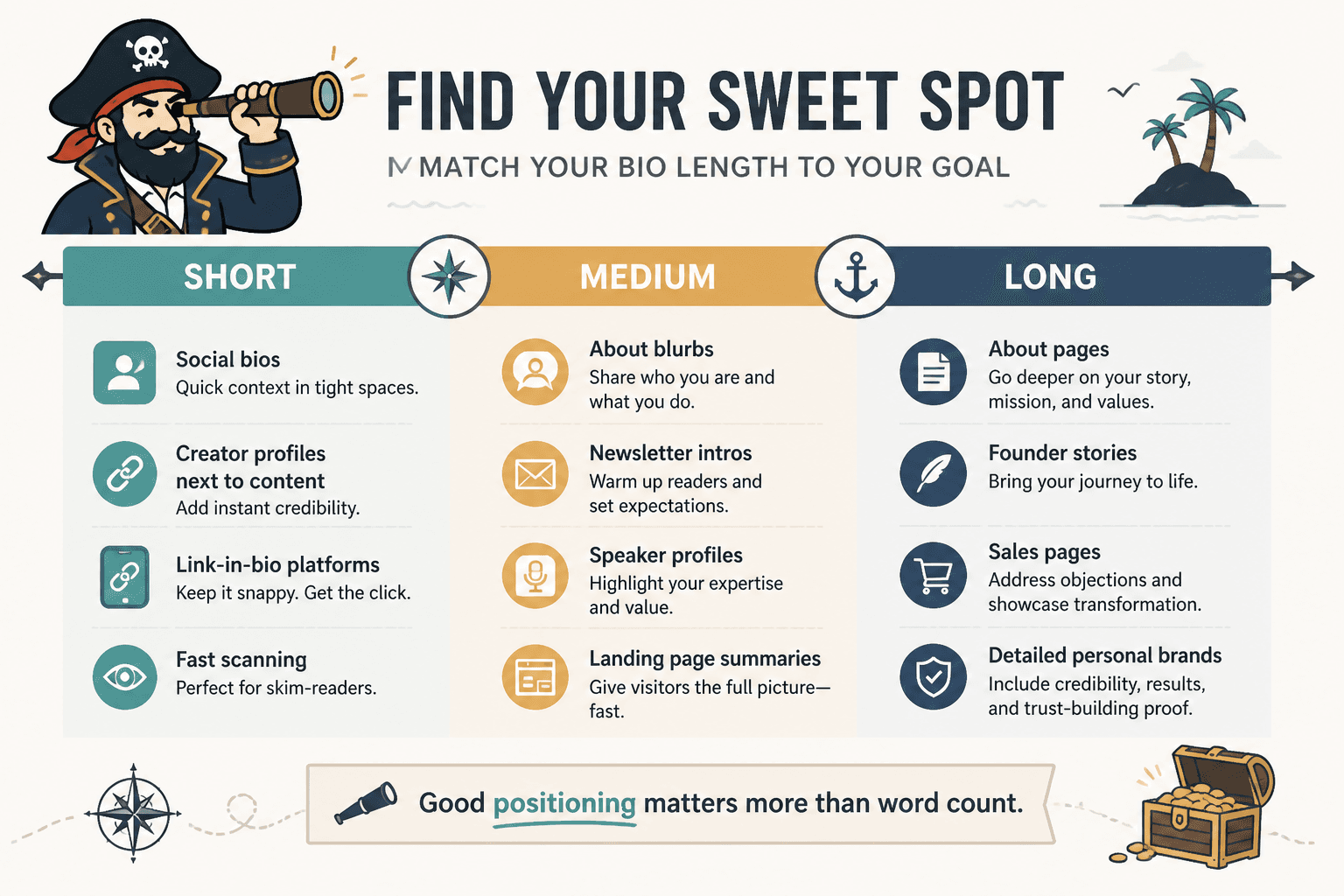
1. Short social bios: keep them tight
For platforms where your bio sits next to your name, face, and recent posts, shorter usually works better.
Why? Because the rest of your profile is already doing some of the persuasion. People can scan your content, pinned posts, featured links, testimonials, and visual branding. Your bio does not need to explain your entire worldview like a tiny manifesto trapped in a sidebar.
For these profiles, aim for:
- One sharp positioning line
- Optional proof fragment
- One simple CTA
Example:
I help consultants turn scattered expertise into content that wins trust and leads.
Seen by 200k+ readers.
Start here ↓
That is enough. Clear audience. Clear outcome. Light proof. Next step. No theatrical branding fog.
2. Creator “about” sections: earn the extra words
If the platform gives you a fuller summary section, you can go a bit longer. But “can” and “should” are not the same thing.
A longer profile section should add things the short bio cannot fit well:
- Your angle or philosophy
- A stronger credibility signal
- The kinds of people you help
- The way you work
- A direct next step
This is where 80 to 180 words can work well. Enough room to build trust. Not enough room to wander off into autobiography.
Good example:
I help coaches, consultants, and personal brands turn their expertise into sharper content and clearer positioning.
That usually means better bios, stronger profile copy, smarter posts, and less of the generic “thought leadership” sludge people scroll past.
If your content sounds polished but forgettable, I can help fix that. Check the resources below or get in touch.
That is longer than a one-line bio, but every sentence is doing a job. That is the standard.
3. Homepage profiles and landing-page intros: more room, same discipline
On your own site, you usually get more space. That does not mean people suddenly want your life story above the fold.
For homepage profile copy or an “about” intro, 50 to 120 words is often enough near the top. If you want a deeper founder story lower on the page, fine. But your first profile section should still get to the point fast.
A good rule: the first screen should explain your relevance. The deeper sections can explain your story.
When short bios beat long ones
Short bios tend to win when the reader is moving quickly and making a simple decision.
For example:
- Should I follow this person?
- Do they seem relevant to me?
- Do they help with the problem I have?
- Should I click their link?
In those moments, compact beats comprehensive.
A short bio also works better when:
- Your niche is clear
- Your offer is simple
- Your content already demonstrates expertise
- Your social proof is visible elsewhere on the profile
- Your audience knows the problem they need solved
This is why short bios can feel more confident. They do not beg to be understood. They say the thing and get out of the way.
If you want a fuller breakdown of when concise copy works better, read when short creator bios and profile copy beat long ones.
When longer profile copy is worth it
Longer profile copy earns its place when the decision is heavier.
If someone might hire you, book you, trust you with a budget, or put you in front of their audience, they often need more than one sentence. Not endless detail. Just enough depth to reduce uncertainty.
Longer profile copy makes sense when:
- Your work is nuanced or strategic
- Your audience needs more education before they “get it”
- You are in a crowded field and need a distinct angle
- You have meaningful proof worth showing
- Your profile is part of a lead-generation path, not just a follow button
But longer only works if the extra words reduce friction. If they create more friction, cut them.
That means no giant credential dump. No adjective soup. No paragraph full of roles like “writer, strategist, consultant, speaker, mentor, founder, operator, creator, advisor.” Pick the identity that matters most to the reader right now. You are not a LinkedIn dropdown menu.
The biggest mistake: writing to fill space instead of move people
People often write profile copy like they are trying to complete a form, not communicate value.
So they fill every available line. They add every title. They explain every pivot. They stack broad claims. They use soft language because specificity feels risky. And suddenly the profile says a lot while communicating very little.
Here is a common weak version:
Helping entrepreneurs, leaders, and brands unlock authentic growth through storytelling, strategy, and transformational content.
Looks polished. Says almost nothing.
Here is a sharper version:
I help solo consultants turn their expertise into clear content that attracts better-fit clients.
Shorter. More useful. Less perfume.
If your opening line is weak, the rest of the profile has to work way too hard. That is why starting creator bios and profile copy without a weak opening matters more than squeezing in one extra proof line later.
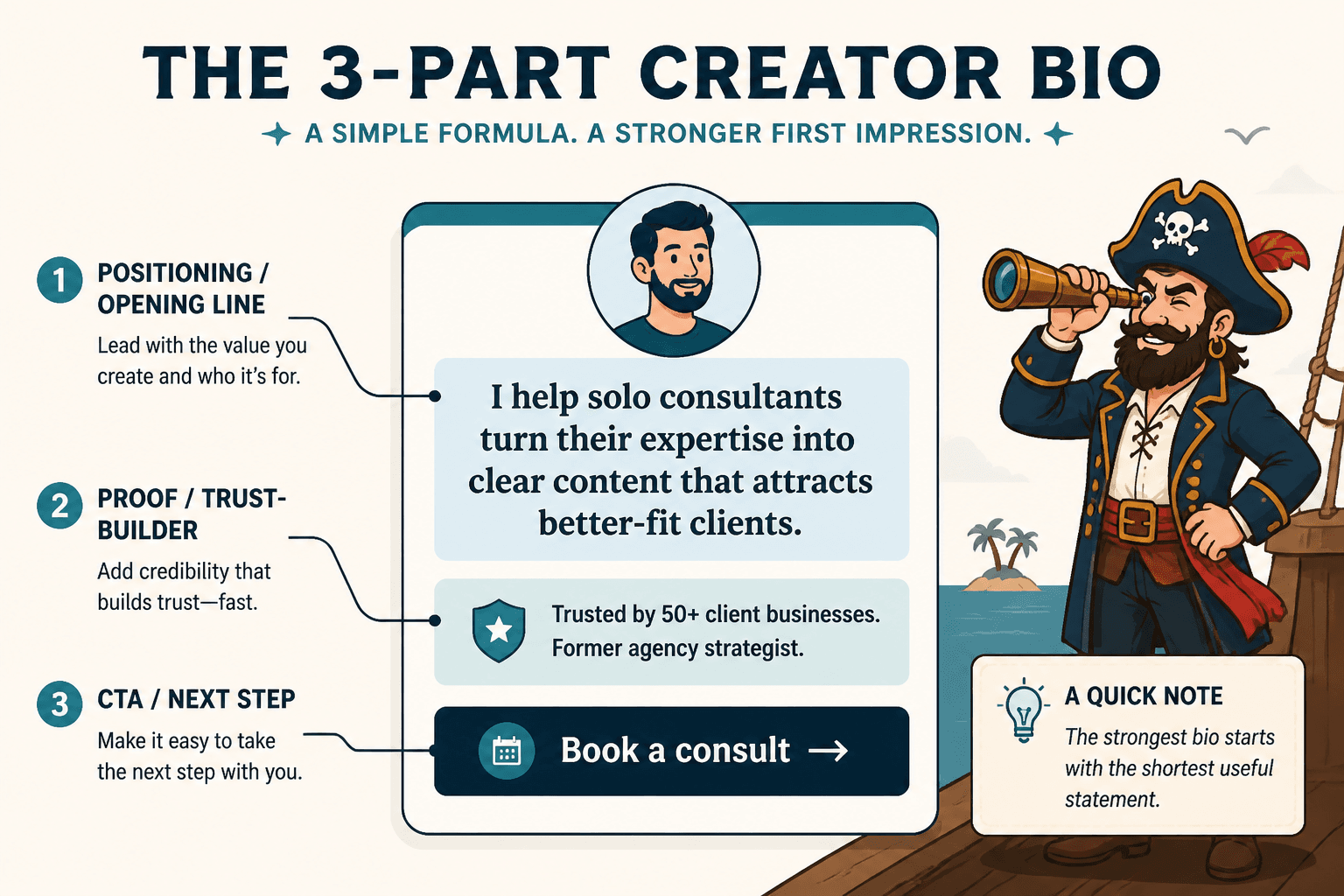
A simple way to decide the right length for your bio
If you are not sure how long your profile copy should be, use this quick filter.
Step 1: Start with the shortest useful version
Write one line that answers:
- Who do you help?
- What result do you help them get?
Example:
I help course creators write launch copy that sounds human and sells clearly.
Step 2: Add one trust-builder if needed
This could be:
- Years of experience
- Audience size
- Client type
- Published work
- Specific result
Example:
I help course creators write launch copy that sounds human and sells clearly.
Trusted by coaches, educators, and small teams selling expert-led offers.
Step 3: Add a next step
Do not make people guess what to do now.
I help course creators write launch copy that sounds human and sells clearly.
Trusted by coaches, educators, and small teams selling expert-led offers.
See examples below or message me.
Step 4: Stop when the next sentence is just “more”
This is the part people skip.
If the next sentence does not make the profile clearer, more credible, or easier to act on, cut it. A lot of profile copy gets bloated because people keep adding adjacent details that feel true but do not help the reader decide anything.
Good length by platform behavior, not just character limits
Character limits matter, but reader behavior matters more.
For fast-scan platforms, your profile should be tighter. For deeper trust platforms, you can use more room. The better question is not “how much space do I have?” It is “how much explanation does this audience need before they care?”
The bigger point is simple: clearer structure and clearer writing make the piece more useful. That is usually what makes the ending land better too.