
Most creator credential lines are trying way too hard to impress people who are not that interested yet.
That is the problem.
Your bio, headline, and profile copy do not get judged like a conference speaker intro. They get scanned in about two seconds by someone wondering, “Is this person relevant to me, useful to me, or easy to ignore?” If your credential line is vague, inflated, crowded, or weirdly self-important, it does not build trust. It creates friction.
Creator credential line mistakes that hurt performance usually are not dramatic. They are small positioning errors that quietly make your profile less clear, less credible, and less compelling. And yes, those tiny errors can absolutely hurt follows, clicks, inquiries, and conversions.
Here’s how to fix the credential line problem without turning your profile into a beige resume in public. We’ll cover the mistakes, what to say instead, and how to write a line that actually helps your profile do its job.
For the broader learning path, visit our parent guide.
First, what a credential line is actually supposed to do
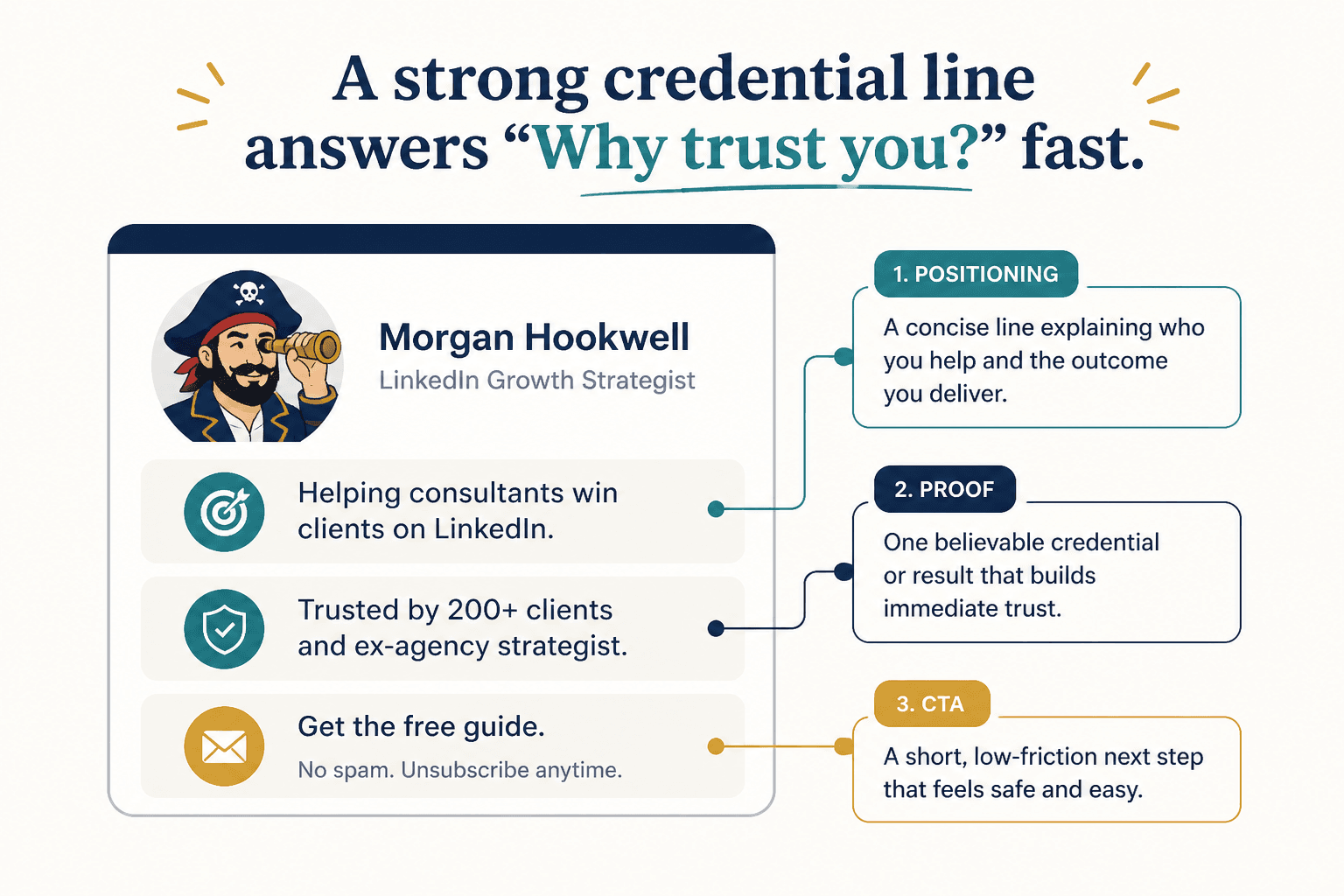
A credential line is the part of your bio or profile copy that signals why someone should take you seriously.
It might mention your experience, client results, role, niche, company background, notable work, audience, certifications, or some form of proof. In theory, it answers a simple question: why trust you?
In practice, a lot of people answer that question badly.
They either write a puffed-up title that says nothing, cram in every credential they have collected since 2018, or go so vague that the whole thing reads like they help “visionary humans step into alignment.” Which is lovely, I’m sure, but not exactly useful.
A strong credential line should do four things fast:
- Show relevance to the right audience
- Signal believable proof
- Support your positioning
- Make the next action feel safer
That is it. Not win a trophy. Not sound famous. Not cosplay authority.
Mistake 1: Leading with prestige instead of relevance
A lot of creators assume the biggest credential is automatically the best one.
It isn’t.
If you help consultants get clients from LinkedIn, saying you are an “Ex-enterprise transformation strategist at a Fortune 100 company” might sound impressive, but it may not be the strongest proof for the reader standing in front of you now. It explains where you came from, not why you are useful to them.
Prestige can help. Relevance helps more.
Weak
Former senior innovation lead at global organizations
Better
I help consultants turn expertise into LinkedIn content that brings inbound leads
Best if true
I help consultants turn expertise into LinkedIn content that brings inbound leads. Former enterprise strategist. 200+ authority posts written.
The prestige detail works better once it supports a useful claim instead of replacing one.
Mistake 2: Using credentials that your audience does not value
Not all proof is equal. Some credentials matter a lot in one niche and barely matter in another.
A formal certification may matter in coaching, finance, health, or certain consulting spaces. It may matter a lot less if you are a ghostwriter, content strategist, designer, or solo founder selling practical expertise. In those cases, outcomes, body of work, and specificity often hit harder than certificates.
If your audience wants results, they may not care that you are a “certified advanced transformational communications practitioner.” They may care that you helped five coaches clean up their bios and increase profile inquiries.
Use the kind of proof your audience actually trusts.
- Service buyers often trust outcomes
- Peers often trust body of work
- Corporate audiences may trust titles and institutions more
- Warm audiences may trust familiarity and consistency
- Cold audiences usually trust clarity first, then proof
This is where a lot of bios quietly fail. The proof is technically real, but strategically useless.
Mistake 3: Stuffing in too many roles
One of the fastest ways to weaken a credential line is to turn it into a professional junk drawer.
You have probably seen versions of this:
Writer | Coach | Strategist | Founder | Speaker | Consultant | Educator | Podcaster | Community Builder
That does not signal range. It signals blur.
When people cannot tell what you are mainly known for, they usually do not stick around to investigate your inner complexity. They move on.
Your credential line needs hierarchy. One primary identity. Maybe one supporting identity. After that, you are probably oversharing your tabs.
Try this instead
- Pick the role most tied to the offer or content
- Add one supporting proof detail
- Cut the rest unless it directly increases trust
For example:
Too much: Writer, coach, founder, brand strategist, course creator, keynote speaker
Clearer: Brand strategist for coaches and consultants | I help experts sharpen their positioning and profile copy
Stronger: Brand strategist for coaches and consultants | I help experts sharpen positioning and profile copy that converts profile views into inquiries
Mistake 4: Sounding impressive instead of understandable
Some credential lines are so dressed up they stop communicating.
This usually happens when people reach for authority language instead of plain language. You get phrases like:
- Thought leadership architect
- Visibility mentor for impact-driven visionaries
- Personal brand elevation expert
- Messaging alchemist
- Authority ecosystem builder
Can a real person decode that? Maybe. Should they have to? No.
Clear beats clever here. Every time.
The best credential lines usually use words your audience already uses. Not words that sound like they were polished in a strategy retreat and left out too long.
Simple rewrites
Instead of: Personal brand elevation expert
Try: I help consultants clarify what they do and say it better online
Instead of: Messaging architect for transformational leaders
Try: Messaging strategist for coaches who want clearer offers and stronger content
If you want more help tightening this part, this guide on improving positioning lines without sounding generic is worth reading next.
Mistake 5: Making claims you cannot support
If your credential line promises too much, people feel it. Even if they cannot quite explain why.
Lines like these tend to wobble:
- Trusted by top leaders worldwide
- Leading authority in personal branding
- World-class growth strategist
- Helping thousands scale freedom-based businesses
If the profile does not immediately back that up, the claim starts leaking credibility.
Here is the safer rule: be specific enough to be believed.
That means replacing inflated claims with grounded proof:
- Who you help
- What you help them do
- How many clients, projects, or years if meaningful
- A recognizable result if true
- A credible past role if relevant
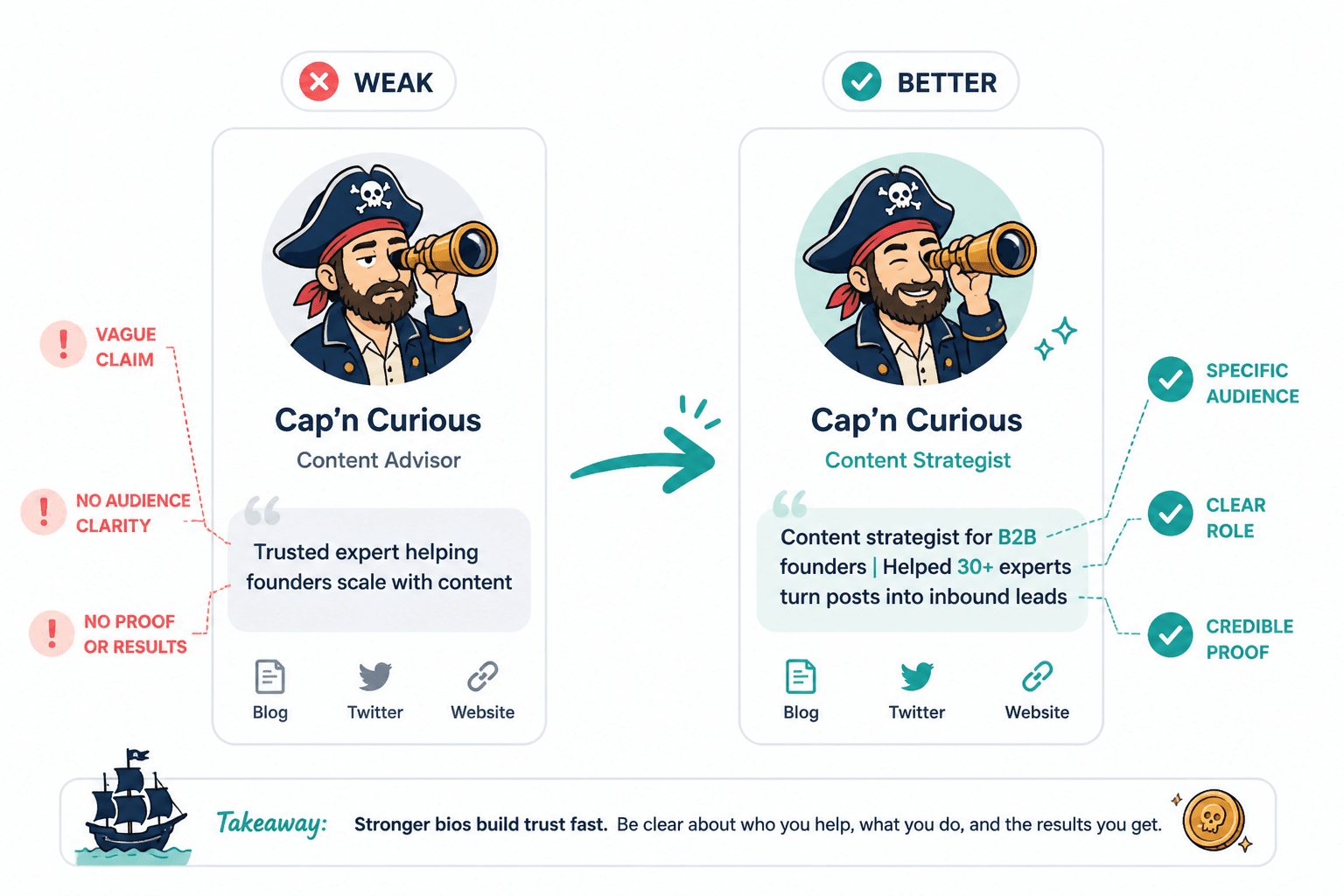
Weak: Trusted expert helping founders scale with content
Better: Content strategist for B2B founders | Helped 30+ experts turn posts into inbound leads
You do not need to sound huge. You need to sound real.
Mistake 6: Hiding the audience you serve
A credential line without an audience often feels weak, even if the person is genuinely skilled.
That is because “who this is for” does a lot of heavy lifting. It creates relevance. It filters. It helps the reader self-select.
Compare these:
Vague: Copywriter helping businesses grow
Better: Copywriter for coaches and consultants who need sharper authority content
Stronger: Copywriter for coaches and consultants | I write authority content that helps expertise sound clear, credible, and worth paying for
When you leave out the audience, your line has to work much harder to create relevance. Usually, it does not.
Mistake 7: Treating the credential line like a mini autobiography
Your profile is not the place to narrate your whole professional evolution in one breath.
People do not need your entire sequence from freelancer to founder to mentor to speaker to builder of systems. They need the version of your credibility that helps them decide what to do next.
This is where editing matters more than accomplishment. A good credential line is not your whole story. It is your most useful trust signal.
If you have a layered background, great. Use the pieces that support your current positioning. Save the rest for your About section, featured content, pinned post, or longer profile areas.
Mistake 8: Writing a credential line that does not match the rest of the profile
This one gets missed a lot.
Your credential line does not work alone. It sits next to your profile photo, content, banner, bio, featured links, offer, and CTA. If it says one thing and the rest of the profile says another, trust slips.
For example, if your credential line says you help founders build authority, but your recent content is generic productivity tips and recycled mindset quotes, the line loses force. If your bio says “email strategist” but your featured links point to life coaching offers, people get confused.
Clarity is not only about one good sentence. It is about alignment across the profile.
If your current profile feels mismatched, start with how to write better creator bios and profile copy, then clean up weak spots with this rewrite guide.
What strong credential lines usually include
You do not need every element below. But the best lines usually combine two or three of them well.
| Element | What it does | Example |
|---|---|---|
| Audience | Makes the line relevant fast | For coaches and consultants |
| Role | Explains what you do | Messaging strategist |
| Outcome | Shows the result you help create | Sharper offers and clearer content |
| Proof | Adds credibility | 50+ client rewrites |
| Context | Supports authority if relevant | Former in-house brand lead |
A few solid formulas:
- Role + audience + outcome
Bio strategist for creators who want clearer positioning and stronger profile conversion - Audience + result + proof
I help consultants fix weak profile copy and turn profile views into inquiries | 100+ rewrites - Role + relevant background + current value
Former agency strategist helping solo experts simplify their messaging and authority content
A quick rewrite process for weak credential lines
If your current line feels bland, bloated, or try-hard, use this process.
The bigger point is simple: clearer structure and clearer writing make the piece more useful. That is usually what makes the ending land better too.