
Most boring creator bios do not fail because they are too short.
They fail because they are trying to sound impressive instead of useful.
You see it everywhere: vague promises, stacked job titles, foggy words like “empowering,” and a profile line that could belong to 4,000 other people with a Canva subscription and a mild interest in thought leadership. The result is a bio that says words, technically, but tells the reader almost nothing.
If you want to know how to rewrite boring creator bios & profile copy, the fix usually is not “be more clever.” It is “be more clear.” Say who you help, what you help them do, why they should believe you, and what they should do next. That is the job. Not interpretive dance.
This guide will help you rewrite your bio so it sounds sharper, more specific, and more worth paying attention to. We’ll cover what makes profile copy boring, how to diagnose the real problem, a practical rewrite process, and examples you can adapt without sounding like you stole them from a template graveyard. If you want more foundational help, this broader guide on how to write better creator bios and profile copy is a useful companion.
For the full path around this topic, head to the parent guide.
Why most creator bios are boring in the first place
Boring bios usually come from one of three instincts:
- Trying to sound professional
- Trying to include everything
- Trying to impress people who are not actually the audience
That is how you end up with copy like this:
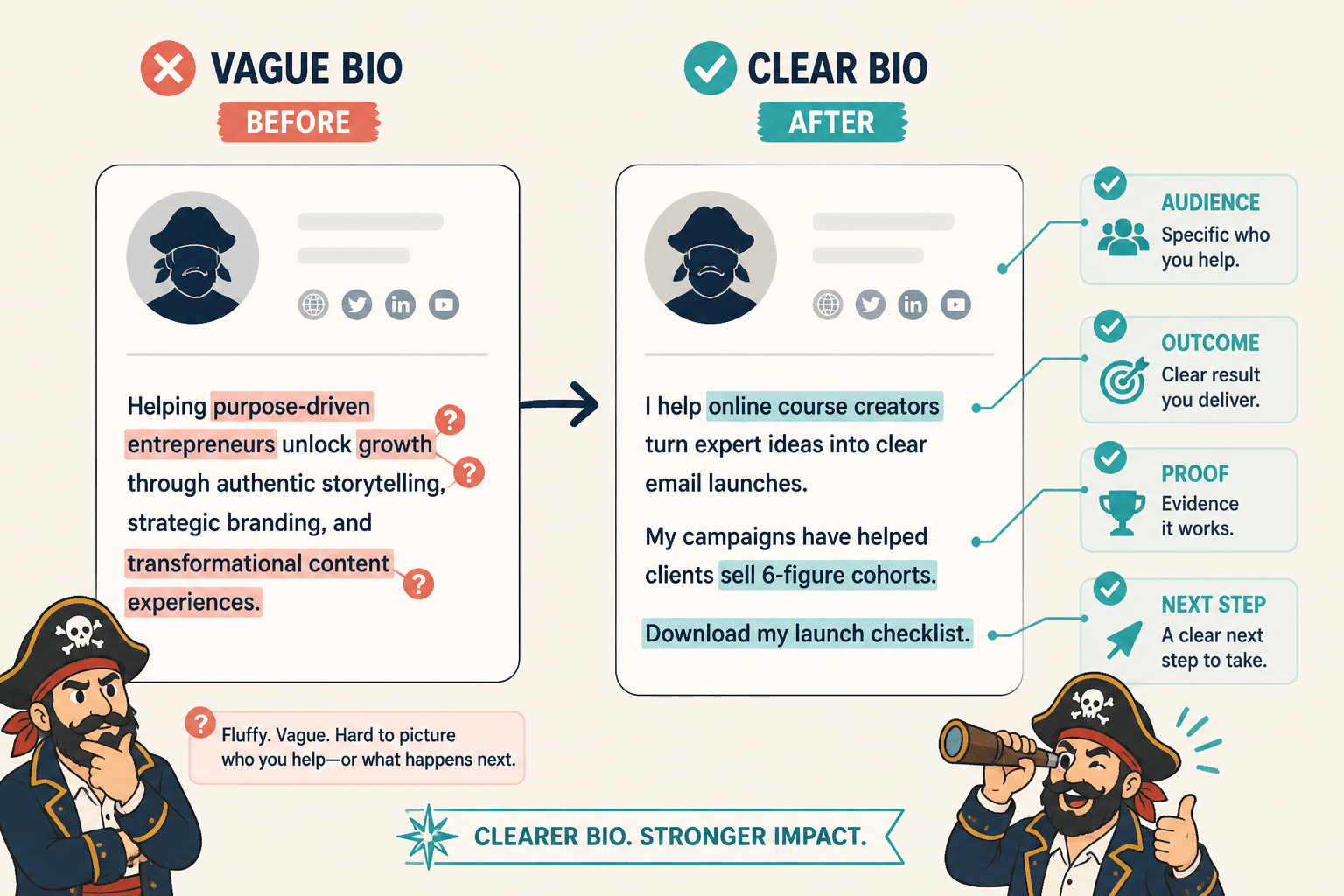
Helping purpose-driven entrepreneurs unlock growth through authentic storytelling, strategic branding, and transformational content experiences.
That sounds polished. It also sounds like absolutely nothing. Who is it for, exactly? What kind of growth? What kind of content? Why should anyone trust this person over the next “strategic storyteller” in line?
Boring profile copy is usually vague, overstuffed, or allergic to proof. Sometimes all three. And when a bio is vague, the reader has to work too hard to understand you. Most won’t. They will move on.
Your bio is not there to capture every nuance of your soul. It is there to make the right person think, “Ah. This is for me.”
What a good creator bio actually needs to do
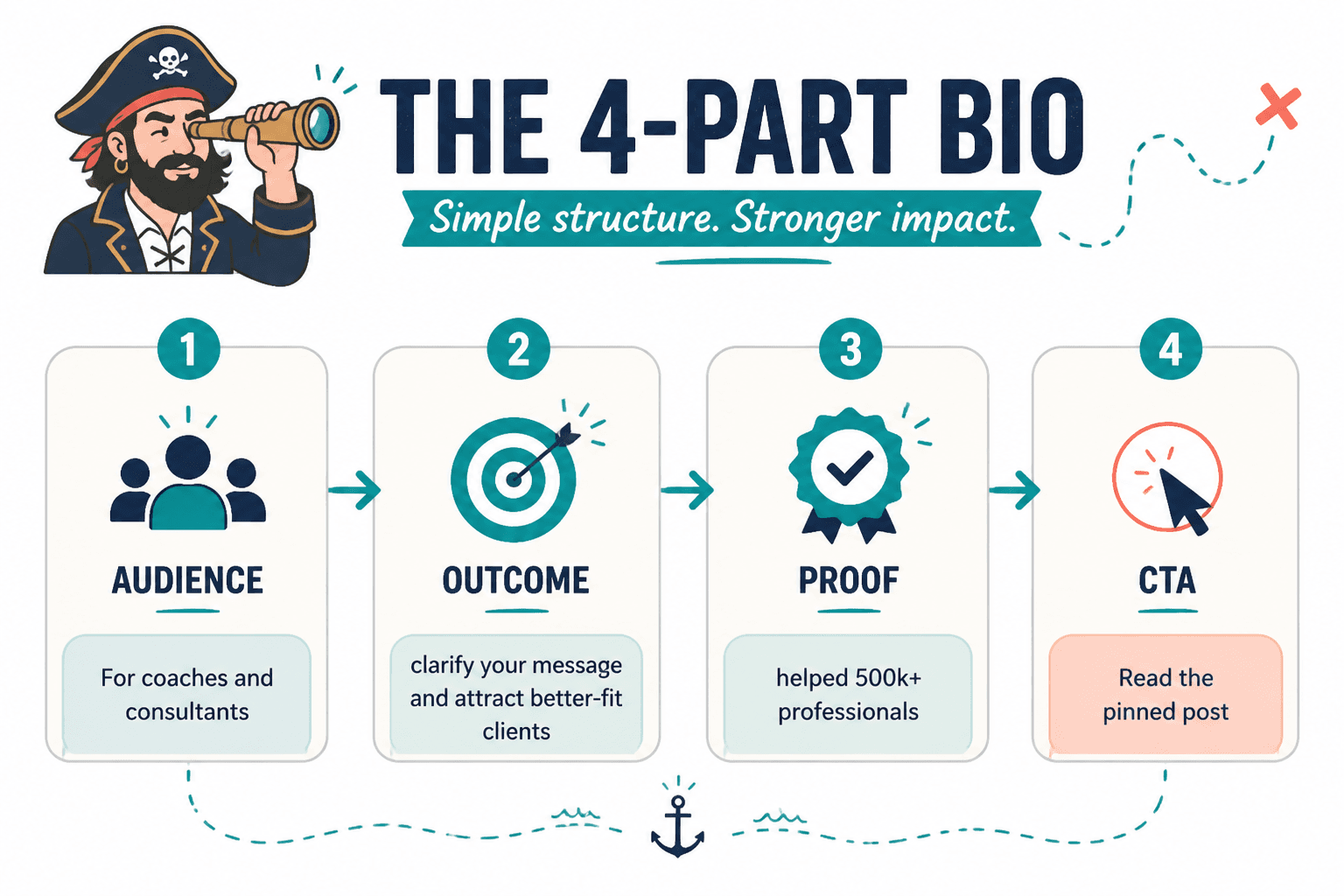
A strong creator bio answers four questions fast:
- Who are you for?
- What do you help them do?
- Why should they trust you?
- What should they do next?
That does not mean every bio has to use the exact same formula. Some can be more playful. Some can be more authority-driven. Some can lean harder on personality. But if your profile skips all four, readers are left guessing. Guessing is bad for attention, trust, and conversions.
A good bio is not just a mini résumé. It is a positioning tool. It tells people where to place you in their mind. If you do not position yourself clearly, they will either misunderstand you or forget you. Neither is especially helpful.
How to spot what is making your current bio weak
Before rewriting, diagnose the problem. Most weak bios break in predictable ways.
1. It is too vague
If your bio could apply to a business coach, copywriter, leadership consultant, and yoga retreat founder at the same time, it is too vague.
Words to watch: authentic, aligned, impactful, transformational, empowering, intentional, purpose-driven, visionary. None of these are illegal. They just become fluff when they are doing all the lifting.
2. It lists roles instead of value
“Founder | Speaker | Coach | Writer | Consultant | Creator | Podcaster” is not a bio. It is a LinkedIn nametag having an identity crisis.
People care less about your collection of labels than what those labels mean for them.
3. It sounds like corporate filler
If your profile copy feels like it came from a committee that was forbidden from having a personality, it will not stick.
Professional does not mean bloodless. Clear, human language usually outperforms polished mush.
4. It has no proof
Claims without evidence feel cheap. Even a little proof helps. That might be:
- Who you have worked with
- What results you helped create
- Years of experience
- Audience size, if relevant
- A specific body of work
- A concrete method or specialty
You do not need to flex like a peacock in a blazer. But you do need something.
5. It gives no next step
A bio that ends with no direction wastes attention. If someone likes what they see, what should they do now? Read your posts? Download something? Book a call? Visit a page?
This is especially important if your profile is part of a content funnel. A sharp bio can quietly move someone from curious to interested without acting like a pop-up ad in human form.
How to rewrite boring creator bios & profile copy step by step
Here is the practical process.
Step 1: Strip out the fog
Take your current bio and highlight every vague phrase, inflated adjective, and filler label. Cut anything that sounds nice but says little.
Examples of common bio fog:
- passionate about helping
- building meaningful brands
- creating impact
- authentic storytelling
- unlocking growth
- multi-passionate entrepreneur
- personal brand strategist for visionary leaders
Some of these can be rescued with specifics. Most need replacing.
Step 2: Identify the actual point
Ask:
- Who do I actually want following, hiring, or trusting me?
- What specific problem do I help them solve?
- What outcome do they care about most?
- What proof or credibility can I mention without sounding unbearable?
This is where a lot of bios improve fast. Not because the writer suddenly becomes brilliant, but because they finally stop trying to appeal to everyone with a Wi-Fi signal.
Step 3: Write a positioning line people can understand on first read
Your opening line matters. If it is weak, abstract, or stuffed with self-important mush, the rest of the profile has to work too hard.
A simple positioning line often works best:
- I help [specific audience] do [specific result].
- [Role] helping [specific audience] get [specific outcome] without [specific pain].
- I write about [topic] for [specific people] who want [specific result].
If you want to sharpen just this part, read how to improve creator bios and profile copy positioning lines without sounding generic and how to start creator bios and profile copy without a weak opening.
Step 4: Add one useful proof point
You do not need a trophy case. You need one believable reason to trust you.
That could look like:
- Helped 60+ consultants tighten their messaging
- 10 years writing for B2B founders and service businesses
- Posts read by 500k+ professionals
- Former agency strategist turned solo consultant
- Creator of a weekly content system used by coaches and freelancers
Specific beats inflated. Every time.
Step 5: Finish with a clear next step
Your CTA does not need to sound like a webinar registration page from 2018.
Try things like:
- Read the pinned post for my content framework
- Grab the free bio rewrite guide below
- Book a strategy call
- Start with my newsletter
- See how I help service businesses sharpen their content
Clear beats clever here too.
Before-and-after bio rewrites
Here is where this becomes more real.
Example 1: The vague brand coach
Before:
Helping visionary entrepreneurs build authentic brands and create aligned content that converts.
What is wrong with it:
“Visionary,” “authentic,” “aligned,” and “converts” are doing a lot of emotional labor here. We still do not know who this is for or what the coach actually does.
After:
I help coaches and consultants clarify their brand message so their content attracts better-fit clients.
Brand strategist for service businesses. 80+ client messaging projects.
Start with the pinned post for my 3-part brand clarity framework.
Example 2: The role collector
Before:
Writer | Founder | Speaker | Consultant | Podcast Host | Community Builder
What is wrong with it:
It tells us what this person calls themselves, not why anyone should care.
After:
I write about content, positioning, and audience growth for solo founders.
Founder of a content studio that helps expertise-led businesses sound sharper and sell more clearly.
Read my latest posts or grab the free messaging guide.
Example 3: The polished nothingburger
Before:
Empowering purpose-led leaders to unlock visibility, confidence, and impact through intentional personal branding.
What is wrong with it:
This is all fog. Nicely scented fog, maybe, but still fog.
After:
I help consultants and experts turn messy experience into clear personal brand messaging.
Personal brand strategist. Former agency copy lead. Known for fixing bios, offers, and profile copy that sound like everyone else’s.
Want the simple version? Start with my bio rewrite tips.
Example 4: The underwritten creator bio
Before:
I help people grow online.
What is wrong with it:
Too broad. Too flat. Too little trust.
After:
I help coaches and service businesses grow on LinkedIn with clearer posts, sharper profiles, and trust-first funnels.
Content strategist. 300+ rewritten posts and profiles.
If your content gets polite silence, start with my pinned guide.
A simple bio formula you can adapt
If you want a reliable structure, use this:
- Line 1: Who you help + what you help them do
- Line 2: Role + proof or specialization
- Line 3: Clear next step
Template:
I help [audience] do [result].
[Role/specialty]. [Proof, credibility, or distinct angle].
[Simple CTA].
Filled example:
I help freelance writers turn scattered expertise into content clients actually remember.
Content strategist and copywriter. Former in-house editor. 120+ bios, homepages, and LinkedIn profiles rewritten.
Read the pinned post for my messaging framework.
That formula is not glamorous. Good. Bios are not there to win literary prizes. They are there to position you clearly and move the right people one step closer.
What to remove from your bio immediately
The bigger point is simple: clearer structure and clearer writing make the piece more useful. That is usually what makes the ending land better too.
The bigger point is simple: clearer structure and clearer writing make the piece more useful. That is usually what makes the ending land better too.