
The common mistake is treating weak offer messaging like a product problem. It usually is not. More often, the offer is fine, but the language around it is doing a fog machine impression: broad, polite, and impossible to buy with confidence.
Better offer messaging and positioning make the same thing obvious from three angles: who it is for, what painful or important problem it solves, and why this specific offer is the right fit. That is the job. Not sounding grand. Not sounding “brand aligned.” Just making the right person think, “Yes, that is for me.”
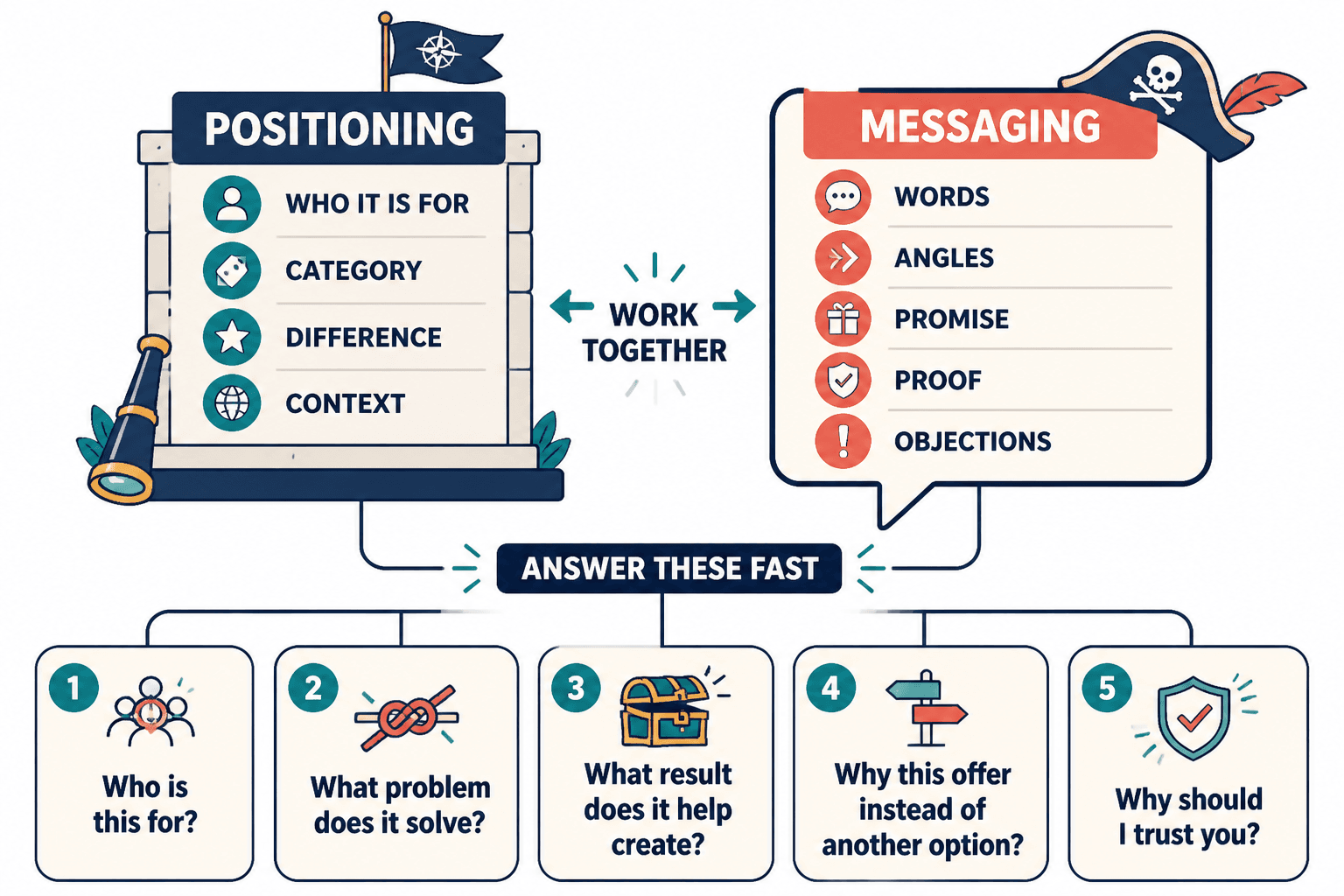
What offer messaging and positioning actually need to do
Offer messaging answers the immediate buying questions. Positioning explains why your offer occupies a useful spot in the market instead of blending into the wallpaper.
In practice, strong messaging should help a reader answer five things quickly:
- Who is this for?
- What problem does it solve?
- What result can I expect?
- How does it work?
- Why should I trust this over the nearest alternative?
If those answers are hidden behind abstract language, the offer may still be real, but the buying path gets annoying. And online, “annoying” is often enough to lose the sale.
For the broader copy system this sits inside, see the parent guide on offer messaging and positioning.
Why creator offers get ignored
Ignored offers are usually not missing potential. They are missing clarity.
Three patterns show up over and over:
- The audience is too broad, so the message tries to please everyone and lands with no one.
- The problem is described in category language instead of the words the buyer would actually use.
- The result sounds impressive but vague, so it does not help anyone picture a real change.
That is why a service page or sales page can feel “well written” and still underperform. Good grammar is not a positioning strategy. A polished blur is still a blur.
Start with the offer foundation before you touch the copy
Before rewriting headlines, value bullets, or calls to action, get the underlying offer logic straight. Otherwise you end up polishing a sentence that was built on sand.
The simplest foundation is this:
- Define the audience properly.
- Name the problem they already feel.
- Clarify the result without promising nonsense.
- Explain your mechanism.
That structure is boring in the best possible way. It gives the copy something solid to stand on.
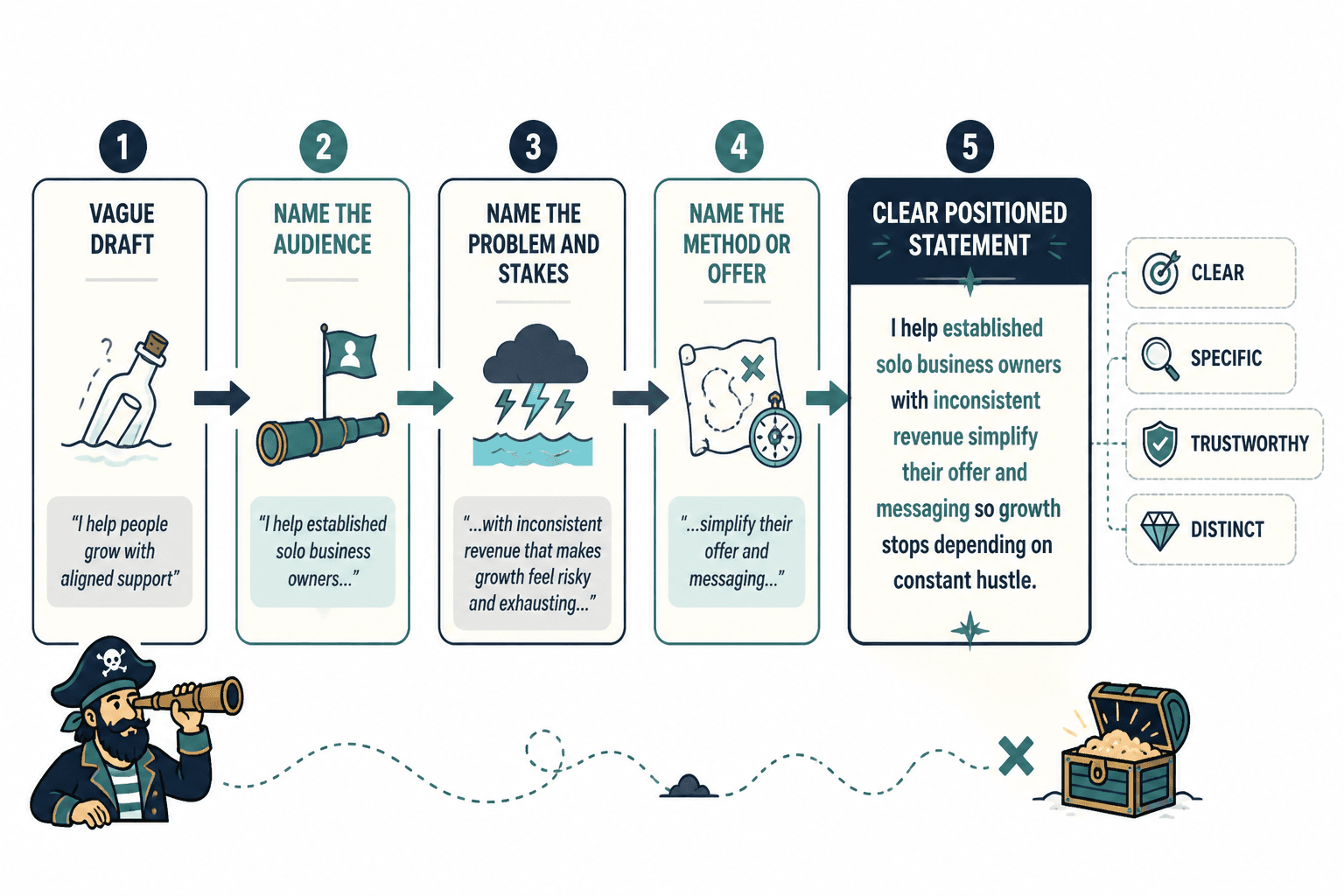
1. Define the audience properly
“For creators” is not an audience definition. It is a category with better lighting.
Useful audience definition gets more specific about context, stage, and need. For example, the offer may be for:
- new freelancers who need a first clean positioning statement
- solo service providers whose homepage sounds too generic
- small brand teams trying to sharpen a conversion page without rewriting the whole site
The point is not to create a tiny vanity niche for sport. The point is to make the message land on a real person with a real problem.
2. Name the problem they already feel
People rarely buy because they admire your process. They buy because they want relief, change, or momentum.
So the problem should be stated in the buyer’s language, not your internal taxonomy. Compare these:
- Weak: “Improve brand alignment through strategic messaging.”
- Stronger: “Your homepage sounds polished, but it still does not tell visitors what you actually do.”
The second version is not poetic. It is useful. That matters more.
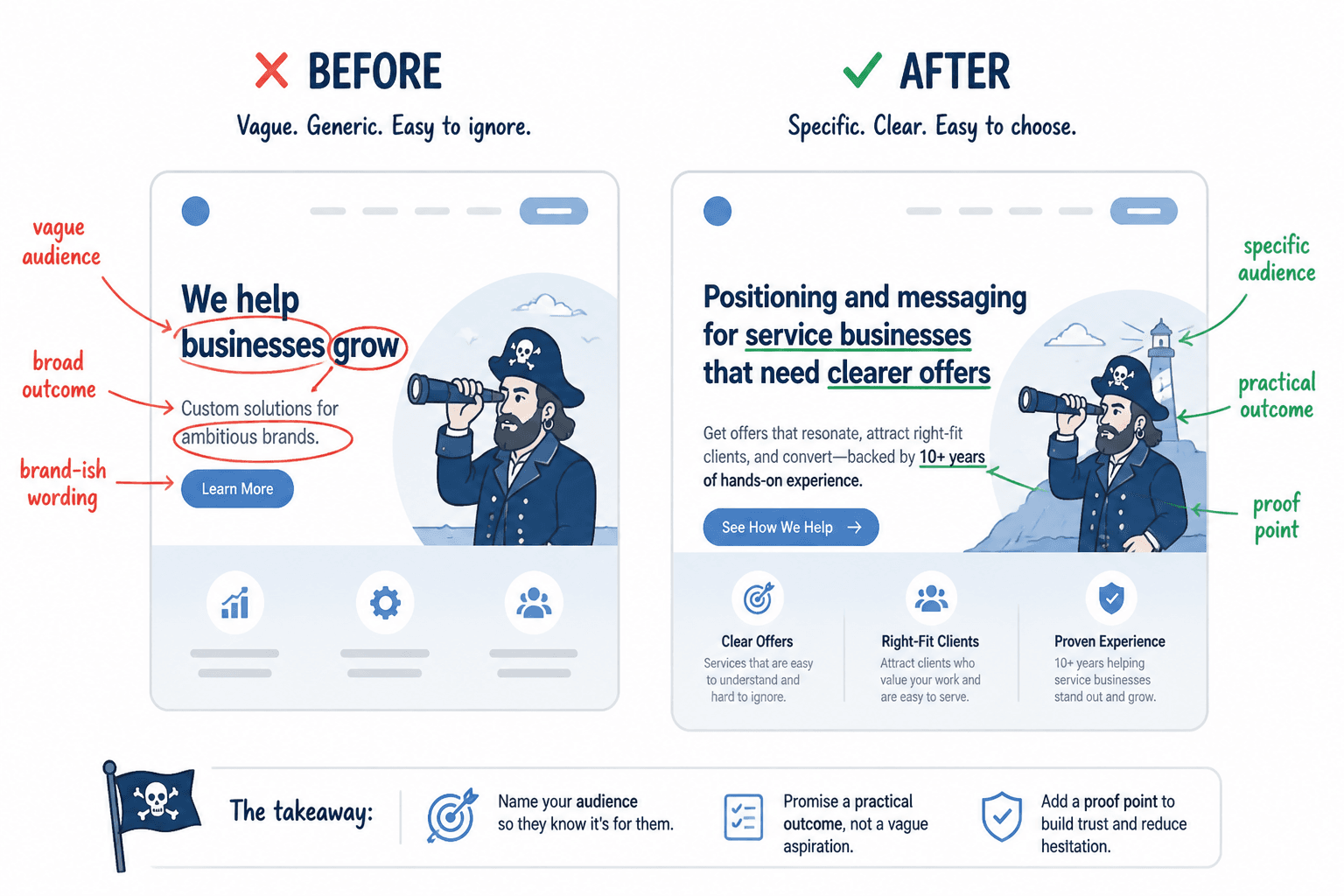
3. Clarify the result without overpromising
A good result statement is specific enough to feel real and careful enough not to drift into miracle territory.
That means describing the shift in plain terms:
- more qualified inquiries
- a clearer sales page
- a homepage visitors can understand in one pass
- a positioning line that stops sounding like everyone else in the category
Avoid the classic “transform your life” fog unless the offer is actually a life coach and even then, maybe take a breath.
For guidance on keeping the opening sharper, the companion piece on how to start offer messaging & positioning without a weak opening is the natural next stop once it is live.
4. Explain your mechanism
This is where many offers either become credible or collapse into generic service soup.
The mechanism is the “how” that makes the result believable. It does not need to be novel. It does need to be understandable.
For example:
- instead of “strategic support,” say you audit, rewrite, and reframe the page based on buyer objections
- instead of “done-for-you messaging,” say you turn raw notes, drafts, and voice-of-customer material into a clear offer page
- instead of “content system,” say you build a repeatable structure for posts, emails, or pages that all point to the same offer
Mechanism is what stops the offer from feeling like a promise pasted onto a vibe.
How to position your offer so it does not blur into the market wallpaper
Positioning is where you make the offer distinct without making it weird for the sake of being weird.
A practical positioning statement usually includes:
- who it is for
- what problem it solves
- what outcome it creates
- what angle, method, or emphasis makes it different
The easiest way to test positioning is to strip the sentence down and ask: would a buyer recognize themselves in this, or would they just nod politely and keep scrolling?
If it could describe five other offers on the same market page, it is not positioned yet.
For a tighter line-level rewrite approach, the companion survivor on how to improve positioning lines without sounding generic is the next logical branch of this topic.
A simple clarity pass before you publish
Use this quick check before the page goes live:
- Is the audience specific enough to picture?
- Is the problem written in buyer language?
- Is the result concrete without sounding inflated?
- Is the mechanism clear enough to trust?
- Does the positioning say something useful that the nearest competitor probably would not?
If any answer is fuzzy, fix that first. Do not hide the fuzz under a nicer adjective.
Helpful external references on clarity, trust, and plain-language communication:
Strong offer messaging does not try to impress the market into submission. It removes uncertainty. That is usually enough.