
A draft offer page has a funny habit of collecting confused artifacts: a headline that sounds impressive but says nothing, a subhead that repeats the headline in different clothes, three CTAs that all try to be the main character, and a paragraph about “helping you transform your business” that could belong to anybody. The page is live in the technical sense. In the persuasive sense, it is still pacing around the lobby.
That is where examples help. Not because examples are magic, but because they make the difference between vague-sounding and actually useful easier to see. Good offer messaging and positioning are mostly about giving the right person a reason to stop, nod, and think: yes, that is my problem, and this person seems to know how to solve it.
If you want the broader strategy behind this, start with the offer messaging and positioning guide. This page stays closer to the concrete stuff: examples, templates, and rewrites you can actually adapt.
What offer messaging and positioning need to do
At a basic level, offer messaging should answer four questions fast:
- Who is this for?
- What problem does it solve?
- What result does it create?
- Why this approach, specifically?
Positioning adds the sharper edge. It separates “this is a coaching offer” from “this is a coaching offer for people who are stuck in launch planning and need a clearer decision path.” Same category. Very different buying energy.
The goal is not to sound grand. The goal is to sound identifiable.
A simple structure for stronger offer messaging
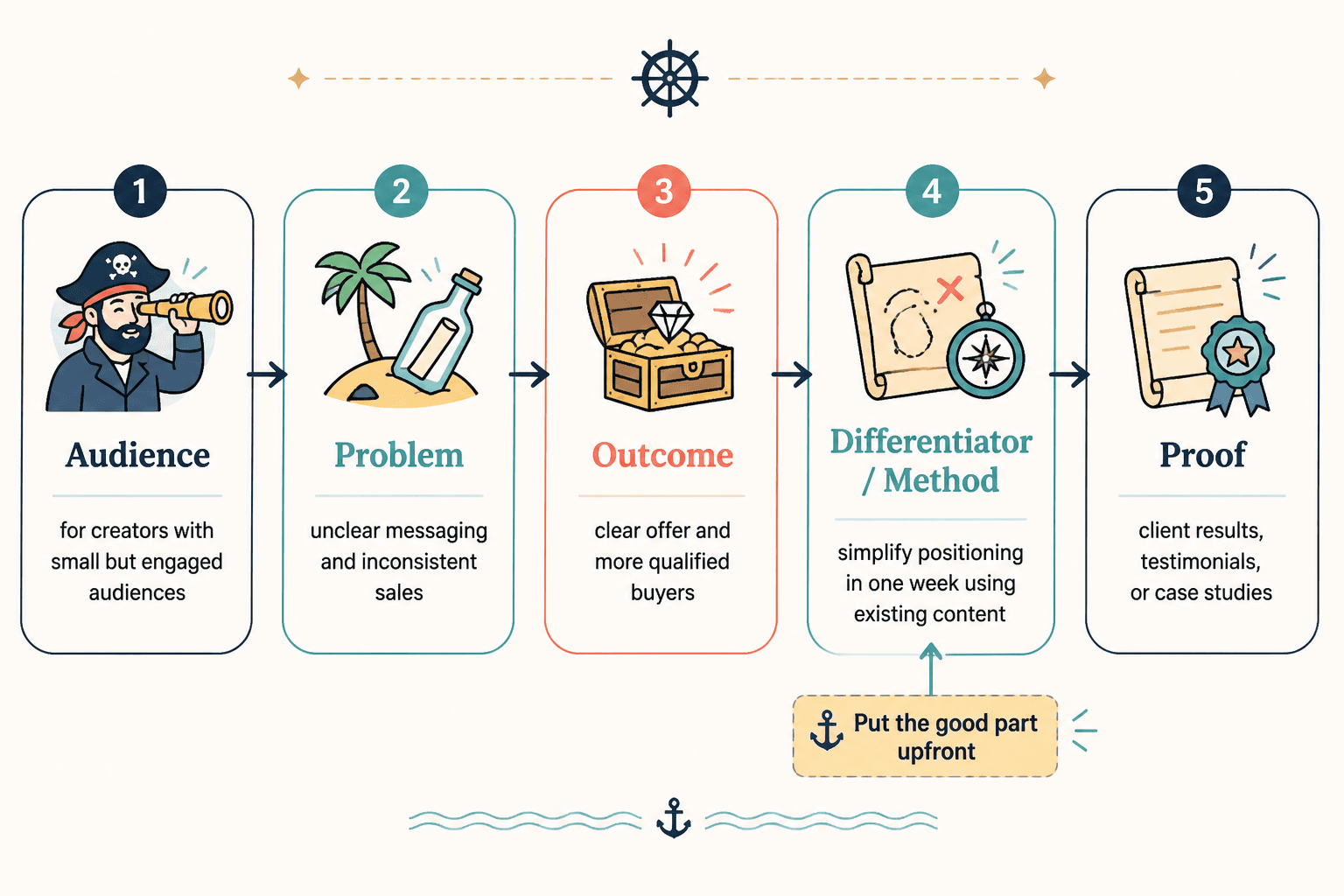
When the copy is getting wobbly, this structure usually helps:
- Audience: who it is for
- Problem: what is not working
- Outcome: what changes
- Differentiator: how the offer approaches the problem
- Proof: what makes the claim feel believable
That is enough to write a clear positioning statement without wandering into brochure fog.
Simple formula: I help [specific audience] solve [specific problem] so they can get [specific result] using [method, angle, or differentiator].
Not glamorous. Useful, which is better.
Example of the formula in action
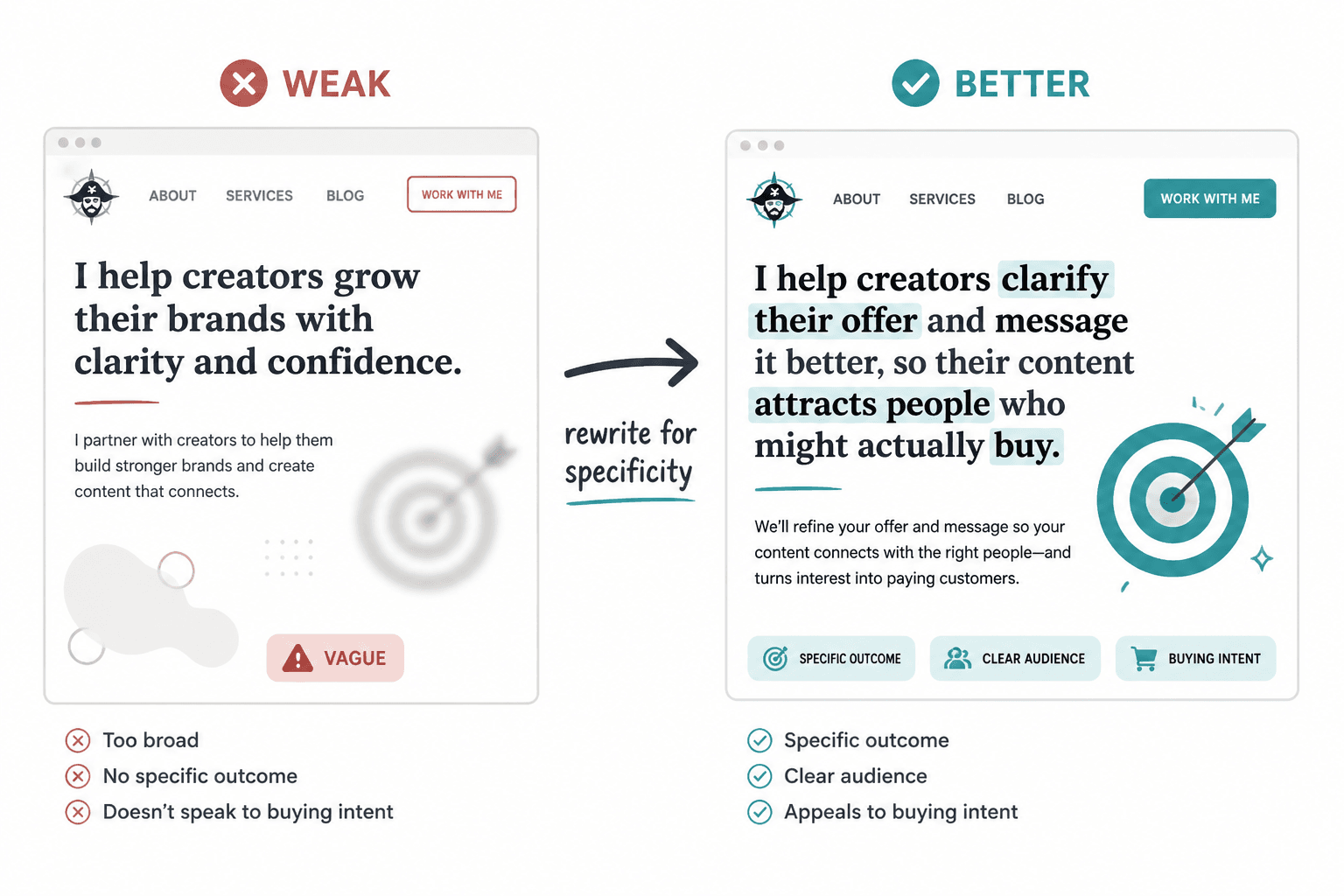
Vague: I help creators grow their business with better copy.
Clearer: I help solo creators tighten their homepage and offer messaging so more of the right visitors understand what they do and why it matters.
Why the second version works better:
- It names the audience more clearly.
- It says what part of the business is being improved.
- It focuses on understanding, not just growth.
- It sounds specific enough to be remembered.
That is the recurring pattern in better offer positioning: fewer abstractions, more conditions.
What makes offer statement examples worth adapting
Not every example deserves to be copied. Some are too polished to be useful, which is a polite way of saying they are decorative. The best examples do three things well:
- they show structure, not just style;
- they use plain language the reader can reuse;
- they make the specific audience obvious.
If an example sounds impressive but could fit ten different businesses, it is not doing much work.
Offer statement examples creators can adapt fast
These examples are intentionally simple. They are meant to be adapted, not admired from a safe distance.
For coaches
- General: I help overwhelmed founders turn scattered goals into a simple weekly plan they can actually follow.
- More positioned: I help early-stage coaches who keep overthinking their next move get clear on the offer, message, and next best action.
- Sharper: I help service-based creators stop rewriting their offer every month and build a message they can stick with long enough to sell it.
What changed: each version gets more specific about the audience and the problem. “Get clarity” is not enough on its own; everybody says that while hiding from the details.
For consultants
- General: I help businesses improve their messaging and conversion strategy.
- More positioned: I help small teams fix unclear website copy so visitors understand the offer faster and take the next step with less hesitation.
- Sharper: I help consultants and founders turn expert-level services into clearer website messaging that sells without sounding salesy.
What changed: the strongest version points at the real friction: unclear messaging, not a vague “strategy” problem.
For writers and copywriters
- General: I write copy that helps businesses grow.
- More positioned: I write homepage and offer copy for creators who need to explain what they do without turning the page into a corporate fever dream.
- Sharper: I help personal brands and creative businesses say what they sell, who it is for, and why it matters in a way people can actually follow.
What changed: the offer now names the pages, the audience, and the communication problem. That is enough to be useful.
Problem framing examples that sharpen the offer
Positioning often gets clearer when the problem is framed better. A lot of weak messaging describes the topic, not the tension. These examples shift the language toward the real friction.
1. “You are doing the work, but not getting the result”
Weak: You need better marketing.
Stronger: You are posting, publishing, and showing up consistently, but the message is still too broad for the right people to see themselves in it.
This version tells the reader the effort is not the issue. The message is.
2. “It is not just X, it is Y”
Weak: Your homepage copy needs work.
Stronger: It is not just that the homepage copy is clunky. It is that the offer is being described in a way that makes the right person do extra interpretation work.
That second sentence does more diagnostic work without becoming a lecture.
3. “Stuck between”
Weak: You need a better offer.
Stronger: You are stuck between sounding too vague to attract buyers and too specific to feel safe saying out loud.
That is a real positioning tension for many creators. Mildly annoying. Very common.
4. “Looks like X, actually causes Y”
Weak: Your messaging is inconsistent.
Stronger: What looks like inconsistent messaging is often just one offer trying to speak to too many problems at once.
This one is useful because it reframes the symptom as a strategy issue.
What to borrow, what to ignore
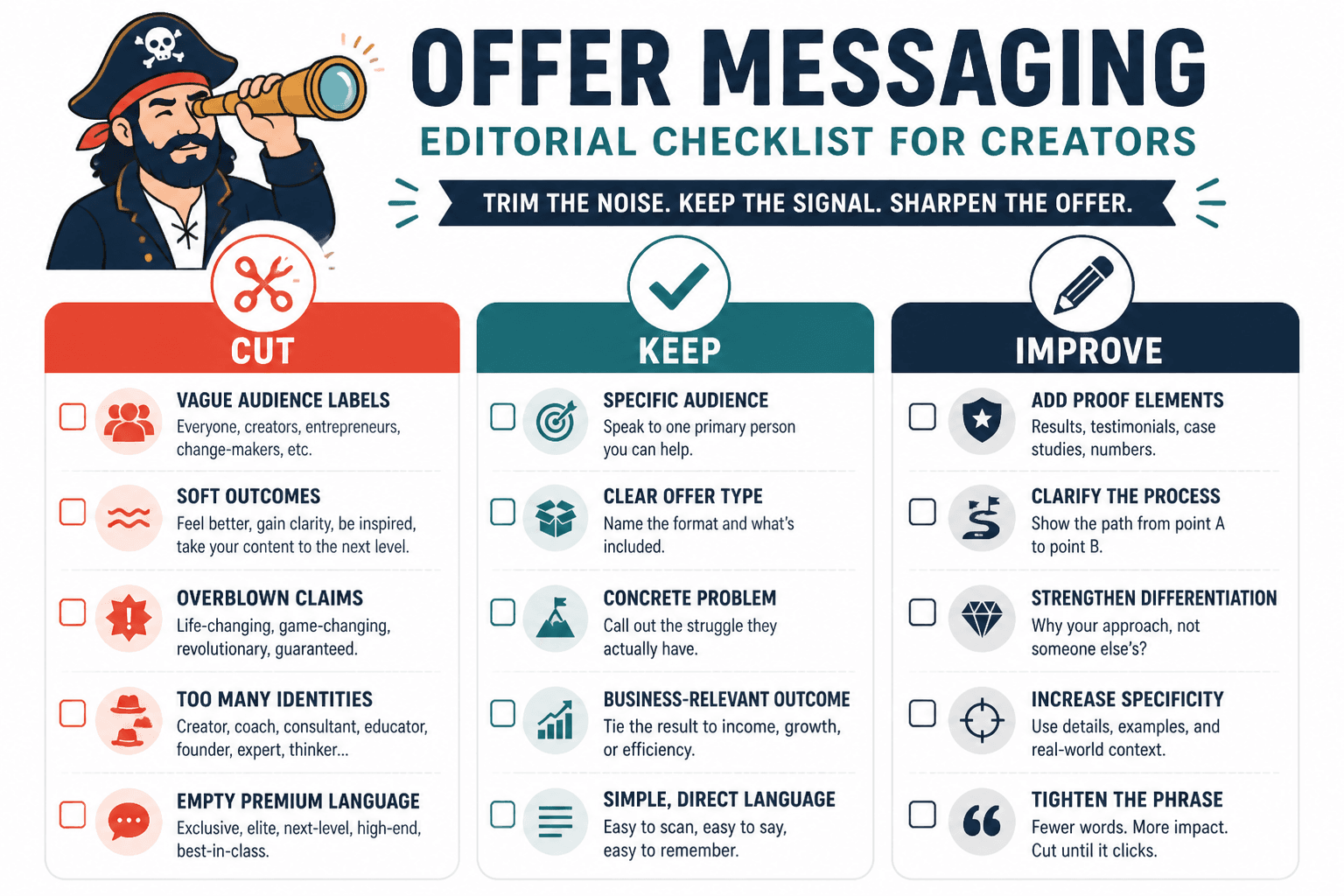
Borrow the shape of the example, not the exact nouns unless they truly fit your offer.
- Borrow: the audience/problem/outcome structure
- Borrow: the habit of naming a concrete friction point
- Borrow: clear, plain wording over clever phrasing
- Ignore: filler like “transform,” “elevate,” and “unlock” unless the rest of the sentence earns it
- Ignore: broad promises that could apply to every competitor in a three-mile radius
Good positioning does not need to sound original at the sentence level. It needs to sound specific enough that the right person recognizes themselves immediately.
Fast checklist before publishing
Before you ship the page, run the copy through this list:
- Can a visitor tell who this is for in one scan?
- Does the problem feel concrete, not generic?
- Does the outcome sound believable?
- Is there a clear difference between this offer and a vague “I help people grow” claim?
- Have you removed any sentence that repeats the same idea in softer language?
If two lines mean the same thing, keep the stronger one and send the other into the compost.
Use these examples as a starting point, not a script
The point of offer messaging examples is not to hand you a ready-made voice. It is to make the structure visible so you can write something that fits your actual offer instead of a generic best-practice smoothie.
For the bigger strategy behind all this, see the parent guide on offer messaging and positioning. If you are also building out the surrounding page copy, the sibling template articles can help with problem framing and offer statements once they are in play.
When the message gets sharper, the rest of the page usually stops arguing with itself. A small mercy.