
A draft sits open with a half-formed opinion in line one, three possible endings in the notes app, and a vague feeling that the post is either too soft or one sentence away from starting a fight. That is the normal stage of the work. The useful part is not making the rant louder. It is giving it shape.
Examples help because they show the shape. They turn “I have something to say” into a post that actually holds attention long enough to land the point. If you want the broader system around this, start with how to write better Facebook long-form and rants, then use this page for ideas, templates, and examples you can adapt fast.
What a strong Facebook long-form example needs to do
A good Facebook rant is not just “an opinion with extra sentences.” It needs a clear job:
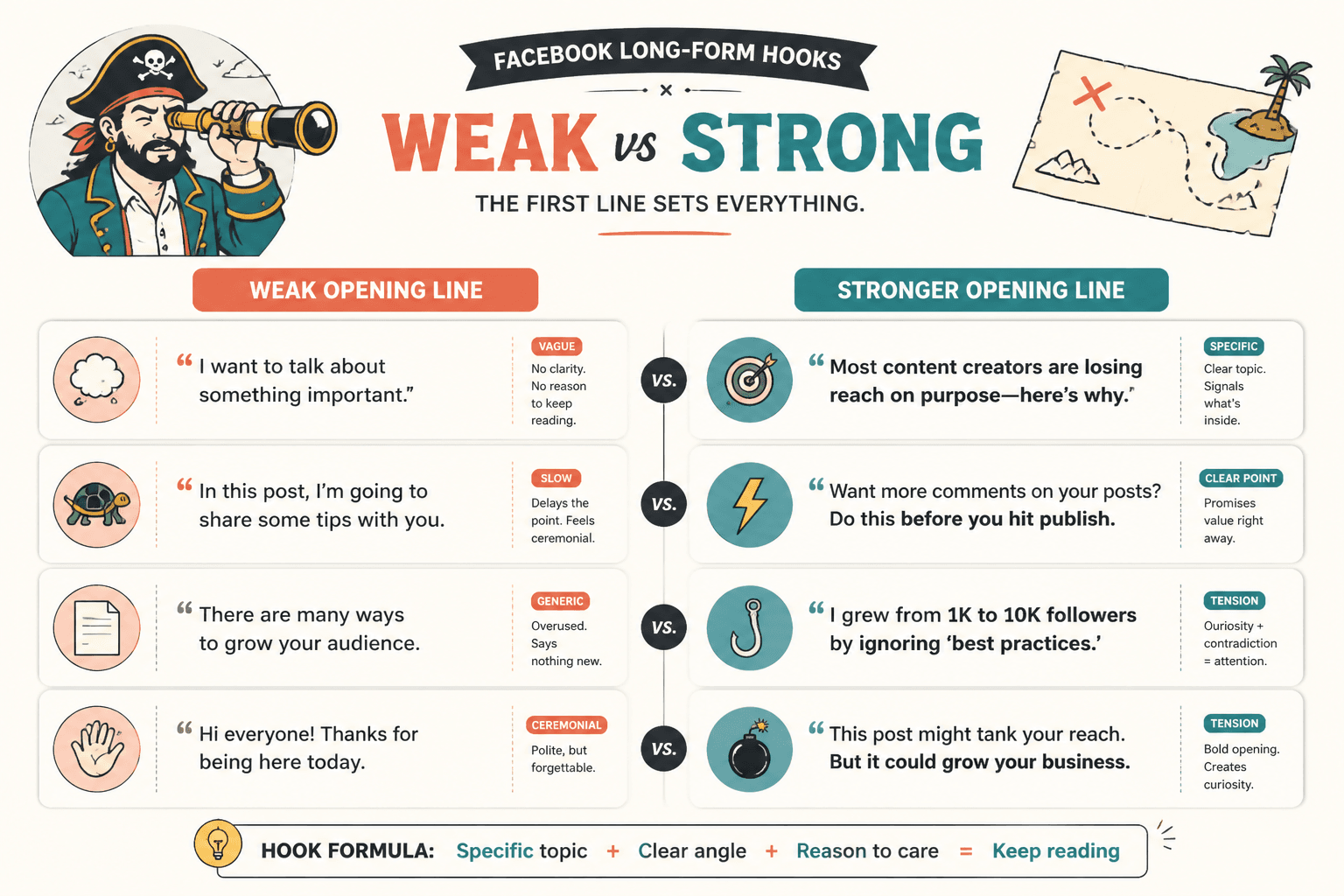
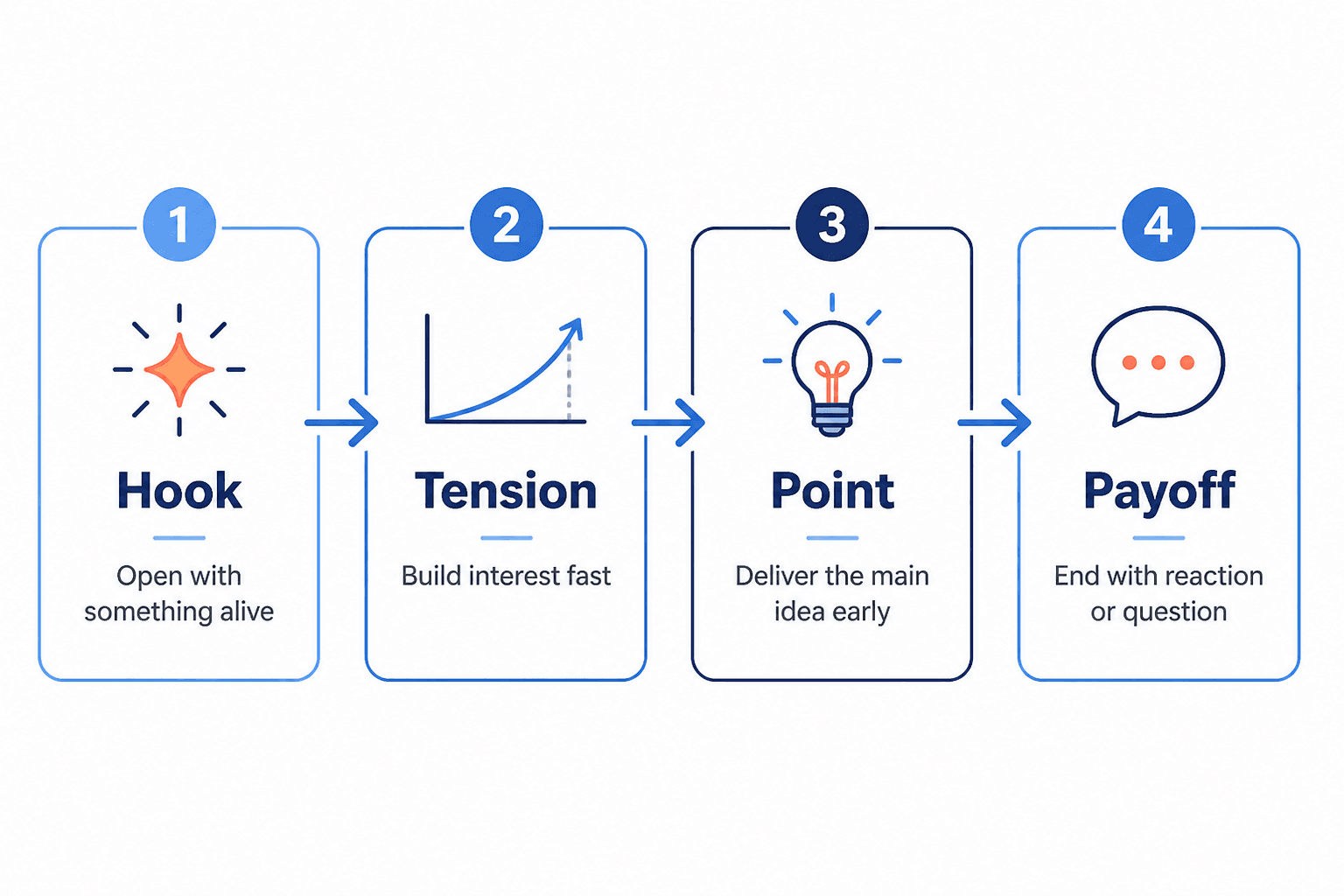
- Hook fast without sounding fake-mysterious.
- Build tension so the reader understands why the point matters.
- Land a clear takeaway instead of wandering off into decorative frustration.
- End with something usable such as a question, a boundary, a lesson, or a practical next step.
That is why the best examples usually feel specific. They name a situation, a pattern, or a bad habit readers already recognize. They do not try to cover every possible angle. They pick one.

7 Facebook long-form and rant examples creators can adapt fast
1. The blunt opinion hook
This one opens with a clear claim and moves straight into the reason behind it. It works when you want to sound confident without getting theatrical.
Template: “Unpopular take: [position]. Here is why.”
Example: “Unpopular take: your audience does not need a motivational speech every time you post. They need a clear point, a real example, and one thing worth thinking about after they scroll away.”
Use this when the point is sharp enough to stand on its own. It is especially useful for creators writing on process, content quality, or common mistakes.
2. The “this happened” tension post
This version starts with a concrete scene. It reads like a live problem, not a polished thesis. That makes it easy to follow.
Template: “A draft is doing X, the audience is doing Y, and the gap is causing Z.”
Example: “A draft is sitting in one tab, a half-finished hook is sitting in another, and the post is somehow supposed to become persuasive before lunch. That is usually where the idea stops being a content idea and becomes a clarity problem.”
It works well for creators writing about friction, workflow, or lessons learned from a messy process.
3. The callout post
This one names a common habit that keeps making posts weaker than they should be. The trick is to call out the behavior, not the people.
Template: “The usual mistake is [pattern]. What actually works is [better pattern].”
Example: “The usual mistake is trying to make a Facebook post impressive. What actually works is making it easy to follow. Readers do not need a performance. They need a path.”
This is a strong format for education, coaching, and personal brand writing because it creates contrast immediately.
4. The unpopular truth post
This format leans on tension without becoming melodramatic. It works best when the point is simple, direct, and slightly annoying in a useful way.
Template: “The hard truth is [statement]. The reason is [brief explanation].”
Example: “The hard truth is that long-form posts do not fail because they are long. They fail because the first two lines do not earn the third.”
That kind of line is useful because it gives the reader a clean mental pivot. It says, “Stop worrying about the wrong thing.”
5. The contrast post
Contrast is one of the easiest ways to create momentum. You put two ideas side by side and let the difference do the work.
Template: “People think [common belief]. In practice, [real version].”
Example: “People think a strong Facebook rant starts with volume. In practice, it starts with a clean point and a reason the reader should care.”
Use this when you want a post to feel crisp, editorial, or quietly corrective.
6. The story-driven rant with a lesson
This one starts with a mini-story and ends with the lesson the story is carrying. It is usually less confrontational and more durable over time.
Template: “Here is what happened. Here is what it showed. Here is what I’d do differently now.”
Example: “A post can look clever in the draft and still fail once it meets actual readers. Usually the issue is not effort. It is the missing bridge between the opening line and the point.”
This format is useful when you want the post to feel lived-in without pretending to be a memoir.
7. The boundary-setting post
Boundary-setting posts are useful when you want to attract the right readers and gently repel the wrong ones. The point is not to be combative. The point is to be clear.
Template: “I do not do [thing]. I do [better fit].”
Example: “I do not write Facebook posts to sound impressive. I write them so the right reader can tell, quickly, whether the idea matters to them.”
This kind of post works well for coaches, consultants, and personal brands that need a stronger filter.
If you want more examples built specifically for positioning and credibility, the sibling page on Facebook long-form rants for leads and sales fits right next to this one.
Simple pacing templates you can reuse
Good examples are easier to write when the pacing is already decided. These templates keep the post from wobbling.
1. Moment → meaning → question
- Moment: what happened or what you noticed
- Meaning: why it matters
- Question: what the reader should think about next
Best for: reflection posts, observations, and lighter rants that still need a point.
2. Complaint → why it happens → better way
- Complaint: the frustration or pattern
- Why it happens: the cause underneath it
- Better way: the replacement or fix
Best for: creator education, process posts, and practical advice.
3. Setup → tension → turn → takeaway
- Setup: the scene or premise
- Tension: what makes it messy
- Turn: the shift in understanding
- Takeaway: the useful point
Best for: story-led posts that need a cleaner arc.
4. Blunt opinion → support → example → close
- Blunt opinion: the claim
- Support: the reason it is true
- Example: a concrete scenario
- Close: a question, takeaway, or final punch
Best for: posts that need authority without sounding bloated.
If you want more hook-specific options before you build one of these, the hook companion piece on Facebook long-form hook examples should be the next stop once that page is live. Until then, keep the opening line doing real work and avoid the vague motivational fog machine.
Ending options that keep the post moving
A strong ending does not need to be dramatic. It just needs to feel like a real finish.
- Question ending: invites conversation without begging for it.
- Boundary ending: makes the position clearer.
- Lesson ending: names the takeaway in plain language.
- Challenge ending: asks the reader to notice or try something.
- Line-in-the-sand ending: closes with a strong stance.
Examples:
- “What part of this keeps showing up in your own drafts?”
- “That is the difference between a rant and a useful post.”
- “The goal is not more noise. The goal is a clearer point.”
The ending should match the tone of the piece. A calm teaching post does not need a hammer. A sharp rant does not need an inspirational group hug.
Quick editing checklist for Facebook long-form examples
Before you publish, run the post through this list:
- Does the first line create a real reason to keep reading?
- Can a reader tell what the post is about by the second or third line?
- Is there a visible point, not just a cloud of frustration?
- Does every paragraph push the post forward?
- Is the ending doing something useful?
- Would this still make sense if someone found it a week later?
That last one matters more than it sounds like it should. Facebook posts can age surprisingly well when they are about a pattern, not just a mood.
For a broader content system around this, the parent guide on Facebook long-form rants is the best home base. If you are choosing tools or workflows to produce these faster, the related guide on AI tools for Facebook long-form rants may be useful too.
Where these examples fit in the bigger Facebook writing stack
Examples are the middle layer. They sit between strategy and execution. The parent guide explains the overall approach. This page gives you usable shapes. Other sibling pages cover hooks, pacing, and lead or sales uses.
Used together, the pieces do a simple job:
- write the post better
- open stronger
- pace the middle cleanly
- end with something that lands
If the draft still feels mushy after that, the issue is usually not inspiration. It is structure.
Final take
The best Facebook long-form examples are not the loudest ones. They are the ones with a clear hook, a clean middle, and an ending that knows what job it has. Once you have a few reliable structures, the blank page gets less annoying and the post gets more useful. A rare win for everyone involved.