
The usual mistake is thinking a Facebook rant becomes strong the moment it gets louder. It does not. Loud without structure is just decorative frustration. The posts people actually read tend to do something much less glamorous: they move from friction to point, with enough shape that the reader can follow the thought without needing a rescue team.
That is the practical frame for this guide. Facebook long-form works when it turns a strong reaction into a readable argument, a useful story, or a controlled rant with a landing. If you want the broader system behind that, the Facebook long-form rants parent guide is the right hub. This article focuses on writing the post itself.
What Facebook long-form and rants are actually good for
Facebook is still one of the better places to publish a post that needs a little room. Not because people have infinite attention, obviously, but because the platform still tolerates personality, context, and a point of view. A good long-form post can do a few useful jobs:
- explain a position without flattening it into a slogan;
- tell a story that carries a lesson;
- turn a complaint into something readable and memorable;
- show judgment, not just volume;
- invite conversation without begging for engagement.
That last one matters. A good rant is not engagement bait in a sarcastic hat. It is a post with enough shape that someone can react to the actual idea, not just the fact that the writer had feelings before breakfast.
If you want ideas or examples first, the sibling piece on Facebook long-form and rant ideas and examples is the better place to start. If you are writing for outcomes beyond likes, the guide on Facebook long-form rants for leads and sales covers that angle.
The biggest mistake: confusing emotion with structure
Emotion helps. It gives the post heat. But heat is not a structure. A post can feel passionate and still read like a pile of unsorted thoughts. That is usually where Facebook rants go wrong: they start with a true feeling, then repeat it six different ways and call that momentum.
The fix is not to dampen the feeling. It is to give the feeling a job.
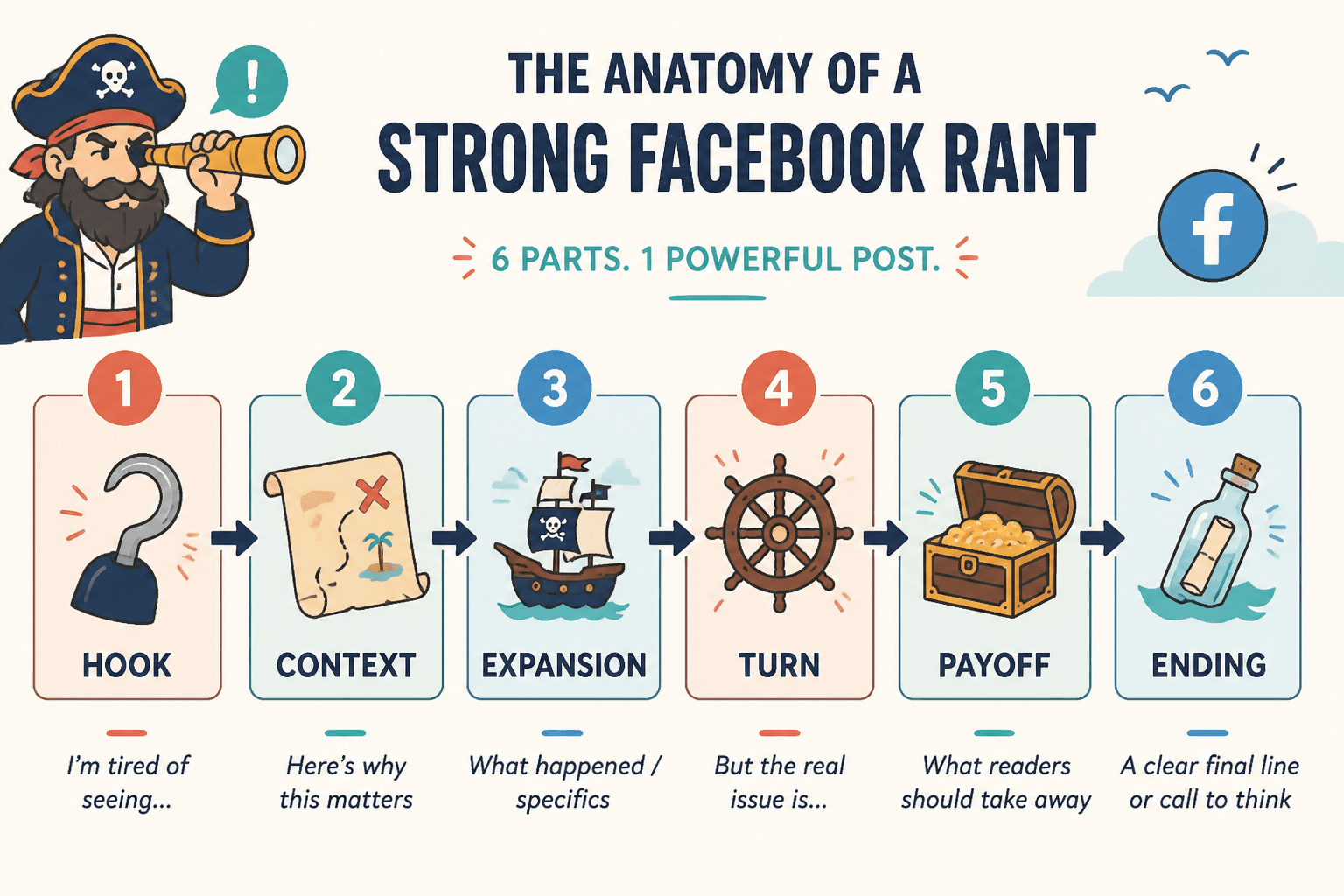
- Friction tells the reader what feels off.
- Context explains why it matters.
- Expansion adds detail, proof, or examples.
- Turn reveals the real point.
- Ending lands that point instead of wandering off.
That shape keeps the rant from becoming a mood with line breaks.
How to structure a Facebook long-form post so people actually read it
The simplest reliable structure is this:
- Start with the friction.
- Build the case, not just the mood.
- Escalate with control.
- End with a point, not a fade-out.
1. Open with the friction
The opening should make the problem visible fast. Do not spend three paragraphs warming up to the issue. Say what is off, what broke, or what annoyed you enough to write the post in the first place.
Good friction feels concrete:
- the pattern you keep seeing;
- the assumption that keeps showing up;
- the awkward outcome nobody wants to name;
- the mismatch between what people say and what they do.
If the opening needs work, that is not surprising. Openings are their own discipline. The sibling guide on strong Facebook openings goes deeper on that piece.
2. Build the case, not just the mood
After the opening, the post needs evidence of thought. That can mean an example, a comparison, a short sequence of events, or a simple explanation of why the issue matters.
What does not work well is repeating the same sentence in slightly different clothing. That is not emphasis. That is a loop.
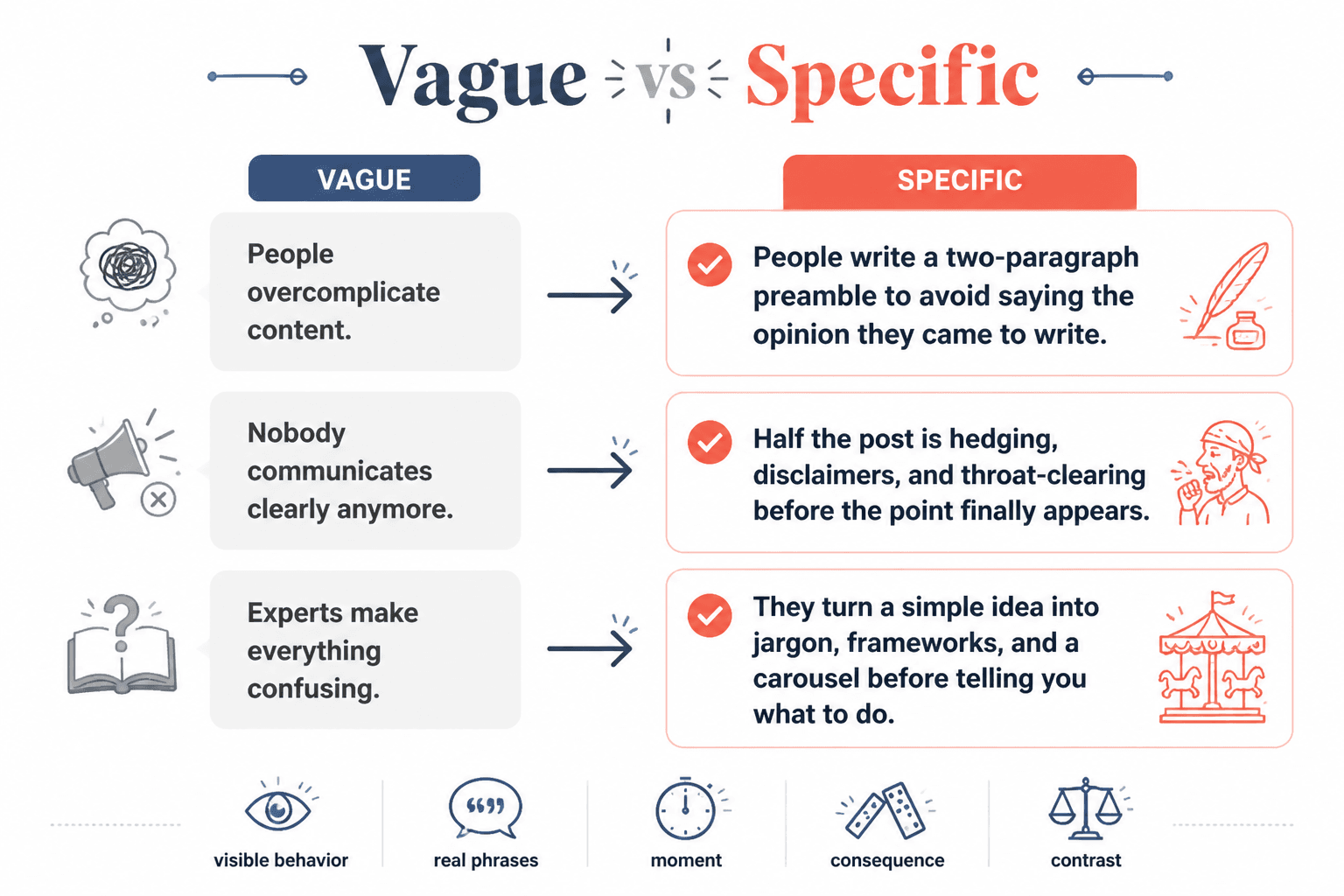
Specificity does the heavy lifting. “People are fake” is fog. “People praise consistency and then disappear the second the work gets boring” is a claim the reader can actually picture. One is a complaint. The other has teeth.
3. Escalate with control
A good rant does not stay flat. It builds. But the escalation should come from sharper observation, not from adding more adjectives until the sentence starts sweating.
Useful escalation might look like this:
- from a single example to a wider pattern;
- from a pattern to the cost of that pattern;
- from the cost to the larger point.
That keeps the post moving. It also keeps the reader from feeling like they were trapped inside one emotional temperature for 900 words.
A useful question while drafting: What new thing does this paragraph add? If the answer is “more intensity,” the paragraph is probably not earning its place.
4. End with a point, not a fade-out
The ending is where a lot of long-form Facebook posts quietly collapse. The writer has the energy to begin, the middle is passable, then the final paragraph turns into a shrug with punctuation.
A stronger ending usually does one of these:
- states the point plainly;
- opens a real question for discussion;
- lands a takeaway the reader can remember;
- makes a soft invitation to respond or reflect.
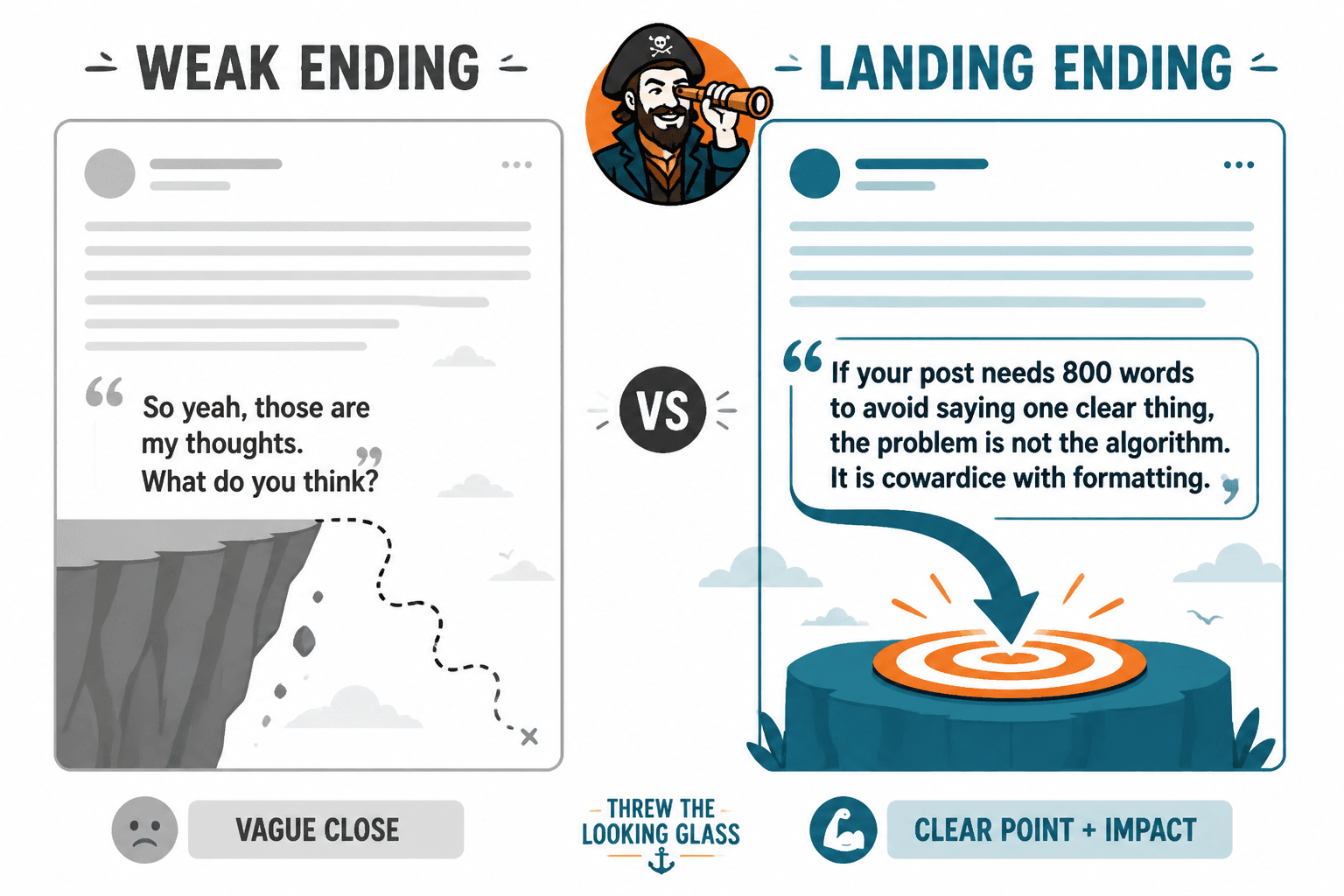
If endings are where your posts tend to leak energy, the sibling guide on strong endings for personal brands is worth keeping nearby. It covers the difference between a post that lands and one that wanders out of frame.
What makes a rant good instead of unbearable
A good rant is not less opinionated. It is more disciplined.
That usually means four things are working together:
- One main target. The post knows what it is really about.
- Concrete language. It uses examples instead of misty generalities.
- Readable pacing. It does not bury the point under endless throat-clearing.
- A landing. It ends with something settled, not just exhausted.
Here is the difference in plain terms: a bad rant wants to discharge emotion. A good rant uses emotion to move a thought somewhere useful.
That does not mean every post has to be polished and clinical. Some friction belongs in the writing. But the friction should feel deliberate, not accidental.
A simple editing checklist for tightening your post
Before publishing, check the draft against this list:
- Does the first line show the friction quickly?
- Does each paragraph add something new?
- Are broad claims anchored in a specific example?
- Is there one clear main point?
- Does the ending land instead of fading?
- Does the tone sound human, not staged?
If you want a cleaner system for editing, the sibling article on not sounding salesy or robotic is useful here. It is especially good for posts that start sounding like a webinar in disguise.
For a broader maintenance mindset, how long Facebook long-form and rants should be is the companion piece on length decisions.
Length, tone, and CTA notes
Length should follow purpose. A post that makes one strong point does not need to imitate a keynote speech. A more complex story or argument may need room, but room is not a virtue by itself.
As a rule:
- shorter works when the point is immediate;
- longer works when the context really earns it;
- the best post length is the one that stops after the point is complete.
Tone matters just as much. Facebook long-form usually performs better when it sounds like a person with a spine, not a brand voice trying on denim.
If your post is meant to invite comments, make the ending match the post. A question should feel like a genuine continuation of the thought, not a conversion trick dressed as curiosity. The sibling guide on comment CTA mistakes covers the common ways that goes sideways.
Common failure modes to watch for
- The soapbox opener: too much setup, too little point.
- The vague anger loop: the same complaint repeated in different shades.
- The generality problem: every statement is broad enough to be useless.
- The over-explained middle: the post keeps explaining what it already said.
- The limp ending: a decent middle followed by a silent drop.
These are all fixable. Most of them come down to one question: What is this post actually doing for the reader? If the answer is “expressing vibes,” that is not enough. If the answer is “showing a pattern, making a case, or landing a useful thought,” you are closer.
Final practical rule
If you want better Facebook long-form posts and rants, do not start by trying to sound more intense. Start by making the thought easier to follow. Then add feeling where it helps the point, cut what repeats, and give the ending a job.
That is usually the difference between a post that gets scrolled past and one that feels like it had a reason to exist.
If you want the larger map for this topic cluster, return to the Facebook long-form rants guide and work outward from there.