
Most people using AI for content research ask weak questions, then act surprised when they get weak ideas back.
They ask things like “give me content ideas for my brand” or “what should I post about coaching?” and then wonder why the output sounds like it was generated by a polite intern who has never spoken to a real client. The problem usually is not the tool. It is the question gathering.
If you want better creator AI question gathering for personal brands, you need a better pile of raw material before the prompt ever starts. Better questions produce better angles. Better angles produce better content. And better content is what gets attention without making you sound like a laminated thought leader.
This article will show you how to gather the right kinds of questions, organize them, and turn them into useful AI research and ideation inputs for your brand. Not vague “brainstorming.” Actual question categories, practical workflows, and examples you can use right away.
For the broader learning path, visit our parent guide.
Why most creator AI research falls flat
AI is good at expanding, organizing, reframing, clustering, and remixing ideas. It is not especially good at knowing what your audience is quietly worried about unless you tell it. That means the quality of your research depends heavily on the quality of the questions you feed into the system.
What a lot of personal brands do instead is skip straight to ideation. They ask for hooks, post ideas, lead magnet ideas, carousel ideas, newsletter ideas, thread ideas. Fine. But if the source material is generic, the output will be generic in a slightly cleaner font.
Good question gathering solves that. It helps you collect what your audience actually asks, what they imply, what they misunderstand, what they resist, and what they are trying to decide. That is the stuff AI can help you shape into useful content.
Bad prompts are often just bad research wearing a tool-shaped excuse.
What “question gathering” actually means
Question gathering is the process of collecting real audience questions, implied concerns, objections, decision points, and recurring thought patterns so you can use them as inputs for research and ideation.
That matters for personal brands because your best content usually does not come from trying to sound smart. It comes from answering something your audience is already trying to figure out.
The useful questions are not just “what should I do?” They include things like:
- What is making this feel harder than it should?
- What am I afraid will happen if I do this wrong?
- How do I know if this is worth paying for?
- What do successful people do differently here?
- Why does the usual advice not seem to work for me?
- What should I fix first?
Those are much more valuable than broad content prompts because they reveal stakes, confusion, emotion, and buying intent. Which, conveniently, is also where good content lives.
For a broader foundation, this article fits nicely with the main creator AI research and ideation hub and the more general guide for creators who want better results.
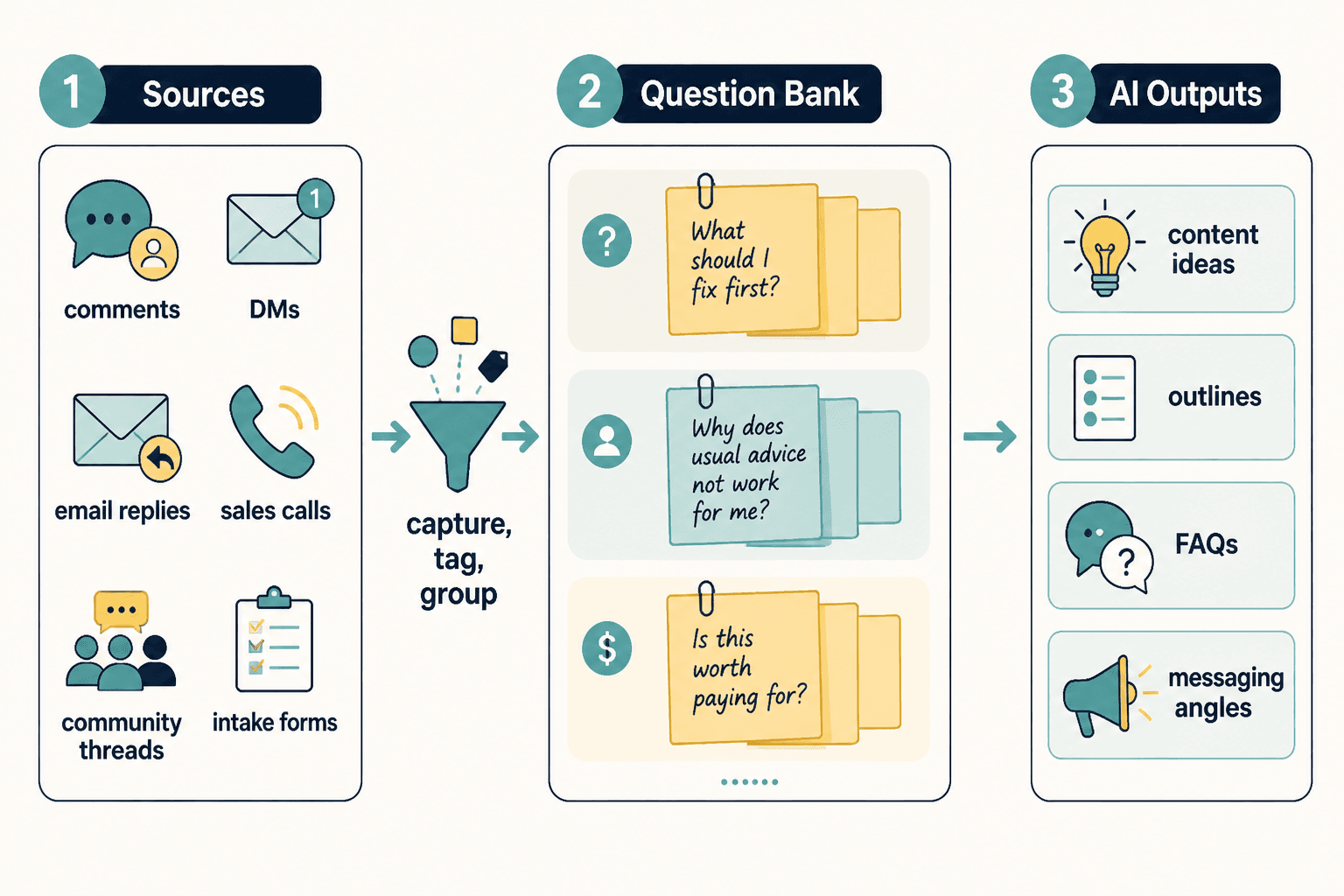
The five question types personal brands should collect
If you only collect surface-level questions, you will only create surface-level content. A better system gathers questions from different layers of audience thinking.
1. Direct questions
These are the easiest to spot. They are the literal things people ask in comments, DMs, sales calls, intake forms, community threads, email replies, and discovery calls.
- How often should I post on LinkedIn?
- What should I put in my bio?
- How do I know if my offer positioning is clear enough?
Useful, but not enough on their own.
2. Implied questions
These sit underneath what people say. Someone asks, “How long should my posts be?” The implied question may actually be “Why is my content getting ignored?” or “Am I doing this wrong?”
This is where better creator AI question gathering for personal brands starts to separate itself from lazy prompting. You are not just collecting the sentence. You are decoding the real concern behind it.
3. Objection questions
These show up before someone buys, books, subscribes, or commits. They are often practical on the surface and emotional underneath.
- Will this work if I do not have a big audience?
- Do I need to be on video for this to work?
- How long before this starts producing leads?
- Is this worth paying for if I can technically do it myself?
If you sell expertise, objection questions are content gold. They help you build trust before the sales conversation starts.
4. Comparison questions
People are constantly trying to choose between methods, tools, platforms, and priorities.
- Should I focus on LinkedIn posts or articles?
- Is a lead magnet better than just sending people to a booking page?
- Should I use AI for drafting or only for research?
This type works especially well for authority-building content because it lets you explain tradeoffs instead of pretending there is one magical right answer.
5. Identity and belief questions
These are deeper. They touch confidence, self-perception, audience fit, and the stories people tell themselves.
- Can I build a personal brand without becoming insufferable?
- Do I need to pick one niche forever?
- Am I too inexperienced to talk about this?
- Will people think I am repetitive if I keep posting about the same thing?
These questions often produce your strongest content because they connect tactics to psychology. People do not just need instructions. They need help crossing the mental friction between knowing and doing.
Where to find better questions
You do not need a giant research budget. You need a repeatable habit of collecting what people are already revealing.
Your own audience channels
- Comments on posts
- DMs
- Email replies
- Discovery calls
- Client onboarding forms
- Sales call notes
- Community discussions
- Newsletter replies
This is your best source because it is specific to your positioning. Fancy research methods are nice. Actual audience language is nicer.
Audience-adjacent spaces
- Relevant Reddit threads
- YouTube comments in your niche
- Podcast episode comments and reviews
- Facebook groups
- LinkedIn post comment sections
- Course reviews in your market
- Amazon book reviews for topic-adjacent books
You are not looking for random noise. You are looking for repeated confusion, repeated goals, repeated complaints, repeated “I thought it would work like this, but…” patterns.
Your own content performance
Sometimes your audience has already told you what they care about through response patterns.
- Posts that got serious comments, not just drive-by likes
- Emails that triggered replies
- Offers that got clicks but no conversions
- Topics people save, share, or ask follow-up questions about
A post with ten thoughtful comments can tell you more than a post with thirty thousand empty impressions. Attention is nice. Signal is better.
How to build a useful question bank
Do not just dump everything into a notes app and call it research. Organize it so AI can actually use it.
A simple spreadsheet, doc, Airtable, Notion database, or even a plain text file can work. What matters is the structure. If you are still figuring out your wider process, you may also want the roundup on best AI tools for creator AI research and ideation.
Use these columns
| Field | What to capture |
|---|---|
| Question | The exact question or paraphrased concern |
| Type | Direct, implied, objection, comparison, identity |
| Source | DM, sales call, comment, email, review, group thread |
| Audience segment | Coach, consultant, founder, freelancer, creator |
| Topic | Content, positioning, lead gen, offers, branding, AI workflow |
| Stage | Beginner, active, evaluating, buying, scaling |
| Emotion | Confused, skeptical, overwhelmed, curious, frustrated |
| Content angle | Myth-busting, tutorial, opinion, case-style breakdown, checklist |
This gives you a research asset instead of a pile of digital lint.
Cluster similar questions together
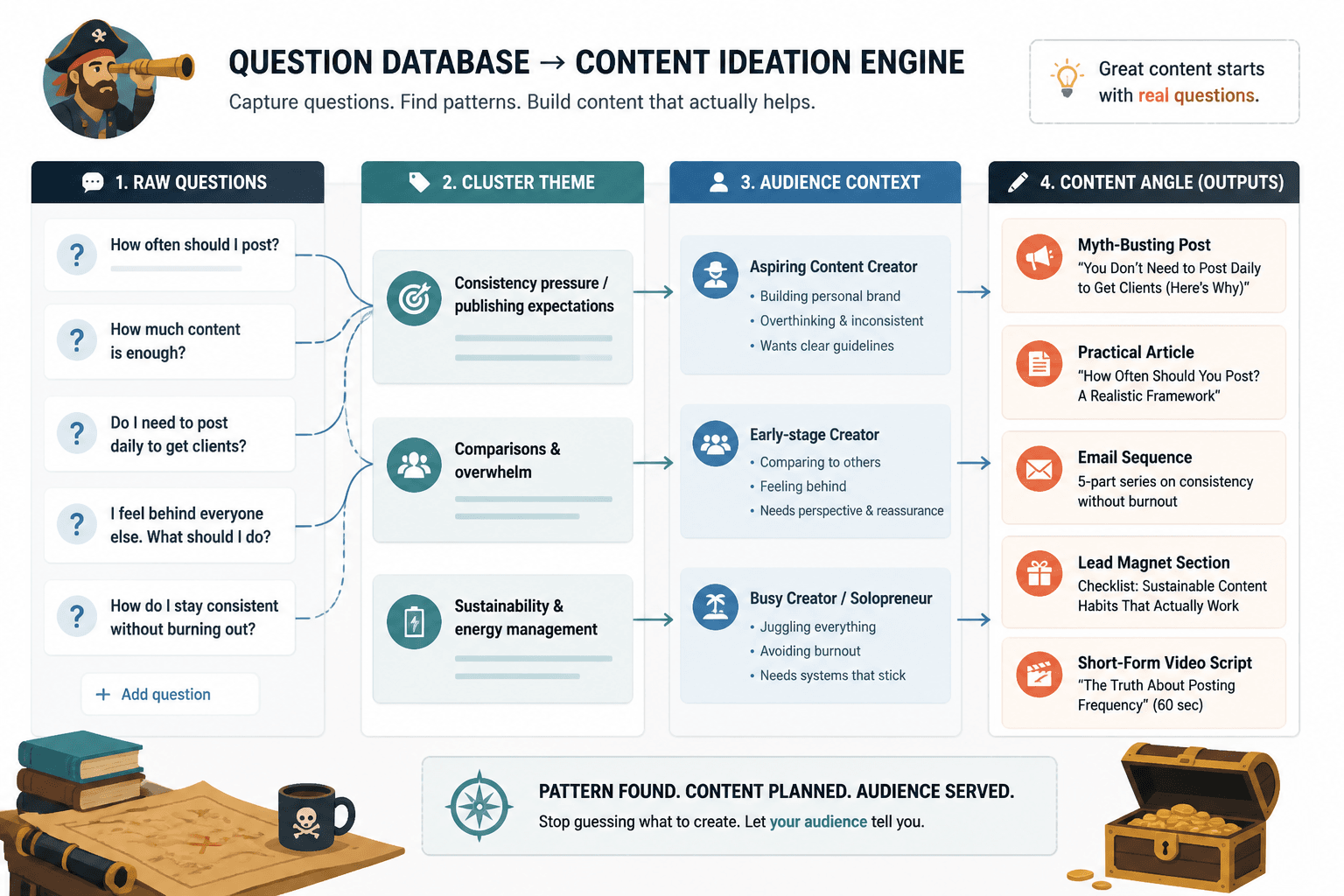
One person asks, “How often should I post?” Another asks, “How much content is enough?” Another asks, “Do I need to post daily to get clients?”
These are not three unrelated questions. They cluster around consistency, visibility pressure, and unrealistic publishing expectations. That cluster can become:
- A myth-busting post
- A practical article
- An email sequence
- A lead magnet section
- A short-form video script
Clustering is what turns question gathering into ideation instead of just note hoarding.
How to turn gathered questions into better AI prompts
Once you have a question bank, do not just paste the whole thing into a tool and ask for “50 content ideas.” That is how you get 50 polished variations of the same forgettable nonsense.
Instead, use the questions with context. Give the AI something to work with beyond topic labels.
Weak prompt
Give me 20 post ideas for my personal brand about AI and content creation.
Better prompt
I help coaches and consultants use AI to improve content research and ideation without sounding generic. Here are 15 real audience questions from comments, sales calls, and DMs. Cluster them into 5 content themes, explain the underlying concern behind each theme, and give me 3 post angles per theme: one practical, one contrarian, and one trust-building.
That is already much better because it includes:
- A specific audience
- A specific promise
- A specific use of AI
- Real source material
- A clear output format
- Angle variety
If you want to sharpen your actual prompt writing, read how to write better creator AI research and ideation. It pairs well with this one because gathering stronger questions is only half the job. Using them well is the other half.
A practical workflow for better creator AI question gathering for personal brands
Here is a simple weekly workflow that does not require turning your business into a research lab.
- Collect: Save 10 to 20 audience questions, comments, objections, or phrasing snippets during the week.
- Label: Tag each one by type, topic, and audience stage.
- Cluster: Group similar questions into 3 to 5 themes.
- Interpret: Write one line about the deeper concern behind each cluster.
- Prompt: Ask AI to create angles, outlines, hooks, FAQs, or content formats from those clusters.
- Refine: Cut anything generic and keep only ideas that sound like your actual brand and actual audience.
- Publish and observe: Track which angles get replies, saves, click-throughs, and qualified conversations.
Then feed that performance back into the next round of research. Good ideation systems improve because they listen, not because they keep demanding novelty every five minutes.
Examples of raw questions becoming useful content angles
Here is where this gets practical fast.
Raw question set 1
- How do I use AI without sounding robotic?
- Can I use ChatGPT for LinkedIn posts?
- Why does AI content always feel off when I use it?
Underlying concern: People want efficiency without losing voice and credibility.
Possible content angles:
- Why AI content sounds generic even when the grammar is perfect
- How to use AI for structure without outsourcing your brain
- The 3 places AI helps my content process and the 3 places I do not let it touch
Raw question set 2
- Do I need a niche before posting consistently?
- What if I have multiple skills?
- Can I build a personal brand without boxing myself in?
Underlying concern: Fear of narrowing too early and making the wrong identity choice.
Possible content angles:
- You do not need one niche. You need one clear relevance bridge
- The difference between messy expertise and confusing positioning
- How to talk about multiple skills without sounding unfocused
Raw question set 3
- Why are my posts getting views but no leads?
- How do I turn content into inquiries?
- Should every post have a CTA?
Underlying concern: People confuse attention with conversion and need a clearer trust path.
Possible content angles:
The bigger point is simple: clearer structure and clearer writing make the piece more useful. That is usually what makes the ending land better too.