
Most creators do not have an AI problem. They have an angle problem.
They ask AI for content ideas, get a tidy list of decent-sounding topics, and then wonder why the posts feel flat, familiar, and weirdly forgettable. The machine gave them output. It just did not give them anything sharp enough to compete with the other 9,000 “helpful” posts drifting through the feed that day.
Creator AI Angle Generation Mistakes That Hurt Performance usually are not dramatic technical failures. They are small strategic mistakes that make your ideas bland before you even start writing. Bad angle generation leads to weak hooks, vague positioning, repetitive posts, low saves, low shares, and content that technically says something but does not really land.
Here’s how to spot the mistakes, fix the process, and get AI to help you produce stronger angles that actually match your audience, expertise, and offer instead of spraying beige sludge all over your content calendar.
To see how this fits into the wider strategy, open the parent guide.
What an angle actually is, because this gets muddled fast
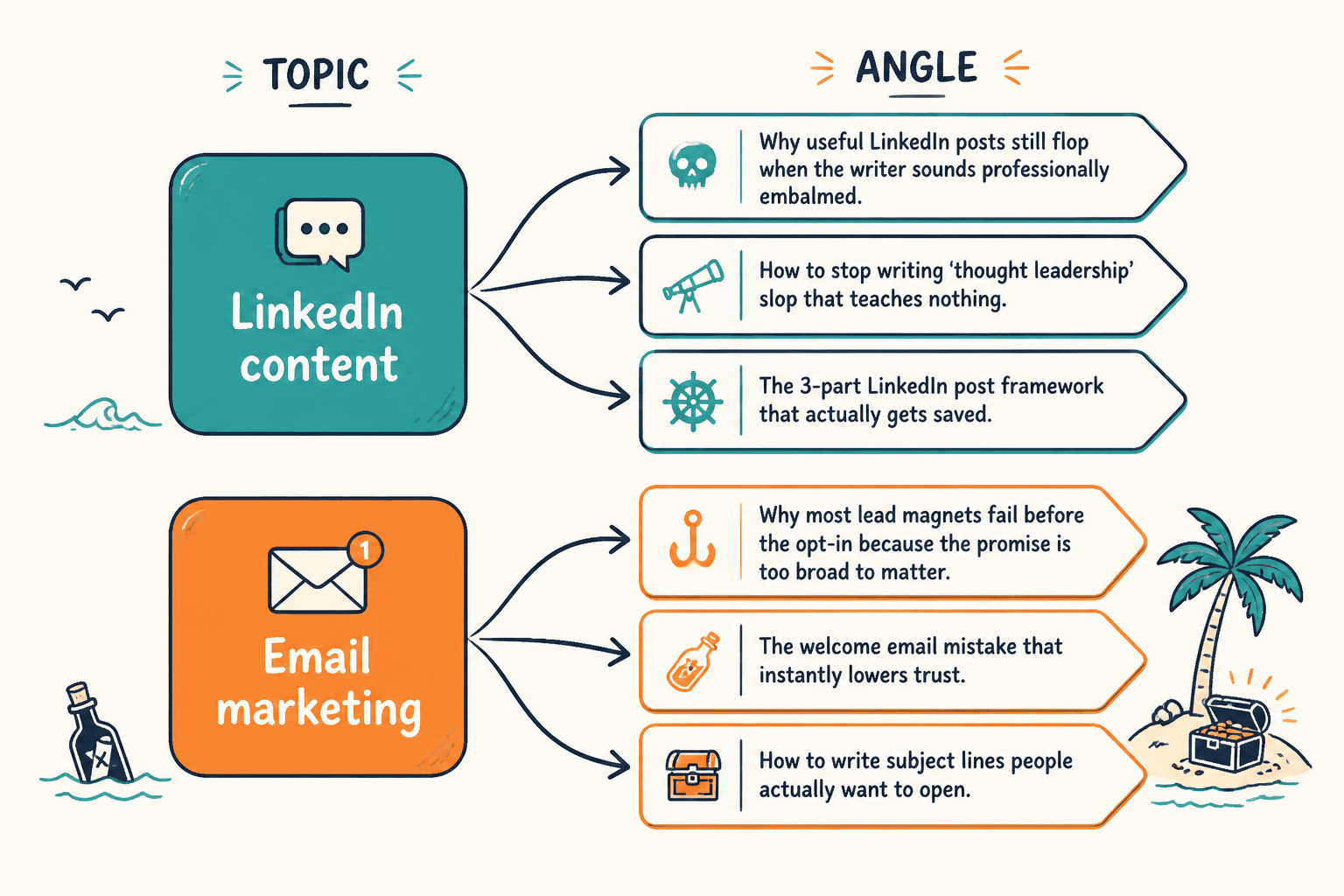
A topic is not an angle.
“LinkedIn content” is a topic. “Why useful LinkedIn posts still flop when the writer sounds professionally embalmed” is an angle. “Email marketing” is a topic. “Why most lead magnets fail before the opt-in because the promise is too broad to matter” is an angle.
An angle gives the idea shape. It creates tension, relevance, and a reason to care now. Without that, AI tends to generate clean, safe, broad ideas that sound marketable but read like someone fed a webinar outline into a copier.
If your ideation process starts with generic topics and never moves into sharp angles, the content will feel generic no matter how polished the final draft is.
The biggest creator AI angle generation mistakes
1. Asking for ideas before giving AI any point of view
This is the classic mistake.
You prompt something like: “Give me 20 content ideas for creators about AI.” AI obediently hands you 20 ideas that sound like every other list on the internet. Not because the tool is broken. Because you gave it no real material to work with.
AI can help you generate angles faster, but it cannot invent your positioning for you. If you do not feed it your audience, your contrarian takes, your proof, your frustrations, your observations, or your expertise, it fills the gap with average internet paste.
Better inputs include:
- Who the content is for
- What they keep getting wrong
- What advice in your niche is overrated
- What patterns you keep seeing in clients or customers
- What beliefs you disagree with
- What outcomes people want but struggle to achieve
- What your offer actually helps with
If you want better outputs, give the machine sharper raw material. Obvious, yes. Rarely done, also yes.
2. Confusing volume with quality
Some creators think a good ideation session means generating 100 ideas in 10 minutes.
That can be useful for exploration. It is not the same as finding strong angles. A giant list of weak ideas is still a weak content plan, just with more scrolling.
Good angle generation is less about raw quantity and more about finding ideas with at least one of these traits:
- Clear tension
- Specific relevance to your audience
- A surprising contrast
- A practical payoff
- Strong opinion backed by experience
- Useful specificity
- Connection to a business goal
If you generate 50 angles and only 4 are strong, that is normal. The goal is not to admire the spreadsheet. The goal is to end up with publishable ideas.
3. Letting AI stay at the “best practices” level
AI loves consensus. Consensus is usually where good content goes to die.
When you ask for angles and accept the first tidy batch, you usually get safe advice:
- How to use AI for content creation
- Benefits of AI for creators
- Tips to streamline your workflow
- Common mistakes to avoid
That is not angle generation. That is a table of contents for a very forgettable ebook.
You need to push past generic best-practice framing and ask for tension, disagreement, tradeoffs, misconceptions, and pattern breaks.
For example, instead of “benefits of AI for creators,” try angles like:
- Why AI speeds up ideation but often weakens differentiation
- The hidden cost of using AI to brainstorm before clarifying audience pain points
- Why creators using AI for idea generation often sound more organized but less memorable
- What happens when AI helps you publish more but think less
Same general topic. Very different level of usefulness.
4. Generating angles with no audience filter
An angle that works for SaaS marketers might flop for solo consultants. An angle that works for beginner creators might feel insultingly obvious to experienced ones.
If your prompts do not specify audience maturity, business model, content goals, and pain points, AI will default to broad middle-of-the-road ideas. Broad usually means easier to generate and harder to care about.
Your prompts should clarify things like:
- Are they beginners, intermediates, or advanced?
- Are they building an audience, leads, authority, or sales?
- Are they creators, coaches, consultants, founders, or freelancers?
- What platform are they posting on?
- What are they frustrated by right now?
The more defined the audience, the more defined the angle can become.
5. Ignoring the difference between topic fit and offer fit
Some angles get attention but do nothing for your business. Others align beautifully with your offer but are too dry to perform. You need both.
One of the more expensive creator AI angle generation mistakes is using AI to generate content ideas without checking whether those ideas build toward the trust, demand, or problem awareness your offer actually needs.
If you sell strategy, but your AI keeps feeding you productivity fluff, you will attract the wrong audience. If you sell implementation, but your angles stay too abstract, people may agree with you and still never buy.
Every angle does not need to pitch. But your idea pool should include angles that naturally support:
- The problem your offer solves
- The mistakes your buyers make before hiring you
- The criteria they should use to evaluate solutions
- The hidden costs of doing it wrong
- The proof that your approach works
If you need help connecting ideation to business outcomes, this guide on turning creator AI research and ideation into more leads or sales is the next logical step.
6. Using AI to imitate what is already overposted
AI is very good at reproducing patterns. That is useful right until those patterns are exhausted.
If your prompts are built around “top-performing posts,” “viral styles,” or “popular content structures,” the results may be optimized for familiarity instead of freshness. Great if your dream is to sound like a content intern wearing someone else’s blazer.
Trend awareness matters. Copying the obvious shape of overused content does not. Better prompts ask AI to identify:
- Underexplored sub-angles
- Common assumptions worth challenging
- Misleading advice in your niche
- Missing nuance in popular conversations
- Contrasts between what sounds right and what works
This is one reason a strong rewrite process matters. If your draft already sounds overfamiliar, this piece on how to rewrite boring creator AI research and ideation helps fix that before you publish another polished snoozer.
7. Treating all angles as equal when some are built for different jobs
Not every content angle should do the same thing.
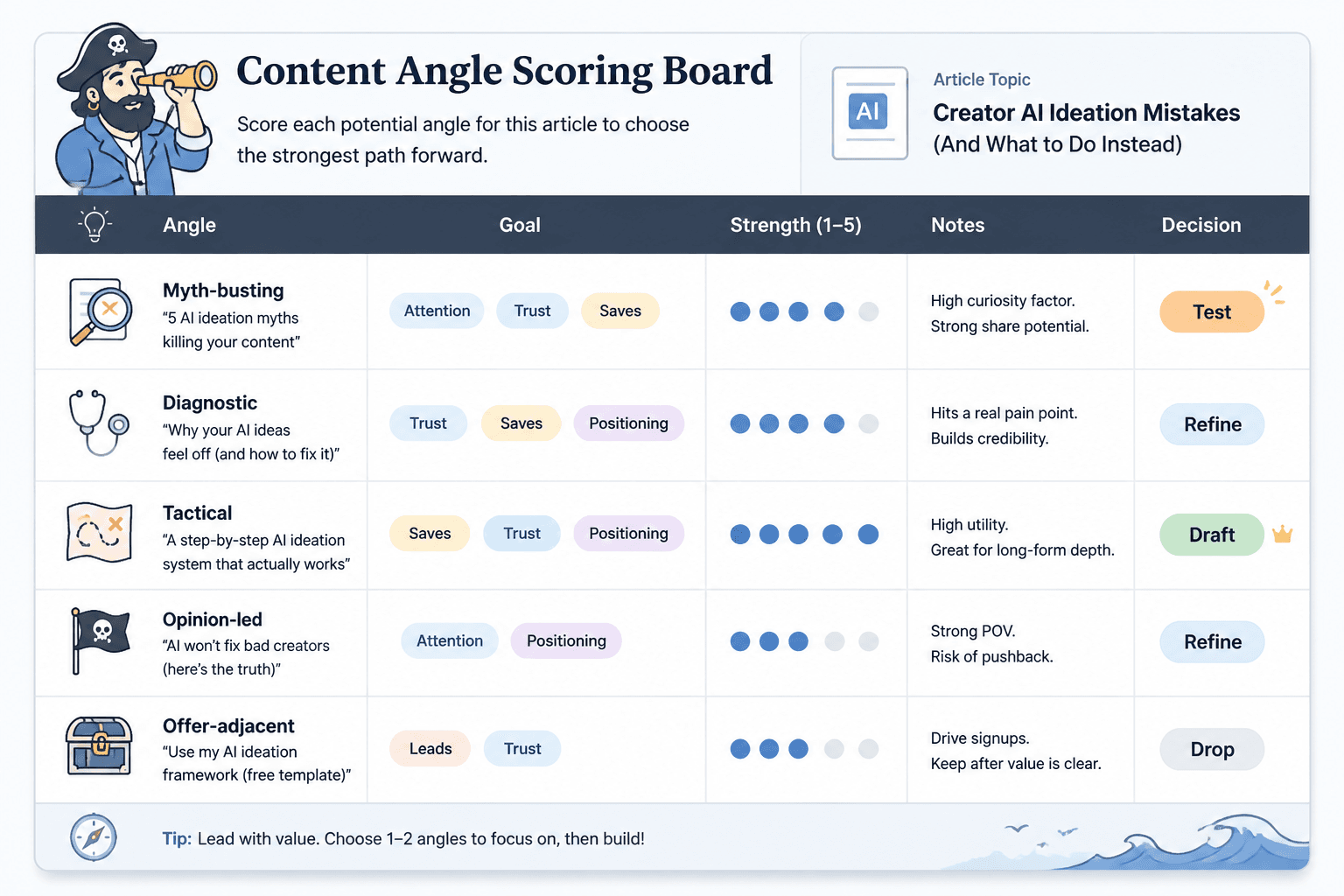
Some angles are for reach. Some build authority. Some start conversations. Some move people toward a sale. If you dump them all into one list with no labels, your content strategy gets sloppy fast.
A cleaner system is to sort AI-generated angles by purpose:
| Angle type | What it helps with | Example |
|---|---|---|
| Myth-busting | Attention and shares | Why more AI content ideas usually lead to worse content |
| Diagnostic | Trust and self-recognition | Signs your AI ideation process is making your content less distinct |
| Tactical | Saves and utility | A 5-step prompt structure for stronger content angles |
| Opinion-led | Positioning and memorability | Why generic AI efficiency advice is overrated for creators |
| Offer-adjacent | Leads and conversions | How weak angle generation attracts the wrong buyers |
Once AI outputs ideas, your job is to sort and refine, not just copy and paste into a scheduler.
8. Not pressure-testing the angle before drafting
This one hurts performance quietly.
Creators often move from AI-generated angle straight into writing. No filtering. No sharpening. No test for whether the idea actually has enough energy to carry a post, article, thread, or email.
Before drafting, pressure-test the angle with questions like:
- Would the right person immediately know this is for them?
- Is there tension, contrast, or a surprising truth here?
- Can I support this with experience, proof, or examples?
- Is this more specific than what people usually post?
- Does this connect to a real business or audience goal?
- Could this become a strong hook without acrobatics?
If the answer is mostly no, the angle needs work. Drafting faster will not save it.
How to generate stronger AI content angles instead
The better workflow is not complicated. It is just more deliberate than “give me 30 post ideas.”
Step 1: Start with friction, not themes
Instead of feeding AI a broad theme, feed it friction points.
Weak starting point: “I write about creator workflows.”
Better starting point: “Creators use AI to generate lots of ideas, but the ideas often sound generic, overlap, and fail to support their offer.”
Friction creates angles. Themes create categories.
Step 2: Give AI strategic constraints
Constraints make angle generation better, not worse.
Useful constraints include:
- Audience type
- Platform
- Offer relevance
- Desired tone
- Content goal
- Things to avoid
- Preferred angle types
For example, ask for angles that are:
- For intermediate creators
- Relevant to LinkedIn posts or articles
- Built around common AI ideation mistakes
- Useful for leads and authority, not empty reach
- Specific, opinionated, and non-generic
If your prompts need work, this guide on improving creator AI research and ideation outline prompts will help you stop getting those suspiciously polished, deeply unhelpful outputs.
Step 3: Ask for angle variations, not just idea lists
Once you have a topic area, ask AI to generate different types of angles around the same issue.
For example:
- A contrarian angle
- A myth-busting angle
- A diagnostic angle
- A tactical angle
- An audience-specific angle
- An offer-adjacent angle
This gives you depth instead of just width. You are not collecting random ideas. You are exploring useful directions.
Step 4: Score angles before you write
You do not need a fancy system. A simple 1 to 5 score works fine across a few criteria:
- Specificity
- Audience relevance
- Originality
- Hook potential
- Business relevance
- Proof potential
If an idea scores low on most of those, do not write it just because it sounds tidy. Tidy is not a content strategy.
Step 5: Rewrite the strongest angle into a sharper working headline
Good angle generation gets better when you force the idea into a more precise statement.
Here are a few before-and-after examples:
| Weak angle | Stronger angle |
|---|---|
| How creators can use AI for ideation | Why AI ideation often gives creators more ideas but fewer good angles |
| Common mistakes with AI research | The AI research mistake that makes your content sound informed but not interesting |
| Tips for better AI prompts | The prompt fix that stops AI from generating polished generic content ideas |
| How to brainstorm faster with AI | Why faster brainstorming is useless if your angles all target the wrong audience |
Notice the difference. The stronger versions have tension. They imply a problem people recognize. They are easier to hook and easier to remember.
A practical prompt structure for better angle generation
If you want AI to help with creator ideation without flattening your thinking, use a prompt structure like this:
The bigger point is simple: clearer structure and clearer writing make the piece more useful. That is usually what makes the ending land better too.