Most creator AI outline prompts are not failing because AI is “bad at structure.” They fail because the prompt itself is a beige mush of vague intentions, broad topics, and no real editorial point of view.
You can ask AI to “create a helpful outline for my audience” all day. You’ll still get the same recycled skeleton: intro, benefits, tips, conclusion, FAQ, done. Technically usable. Creatively forgettable.
If you want to know how to improve creator AI outline prompts without sounding generic, the fix is not adding more adjectives like “engaging,” “high-quality,” or “unique.” AI does not suddenly develop taste because you politely begged for it. The fix is giving it sharper inputs: clearer audience tension, stronger angle, tighter exclusions, better source material, and a much more specific job.
This is where a lot of creators get stuck. They use AI for research and ideation, then wonder why the outline reads like a content intern trying not to get fired. The good news is that outline prompts are very fixable once you know what to change.
Here’s how to make your AI-generated outlines more specific, more useful, and a lot less like they were assembled in a hurry by a machine that just discovered the phrase “best practices.”
For the broader learning path, visit our parent guide.
Why generic creator AI outline prompts produce generic content
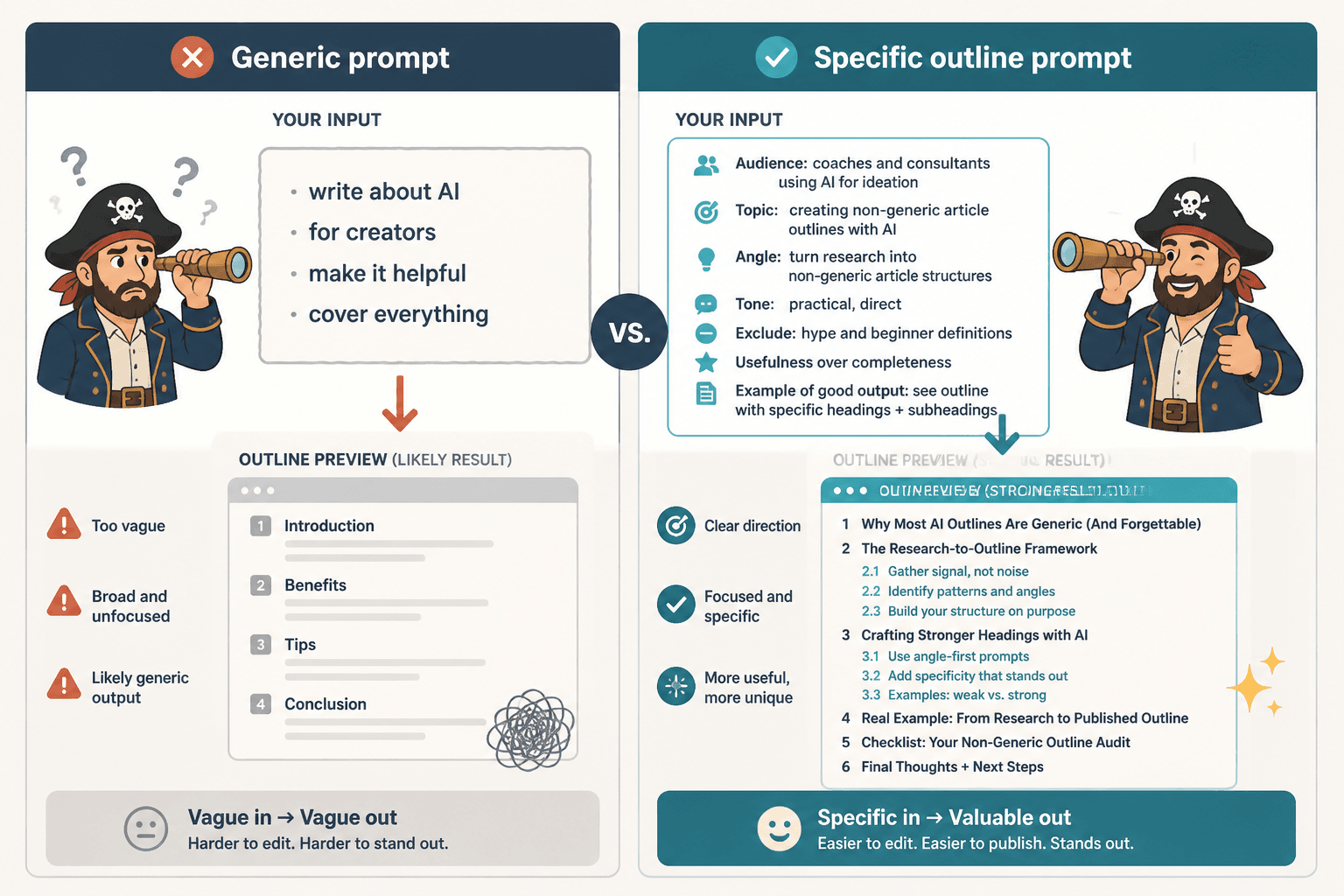
AI outlines usually get generic for one simple reason: the prompt asks for a format before it asks for a point.
Most prompts sound something like this: “Create an outline for a blog post about creator research and ideation for entrepreneurs. Make it helpful, actionable, and SEO-friendly.” That sounds reasonable. It is also an excellent way to get a painfully average outline.
The model fills in the blanks with common patterns. It reaches for the safest structure, the broadest claims, and the most overused subtopics because you did not tell it what to prioritize, what to ignore, or what your actual stance is.
Generic prompts usually have at least one of these problems:
- The audience is too broad
- The topic is too broad
- The angle is missing
- The desired tone is vague and fluffy
- The exclusions are missing
- The prompt asks for completeness instead of usefulness
- The prompt gives no examples of what “good” looks like
If you fix those, the outline quality usually improves fast. Not magically. Just noticeably.
And if you are building a more repeatable workflow around AI writing, it helps to zoom out and tighten your full process, not just the prompt itself. This is where broader AI writing tools and workflows and stronger creator AI workflows start to matter. Better prompts work even better when the surrounding system is not a mess.
What a strong AI outline prompt actually needs
A useful outline prompt gives AI enough context to make decisions, not just enough words to generate text.
That means your prompt should include a few key ingredients before you ask for headings and subheadings.
1. A specific audience
“Creators” is often too broad. A coach, ghostwriter, solo founder, and consultant do not all need the same outline.
Better: “Write for creators, coaches, and consultants using AI to brainstorm article ideas but struggling to turn rough research into non-generic content structures.”
2. A clear problem
Not just the topic. The actual issue underneath the topic.
For example: “They keep getting outlines that are repetitive, broad, and full of filler sections that sound like every other AI-assisted article online.”
3. A sharp angle
This is where the prompt stops sounding like a content request and starts sounding like editorial direction.
Your angle might be:
- Why most prompt advice is too vague to help
- How to get stronger structure without overengineering the prompt
- What details improve outline quality fastest
- How to force specificity into ideation prompts
If the angle is weak, the outline will flatten into generic sections almost every time.
4. Useful constraints
Constraints are underrated. A lot of people think better prompting means adding more freedom. Usually it means adding better boundaries.
Tell AI what to avoid:
- No generic intro about why AI matters
- No filler sections like “common mistakes” unless tied to the main argument
- No vague headings like “best practices”
- No corporate tone
- No repeated points phrased three different ways
5. The job of the outline
An outline can serve different purposes. Search article. Newsletter essay. LinkedIn article. Lead-gen post. Teaching piece. Authority piece. If you do not define the job, AI will produce a generic all-purpose skeleton.
Say what the outline needs to accomplish. For example: “The outline should help readers immediately write stronger prompts and understand why their current prompt structure keeps producing stale content.”
How to improve creator AI outline prompts without sounding generic
Here is the practical part. If your prompts keep producing forgettable outlines, these are the upgrades that tend to matter most.
Start with source material, not just instructions
One of the fastest ways to improve outline quality is to give AI raw thinking before asking for structure.
That can include:
- Your rough notes
- Client questions
- Voice-of-customer phrases
- Contrarian observations
- A short opinionated rant
- Existing post snippets
- Points you absolutely want included
Why this works is simple. AI is much better at shaping material than inventing meaningful specificity from nothing. If you give it richer ingredients, it has a chance to build something worth using.
Weak prompt:
Create an outline for an article about using AI for content ideation.
Stronger prompt:
Using the notes below, create an outline for an article aimed at creators and consultants who use AI for content ideation but keep getting generic article structures. Emphasize that better prompts need sharper inputs, better exclusions, and a stronger editorial angle. Avoid fluffy sections and broad advice. Build an outline that teaches a practical process and includes before-and-after prompt examples.
Give AI an opinion to organize around
A lot of weak prompts ask AI to be neutral. Neutrality is often what makes the result so dull.
Try feeding it a point of view:
- Most AI outline prompts are too broad to produce useful structure
- Prompt quality depends more on specificity than clever formatting tricks
- Creators overfocus on prompt length and underfocus on editorial direction
- AI works better as a structuring partner than an idea oracle
You do not need fake controversy. You just need a real stance. Otherwise the outline defaults to balance, and balance often reads like mush.
Ask for exclusions as aggressively as you ask for inclusions
This is one of the easiest fixes and one of the most ignored.
Most people tell AI what to include. Fewer tell it what to leave out. That is a problem because generic content is usually what happens when the model tries to be broadly complete.
Useful exclusions might look like this:
- Do not include beginner-level definitions unless needed
- Do not repeat the same idea under multiple headings
- Do not use headings like “benefits,” “challenges,” or “tips” unless they are highly specific
- Do not include generic AI ethics filler
- Do not make the outline sound like a SaaS blog
That last one should honestly be taped to half the internet.
Define the desired level of depth
Some prompts accidentally ask for broad coverage when what they really need is selective depth.
If you want a better outline, tell AI how deep to go and where. For example:
- Spend more space on prompt structure than tool comparisons
- Include two rewrite examples and one practical prompt formula
- Focus on article outlines, not social post ideation
- Prioritize steps the reader can use immediately
This gives the outline shape. Without that, AI tends to distribute attention too evenly, which is a nice way of saying it gives everything the same bland weight.
Specify the reading experience
You are not just asking for topics. You are asking for flow.
That means your prompt can instruct AI on how the outline should feel:
- Open by calling out the common mistake
- Move from diagnosis into practical fixes
- Use examples before templates
- End with a simple process the reader can steal
- Keep the structure sharp, not academic
This matters because a good outline is not just a list of boxes. It is a sequence of decisions that helps the reader care long enough to keep going.
If your intros also keep coming out weak, pair this with how to start creator AI research and ideation without a weak opening. Better outlines still need stronger openings than “AI is changing content creation.” Yes, we know.
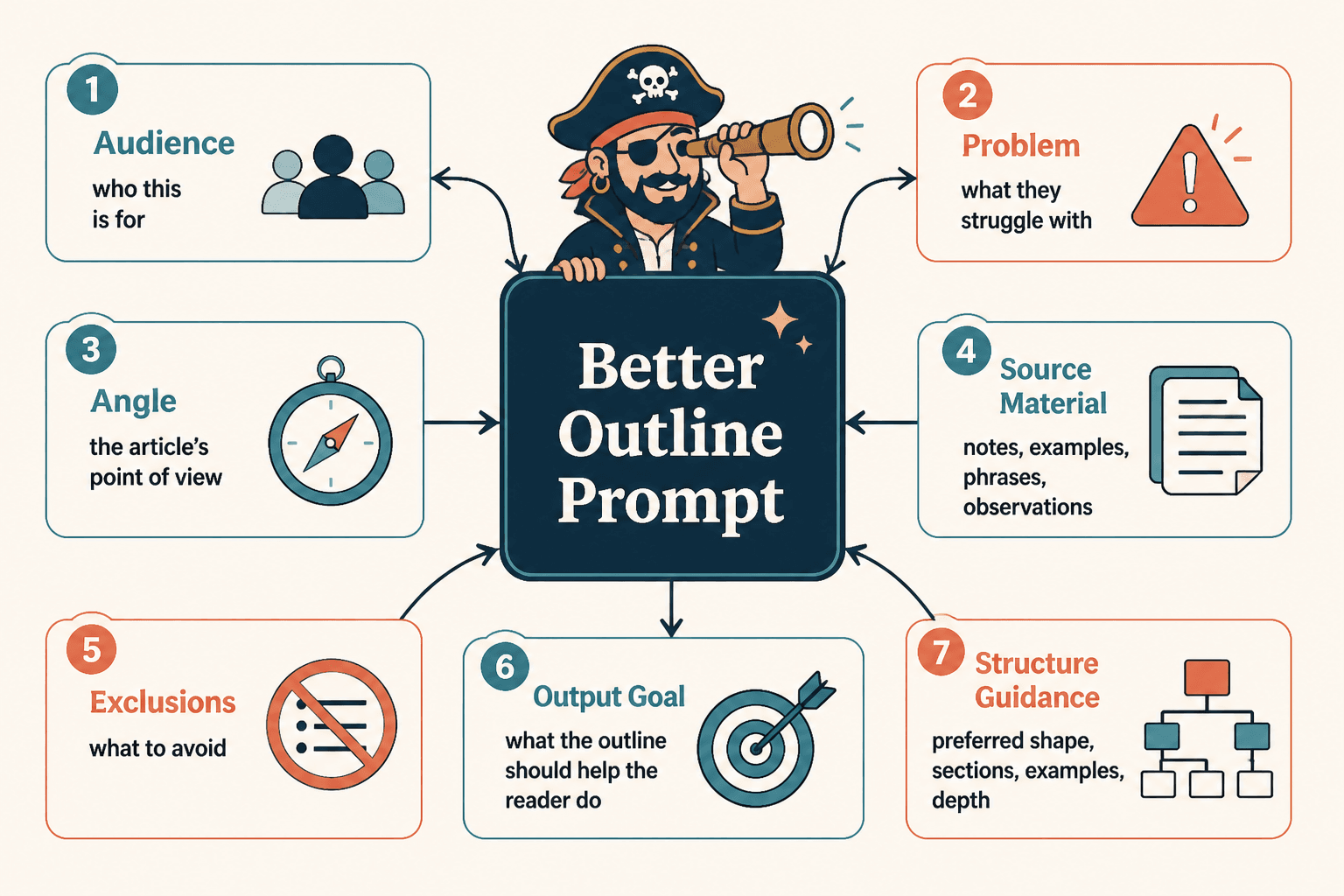
A simple prompt framework that makes outlines better fast
You do not need a 47-part mega-prompt. You need a cleaner framework.
Use this:
- Audience: Who this is for
- Problem: What they are struggling with
- Angle: What the article believes or argues
- Source material: Notes, examples, phrases, observations
- Exclusions: What to avoid
- Output goal: What the outline should help the reader do
- Structure guidance: Preferred shape, examples, sections, depth
Here is a cleaner template:
Create a detailed article outline for [specific audience]. They are struggling with [specific problem]. The article should argue or emphasize [clear angle]. Use the source material below to shape the structure and examples. Avoid [list of generic or unwanted elements]. The outline should help the reader [specific outcome]. Use clear H2 and H3 sections, include practical examples or rewrites where useful, and make the structure feel specific rather than broad.
And here is that template filled in:
Create a detailed article outline for creators, coaches, and consultants using AI to brainstorm article ideas. They are struggling with generic outlines that sound polished but say nothing. The article should emphasize that stronger outline prompts come from clearer audience pain, sharper editorial angles, better source material, and stronger exclusions. Use the notes below to shape the structure and examples. Avoid broad headings, generic “benefits” sections, robotic tone, and repeated points. The outline should help readers immediately improve their own AI ideation prompts and get more original article structures. Use H2s and H3s, include before-and-after prompt examples, and end with a practical prompt formula.
Before-and-after prompt rewrites
Sometimes the easiest way to improve your prompting is to see exactly where the original went wrong.
| Weak prompt | Why it fails | Stronger rewrite |
|---|---|---|
| Create an outline about AI ideation for creators. | Too broad. No angle. No constraints. | Create an outline for creators using AI for ideation who keep getting repetitive content ideas. Focus on how to improve prompt specificity, source inputs, and exclusions to generate more original article directions. |
| Write an engaging SEO-friendly outline about AI prompts. | “Engaging” and “SEO-friendly” are not enough to guide structure. | Build an SEO-aware outline for an article teaching consultants how to write better AI outline prompts. Prioritize practical fixes, examples, and common prompt mistakes over generic theory. |
| Give me a blog post outline that is unique and valuable. | Asking for uniqueness without supplying specifics rarely works. | Using the notes below, create a sharp article outline that argues most creator AI prompts fail from vague inputs, not weak tools. Include a section on rewriting bad prompts into specific ones. |
If you want more help cleaning up flat, machine-smelling drafts after the outline stage, how to rewrite boring creator AI research and ideation is the next useful stop.
Common mistakes creators make when prompting for outlines
Some of these seem small. They are not. They quietly wreck the output before you even get to drafting.
Mistake 1: Asking for everything at once
Research, ideation, title options, outline, CTA, SEO, examples, tone matching, FAQs, and repurposing plan all in one prompt. Can AI do that? Sort of. Will the result usually be cleaner? Not really.
Outline prompts get better when the task is narrower and the thinking is staged.
Mistake 2: Confusing length with specificity
A giant prompt can still be vague. A shorter prompt can be excellent if the details are sharp.
Do not chase prompt length. Chase decision-quality.
Mistake 3: Using style words instead of editorial direction
Words like “smart,” “engaging,” “human,” and “interesting” are not useless, but they are weak compared to actual guidance.
The bigger point is simple: clearer structure and clearer writing make the piece more useful. That is usually what makes the ending land better too.