
Most team bio pages are written like HR got hold of the homepage and refused to leave.
You get stiff job titles, vague corporate fluff, and smiling headshots attached to paragraphs that tell visitors almost nothing useful. The result is not just boring. It quietly hurts trust, conversion, and the reader’s sense that real competent humans work here.
Team bio mistakes that hurt website performance usually are not dramatic. They are small, common, and expensive in the way quiet conversion problems tend to be. A weak team page can make a good business feel generic, evasive, or oddly forgettable.
If your bios are supposed to help people trust your company, book a call, choose your firm, or feel better about buying, the copy has a job to do. Here is how bios go wrong, what to fix, and how to make your team page pull its weight instead of just existing politely in the navigation.
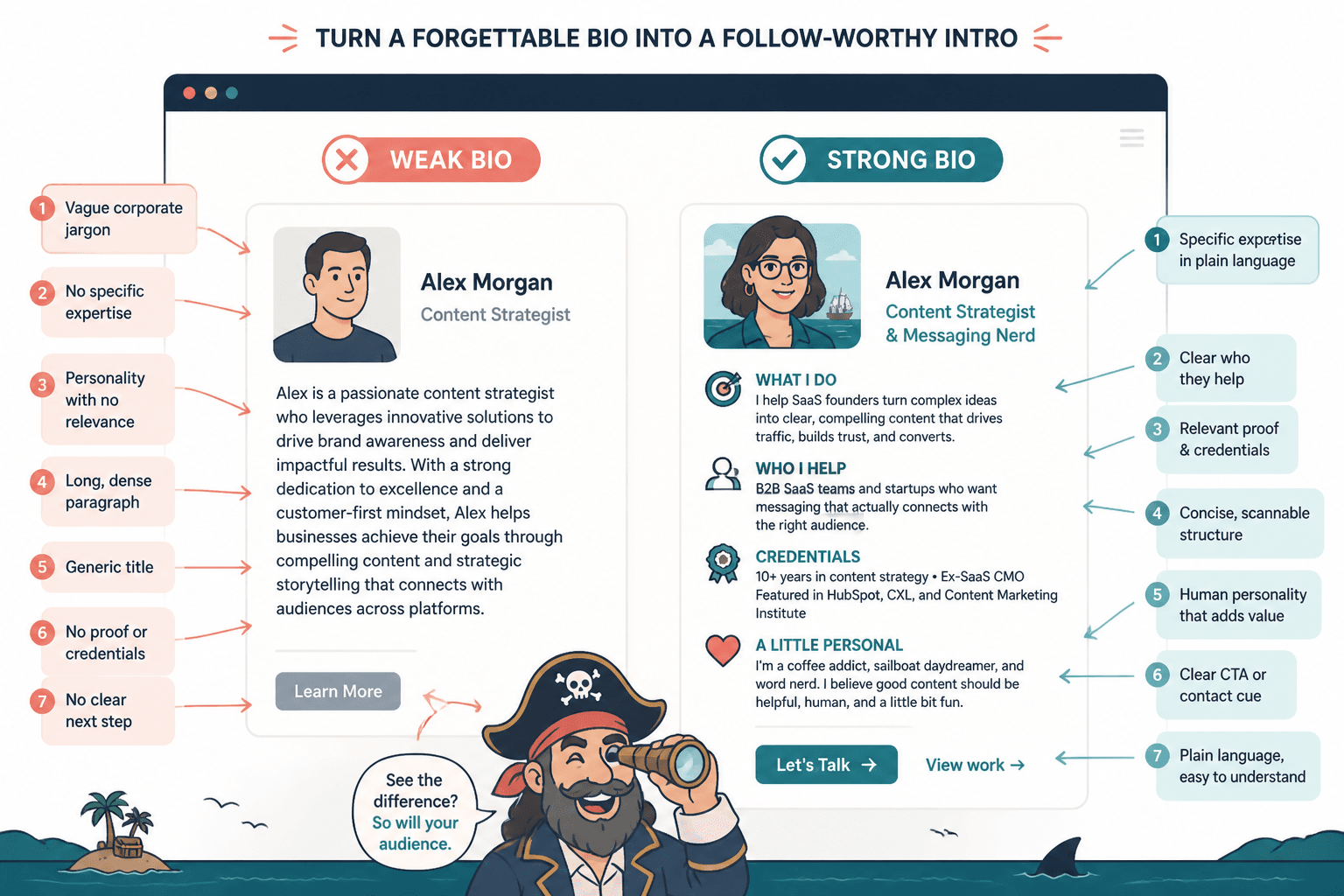
For the broader learning path, visit our parent guide.
Why team bios affect website performance more than people think
A lot of businesses treat team bios like a side dish. Nice to have. Not strategic. Something you publish after the “real” pages are done.
That is usually a mistake.
Team bios often get read by high-intent visitors. People check them when they are comparing providers, deciding if your expertise is real, looking for signs that you understand their world, or trying to figure out whether your business feels credible or weirdly anonymous.
In other words, this is not filler copy. It supports trust.
A strong team bio page can help visitors answer four useful questions quickly:
- Who are these people?
- What do they actually do well?
- Why should I trust them?
- Do I want to work with this company?
If the page does not answer those questions, it is not neutral. It is creating friction.
If you want the broader strategy behind this, start with Bio & Profile Copy for Websites. It gives the wider framework. This article is the messier practical version: the mistakes people keep making.
Mistake #1: Writing bios like resumes nobody asked to read
A website bio is not a CV pasted into a prettier container.
Visitors do not need every certification, previous employer, committee role, or chronological career detail. They need the pieces that build relevance and trust for the buying decision in front of them.
Bad bio copy often sounds like this:
Jane is a seasoned professional with over 15 years of experience across multiple industries. She has held numerous leadership roles and is passionate about excellence, innovation, and client success.
This says very little. It is technically positive and practically useless.
A stronger version sounds more like this:
Jane leads client strategy for B2B service firms that need sharper messaging, cleaner offers, and websites that convert without sounding like a committee wrote them. Over the last 15 years, she has helped consulting and software teams simplify complex positioning and turn it into clearer sales copy.
That second version does what a bio should do. It tells the reader what Jane does, who she helps, and why her experience matters here.
What to do instead
- Lead with current relevance, not chronology
- Choose proof that supports the buying decision
- Cut anything that sounds impressive but changes nothing
- Write for the client’s question, not the employee’s ego
Mistake #2: Using vague praise words instead of actual substance
Strategic. Passionate. Dedicated. Innovative. Results-driven. Collaborative.
These words are not evil. They are just deeply overworked. On their own, they mean almost nothing. Every team page says some version of them. So they stop helping.
When bios lean too hard on praise language, they read like internal award nominations. Nice sentiment. Thin evidence.
Instead of adjectives, use specifics:
- What problems does this person solve?
- What kind of clients do they help?
- What outcomes are they known for?
- What expertise or perspective do they bring?
- What should a prospective client understand after reading this bio?
Specifics feel more trustworthy because they give the reader something to hold onto. “Client-focused leader” is wallpaper. “Helps law firms simplify messy intake and improve lead handling across multi-location teams” is useful.
Mistake #3: Forgetting that bios are conversion copy, not just identity copy
This is one of the bigger team bio mistakes that hurt website performance.
A lot of businesses write bios as if the only goal is introducing the team. But a website bio also supports conversion. It should reduce hesitation. It should reinforce fit. It should help the reader move one step closer to trusting the business.
That does not mean every bio needs to sound salesy. Please do not do that. It means the page should be written with buyer psychology in mind.
For example, if your visitors worry about competence, show depth. If they worry about fit, show audience relevance. If they worry your firm is too corporate or too small or too generic, your bios can answer that without awkwardly announcing it.
The best bios do not just say “here is who we are.” They also quietly say “here is why you can trust us.”
Useful things a bio can reinforce
- Industry knowledge
- Specialization
- Years of relevant experience
- Approach or philosophy
- Credibility markers
- Human personality without chaos
If your current bios do not support trust or help move visitors toward action, they are decoration. Expensive decoration, but still.
Mistake #4: Making every team member sound exactly the same
Consistency matters. Copy-paste sameness does not.
Many team pages use one rigid template that strips out any trace of individuality. Every person is “passionate about clients,” “committed to excellence,” and “brings a wealth of experience.” By the third bio, the reader is skimming with the enthusiasm of someone reading printer instructions.
A good team page should feel cohesive, but each person should still come across like a distinct human with a real role.
You can standardize the structure while varying the substance. For example:
- Sentence 1: role and area of expertise
- Sentence 2: who they help or what they handle
- Sentence 3: proof, experience, or specialty
- Sentence 4: a small humanizing detail, if appropriate
That gives you consistency without flattening everybody into one bland company voice.
Mistake #5: Adding quirky personal details that do nothing for trust
This one gets mishandled in both directions.
Some team pages are so sterile they feel generated in a lab. Others swing hard into personality and tell me everyone enjoys coffee, hiking, rescue dogs, travel, and tacos. Which is lovely, but not exactly a buying trigger.
Human details can help. They make a company feel less faceless. But they need proportion. If the bio spends more time on marathon medals than client-relevant expertise, the priorities are off.
The trick is using personal detail as seasoning, not as the whole meal.
Better personal details tend to be
- Brief
- Actually distinctive
- Consistent with the brand tone
- Placed after the trust-building information
Good example: “Outside client work, she mentors first-generation founders and has a weakness for color-coded notebooks.”
That gives a little texture without hijacking the point of the page.
If you need help balancing credibility and personality, this guide on writing bio and profile copy without sounding salesy or robotic will save you from both extremes.
Mistake #6: Hiding the good stuff under weak openings
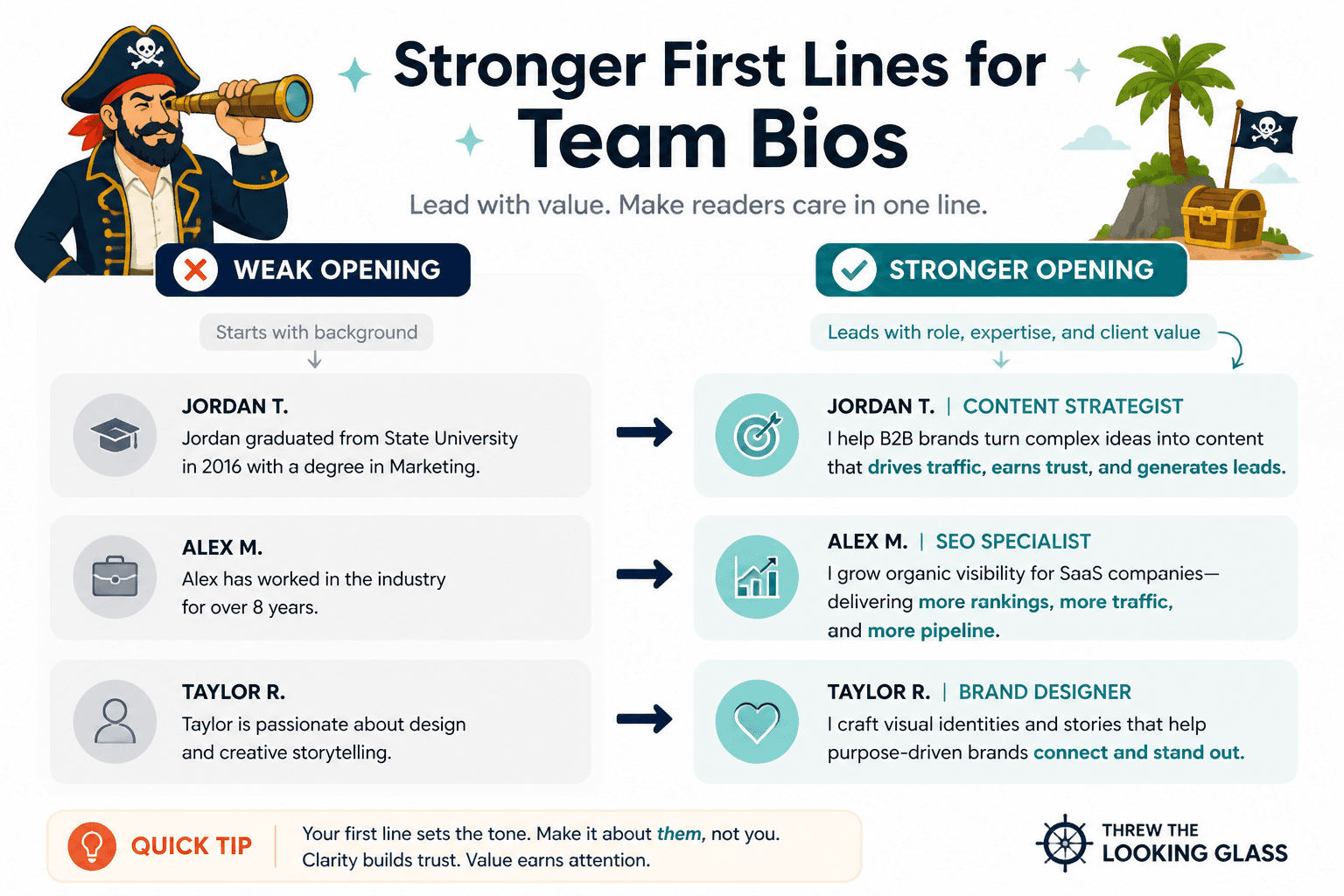
The first line of a bio does a lot of work. Yet many bios waste it on throat-clearing.
You do not need to open with “John joined the company in 2021” unless that fact matters to the reader. It usually does not. You also do not need “Sarah is a valued member of the team.” That is assumed. If she were not, this would be a different kind of website problem.
Open with the most useful thing first: role, expertise, specialty, or client relevance.
| Weak opening | Stronger opening |
|---|---|
| Mark joined the firm after graduating from… | Mark helps SaaS and consulting clients turn scattered service messaging into clearer offers and stronger conversion copy. |
| Priya is a dedicated member of our growing team. | Priya leads onboarding and client success, making sure new clients get fast clarity, smoother communication, and fewer dropped details. |
| Emma has always been passionate about design. | Emma designs high-converting page layouts that make dense service offers easier to understand and easier to trust. |
Lead with relevance. Everything else can follow.
Mistake #7: Skipping proof
Trust likes evidence.
If a bio claims someone is an expert, strategic thinker, specialist, or leader, the obvious next question is: based on what?
Proof does not have to be flashy. It just has to be real. Depending on the business, that might include:
- Years of relevant experience
- Specific industries served
- Notable project types
- Credentials or certifications that matter
- Media features or speaking experience
- Results or outcomes, if appropriate
The key phrase there is “that matter.” Not every credential deserves space. A bio should not become a junk drawer of achievements.
Use proof that helps the reader trust the person in the role they are evaluating. If you run a consulting firm, “has worked with private equity-backed healthcare groups” probably matters more than “featured in a local alumni spotlight.”
Mistake #8: Writing bios for the company instead of the customer
This one is subtle.
Sometimes bios are really internal image management. They are written to make the company feel polished, inclusive, accomplished, impressive, culture-rich, or high-status. Fine. But if that becomes the main goal, customer usefulness starts to disappear.
The customer is not reading your team page to admire your org chart. They are reading to assess fit, credibility, and confidence.
So the copy should reflect the reader’s concerns. A good practical test is this: if a prospective client reads the bio, do they come away knowing how this person is relevant to the work they might buy?
If not, the bio is too inward-facing.
Mistake #9: Having no clear structure across the page
Even good individual bios can underperform if the page itself is messy.
When visitors hit a team page, they are scanning fast. If the structure is inconsistent, hard to skim, or visually chaotic, it creates unnecessary effort. And effort is where attention goes to die.
A solid team bio page usually includes:
- Consistent photo style
- Clear names and titles
- Predictable bio length
- Skimmable formatting
- Useful hierarchy for seniority or function
- A next step somewhere on the page
That last point matters. If the page builds trust but offers no next move, you are leaving value on the table.
The next step does not need to be aggressive. It can be simple: view services, book a consultation, read case studies, contact the team, or explore the company story.
For ideas on connecting profile copy to actual business outcomes, read how to turn bio and profile copy for websites into more leads or sales.
Mistake #10: Making bios too long or too thin
Some bios are one limp sentence. Others are mini memoirs. Neither extreme helps much.
The right length depends on the business model, the role, and how much trust needs to be established. A founder of a boutique consultancy may deserve more depth than a support role on a larger team page. A law firm or agency may need stronger bios than a casual lifestyle brand.
Still, there is a practical middle ground. Most website team bios work well when they are long enough to establish relevance and proof, but short enough to skim comfortably.
As a rough guide:
- Short bio: 40 to 80 words
- Standard bio: 80 to 150 words
- Expanded leadership bio: 150 to 250 words
Not laws. Just useful boundaries so nobody writes a hostage note disguised as a profile.
The bigger point is simple: clearer structure and clearer writing make the piece more useful. That is usually what makes the ending land better too.