
Most author bios are trying way too hard.
They puff up simple work into grand missions, stack vague credentials like damp cardboard, and somehow say nothing useful in 80 to 150 words. The result is a bio that sounds polished enough, but does not help a reader trust you, remember you, or click anything.
If you need simple author bio templates for busy creators, the good news is this is not complicated. You do not need a tiny manifesto. You need a clear sentence or two that tells people who you help, what you do, why you are worth listening to, and what they should do next if they want more.
That is what this guide will help you write. Fast. Without sounding like a motivational LinkedIn mug.
If you want the broader strategy behind bio and profile copy for websites, that guide is worth bookmarking too. Here, we are keeping the focus narrow: practical author bio templates you can actually use.
To see how this fits into the wider strategy, open the parent guide.
What a good author bio actually needs to do
A website author bio is not there to impress your old colleagues or prove you own a thesaurus. It has a job.
- Show readers who you are
- Make your expertise easy to understand
- Connect your background to the topic they are reading
- Add a little personality
- Point them toward a sensible next step
That is it.
For busy creators, simple wins because simple reads. Especially on websites, where people skim first and decide later. A bloated bio creates friction. A tight one builds trust quickly.
There is a useful difference between sounding credible and sounding inflated. Credible is specific. Inflated is where you say things like “passionate storyteller helping brands unlock authentic transformation through content.” Nobody knows what that means, including the person who wrote it.
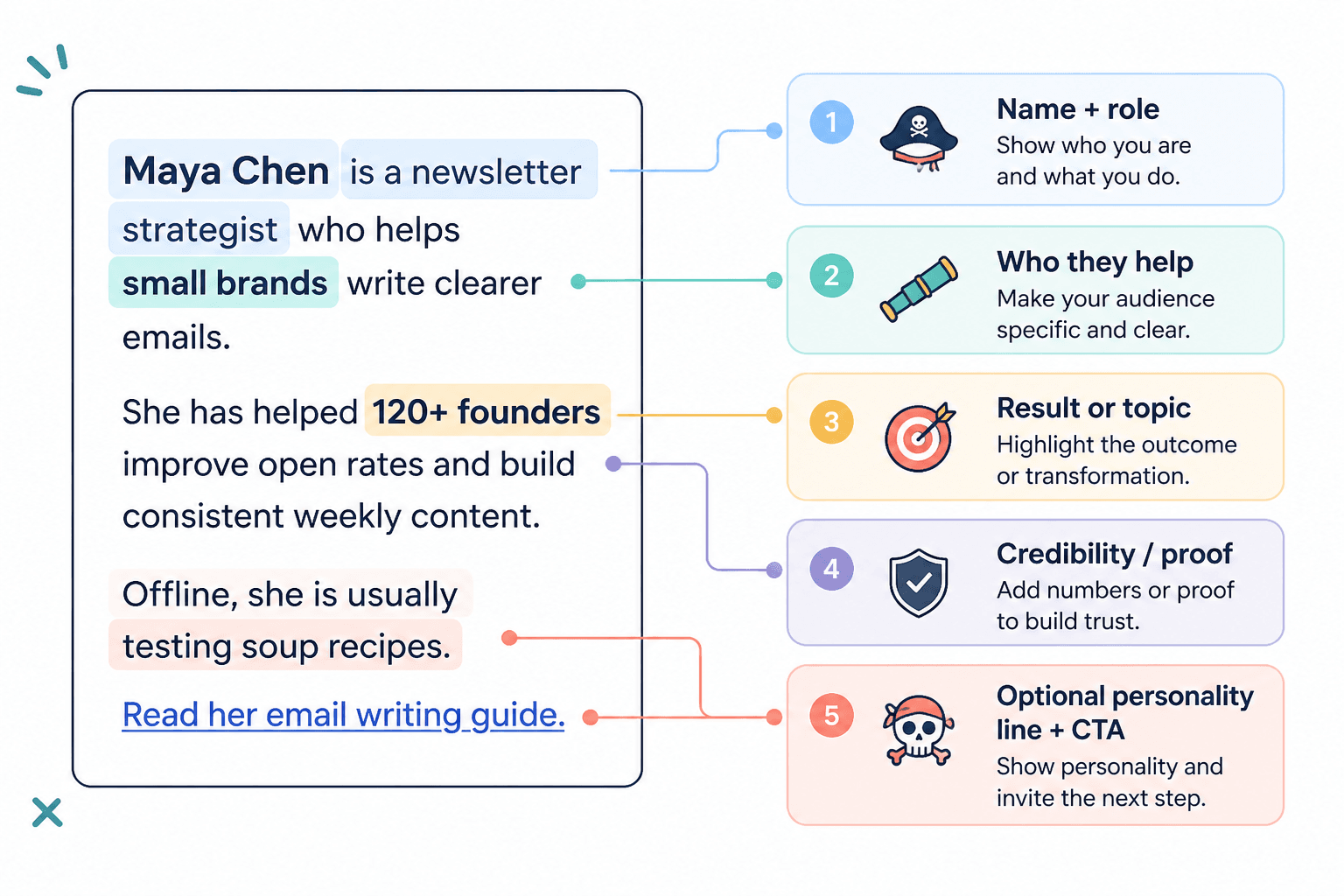
The simple structure behind strong author bios
Before the templates, here is the basic formula.
- Who you are: creator, writer, coach, consultant, founder, strategist, marketer
- What you help with: the outcome, topic, or problem area
- Why trust you: proof, experience, niche, results, platform, clients, body of work
- Optional personality line: a small human detail, not a stand-up routine
- Optional CTA: where to go next
In plain English, that often becomes:
[Name] is a [role] who helps [audience] do [result]. [Proof or credibility line]. [Optional personality or next-step line].
You do not need every part every time. A byline bio under an article might only need two sentences. An About page version can stretch a little more. A sidebar profile can be even shorter.
Simple author bio templates for busy creators
Here are flexible templates for different kinds of creators. Use them as scaffolding, not as sacred text.
1. The clean general template
[Name] is a [role] who helps [audience] [achieve result]. [He/She/They] writes about [topics].
Example: Maya Chen is a content strategist who helps solo consultants turn their expertise into clear, trust-building website copy. She writes about messaging, content systems, and conversion-focused brand positioning.
This one works well for article bios, contributor pages, and clean professional websites.
2. The proof-first template
[Name] is a [role] with [specific experience, credential, or proof]. [He/She/They] helps [audience] [result].
Example: Daniel Ruiz is a conversion copywriter who has helped SaaS and service brands sharpen their messaging across websites, emails, and landing pages. He helps small businesses turn vague positioning into copy that actually pulls its weight.
Use this when credibility matters and you have relevant proof worth mentioning. Not every bio needs credentials, but if you have strong ones, do not bury them under fluff.
3. The audience-specific template
[Name] helps [very specific audience] [solve specific problem] through [method or expertise area]. [Optional second sentence with proof or topic focus].
Example: Priya Shah helps coaches and independent experts write clearer website copy that earns trust faster. Her work focuses on bios, service pages, and homepage messaging that sound like a real person, not a beige funnel template.
This is especially good if your niche is part of your value.
4. The creator-personality template
[Name] is a [role] who creates [type of content] for [audience]. [He/She/They] focuses on [topics]. [Optional personality line].
Example: Lena Brooks is a writer and educator who creates practical content for freelancers building smarter businesses. She focuses on client communication, authority-building content, and sustainable marketing. She likes clean sentences and deeply mistrusts vague advice.
The last line works because it supports the brand voice. It is small, relevant, and controlled. It is not “coffee lover, dreamer, and proud dog mom.” That kind of detail can work on social, but it usually does not earn its keep in a website author bio.
5. The short byline template
[Name] is a [role] who helps [audience] [result]. [Optional CTA or website focus].
Example: Omar Ali is a brand strategist who helps creators tighten their messaging and sell with more clarity. He writes about positioning, offers, and website copy that does not waste the reader’s time.
This is ideal when space is tight and attention is thinner than people admit.
6. The founder-expert template
[Name] is the founder of [brand/company], where [he/she/they] helps [audience] [result]. [Optional second sentence about expertise, writing topics, or proof].
Example: Nina Patel is the founder of Draft & Done, where she helps service businesses simplify their messaging and improve conversion copy across their websites. She writes about positioning, pages that pull their weight, and content strategy for small teams.
If your company name helps with credibility or recognition, this is a clean way to include it.
How to adapt the templates without making them worse
Templates are useful right up until people start filling them with fog. The easiest way to keep your bio strong is to make every phrase answer a real question.
| Bio part | Question it should answer | Weak version | Better version |
|---|---|---|---|
| Role | What do you actually do? | Digital entrepreneur | Email copywriter |
| Audience | Who is this for? | Ambitious professionals | Coaches and consultants |
| Result | What do you help them do? | Grow online | Turn website traffic into qualified leads |
| Proof | Why trust you? | Passionate expert | Has written for 50+ service brands |
| Personality | What human detail fits your brand? | Coffee addict | Prefers sharp copy to clever copy |
If you want more examples of clean, adaptable bios, these short bio examples creators can adapt fast will help.
What to cut from your author bio immediately
If your current bio feels off, there is a decent chance it is carrying dead weight. Common offenders include:
- Vague mission language
- Empty adjectives like passionate, dynamic, authentic, visionary
- Too many job titles piled into one sentence
- Irrelevant credentials
- Life story backstory no one asked for
- Generic hobby details that add nothing
- No mention of the reader, topic, or outcome
A bio is not stronger because it is longer. It is stronger when each line earns its spot.
One sharp sentence beats three padded ones every time. Especially if your website already has other places to expand on your background.
Before and after: boring bio rewrites
Sometimes the easiest way to fix a bio is to see the difference in action.
Rewrite 1
Before: Sarah is a passionate entrepreneur and storyteller dedicated to helping others unlock their true voice and elevate their brand presence in the digital world.
After: Sarah Kim is a brand writer who helps coaches and creators clarify their message and sound more like themselves online.
Why it works: The rewrite drops the scented candle language and tells us what Sarah actually does.
Rewrite 2
Before: James has years of experience in marketing, business growth, social media, sales strategy, leadership, and content creation.
After: James Porter helps service businesses use content and messaging to attract better leads and shorten the path to a sale.
Why it works: A pile of skill nouns is not a bio. This version turns broad experience into a clear value proposition.
Rewrite 3
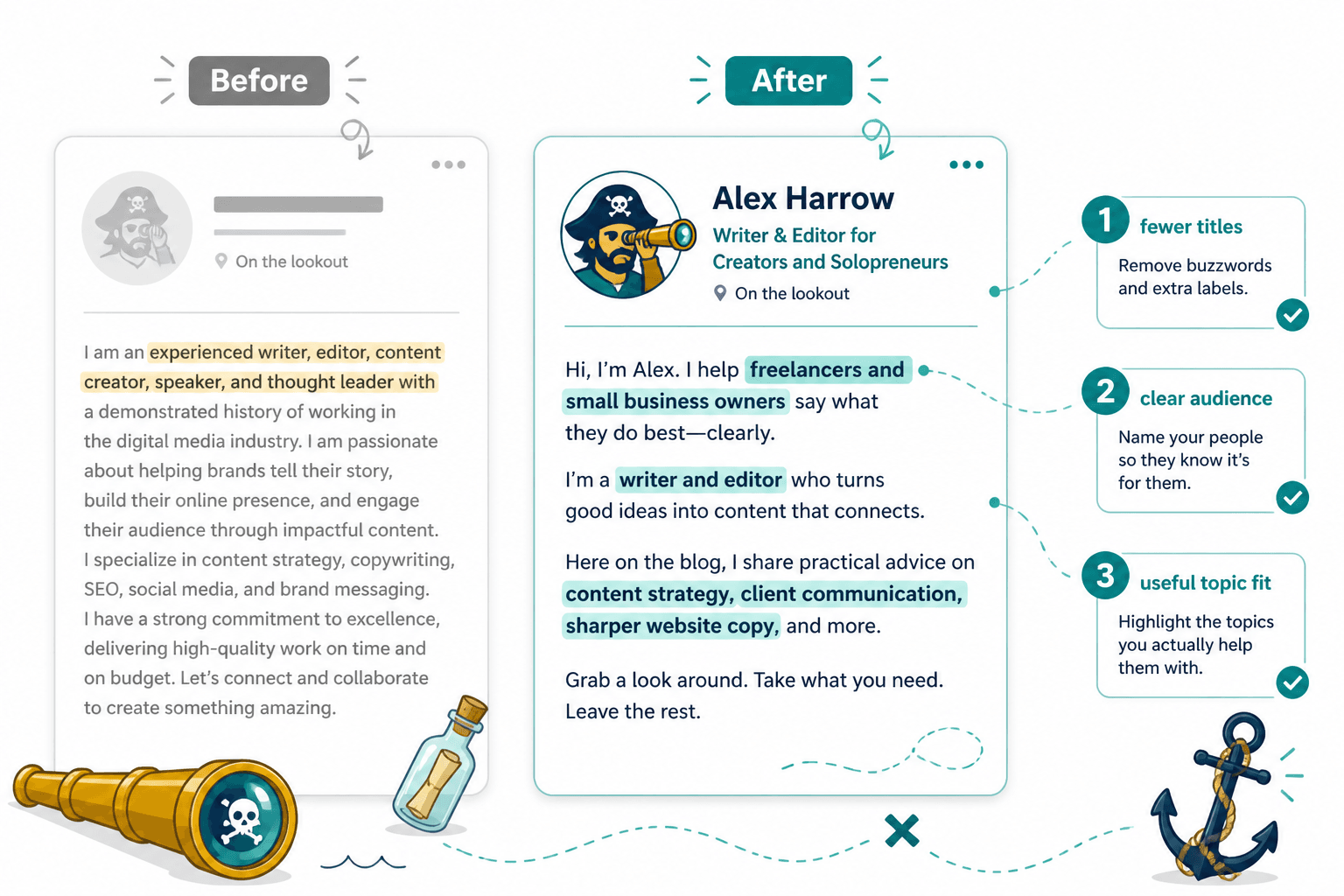
Before: Maria is an experienced writer, editor, content creator, speaker, and thought leader with a passion for empowering audiences through transformational insights.
After: Maria Torres is a writer and editor who creates practical content for freelancers and small business owners. She covers content strategy, client communication, and sharper website copy.
Why it works: Fewer titles, clearer audience, more useful topic fit.
For a deeper breakdown of what makes bios work, this guide on how to write better bio and profile copy for websites goes further.
How long should an author bio be?
There is no magic number, which annoys people who want one, but there are useful ranges.
- Short byline bio: 20 to 50 words
- Standard website author bio: 50 to 100 words
- Expanded About-page bio snippet: 100 to 150 words
If your bio sits under blog posts, shorter is usually better. If it appears on a contributor page or About page, you can use a bit more room for proof or personality.
The real test is simple: can someone scan it in a few seconds and understand who you are, what you do, and why your perspective matters here? If not, the problem probably is not length. It is clarity.
Should your author bio include a CTA?
Often, yes. Just do not make it sound like a thirsty landing page button learned to speak.
A good bio CTA feels natural because it matches what the reader is already doing. They just read your article. They may want more from you. Great. Make that easy.
- Read more articles
- Visit your About page
- Check out your newsletter
- See your services
- Download a relevant resource
Example: She writes about messaging, website copy, and content strategy for service businesses. You can find more of her work in the website conversion copy section.
Keep it low-friction. The bio is not the place for a full sales speech.
A quick fill-in framework you can use in five minutes
If you are staring at a blinking cursor and mildly regretting having a website at all, use this.
- Write your role in plain English.
- Name the audience you actually want.
- State the result you help with.
- Add one proof point if relevant.
- Add one sentence on what you write about or where to go next.
That gives you something like this:
I am a [role] who helps [audience] [result]. My work focuses on [topics], and I have [proof point]. [Optional CTA].
Filled example: I am a website copywriter who helps coaches and consultants explain what they do more clearly and convert more of the right visitors. My work focuses on homepages, service pages, and bios that build trust fast. Read more in the bio and profile copy guide for creators who want better results.
How to make your bio sound more human without getting weird
A lot of creators swing between two bad options.
- Option one: sterile corporate fog
- Option two: oversharing brunch-energy chaos
You do not need either.
The easiest way to sound human is to choose cleaner words, make sharper claims, and include one detail that sounds like a person wrote it. That detail should support your voice, not distract from your credibility.
Good human touches might include a clear opinion, a subtle style cue, or a line that reflects how you approach your work. For example: “He prefers useful copy over clever copy.” That tells me something. “She loves coffee and sunsets” tells me almost nothing, unless your target reader is somehow hiring based on latte sincerity.
The bigger point is simple: clearer structure and clearer writing make the piece more useful. That is usually what makes the ending land better too.