Most speaker bios are not bad because the person lacks experience. They are bad because the bio tries so hard to sound impressive that it forgets to sound specific.
You have probably seen the usual version: “internationally recognized speaker, thought leader, passionate advocate, dynamic voice.” That kind of copy is doing a lot of posing and very little explaining. It sounds polished. It also sounds like 600 other bios sitting on conference pages right now.
If you want to know how to improve speaker bios without sounding generic, the fix is not to make them louder. It is to make them clearer, sharper, and more useful to the person deciding whether to book you, introduce you, or trust you.
Here’s how to write a speaker bio that actually sounds like a real person with a real point of view, not a LinkedIn summary wearing stage makeup.
Want the broader roadmap? Start with the parent guide.
Why most speaker bios sound the same
Speaker bios usually go generic for three reasons.
- They lead with status words instead of substance.
- They try to cover every credential, audience, and topic at once.
- They are written to impress the speaker, not help the event host.
That last one matters more than people think. A strong speaker bio is not just a vanity paragraph. It is a conversion asset. It helps an organizer quickly understand who you are, what you speak about, why you are credible, and what kind of room you are right for.
If the bio is vague, stuffed with buzzwords, or trying to sound “premium” at the expense of clarity, it creates friction. And friction is great if you are trying to assemble flat-pack furniture. Not so great if you want bookings.
What a good speaker bio actually needs to do
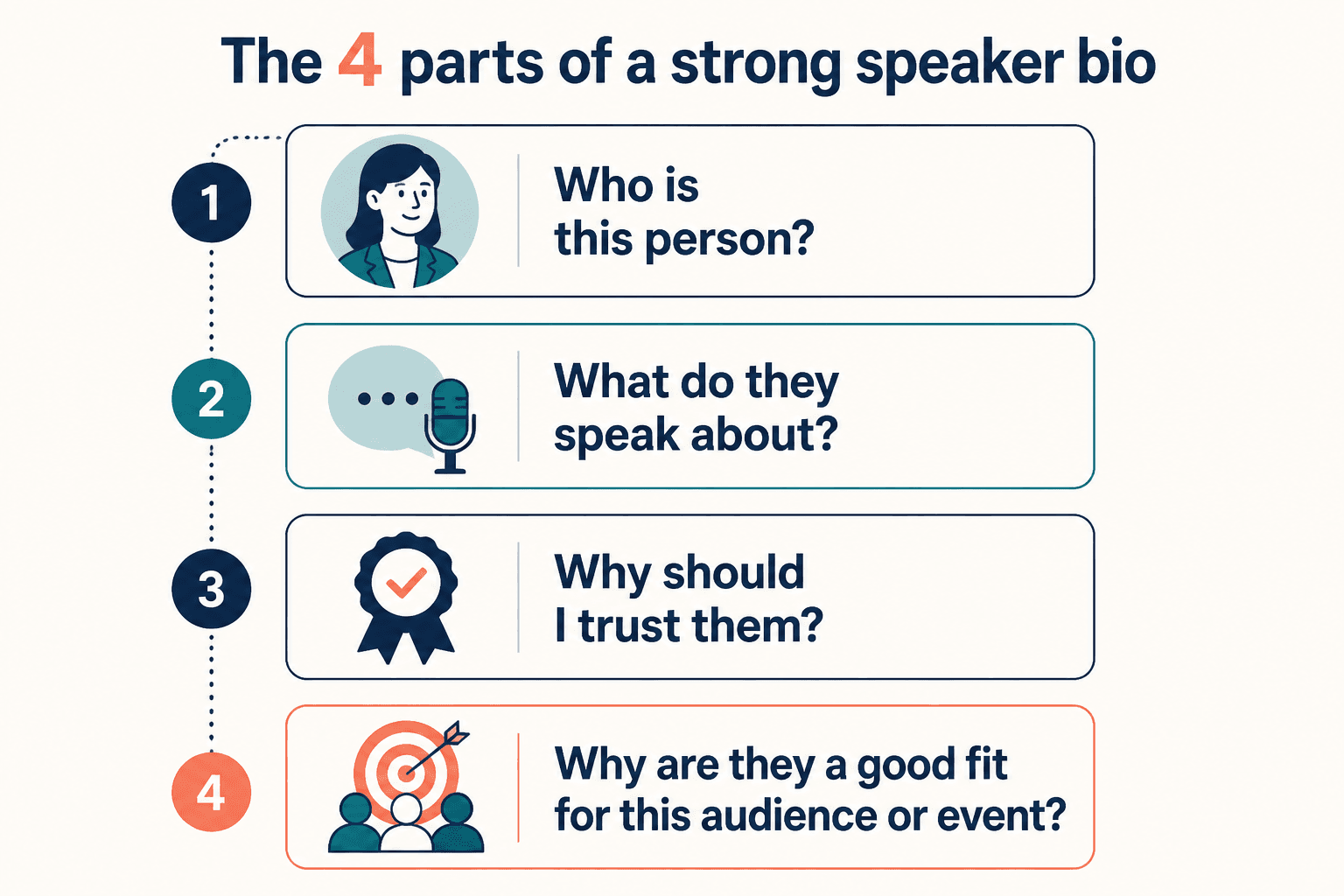
A good speaker bio should answer four simple questions fast:
- Who is this person?
- What do they speak about?
- Why should I trust them?
- Why are they a good fit for this audience or event?
That is it. Not “how can I fit every career achievement into 180 words.” Not “how can I sound like an awards presenter introducing myself in the third person.” Just those four things, clearly.
If you also want your website bio to pull more weight beyond event pages, it helps to think of it as part of your broader profile positioning. If that piece needs work too, this guide on writing better bio and profile copy for websites is a useful companion.
Start with your actual speaking angle, not your life story
One of the quickest ways to improve speaker bios without sounding generic is to stop opening with broad identity labels.
“Jane Smith is a speaker, consultant, author, entrepreneur, and passionate advocate for innovation” tells me almost nothing. It is technically information. It is not useful information.
Instead, lead with the thing you are known for saying, teaching, challenging, or helping audiences understand.
Weak opening
Mark Evans is an internationally recognized keynote speaker, business strategist, and thought leader in leadership, innovation, and performance.
Stronger opening
Mark Evans helps leadership teams fix the communication habits that quietly wreck trust, speed, and execution inside growing companies.
See the difference? The second version creates a picture. It gives the reader a reason to keep going. It sounds like someone with a point, not just a title collection.
Your speaking angle is the specific problem, shift, or idea your talks are built around. If you cannot state that clearly, your bio will keep sliding into fluff because the positioning underneath it is fuzzy.
Use proof that means something
Generic bios lean heavily on adjectives because they do not have enough grounded proof. So they reach for words like “renowned,” “sought-after,” “inspiring,” and “impactful.”
Here is the problem: you do not get to call yourself inspiring. Other people decide that. Your job is to provide evidence that makes the claim feel believable.
Useful proof can include:
- Specific clients or types of organizations
- Books, research, or notable publications
- Relevant leadership roles
- A clear body of work
- Audience size or stage type, when it actually matters
- Results tied to your expertise
- A recognizable niche you are known in
The key is relevance. A long list of random achievements is not proof. It is clutter with self-esteem issues.
Weak proof
Sarah is a highly respected expert who has inspired audiences around the world with her powerful message.
Better proof
Sarah has delivered talks for association conferences, in-house leadership teams, and founder communities, helping audiences turn vague brand messaging into clear offers people actually buy.
The second one still sounds polished, but now it is anchored in reality.
Cut the words that make everyone sound interchangeable
Some words are not evil. They are just overworked. And in speaker bios, overworked words make people blend together.
Words and phrases to treat with suspicion:
- thought leader
- passionate
- dynamic
- renowned
- visionary
- trailblazer
- industry expert
- motivational speaker
- sought-after
- empowering audiences
- transformative insights
- inspiring others to reach their full potential
You do not have to ban every one of these forever. But if your bio relies on them, it will read like it was assembled from conference brochure leftovers.
Replace labels with specifics. Replace praise words with evidence. Replace broad claims with an actual point of view.
Make your bio fit the event host’s needs
A surprisingly common mistake is writing one grand universal bio and using it everywhere.
That sounds efficient. It is also lazy in a way that costs opportunities. A startup conference, a healthcare association, a university event, and a women-in-business summit are not all looking for the exact same framing, even if your topic overlaps.
You do not need 47 completely different bios. You do need a few adaptable versions.
At minimum, keep these versions ready
- Short bio: 50–80 words for event pages and quick intros
- Standard bio: 100–150 words for booking pages and speaker directories
- Expanded bio: 150–250 words for your website or media kit
Each version should keep the same core positioning, but you can shift examples, proof, or emphasis based on the audience. That way you sound relevant, not recycled.
If you want examples of shorter bio formats that still feel human, these short bio examples for creators can help you tighten your wording without flattening your personality.
A simple structure for a non-generic speaker bio
If your current bio is a mess of credentials, here is a clean structure that works for most speakers.
1. Lead with what you help audiences understand or do
Start with the core idea, problem, or transformation your talks are built around.
2. Add relevant credibility
Include credentials, experience, body of work, or context that supports your authority on that topic.
3. Show where your perspective has been applied
Name types of stages, organizations, industries, or audiences you have worked with if they strengthen fit.
4. End with a humanizing detail or distinct angle
This could be your style, your signature approach, or a sentence that makes you sound like a person instead of a brochure.
Template
[Name] speaks about [specific topic/problem] for [specific audience], helping them [practical outcome]. [He/She/They] is the [role/body of work/credential] behind [relevant proof]. [Name] has spoken for [types of events, organizations, or audiences]. Known for [distinctive style or perspective], [he/she/they] brings [specific quality] to conversations about [topic].
That structure is not magic. It just stops the usual drift into generic mush.
For more adaptable frameworks, these bio templates for busy creators make a good starting point.
Before-and-after rewrites
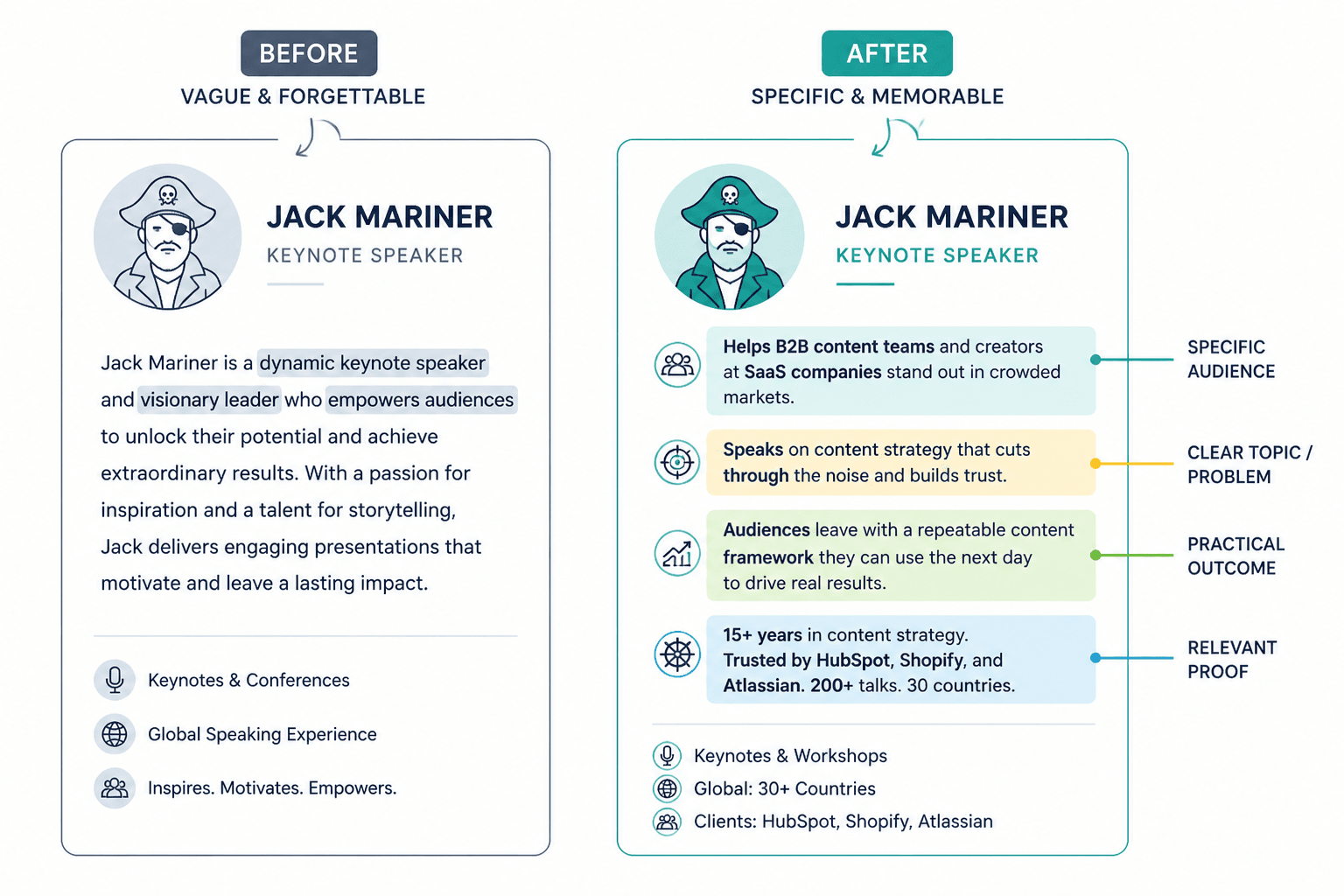
Sometimes the easiest way to fix a generic bio is to see the problem in action.
Example 1: The buzzword pileup
Before: Amanda Lee is a dynamic keynote speaker, entrepreneur, and visionary leader who empowers audiences through transformative talks on leadership, resilience, and success.
After: Amanda Lee speaks to founders and leadership teams about building steadier companies without burning out the people running them. As the founder of a consultancy focused on operational resilience, she brings practical lessons from scaling teams through messy growth, not just pretty slide decks.
The rewrite works because it trades empty praise for a real perspective.
Example 2: The everything-bio
Before: David is an author, coach, consultant, speaker, podcast host, content creator, and digital strategist with a passion for helping people live their best lives and build successful businesses.
After: David speaks about audience growth and content strategy for experts who are good at their work but tired of sounding generic online. He is the author of two books on digital positioning and has helped consultants and personal brands turn scattered content into clear authority assets that attract better-fit leads.
The first version lists roles like someone emptying a backpack onto the floor. The second version chooses a lane.
Example 3: The too-corporate intro
Before: Priya Nair is a highly accomplished business leader with over 20 years of experience driving innovation and delivering excellence across multiple sectors.
After: Priya Nair helps organizations make innovation less performative and more operational. Drawing on 20 years of leadership across healthcare, tech, and public sector teams, she speaks about what actually helps new ideas survive beyond the workshop stage.
That rewrite has texture. It gives the reader something to remember.
How to sound more human without getting sloppy
A lot of people hear “do not sound generic” and swing too far in the other direction. Suddenly the bio is trying to be quirky, overly casual, or weirdly confessional.
You do not need to turn your speaker bio into a stand-up set or a diary entry. Human does not mean random. It means your language has shape, your point of view is visible, and your sentences do not sound like they were approved by seven committee members and one anxious robot.
Some easy ways to make a bio sound more human:
- Use concrete verbs instead of abstract nouns
- Keep sentence rhythm varied
- State what you believe or challenge
- Include one line that reflects your style or perspective
- Cut stiff phrases like “has a proven track record of”
For example, “She helps teams say what they actually mean before another strategy deck dies in a shared drive” is more human and memorable than “She facilitates strategic alignment through communications excellence.” One of those sounds like a person. The other sounds like office wallpaper.
What to include on your website speaker page besides the bio
If your speaker bio lives on your website, the bio itself should not do all the heavy lifting.
A better speaker page usually includes:
- A sharp headline about what you speak on
- A short speaker bio and a longer version
- Talk topics or signature keynotes
- Audience fit or event types
- Selected proof like past stages, media, or client logos if relevant
- A clear booking CTA
- A downloadable bio and headshot if you want to make organizers’ lives easier
This matters because a bio alone rarely closes the loop. It introduces you. The page should also help someone picture booking you.
If your whole profile copy needs tightening, this broader bio and profile copy guide for websites gives you the bigger strategy behind clearer positioning.
A fast editing checklist for speaker bios
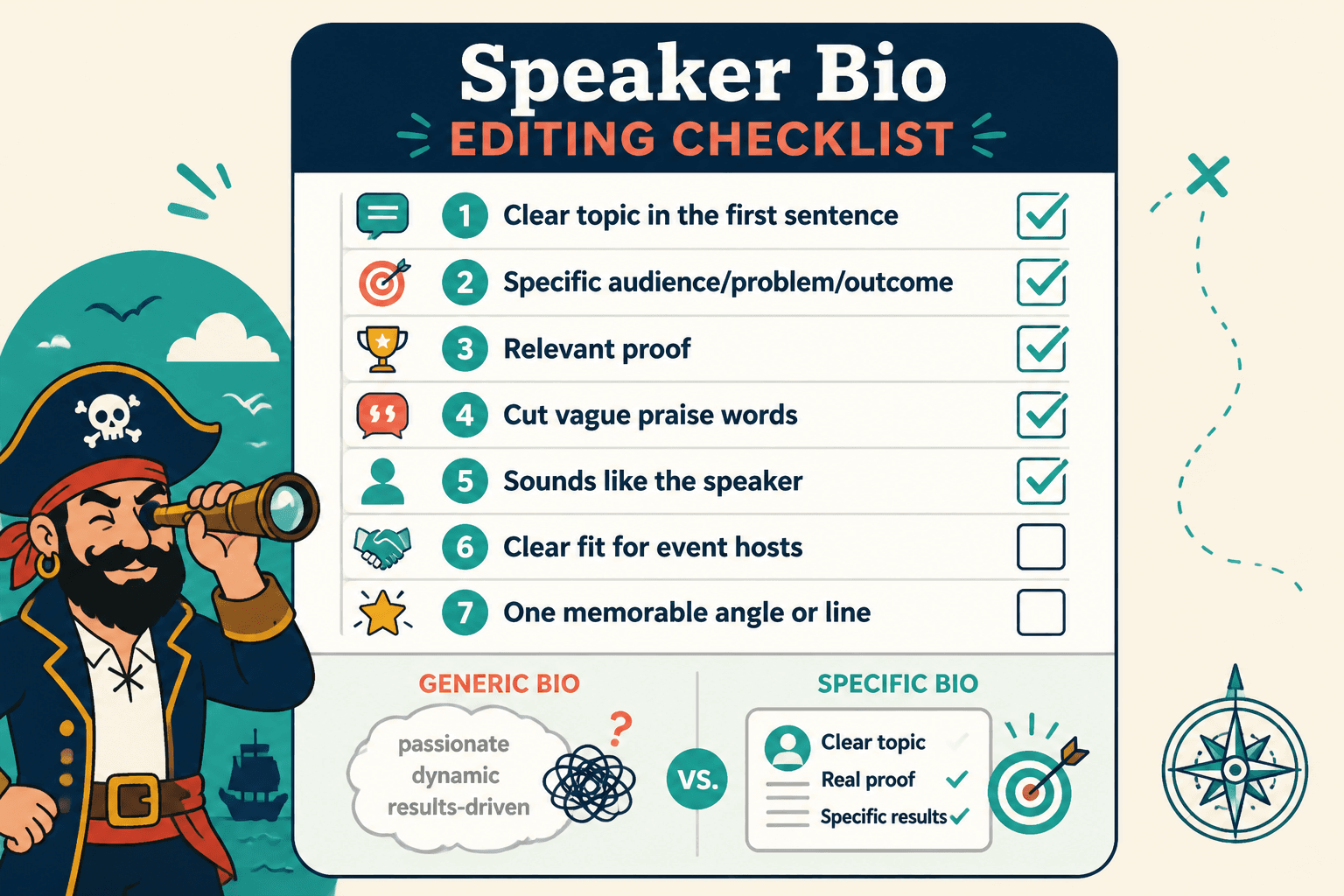
Before you publish or send a speaker bio, run it through this filter:
- Can someone tell what you speak about in the first sentence?
- Have you named a specific audience, problem, or outcome?
- Did you include proof that is relevant, not just flattering?
- Did you cut vague praise words that anyone could use?
- Does it sound like you, or like a conference template?
- Would an event host know where you fit?
- Is there at least one memorable line or angle?
If the answer to most of those is no, the bio is not finished. It is just dressed.
FAQ
How long should a speaker bio be?
Keep a few versions ready. Around 50–80 words for short intros, 100–150 for standard use, and 150–250 for your website or media kit works well for most speakers.
Should a speaker bio be in first person or third person?
Third person is still the safer default for event use. It is easier for hosts to paste into programs and introductions. First person can work on your own website if the rest of the page is written that way.
What makes a speaker bio sound generic?
Buzzwords, vague praise, too many roles, no clear topic, and no useful proof. If your bio could belong to ten other people, it needs work.
Can I use the same bio for every event?
Use the same core positioning, yes. Use the exact same wording everywhere, probably not. A little tailoring goes a long way.
Write the bio people can actually remember
If you want to improve speaker bios without sounding generic, stop trying to sound important and start trying to sound clear.
The strongest bios do not shout. They orient. They tell people what you are about, why your perspective matters, and where you fit. They make the booking decision easier.
So cut the thought leader fog. Pick the real angle. Add proof that means something. And write the version of your speaker bio that a host, editor, or event organizer can read once and actually remember.
If you want to keep refining this part of your site, you may also want to read this guide to better bio and profile copy for creators and explore the broader