
Most Facebook long-form posts do not fail in the middle. They fail in the first two lines.
You can have a sharp story, a smart point, and a solid offer at the end, but if the opening feels vague, self-important, or weirdly polished, people scroll right past it. Facebook is not the place for stiff “thought leadership” throat-clearing. It is the place where people decide, very quickly, whether your post feels human enough to read.
That is why strong Facebook long-form hook examples matter. Not because you should copy them word for word, but because a good hook gives your post momentum. It creates tension, earns attention, and makes the reader think, “Alright, go on then.”
Here’s how to write Facebook long-form hooks that feel natural, pull people in fast, and actually fit the kinds of stories, rants, lessons, and opinion posts creators tend to publish. You’ll get examples, breakdowns, quick templates, and a simple way to adapt them without sounding like you stole them from a content swipe file with emotional damage.
For the main guide behind this topic, visit the parent guide.
What a good Facebook long-form hook actually needs to do
A Facebook long-form hook does not need to be dramatic. It needs to create enough friction, curiosity, specificity, or emotional pull to make the next line feel worth reading.
That is the job. Not “go viral.” Not “hack the algorithm.” Just earn the next few seconds.
The best hooks for long-form Facebook posts usually do at least one of these things:
- State a surprising opinion clearly
- Open a story at the moment of tension
- Name a mistake people keep making
- Set up contrast between what people believe and what is true
- Say something emotionally honest without becoming mushy
- Make a reader feel seen fast
What they do not do is wander in politely. A weak hook sounds like it is asking permission. A strong one sounds like it has a point.
Why Facebook long-form hooks are different from LinkedIn and X
Facebook long-form writing lives in a slightly different social climate. On X, you usually need compression and speed. On LinkedIn, you need credibility and clean packaging. On Facebook, people are more willing to read something longer if it feels conversational, emotionally real, and built for an actual human audience rather than a funnel in loafers.
That does not mean sloppy. It means alive.
A Facebook hook can be a little more personal, a little more narrative, and a little more textured than a hook on other platforms. But it still needs control. Long-form is not an excuse to ramble. A rant is not just complaining with line breaks.
If you want more platform-specific help beyond hooks, the broader Facebook long-form and rants section is the right rabbit hole.
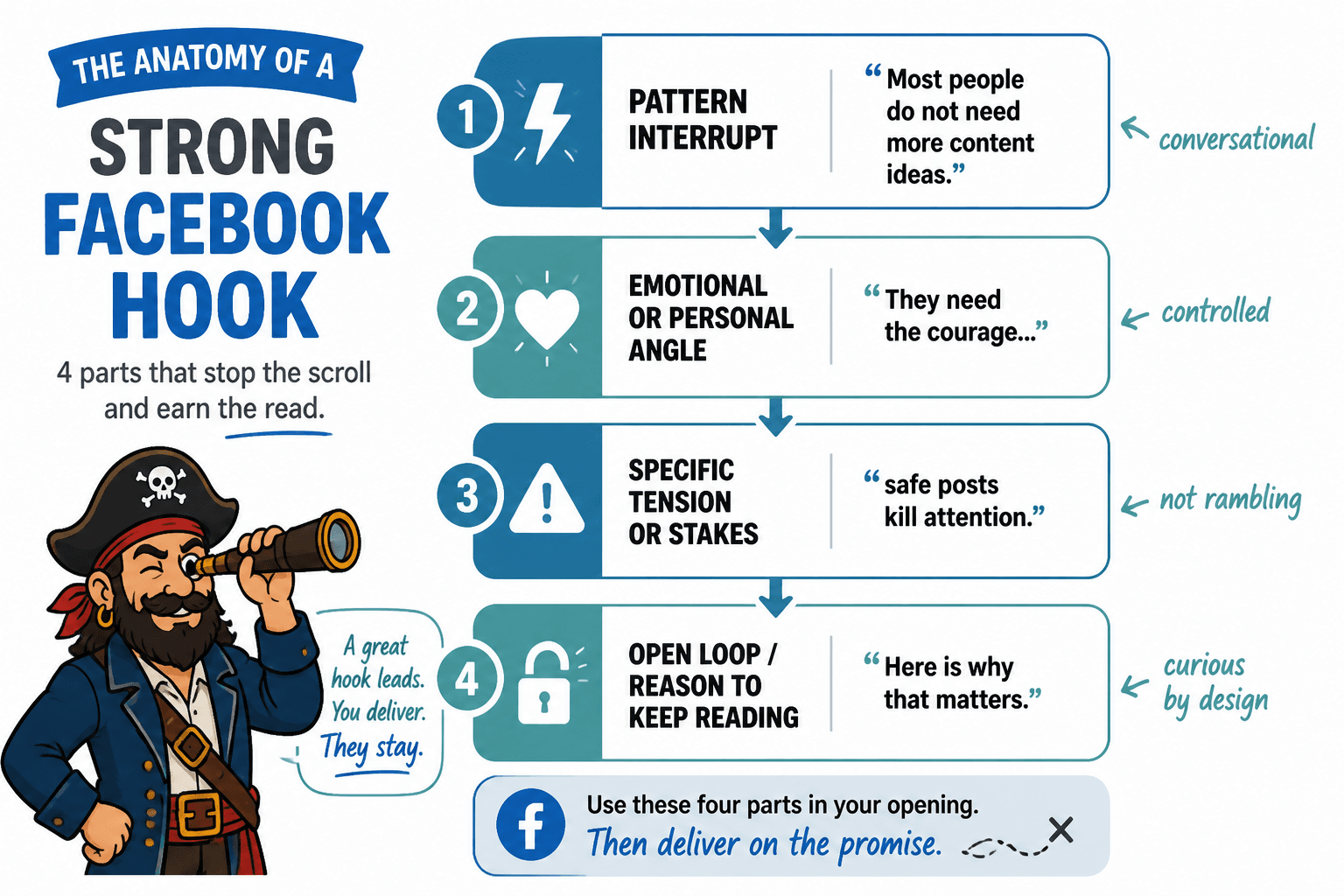
7 types of Facebook long-form hook examples creators can adapt fast
These are not gimmicks. They are practical opening patterns that work because they create movement. Use them as starting points, then make them sound like you.
1. The blunt opinion hook
This works well for rants, industry takes, myth-busting posts, and creator opinions that need a clean opening punch.
Most people do not need more content ideas.
They need the courage to stop posting boring safe ones.
“Authentic content” has become an excuse for underedited content.
Some offers do not have a traffic problem.
They have a clarity problem wearing a traffic costume.
Why this works: it starts with a claim. Not a setup. Not a weather report. A claim. If the reader agrees, they keep going. If they disagree, they may keep going harder.
Template:
- Most people do not need [popular solution]. They need [actual fix].
- [Common phrase] has become an excuse for [real problem].
- Some [audience/problem] do not have a [surface problem]. They have a [deeper problem].
2. The “this happened” tension hook
This is great for story posts, client lessons, behind-the-scenes content, and personal brand posts where the story leads to a useful point.
Last week I deleted a post that took me two hours to write.
It was polished, clever, and completely dead on arrival.
I knew the sales call was going badly when the prospect said, “I read your posts, but I still do not know what you actually sell.”
I almost posted the safer version.
Then I realized the safer version was also the more forgettable one.
Why this works: it opens inside a moment. There is movement already happening, which gives the reader something to follow.
Template:
- Last week I [action], and it exposed [lesson].
- I knew [thing] was going wrong when [specific moment].
- I almost [safe move]. Then I realized [truth].
3. The callout hook
This one works when you want the reader to feel immediately recognized. It is especially useful for coaches, consultants, freelancers, and creators speaking to a clear type of person with a clear recurring problem.
If your Facebook posts get polite likes and zero business, the problem is probably not consistency.
If every post you write sounds “fine” but none of them start conversations, you are likely editing for neatness instead of impact.
If your audience keeps saying “this is so helpful” and still does not buy, your content may be useful but unpositioned.
Why this works: the right reader instantly self-identifies. That is half the battle.
Template:
- If your [content/business result] is happening, the problem is probably not [obvious thing].
- If every [piece of content] feels [frustrating pattern], you may be [real cause].
4. The unpopular truth hook
This is useful when you want to challenge lazy advice or push back on creator myths without sounding like you are trying way too hard to be controversial.
Unpopular truth: long-form posts do not need more storytelling.
They need more point.
Unpopular truth: some “high-engagement” posts are just public journaling with branding attached.
Unpopular truth: clarity beats cleverness more often than creators want to admit.
Why this works: it signals tension fast. But the key is that the payoff has to be real. If your “unpopular truth” is just reheated common sense wearing dark sunglasses, people will notice.
5. The contrast hook
Contrast is one of the easiest ways to create interest without sounding clickbaity. It gives the reader a clear mental shift to follow.
I used to think good Facebook posts needed more personality.
Most of mine needed more structure.
The post that got the most comments was not my best-written post.
It was the one with the clearest tension.
The problem was not that I was posting too little.
The problem was that every post sounded like it was trying not to offend anyone.
Why this works: before-and-after thinking pulls readers in because it offers change, correction, and a lesson in one move.
6. The emotional honesty hook
Used carefully, this can work beautifully on Facebook. The problem is that a lot of creators confuse emotional honesty with vague performance sadness. One creates trust. The other creates secondhand embarrassment.
I was tired of writing posts that sounded competent but not true.
I did not need a better content plan.
I needed to stop hiding behind tidy advice.
The frustrating part was not low reach.
It was knowing I had better things to say than what I was posting.
Why this works: it feels human, but it still has shape. It names a real internal tension and points toward something useful.
7. The direct lesson hook
If you are writing a practical post and do not want to overcook the opening, this is often the cleanest move.
One of the fastest ways to improve a long Facebook post is to cut the first three lines.
Here is what makes most long-form Facebook posts feel longer than they are: the point arrives too late.
A strong rant has four parts: tension, argument, examples, payoff.
Why this works: the value is obvious immediately. No mystery box required.
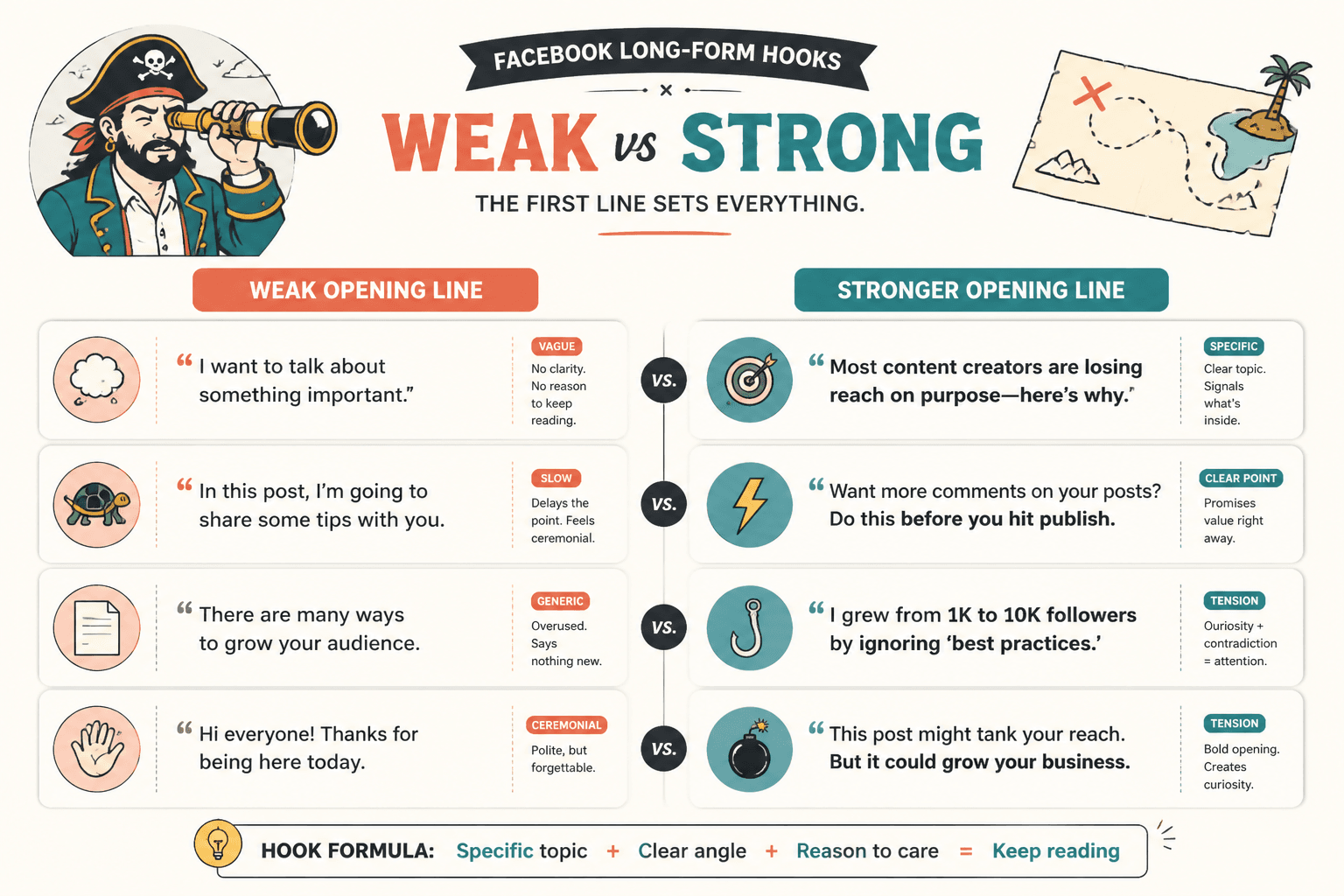
Before-and-after Facebook long-form hook rewrites
Sometimes the easiest way to improve your hook is to see what weak looks like first. Here are a few common misses and sharper rewrites.
| Weak hook | Stronger rewrite |
| I have been thinking a lot lately about content and how it impacts business growth. | Most content does not fail because it lacks value. It fails because nobody feels pulled into it. |
| Story time. I wanted to share something that happened to me recently. | Last Tuesday I opened my draft, read the first paragraph, and knew instantly why the post would flop. |
| Here is something nobody tells you about showing up online. | Showing up online is not the hard part. Showing up with a clear point is. |
| I am seeing so many people making this mistake. | Too many creators are writing Facebook posts like mini webinars when what the platform rewards is readable tension. |
| I was inspired to write this after a conversation. | A client said, “I post all the time, but none of it leads anywhere.” That sentence explains half the content problem on Facebook. |
Notice the difference. The stronger versions get to the actual thing faster. They sound less ceremonial. They do not stand around adjusting the microphone.
How to adapt these hook examples without sounding borrowed
This is where a lot of creators go wrong. They find a hook formula that works, then use it so literally that the post feels prefab. Readers may not always know why something sounds stale, but they can feel it.
The fix is simple: do not start with the template. Start with your actual point.
Use this quick process:
- Write the blunt truth of the post in one sentence
- Identify the tension: what is frustrating, surprising, annoying, or misunderstood here?
- Choose a hook type that fits that tension
- Swap in specific language from your audience, niche, or experience
- Read it out loud and remove anything that sounds overperformed
For example, do not write:
Unpopular truth: consistency is not enough.
That is too vague. It sounds like 4,000 other posts.
Write this instead:
Unpopular truth: posting every day will not help much if every post sounds like the same cautious paragraph in a different shirt.
Now there is texture. There is voice. There is something to picture.
A simple hook formula for Facebook long-form posts
If you want one flexible framework, use this:
- Tension: what is wrong, surprising, frustrating, or misunderstood?
- Specificity: what exact person, situation, or example makes it real?
- Direction: where is this post going and why should the reader care?
That means your hook can be as short as two lines, but it should still imply motion.
Example:
The weird thing about long-form Facebook posts is that they usually do not lose readers because they are too long.
They lose readers because the writer takes forever to arrive anywhere interesting.
Tension: long-form posts lose readers.
Specificity: the problem is not length, it is delay.
Direction: the post will probably explain how to fix that.
The bigger point is simple: clearer structure and clearer writing make the piece more useful. That is usually what makes the ending land better too.