
Most people ask how long blog titles should be because they want a neat little number. Something like 55 characters. Or 8 words. Or “keep it under 60 unless Mercury is in retrograde.”
That would be convenient. It would also be a bit nonsense.
If you are trying to figure out how long should blog titles and headlines be in 2026, the better answer is this: long enough to be clear, specific, and clickable, but short enough to scan fast and display well in search, email, social shares, and mobile layouts.
So no, there is not one perfect headline length. There is a useful range. There are tradeoffs. And there are plenty of titles that fail not because they are too long, but because they say absolutely nothing worth reading.
This article will help you choose title length based on what actually matters: clarity, search intent, platform display, specificity, and human attention span. Not superstition dressed up as “best practice.”
For the main guide behind this topic, visit the parent guide.
Here is the short answer
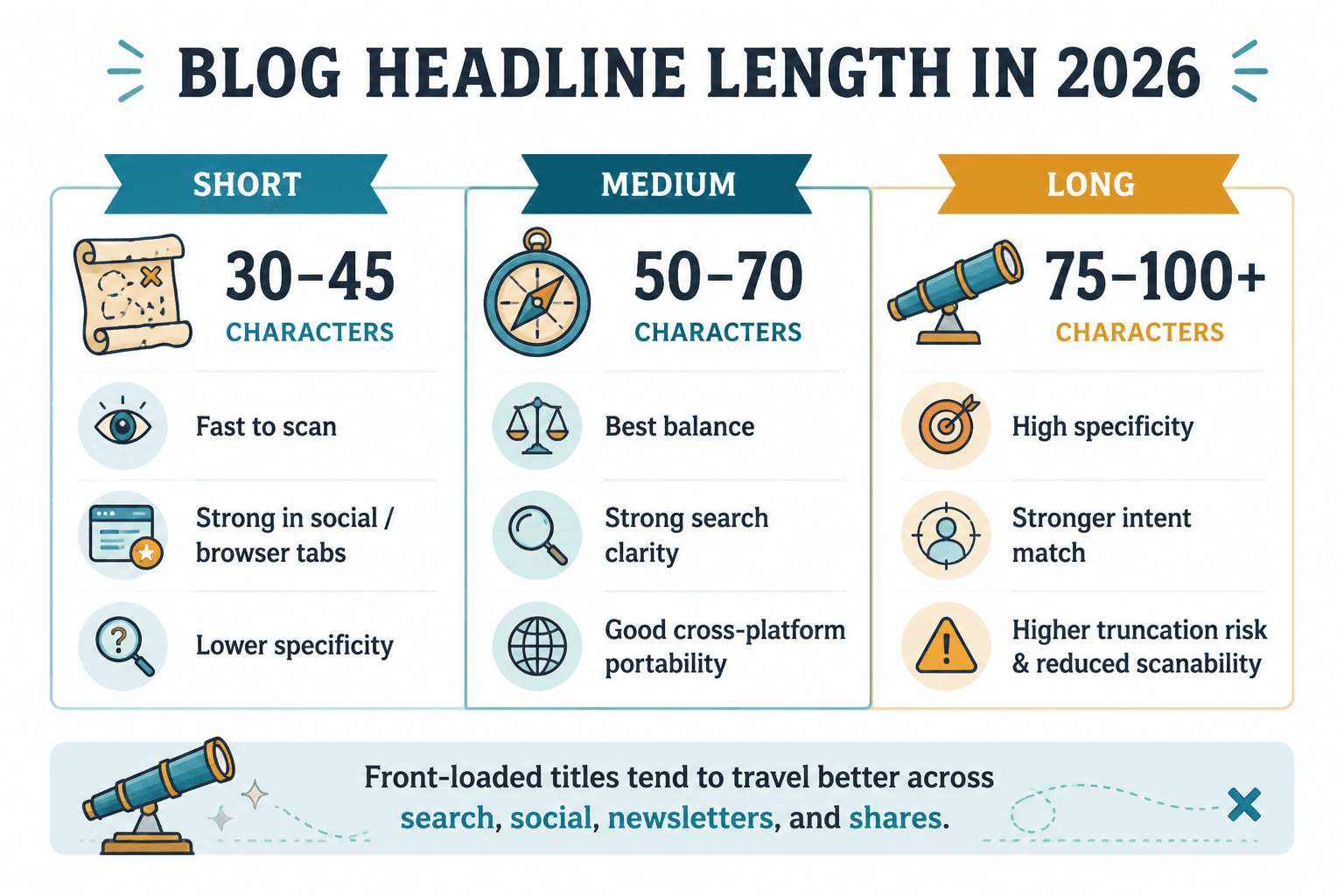
For most blog posts in 2026, a strong working range is:
- 50 to 70 characters for SEO-friendly titles that usually display well in search
- 7 to 12 words for readable, specific headlines that do not drag
- Up to around 80 characters if the extra words add real clarity or search relevance
That is the practical range. Not a law.
A 42-character title can outperform a 63-character title. A 13-word headline can beat a 7-word one. A slightly longer title often wins when it includes the thing the reader is actually searching for.
Length matters. But title quality matters more.
What actually determines the right title length
The right title length depends on a few things working together. If you ignore those and obsess over character count alone, you will end up trimming useful words and keeping weak ones. That is how people create titles like “Content Strategy Tips for Better Growth.” Short. Clean. Completely forgettable.
1. Search result display
Search engines do not count your title the way a robot accountant counts receipts. They display titles based on pixel width, device type, and layout. That means two titles with the same character count can display differently.
Still, a useful rule of thumb is that titles often begin truncating somewhere around the equivalent of roughly 50 to 60-ish characters on many search results, sometimes a little more, sometimes less. It varies. That is why writing for an exact number is not especially smart.
What matters more is front-loading the important words. If your key topic appears late in the title, you are more likely to lose the useful part when it gets cut off.
2. Reader clarity
People do not click titles because they admire your restraint. They click because the title tells them what they will get.
If a short title is clear, great. If adding four more words makes the benefit obvious, add the four words. “Email Funnels for Coaches” is fine. “Email Funnels for Coaches That Turn Readers Into Consult Calls” is longer, but also much more useful.
3. Search intent
Some topics need extra words because the search itself is more specific. Someone searching for “best homepage headline examples for consultants” is not looking for a vague little title like “Better Homepage Headlines.” They want precision. The title should reflect that.
Specific search intent often rewards slightly longer headlines because they better match what the reader actually wants.
4. Distribution outside your blog
Your title does not live only on your website. It can show up in search, social previews, newsletters, Slack shares, browser tabs, link roundups, and AI summaries. A title that works beautifully in one place can feel clunky somewhere else.
That is one reason clean, front-loaded titles tend to age better. They travel better.
Best headline length ranges for different goals
Not every blog title has the same job. Some are trying to rank. Some are trying to earn clicks from existing subscribers. Some are trying to build authority. Some need to sound more editorial. So the right length depends partly on the goal.
| Goal | Useful title range | What matters most |
|---|---|---|
| SEO-driven blog post | 50 to 70 characters | Keyword clarity, scanability, front-loaded topic |
| Thought leadership article | 55 to 80 characters | Specific angle, credibility, intrigue without vagueness |
| Newsletter-style article title | 40 to 65 characters | Readability, voice, curiosity, clarity |
| How-to or tutorial post | 55 to 75 characters | Clear outcome, practical phrasing, topic match |
| List post or examples post | 50 to 70 characters | Useful specificity, not fake hype |
| Opinion or contrarian article | 45 to 70 characters | Sharp claim, not vague provocation |
Again, these are ranges, not commandments carved into a content tablet.
How long should blog titles and headlines be in 2026 for SEO?
If your main concern is SEO, keep your primary topic close to the front, aim for a title that is easy to scan, and do not stuff every keyword variation into one sad sentence.
A practical SEO title in 2026 usually does four things:
- Includes the core topic naturally
- Makes the benefit or angle obvious
- Avoids unnecessary filler words
- Still sounds like a human wrote it
Here is what that looks like in practice.
Weak SEO title
Everything You Need to Know About Blog Title Length for Better SEO Results in 2026 and Beyond
Too long. Bloated. Sounds like it was generated by an intern trapped in a keyword spreadsheet.
Stronger SEO title
How Long Should Blog Titles and Headlines Be in 2026?
Clear topic. Natural phrasing. Matches a likely search. No fluff hanging off the back like spare luggage.
If you want more help with title structure itself, the blog titles and headlines hub is a sensible next stop.
Why short titles are not automatically better
People love to repeat that shorter is better because shorter is easier to remember. Sometimes true. Also wildly incomplete.
Short titles work when the idea is already strong, clear, and specific. They fail when they become vague little stubs.
Compare these:
- Too short and vague: Better Headlines
- Short and useful: Better Headlines for SEO
- Slightly longer and much stronger: How to Write Better Headlines for SEO Without Sounding Generic
The third one is longer, but it is also doing a real job. It tells the reader what the article is about and hints at the pain point. That is usually worth a few extra words.
There are definitely times when shorter wins, especially if the phrase is already familiar or the concept is naturally punchy. If you want to see where brevity actually helps instead of just sounding disciplined, read when short blog titles and headlines beat long ones.
Why long titles are not automatically worse
Longer titles can work very well when they add one or more of these things:
- A clearer promise
- A sharper audience fit
- A meaningful qualifier
- A better search match
- A stronger contrast or angle
For example:
- Basic: Website Copy Tips
- Better: Website Copy Tips for Consultants
- Best: 11 Website Copy Tips for Consultants Who Need More Inbound Leads
The longer version is not better because it is longer. It is better because it is more useful to the right person.
Of course, longer titles can also become cluttered, repetitive, and desperate. If your title contains three promises, two colons, and a phrase like “that will skyrocket your traffic,” maybe step away from the keyboard for a moment.
The real sweet spot: enough detail without drag
If you want a simple working principle, use this:
Say the exact thing the right reader wants, in as few words as you can, without making it vaguer.
That is the sweet spot.
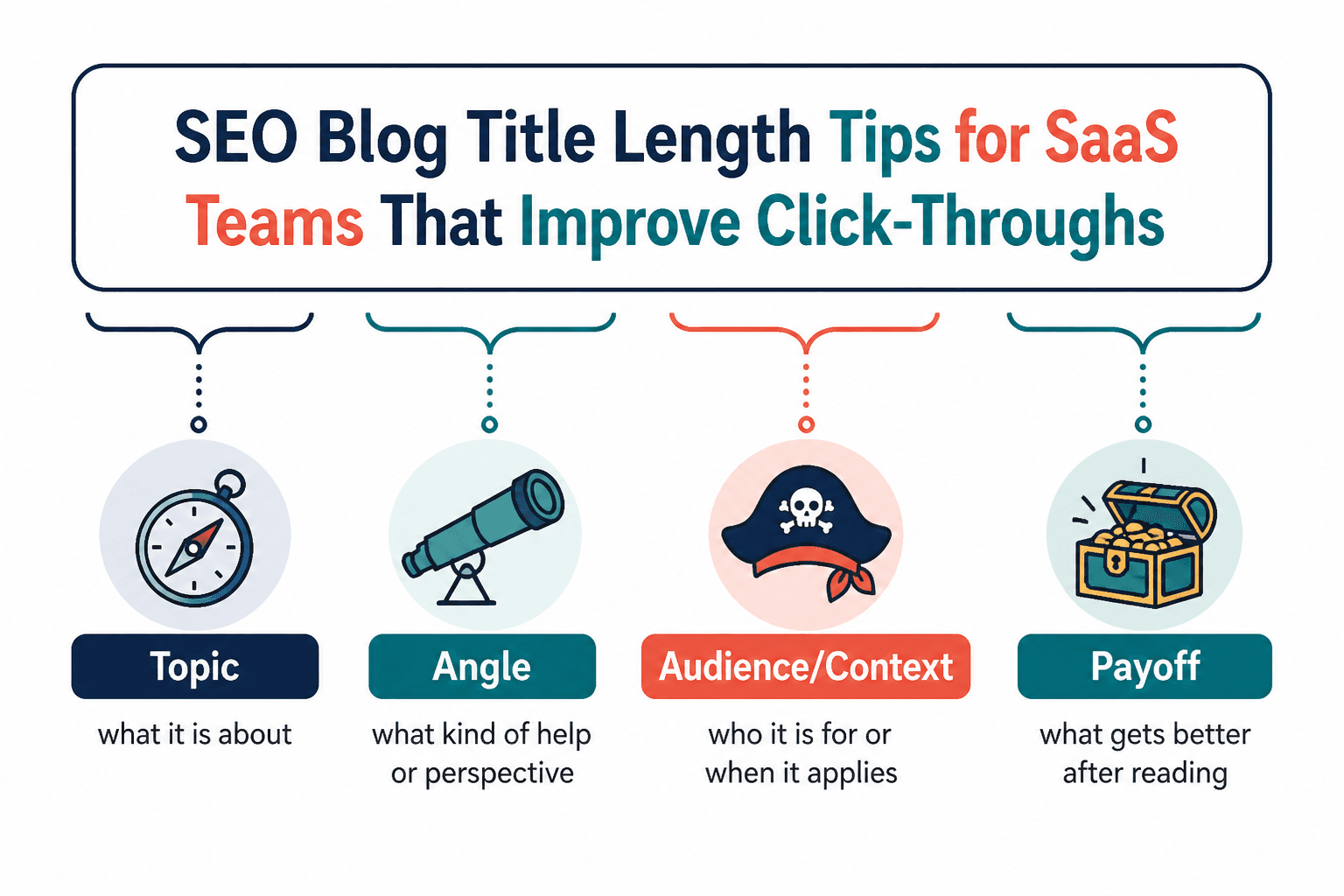
For most articles, that means your title should contain four essential ingredients:
- The topic — what this is about
- The angle — what kind of help or perspective this gives
- The audience or context — if useful
- The payoff — what gets better after reading
You do not need all four every time. But if your title is weak, one of these is usually missing.
Character count vs word count: which matters more?
Both matter a bit. Neither should run your life.
Character count is more useful for display concerns, especially search results and tight interface spaces.
Word count is more useful for readability and rhythm. Most titles that feel clean and natural land somewhere between 7 and 12 words, with some excellent ones shorter and some perfectly good ones longer.
If you force me to choose which matters more, I would say clarity and front-loading matter more than both. A 72-character title that starts strong can outperform a 56-character title that meanders into the point halfway through.
A quick practical check
- If the first 40 to 50 characters already tell the reader the topic, you are usually in decent shape
- If the last few words are optional filler, cut them
- If the extra words create needed specificity, keep them
Examples: bad title length decisions and better rewrites
Length problems usually show up in one of two ways: too short to mean much, or too long to stay sharp.
Example 1: too short
Blog Headline Tips
This is not concise. It is undercooked.
Better: Blog Headline Tips That Improve Clicks Without Clickbait
Example 2: too long
The Complete Guide to Understanding Exactly How Long Your Blog Headlines Should Be for SEO and Better Reader Engagement in 2026
That title is trying to do cardio.
Better: How Long Should Blog Headlines Be in 2026?
Example 3: short but generic
Write Better Titles
Better: How to Write Better Blog Titles That Earn More Clicks
Example 4: long but justified
How to Write Blog Titles for Service Businesses That Need Qualified Traffic, Not Empty Clicks
Longer, yes. But every part earns its place. It narrows the audience, clarifies the result, and filters out the wrong expectation.
If your current titles feel flat, read how to rewrite boring blog titles and headlines. A lot of title issues look like length problems when they are actually clarity problems.
How to choose the right title length before you publish
Here is a simple process you can use in a few minutes.
1. Write the clear version first
Do not start by trying to be clever. Start by naming the thing plainly.
Example: How Long Should Blog Titles Be for SEO?
2. Add specificity only where it helps
Ask what useful detail would make the title more compelling or more accurate.
Example: How Long Should Blog Titles and Headlines Be in 2026?
3. Cut filler words
Remove phrases like:
- everything you need to know about
- the ultimate guide to
- for better results
- and why it matters
- in a simple step-by-step way
Most of those phrases add bulk, not value.
4. Front-load the important words
If the topic or core keyword appears late, move it up if you can. This helps with scanability and display.
5. Read it out loud
If it sounds stiff, overpacked, or weirdly formal, it probably reads that way too. Titles are tiny pieces of copy. Rhythm matters.
6. Check if every word is earning rent
Harsh but useful. If a word is not adding clarity, specificity, relevance, or appeal, evict it.
Common title length mistakes people keep making
- Cutting too aggressively: They trim the title until it becomes generic mush
- Adding fluff for SEO: They stack keywords and end up with robotic sludge
- Hiding the topic too late: The useful phrase appears after the part likely to be truncated
- Using long intros before the point: “A helpful guide to understanding…” is not doing anyone a favor
- Confusing cleverness with clarity: Cute titles can work, but not when nobody knows what the article is about
If you want a fuller breakdown of what tends to hurt title performance, have a look at blog titles and headlines title templates and mistakes that hurt performance.
Does title length affect click-through rate?
Yes, but not in a neat one-direction way.
A title that is too short can lower clicks because it is vague. A title that is too long can lower clicks because it is hard to scan, gets truncated, or feels exhausting before the article even starts. The best-performing titles usually land in the middle because they balance clarity and brevity.
But click-through rate is shaped by more than length. It also depends on:
- Topic demand
- Search intent match
- Title strength
- Competing results on the page
- Brand trust
- Meta description support
- The promise the title makes
So yes, title length affects clicks. No, shaving off three words is not a growth strategy.
Good title formulas that tend to stay in the right range
Some title patterns naturally help you stay clear without turning into headline soup.
- How to + outcome
How to Write Blog Headlines That Get More Qualified Clicks - Question + timeframe or context
How Long Should Blog Titles and Headlines Be in 2026? - Number + audience + payoff
9 Blog Title Formulas for Consultants Who Need Better SEO - Mistake + consequence
Blog Title Mistakes That Quietly Kill Click-Through Rate - Comparison
Short vs Long Blog Titles: What Actually Performs Better?
If you are building a repeatable headline workflow, you might also want the broader blog SEO writing section and the blog article systems section. Better titles are easier when your article structure is not a mess.
And if you want tools that help you test, compare, and tighten headline options without treating software like a mystical oracle, see best SEO headline tools and content planning tools for blog titles and headlines.
The right title length is whatever lets the idea stay clear, specific, and worth clicking. The moment trimming starts hiding the benefit, the title is getting shorter but not better.