
Most welcome email mini onboarding flows are not bad because they are too short.
They are bad because they sound like they were assembled from the same dusty box of internet manners: “Welcome to the community.” “Here’s what to expect.” “We’re so excited you’re here.” Then a polite little shrug where trust, momentum, and actual direction should have been.
If someone just joined your list, followed your lead magnet, or signed up for your newsletter, that moment matters more than people treat it. It is one of the few times you have full attention without having to beg for it. Waste that with generic copy and you train people to ignore you early. Not ideal.
Here’s how to improve welcome email mini onboarding flows without sounding generic: stop writing them like polite admin messages and start writing them like a useful guided first experience. Your job is not just to say hello. Your job is to orient the reader, build trust fast, show what makes your stuff worth opening, and make the next step feel obvious.
If you need the broader welcome email basics first, this whole cluster will help: email newsletter writing and welcome email systems. You can also pair this article with how to write welcome emails without sounding salesy or robotic, how to start welcome emails without a weak opening, and best welcome emails ideas and examples for creators.
If you want the bigger picture, start with the parent guide.
What a mini onboarding flow is actually supposed to do
A mini onboarding flow is a short sequence of emails that helps a new subscriber get oriented quickly. Usually that means 2 to 5 emails sent over a few days. Not 14 emails. Not a tiny memoir. Not a stealth sales funnel in a fake mustache.
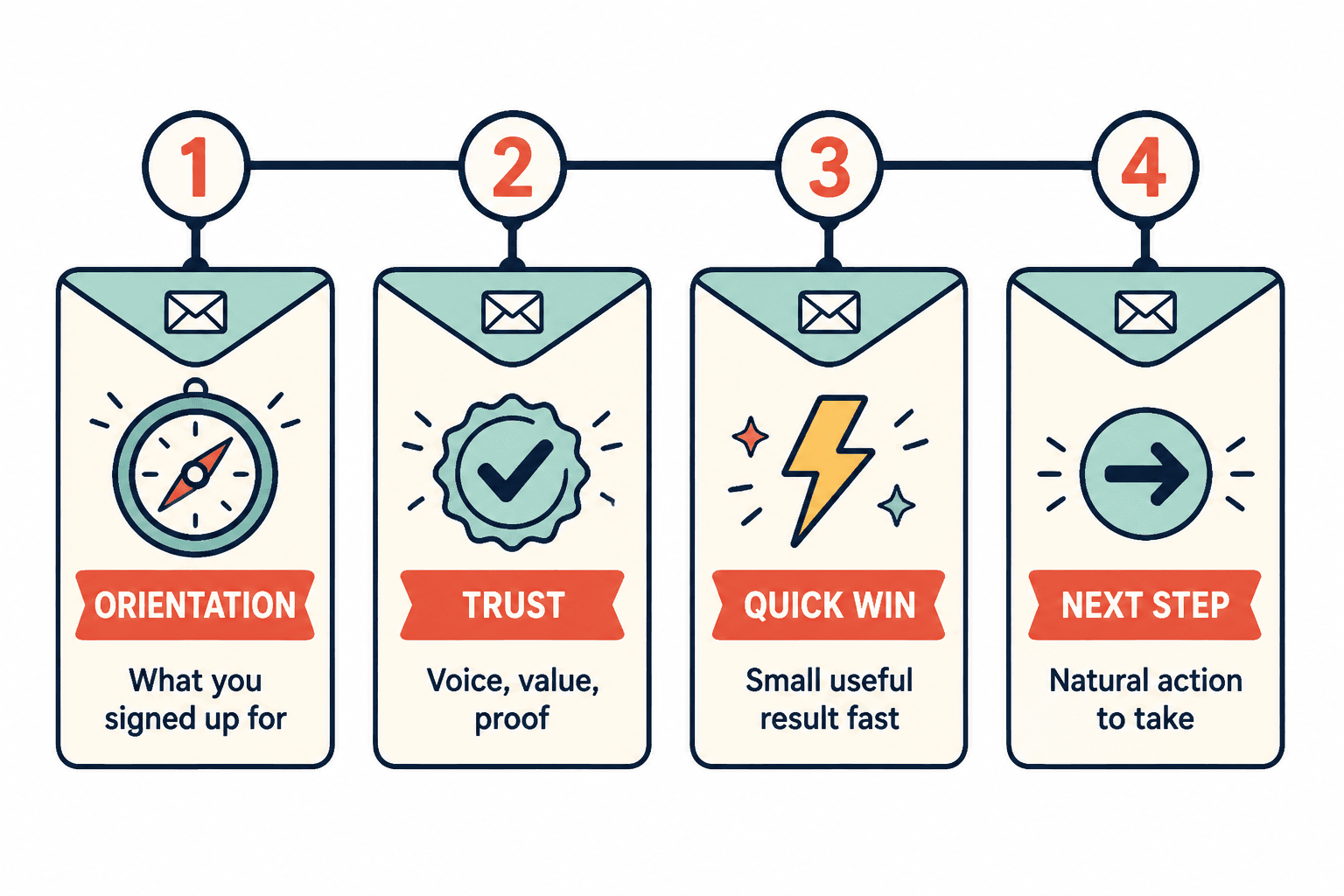
The best flows do four things well:
- They explain what the subscriber signed up for
- They show the voice, value, and point of view behind your brand
- They help the reader get a small win or useful shift fast
- They lead naturally to a next action, not a random pile of links
That is it. If your welcome sequence tries to do everything at once, it usually does none of it clearly.
Why generic welcome flows feel generic so fast
Generic does not just mean “boring.” It usually means the flow could belong to almost anyone.
That happens when the copy is full of vague niceness, broad promises, and standard issue creator language. The reader learns almost nothing except that you know how to use an email platform.
Here’s what tends to make welcome flows feel bland:
- They open with generic gratitude instead of relevance
- They explain logistics but not value
- They talk about the brand more than the reader’s problem
- They make big claims with no proof, personality, or specifics
- They cram in every resource you have ever made
- They use the same flat tone in every email
- They force a pitch before trust exists
The reader is not asking, “Did this brand remember to welcome me?”
The reader is asking, even if silently, “Is this going to be useful, relevant, and worth more of my attention?”
The easiest way to improve welcome email mini onboarding flows without sounding generic
Build the flow around a clear transformation in understanding, not around a checklist of brand facts.
In plain English: each email should move the subscriber from one mental state to a better one.
- From unsure to oriented
- From skeptical to interested
- From curious to trusting
- From passive to engaged
- From subscriber to likely buyer, client, reader, or regular opener
That shift is what makes the flow feel intentional instead of generic. You are not just “sending the welcome sequence.” You are guiding a new person into your world with some actual care and structure.
A simple 4-email structure that works
You do not need some elaborate lifecycle masterpiece. For most creators, consultants, coaches, writers, and solo businesses, a short welcome flow like this does the job well.
Email 1: Orient and reassure
This email should answer three things quickly:
- What did they sign up for?
- What kind of help or content are they going to get?
- What should they do next?
Do not bury the value under a paragraph of ceremonial gratitude.
Weak: “Welcome to my newsletter. I’m so excited to have you here. I’ll be sharing insights, tips, and updates to help you on your journey.”
Better: “You signed up for practical emails on content, positioning, and marketing systems that help small brands sound sharper and sell more cleanly. Expect useful ideas, honest opinions, and the occasional removal of nonsense.”
That second version has a spine. It says something.
Email 2: Deliver a fast win
The best second email proves your usefulness quickly. Give the reader something they can apply without needing a course, a call, or a mood board.
This can be:
- A small framework
- A common mistake and fix
- A before/after example
- A short checklist
- A smart shortcut
If your whole brand promise is “I help people communicate clearly,” then your welcome sequence should not make them wait two weeks to experience clarity.
Email 3: Build belief
This is where you show how you think and why your approach is worth trusting.
Not by saying “I’m passionate about helping people.” That line has done enough damage.
Use this email to explain a core belief, a contrarian take, a useful distinction, or a short case-style example. Give the reader a reason to remember your angle.
For example:
- A writing coach might explain why most weak content is not a consistency problem but a clarity problem
- A consultant might show why a messy offer breaks conversion before bad traffic does
- A creator educator might explain why small audiences often outperform broad ones when the audience is actually relevant
Email 4: Point to the next step
Now that the subscriber knows what you do, has seen your style, and has gotten something useful, you can invite a next action.
That next step might be:
- Read your best article
- Reply with a specific answer
- Book a call
- Check out a resource
- Join a waitlist
- Browse a relevant offer
The key word is relevant. The CTA should fit what they just learned about you, not feel like a sudden cashier jump-scare.
What to say instead of generic welcome email filler
Most generic lines are not evil. They are just empty. They take up space where specificity should go.
Generic line: “Thanks for joining”
Better: remind them what they joined for and why that matters.
“You’re in. Which means you’ll now get practical emails on writing stronger client-facing content, fixing fuzzy messaging, and making your expertise easier to trust.”
Generic line: “Here’s what to expect”
Better: be concrete about cadence, topics, and tone.
“I usually send one email a week. Sometimes two if I have something actually worth sending. Expect sharp writing advice, positioning fixes, and examples that show what works and what just looks productive.”
Generic line: “I’m excited to have you here”
Better: replace emotion wallpaper with a useful statement.
“The point of these emails is simple: help you make your content clearer, more credible, and easier for the right people to act on.”
Generic line: “Be sure to follow me everywhere”
Better: give one focused action, not six desperate ones.
“If you want the best place to keep going after this, start with this guide on welcome emails: welcome email systems.”
Use specificity to create personality without trying too hard
A lot of people hear “don’t sound generic” and immediately start adding forced quirk. Random jokes. Weird metaphors. Overfriendly lines. Brand voice cosplay.
You do not need more glitter. You need more specificity.
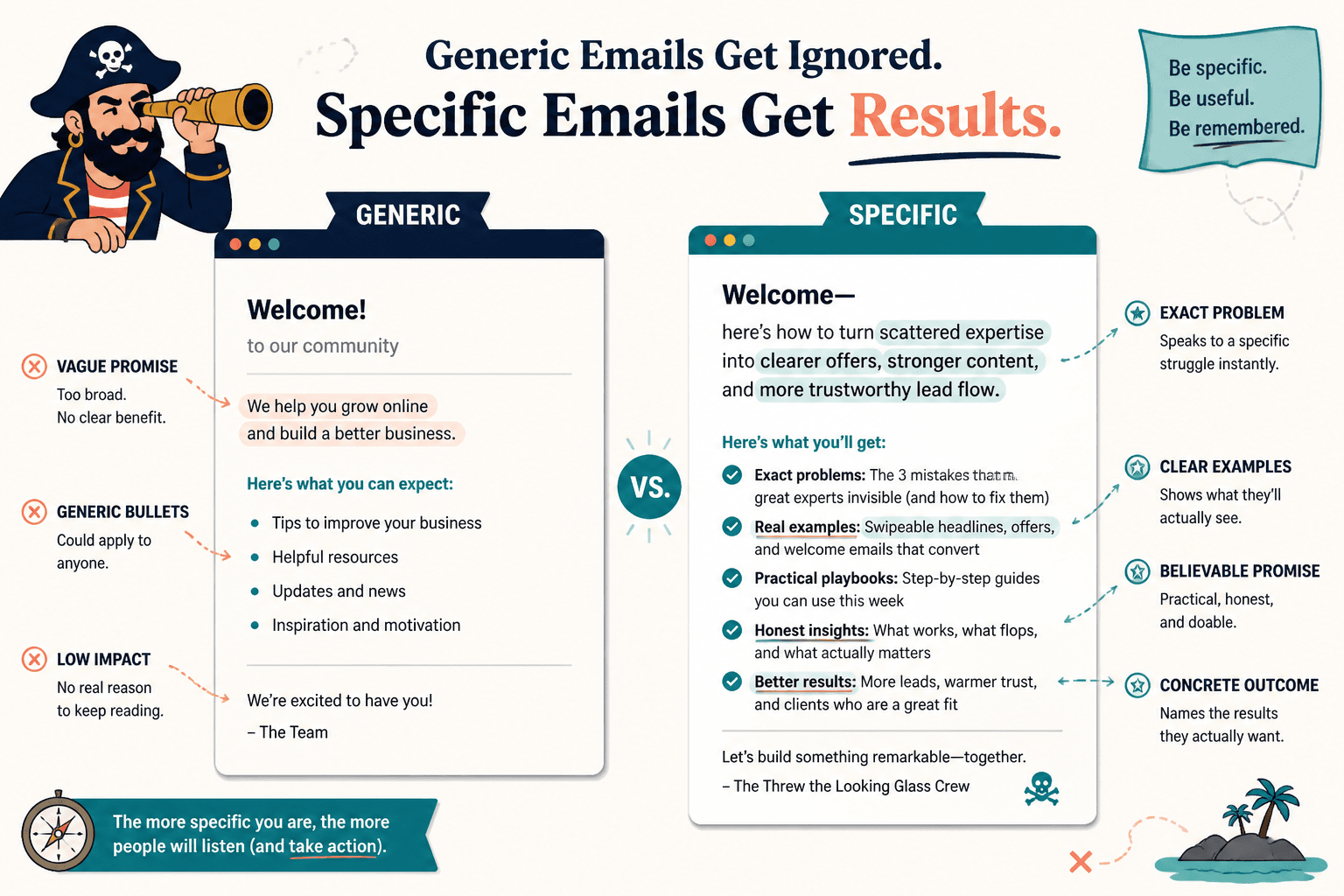
Specificity creates personality because it reveals how you think. It shows taste, standards, and priorities. If you say you help consultants “grow online,” you sound like everyone. If you say you help consultants turn scattered expertise into clearer offers, stronger content, and more trustworthy lead flow, now we are somewhere.
Good specificity can show up in:
- The exact problem you solve
- The kinds of examples you use
- The mistakes you call out
- The tone of your promises
- The kind of result you emphasize
That is where a real voice comes from. Not from typing “hey friend” and hoping for chemistry.
A practical writing formula for each email
If you tend to freeze when writing email sequences, use this simple structure:
- Context: Why they are getting this email
- Relevance: What this means for them
- Value: One useful idea, example, or resource
- Direction: One clear next step
Here is a stripped-down example:
Context: You signed up for content strategy emails for small personal brands.
Relevance: If your content is decent but still not pulling leads or trust, the problem is often not effort. It is packaging.
Value: One quick fix: before posting, ask “Is my actual point visible in the first two lines?” If not, your reader is doing too much work too early.
Direction: If you want more help with openings, read this guide on stronger welcome email starts.
That structure works because it moves. It does not stall inside vague pleasantries.
How to make the sequence feel cohesive instead of repetitive
One common problem with mini onboarding flows is that every email sounds like the same welcome email wearing a different hat.
To avoid that, give each email a distinct job and emotional texture.
| Job | Main feeling | |
|---|---|---|
| 1 | Orient | Clarity |
| 2 | Help quickly | Relief |
| 3 | Build belief | Trust |
| 4 | Prompt next step | Momentum |
That does not mean every email needs a dramatic tonal reinvention. It means each one should earn its place. If Email 2 says the same thing as Email 1 but slightly longer, it is filler. People can smell filler from space.
Common mistakes that flatten welcome sequences
The bigger point is simple: clearer structure and clearer writing make the piece more useful. That is usually what makes the ending land better too.