
Most weak newsletter subject lines do not fail because they are too short, too long, or missing an emoji. They fail because the opening is vague, generic, and weirdly proud of saying almost nothing.
You have probably seen the usual offenders: “A quick thought,” “Big update,” “Something I’ve been thinking about,” or the timeless classic, “Newsletter #27.” These are not subject lines. They are labels. And labels do not earn opens.
If you want better newsletter subject lines, especially as a personal brand, you need better openers. Not louder ones. Not more clickbaity ones. Better. More specific. More relevant. More clearly worth a busy person’s attention.
This is what we are fixing here: weak opener habits that make your emails easy to ignore, and the practical rewrites that make them sharper without turning you into an inbox carnival barker. If your current subject lines sound polite but forgettable, this should help fast.
If you want the bigger picture, start with the parent guide.
Why personal brands keep writing weak subject line openers
Personal brands usually do not write bad subject lines because they are lazy. They write bad ones because they are trying to sound smart, warm, and professional all at once.
That mix tends to produce mush.
You end up with subject lines that are technically pleasant but strategically useless. They hint at a topic without making it feel urgent, relevant, or concrete. They sound like they were written by someone hoping the subscriber will do the work of caring.
Readers do not do that work. They scan. They decide in seconds. Your subject line opener needs to carry its weight immediately.
For personal brands, this matters even more because your emails are usually tied to trust. You are not just selling a product. You are building recognition around your ideas, point of view, and usefulness. Weak openers make you sound less clear than you are, which quietly damages authority over time.
If you want a broader foundation for this, the main newsletter subject lines guide is worth bookmarking. But let’s stay focused on the opening problem.
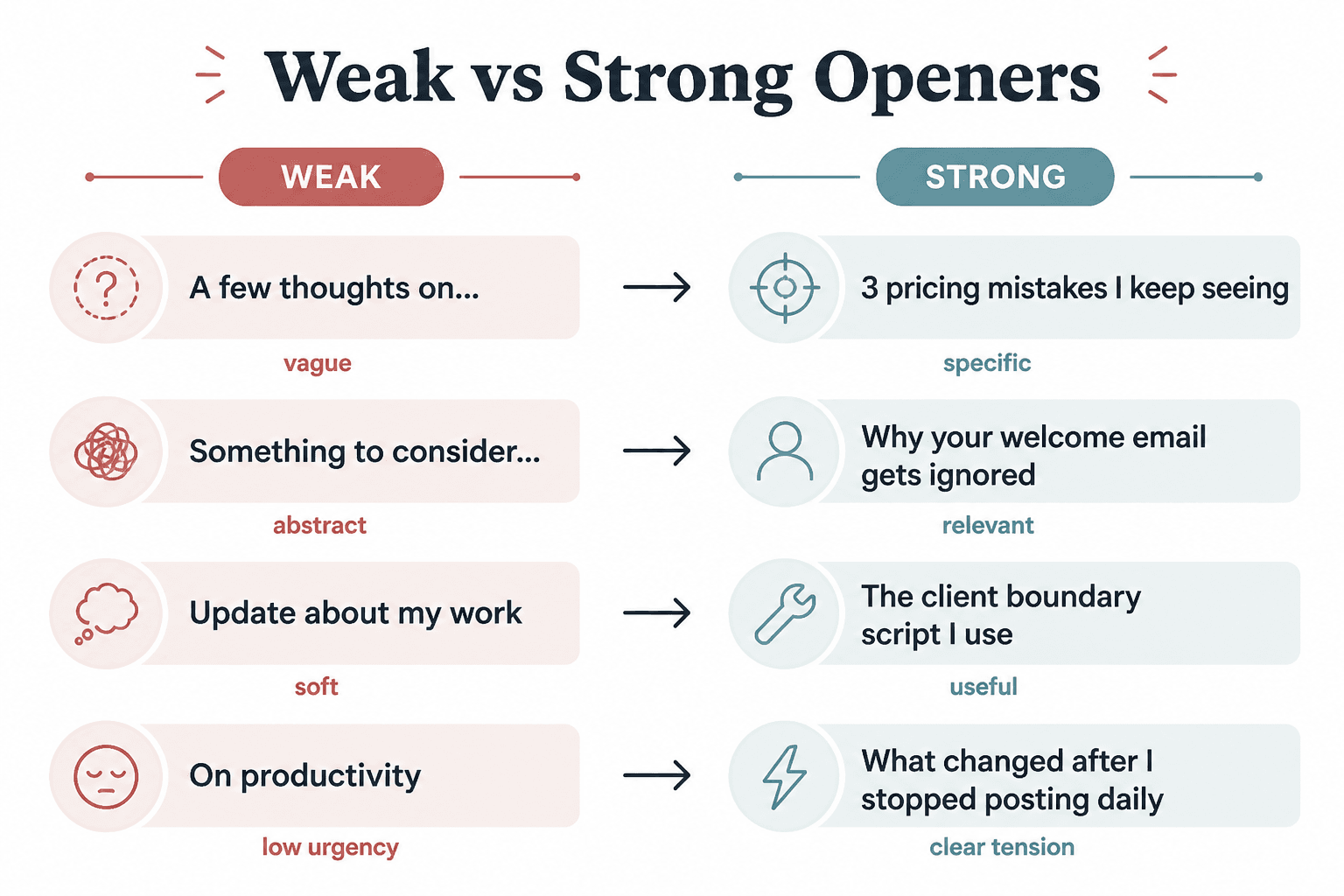
What a strong opener actually does
A strong opener does not need to be clever. It needs to create a clean reason to open.
Usually that reason comes from one of five things:
- Specificity: it names something concrete
- Relevance: it connects to a known problem, desire, or situation
- Tension: it suggests a mistake, contrast, or surprising angle
- Usefulness: it promises a practical payoff
- Curiosity with boundaries: it creates interest without becoming a cheap teaser
Weak openers usually do the opposite. They use abstract nouns, soft language, and filler phrases that add tone but remove force.
If the first few words of your subject line could fit on almost anyone’s email, they are probably too weak for yours.
The weak opener patterns ruining better newsletter subject lines
Let’s get specific. These are the common opener patterns that make personal brand newsletters easier to skip.
1. The vague thought opener
Examples:
- A thought on growth
- Something I’ve noticed
- A quick reflection
- Some thoughts for today
The problem is not that these are calm. The problem is that they do not tell the reader why this thought matters. “A thought” is not a hook. It is a shrug in subject line form.
Better rewrites:
- The growth advice that wastes most creators’ time
- What I noticed after reviewing 50 weak landing pages
- A simple fix for content that gets polite silence
- The reason your newsletter sounds smart but feels flat
2. The announcement opener
Examples:
- Big update
- An announcement
- I am excited to share
- News from me
Unless your readers are already deeply invested in your every movement, they do not care about “news from me.” They care about what the update means for them.
Better rewrites:
- I changed how I write content offers. Here is why.
- The new free resource for fixing weak subject lines
- I rebuilt my newsletter format to make it more useful
- What is changing in these emails and what you will get now
3. The fake intimacy opener
Examples:
- Just being honest
- A personal note
- Real talk
- Something vulnerable
This can work occasionally, but most of the time it feels like emotional packaging around an ordinary email. Readers have learned to be suspicious of subject lines that ask for emotional attention before proving there is anything useful inside.
Better rewrites:
- The business advice I ignored for too long
- Why I stopped writing “valuable content” for everyone
- The pricing mistake I kept explaining away
- What burnout looked like in my content, not just my calendar
4. The broad topic opener
Examples:
- On productivity
- About content strategy
- Marketing thoughts
- Let’s talk about writing
Broad topics feel safe to the writer and dull to the reader. They do not signal a clear angle. A strong opener narrows the conversation.
Better rewrites:
- The productivity habit that makes your writing worse
- Content strategy is not your problem. Packaging probably is.
- The marketing emails people delete before the first sentence
- Why good writers still send weak newsletters
5. The cryptic opener that thinks it is intriguing
Examples:
- This changed everything
- Well, that happened
- I did not expect this
- Oof
This style can work if you already have a highly engaged audience that opens nearly everything. Most personal brands do not. For everybody else, cryptic usually just means ignorable.
Better rewrites:
- The tiny subject line change that lifted reply rates
- What happened when I stopped writing clever email intros
- The result of sending shorter, sharper newsletters for 30 days
- Why my “smartest” emails kept underperforming
How to fix a weak opener without sounding generic
You do not need a giant brainstorming ritual here. Most weak subject line openers can be improved by running them through a simple filter.
The 4-part opener fix
- Find the real point. What is the email actually about? Not the polite topic. The real point.
- Name the tension. What is going wrong, changing, improving, or getting challenged?
- Add specificity. Use a concrete outcome, audience, mistake, or scenario.
- Trim the throat-clearing. Cut opening filler like “a thought on,” “some notes about,” or “I wanted to share.”
Here is what that looks like in practice.
| Weak opener | What it is trying to say | Stronger subject line |
|---|---|---|
| A quick thought on consistency | Most people are posting often but not saying anything memorable | Consistency is useless if your ideas are forgettable |
| Something I’ve been thinking about lately | I have changed my opinion on niche positioning | I think most niche advice is too broad to help |
| Marketing update | I changed my email strategy and learned something useful | Why I stopped writing newsletters like mini blog posts |
| A personal note | I hit burnout and it showed up in my content quality | The content signs I was burning out before I admitted it |
If you want more formulas without drifting into bland fill-in-the-blank territory, this piece on subject line formulas without sounding generic is a useful next step.
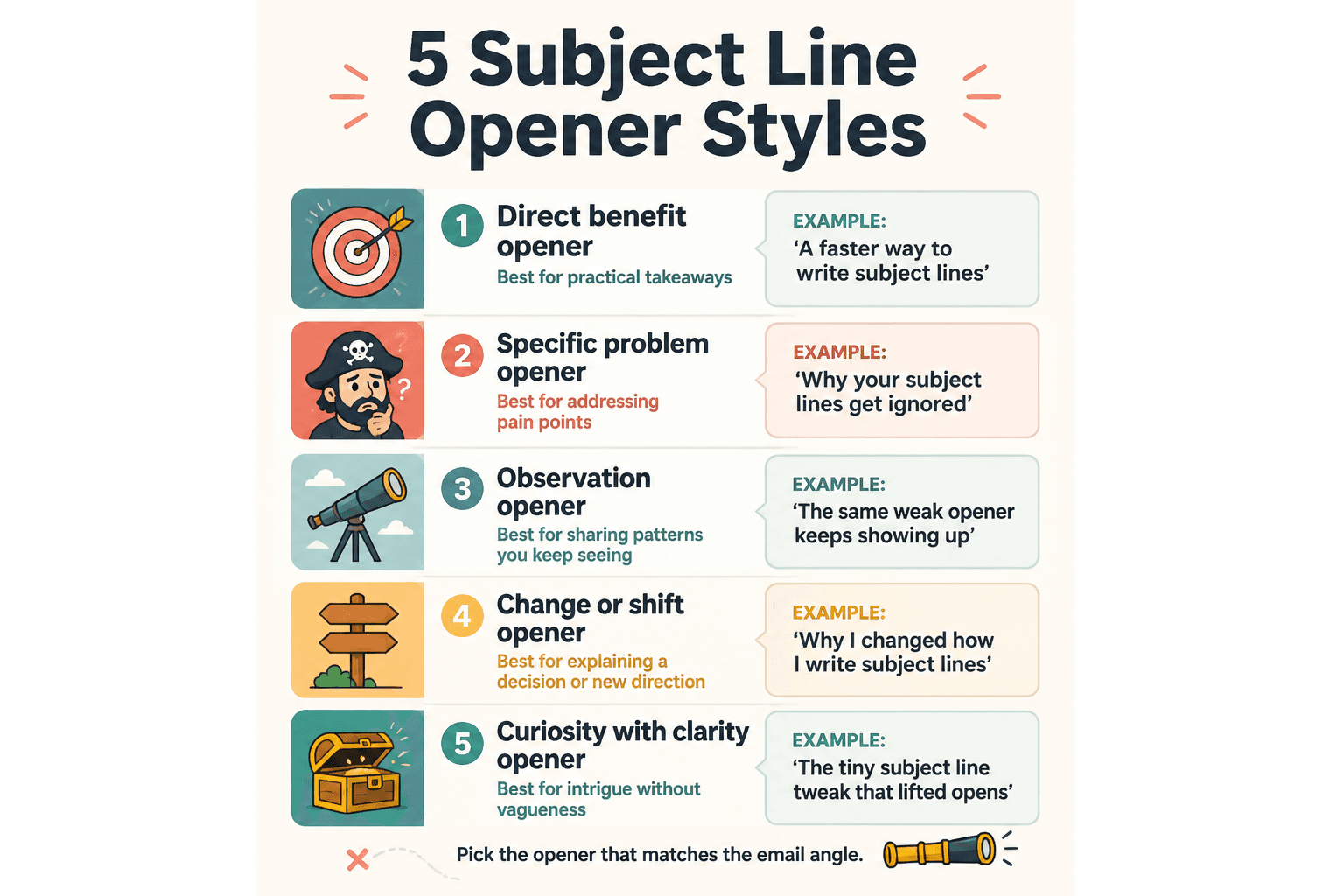
Better newsletter subject lines usually start with these opener types
You do not need infinite creativity. You need a handful of opener styles that actually fit personal brand emails.
Problem-first opener
Good when the email helps the reader avoid a mistake or solve something specific.
- Why your newsletter sounds fine but gets ignored
- The mistake making your welcome emails forgettable
- Your subject line is not too short. It is too vague.
Contrarian opener
Good when you have a real opinion, not just a recycled “hot take” in a fake leather jacket.
- Most email advice rewards the wrong kind of open
- You do not need curiosity gaps. You need clearer angles.
- “Shorter subject lines win” is not useful advice
Specific payoff opener
Good when the email delivers a clear practical result.
- 3 subject line fixes for low open-rate newsletters
- A cleaner way to write newsletter intros that get read
- How to make personal brand emails feel less self-important
Observation opener
Good when you are sharing a pattern you keep seeing in clients, peers, or your own content reviews.
- The same weak opener keeps showing up in creator newsletters
- Most personal brand emails lose me in the first six words
- I keep seeing smart people use subject lines that hide the point
Change or shift opener
Good when the email explains a decision, lesson, or new direction.
- Why I changed how I write every subject line
- I stopped trying to sound clever in the inbox
- What I write now instead of “quick thoughts” emails
A simple rewrite process for weak newsletter subject lines
Here is a fast process you can use before sending any email. It takes a few minutes and catches most weak opener problems.
Step 1: Draft the blunt version first
Write the subject line as if you were explaining the email to a smart friend who is busy and mildly impatient. Not rude. Just not here for fluff.
Example:
- Blunt version: Why most of my newsletter intros were too slow
Step 2: sharpen the angle
Ask: what makes this worth opening now? Can you add a mistake, contrast, audience, or outcome?
- Sharper version: The intro mistake that made my newsletters easier to ignore
Step 3: remove soft filler words
Words like “quick,” “just,” “some,” “thoughts,” and “little” often make the opening feel smaller and weaker.
- Weaker: Just a quick thought on email intros
- Stronger: Why weak email intros lose readers fast
Step 4: test for standalone value
Read the subject line without knowing the email. Would a relevant subscriber understand why it matters? If not, the opener is still leaning too hard on your existing relationship.
Step 5: make sure it still sounds like you
This part matters more than people admit. You are not trying to win the subject line Olympics. You are trying to train your readers to associate your name with emails that are consistently worth opening.
That is what readers remember anyway. If the line sounds recognizably like you and still carries a real reason to open, it is doing the job.