
Most Facebook posts do not fail because Facebook is dead, broken, hostile, or secretly punishing your brilliance.
They fail because they read like recycled LinkedIn posts with the personality sanded off. Too polished. Too performative. Too obviously trying to “provide value” while saying almost nothing worth responding to.
If you want better results on Facebook, you need to stop treating it like a stage and start treating it like a room. A room with actual people in it. People who want useful ideas, yes, but also texture, opinion, story, timing, and something they can react to without feeling like they’re filling out a feedback survey.
This Facebook Posts Guide for Creators Who Want Better Results will help you write posts people actually read, respond to, and remember. Not vague “content” that earns a few pity likes and then vanishes into the feed abyss.
We’ll cover what works, what usually flops, how Facebook posts differ from other platforms, and how to make your posts more conversational, more useful, and a lot less forgettable.
To see how this fits into the wider strategy, open the parent guide.
What better results on Facebook actually means
First, a quick reality check. “Better results” does not always mean viral reach.
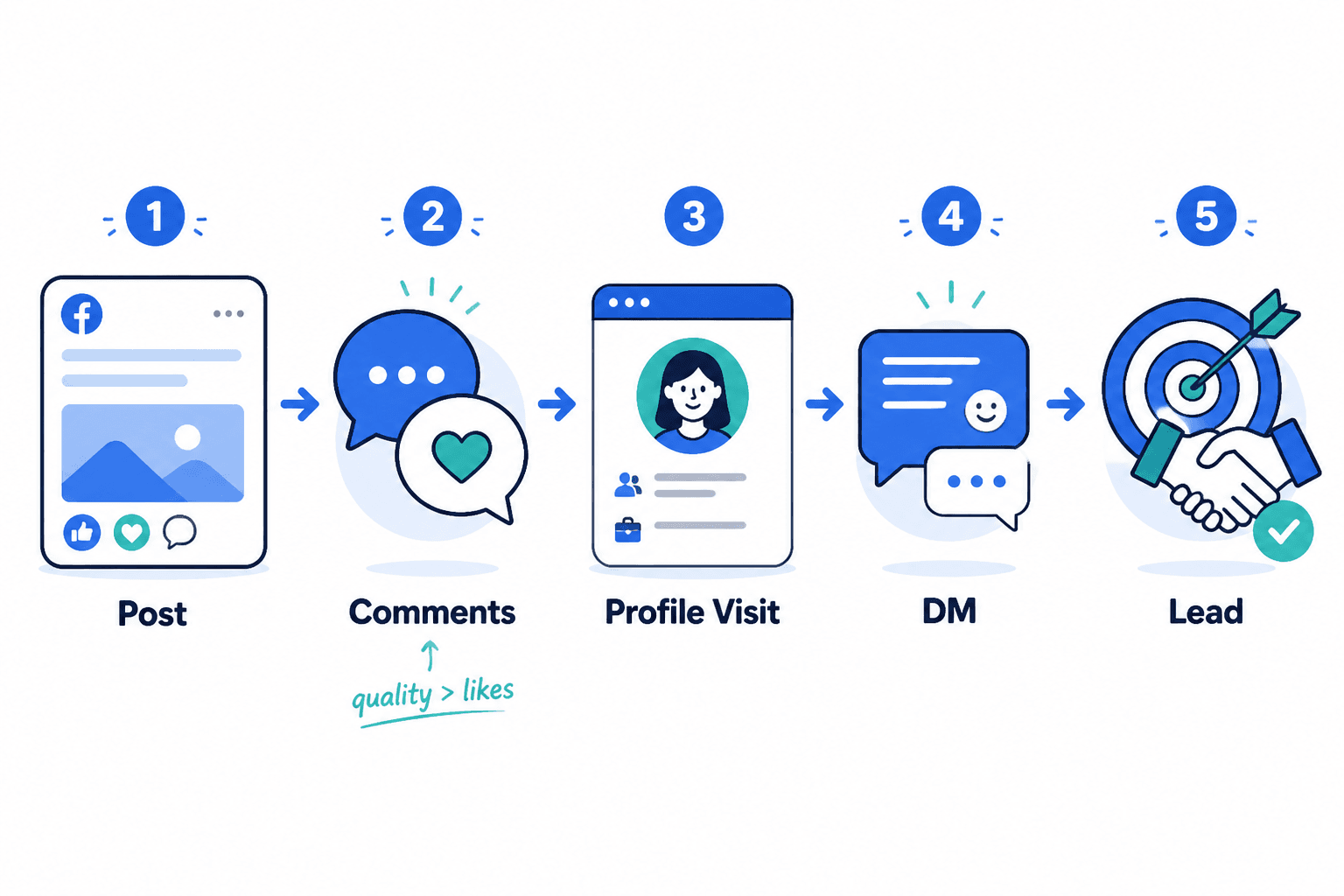
For creators, coaches, consultants, writers, and solo business owners, better Facebook results usually look more like this:
- More comments from the right people
- More profile visits
- More recognition and familiarity
- More direct conversations
- More trust before the pitch
- More useful engagement, not empty reactions
- More clicks to an offer, newsletter, or resource when the timing makes sense
If your post gets 18 good comments from people who could become clients, collaborators, subscribers, or strong referrals, that can beat 800 likes from random drive-by scrollers. Reach is nice. Relevance pays better.
This matters because too many creators chase the wrong metric, then conclude their content is not working. Meanwhile, the post quietly started three conversations, landed two DMs, and reminded a warm audience member that you know what you’re talking about. That is not failure. That is content doing its job without fireworks.
Why Facebook posts feel different from LinkedIn and X
Facebook is not LinkedIn in a hoodie.
The strongest Facebook posts usually feel more conversational, less polished, and more socially alive. That does not mean sloppy. It means human. Readers on Facebook are often more willing to engage with a strong observation, a relatable story, a thoughtful mini-rant, or a question that feels real instead of strategically engineered.
Here is the mistake a lot of creators make: they copy the tone that works somewhere else and paste it onto Facebook unchanged.
- LinkedIn style can sound stiff on Facebook
- X style can sound too compressed or cryptic
- Instagram caption style can sound too curated
- Email style can feel too long-winded if it has no social energy
Facebook likes posts with a pulse. Not fake vulnerability. Not needy engagement bait. Just writing that feels like it came from a person with a point of view who understands how conversations actually work.
If you want more platform-specific guidance, it helps to browse the broader social media writing section and the full Facebook posts hub, especially if you’re building a whole content system instead of trying to rescue one lonely post.
The 5 qualities of Facebook posts that get better results
1. They have a clear point
A lot of posts die because the writer never really decided what the post is about.
Not the topic. The point.
“Marketing” is a topic. “Most service businesses do not need more content ideas, they need stronger angles” is a point.
“Burnout” is a topic. “Half the burnout advice online is just prettier language for poor boundaries” is a point.
Before you write a Facebook post, force yourself to answer this in one sentence:
What exactly should the reader think, feel, realize, or do after reading this?
If you cannot answer that cleanly, the post will probably wander.
2. They sound like a person, not a content machine
The best Facebook posts usually have some voice in them. Rhythm. Texture. A sentence that does not sound workshop-tested by twelve ghostwriters and a compliance team.
This does not mean stuffing your post with slang or trying too hard to be quirky. It means writing with enough naturalness that a reader can feel there is a brain behind the words.
Flat example:
Consistency is important if you want to build a personal brand online.
Stronger example:
People say they want a stronger personal brand, then vanish for three weeks and come back with a logo refresh. That is not consistency. That is decorative avoidance.
Same basic idea. One has a pulse.
3. They create something worth responding to
Facebook is social. Obvious point, somehow still widely ignored.
The post should leave a door open for response. Not by begging for comments with “Thoughts?” slapped on the end like an afterthought, but by giving readers something specific to react to.
Good response triggers include:
- A debatable opinion
- A relatable tension
- A specific question with context
- A story that invites similar stories
- A strong observation people want to add to
- A practical takeaway readers can apply or challenge
Bad response triggers include:
- “Agree?”
- “Anyone else?” with no substance
- Generic questions like “How do you stay productive?”
- Engagement bait disguised as community-building
4. They are easy to read
This part is not glamorous, but it matters.
People skim first. Dense walls of text can work sometimes if the writing is excellent and the story has momentum, but most creators have not earned the right to post a brick and expect readers to excavate the point.
Make the post easier on the eyes:
- Use short paragraphs
- Give key lines room
- Do not break every sentence into its own dramatic fragment
- Keep the pace moving
- Cut filler before publishing
Readable does not mean choppy. It means controlled.
5. They match the relationship stage
Not every post should sell. Not every post should be a diary entry. Not every post should be a tutorial.
Good creators mix post types based on what the audience needs from them right now: awareness, trust, familiarity, proof, perspective, conversation, or a next step.
If every post sounds like “here is why my method works,” people get tired fast. If every post is vague reflection, people never understand what you actually do. You need range.
What to post on Facebook as a creator
You do not need 47 content pillars and a color-coded spreadsheet for every mood cycle. You need a few reliable post types you can use well.
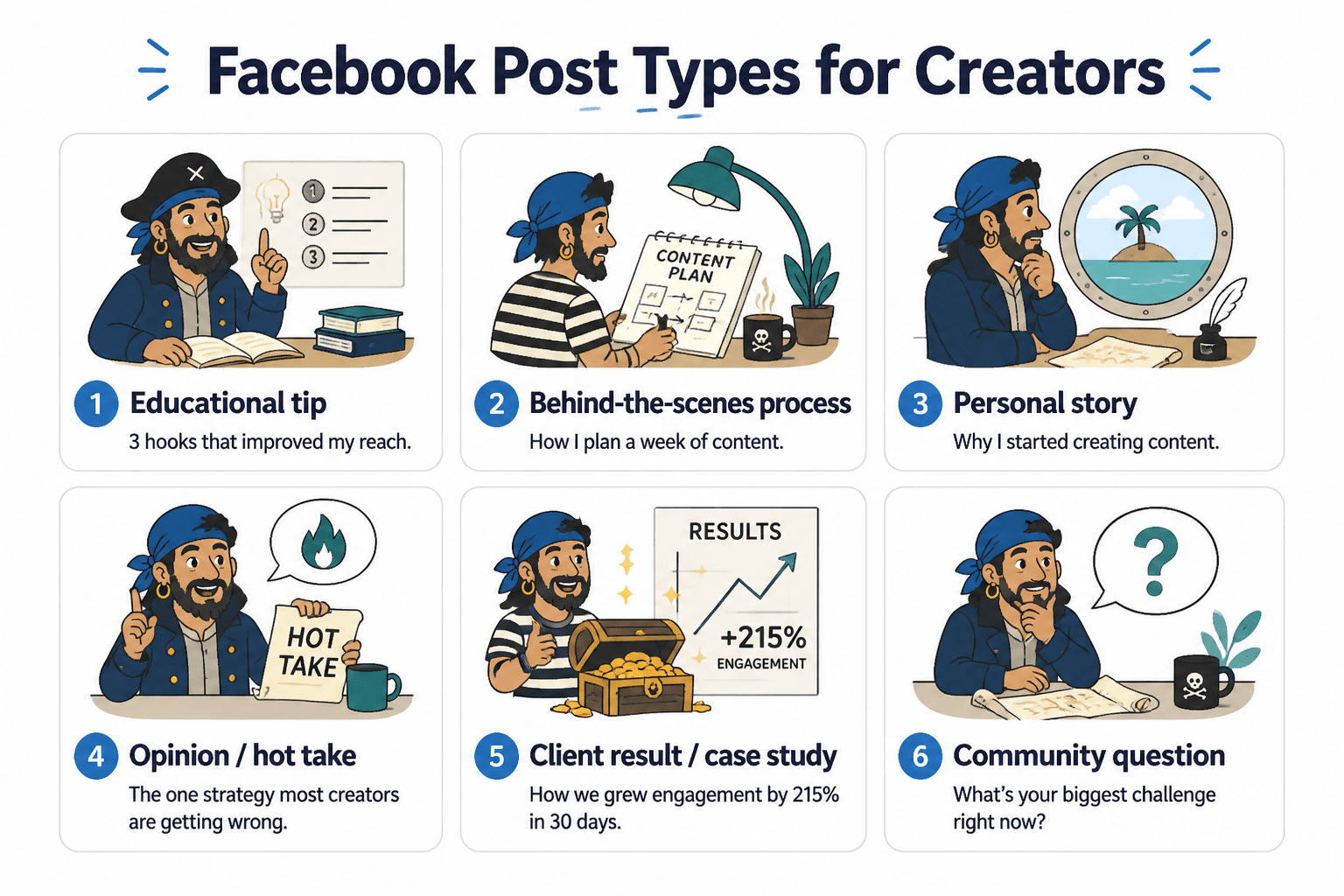
These tend to work especially well for creators and personal brands on Facebook:
Useful opinion posts
Take a position on something your audience actually cares about.
Example angles:
- Common advice in your niche that is overrated
- A mistake smart people keep making
- A strategy that works better than the popular one
- A trend that sounds good but creates problems
The key is to explain the why, not just throw out hot takes like confetti.
Story posts with a point
Stories work well on Facebook, but only if they go somewhere.
A decent story post usually includes:
- A specific situation
- Some tension or contrast
- A lesson, shift, or realization
- A reason the reader should care
Do not tell a long story just because stories “perform.” If the point could be made in four lines, make it in four lines. Facebook readers are generous, not hostage negotiators.
Conversation posts
These are built to spark genuine comments, not forced engagement.
Good format:
I keep seeing creators confuse visibility with trust.
Someone can see your posts for months and still have no idea what you actually help people do.
What is one thing you wish more experts said more clearly in their content?
The setup gives people a lane. It is not just “What do you think?” floating in empty space.
If you want more formats like that, these Facebook community question templates are useful when your brain is tired but you still want a post people can actually respond to.
Mini teaching posts
Short lessons work well when they are sharp and specific.
Example:
A lot of weak content starts with explanation instead of tension.
Do not open with “I want to talk about…”
Open with the problem your reader already feels.
People pay attention faster when the post meets them where they are.
No bloat. No fake profundity. Just one useful idea.
Behind-the-scenes process posts
These help people understand how you think, work, decide, or solve problems. That is often more persuasive than generic advice because it shows your method in motion.
Examples:
- How you plan a week of content
- How you turn client questions into posts
- How you structure a sales page review
- How you simplify a messy offer
Process posts build trust because they show your expertise without needing to scream about your expertise.
How to structure a Facebook post so people keep reading
You do not need a complicated formula, but structure matters. A good Facebook post usually moves through a few simple stages.
1. Start with a line that earns the next line
Your opening does not need to be dramatic. It needs to be interesting enough to continue.
Weak openings:
- I have been thinking a lot about content lately
- Happy Monday everyone
- As entrepreneurs, we all know consistency matters
- Here is a little reminder for whoever needs it today
Stronger openings:
- Most creators do not have a consistency problem. They have a clarity problem.
- A lot of Facebook posts sound fine and still get ignored. Fine is the issue.
- If your content gets polite silence, the problem might be the packaging, not the idea.
- One of the easiest ways to kill a good post is to make it sound professional.
2. Build the idea quickly
After the opening, explain or expand without rambling.
This is where many posts sag. The writer keeps circling the idea instead of developing it. If the first line makes a claim, the next few lines should support, sharpen, or illustrate it.
Try these development moves:
- Explain the mistake
- Show the contrast
- Give an example
- Name the consequence
- Offer the better approach
3. Add specificity
Specificity is what separates a post that feels useful from a post that sounds like decorative advice.
Vague:
You need to connect with your audience authentically.
Specific:
Instead of saying “I help people grow online,” say what you actually help them do, for whom, and why your approach works better than generic content noise.
Specificity gives readers something they can use, argue with, or remember.
4. End cleanly
Do not wander off the page with three extra moral-of-the-story lines.
Strong endings often do one of these:
- Land the point
- Invite a specific response
- Give a next step
- Offer a short CTA
Examples:
- That is why some posts look simple but still work. The idea is doing the heavy lifting.
- If your posts feel flat lately, check the opening before you blame the algorithm.
- If you want, drop your current bio or post opener in the comments and I’ll show you where it’s losing people.
What creators keep doing wrong on Facebook
Some mistakes are so common they deserve to be named plainly.
Posting like every update is a pitch
If every post is steering people toward your offer, your audience starts reading defensively. They can smell a funnel from across the room.
That does not mean never selling. It means earning the right to sell by mixing in perspective, usefulness, process, proof, and conversation. Trust first. Then ask.
Writing polished nothing
Some posts are grammatically fine, professionally phrased, and completely lifeless. They are not bad enough to hate. They are just too vague to matter.
If your post could have been written by anyone in any niche talking to everyone and no one, it probably needs more specificity, stronger opinion, or a sharper example.
Copying LinkedIn posture
Facebook does not need every post to sound like a keynote warm-up.
Lines like these often feel awkward on Facebook:
- I am thrilled to announce
- Here are 5 leadership lessons
- I had the privilege of reflecting on my journey
- This is your reminder to stay resilient
You can be thoughtful without sounding laminated.
Asking weak questions
Boring questions get boring comments or no comments at all.
Weak question:
What are your thoughts on content marketing?
Better question:
What is one content habit you dropped because it looked productive but was mostly busywork?
One gives people homework. The other gives them a lane.
Posting without enough proof of thought
You do not need case studies in every post, but readers should feel some depth behind your claims. Show your reasoning. Mention a pattern you have noticed. Give an example. Reference what tends to happen in practice.
Unexplained opinions often read as posturing. Supported opinions read as expertise.
A simple Facebook post formula that does not sound formulaic
If you want a repeatable structure, use this:
- Open with a sharp observation or tension
- Explain why it matters
- Add an example, contrast, or mini-story
- Land the lesson
- Invite a response or next step
Template:
[Sharp observation]
A lot of people do X because they think it leads to Y.
Usually, it creates Z instead.
Example or quick story.
The better move is [clear recommendation].
[Question or CTA]
Filled example:
A lot of creators think posting more often will fix weak engagement.
Usually, it just gives them more proof that vague content gets ignored at scale too.
If your post opens softly, says familiar things, and ends with “what do you think,” posting five more versions of it won’t rescue the strategy.
The better move is to tighten the point, strengthen the opening, and write something people can actually react to.
What is one kind of post you know you should improve this month?
Use the structure. Do not worship it.
How often should you post on Facebook?
There is no sacred number, and anyone pretending otherwise is probably trying to sell you a calendar.
For most creators, a good posting rhythm is the one you can maintain without turning every thought into exhausted content dust.
A practical approach:
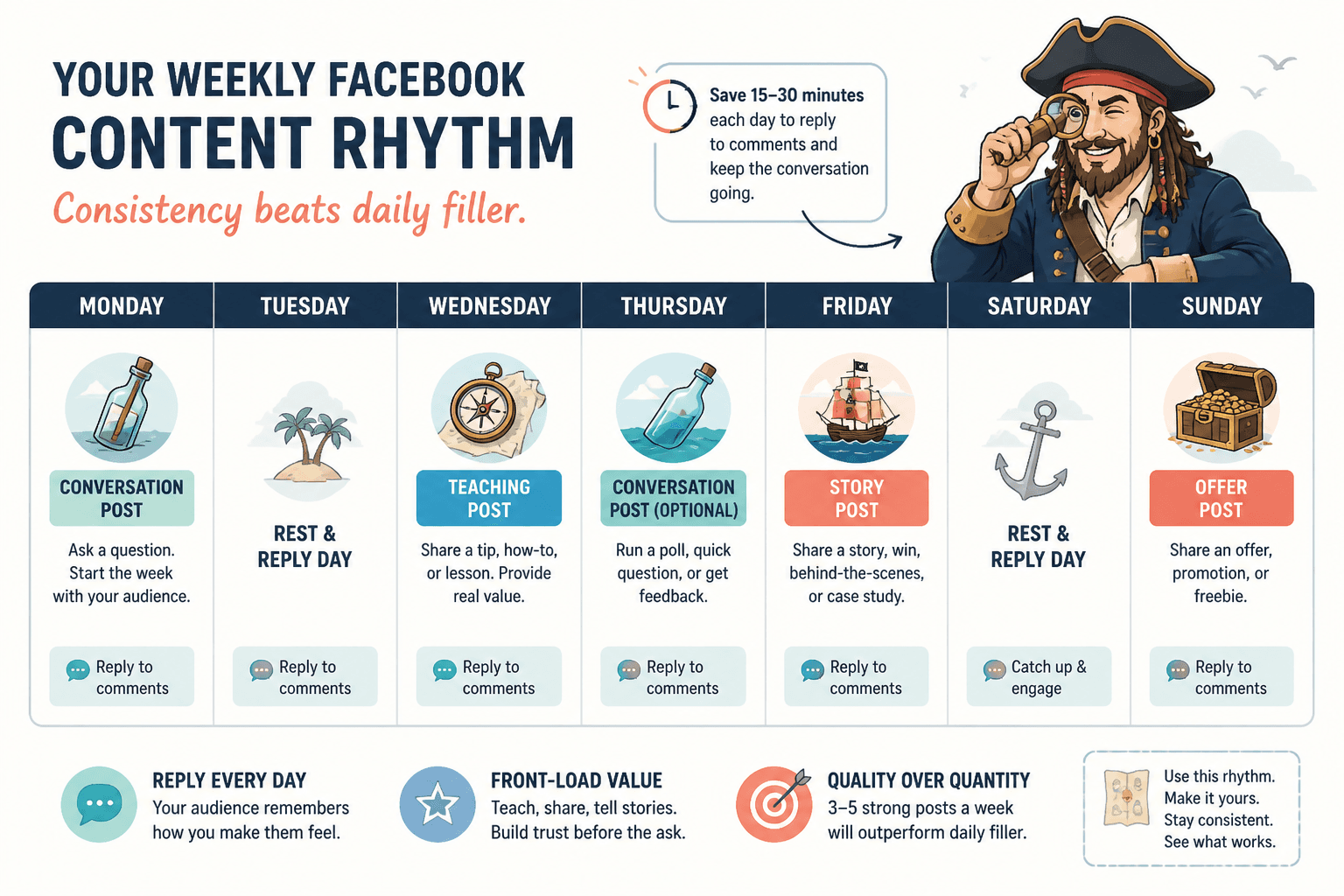
- Start with 3 to 5 strong posts per week if Facebook is a serious channel for you
- Use lighter conversation posts to support heavier teaching or story posts
- Prioritize consistency of quality over daily filler
- Leave room to reply to comments, because that is part of the strategy too
If your audience is small, this matters even more. Small audiences usually grow faster from relevance, conversation, and clarity than from frantic posting volume. If that is your situation, read this guide to Facebook posts for creators with small audiences. It is a better strategy than trying to mimic someone with a giant existing network and a suspicious amount of free time.
How to get more comments without sounding needy
The bigger point is simple: clearer structure and clearer writing make the piece more useful. That is usually what makes the ending land better too.
Facebook posts work best when the point is easy to follow and worth reacting to. Clearer structure usually beats longer wandering.