
Most Facebook community questions fail for one very simple reason: they do not give people an easy way to answer.
Busy creators love posting things like “What do you think?” or “Anyone else feel this?” and then acting shocked when the comments section looks like an abandoned food court. The problem usually is not your audience. It is the question. Too broad, too vague, too boring, too much like homework.
If you want better conversations, your Facebook prompts need less fog and more structure. Simple Facebook community question templates for busy creators work best when they feel casual, specific, and easy to respond to in under 30 seconds.
This article will help you write community questions people actually want to answer, with practical templates, examples, and a few fixes for the usual mistakes. If you want more general help with Facebook posts, that is a good next stop too.
For the main guide behind this topic, visit the parent guide.
Why community questions matter more than polished “content” on Facebook
Facebook is still one of the better platforms for actual back-and-forth conversation. Not performative thought leadership. Not sleek little content bricks trying to sound profound. Conversation.
That matters if you are a creator, coach, consultant, or solo business owner because comments do a few useful things at once:
- They show you what your audience actually cares about
- They create social proof around your ideas
- They increase familiarity and trust
- They give you raw material for future posts, offers, emails, and FAQs
- They make your page feel alive instead of staged
A good community question is not just “engagement content.” It is audience research that does not feel like a survey designed by a haunted webinar funnel.
And if your schedule is tight, this kind of post is useful because it does not require a giant story or a polished mini essay. You just need the right shape.
What makes a Facebook community question actually work
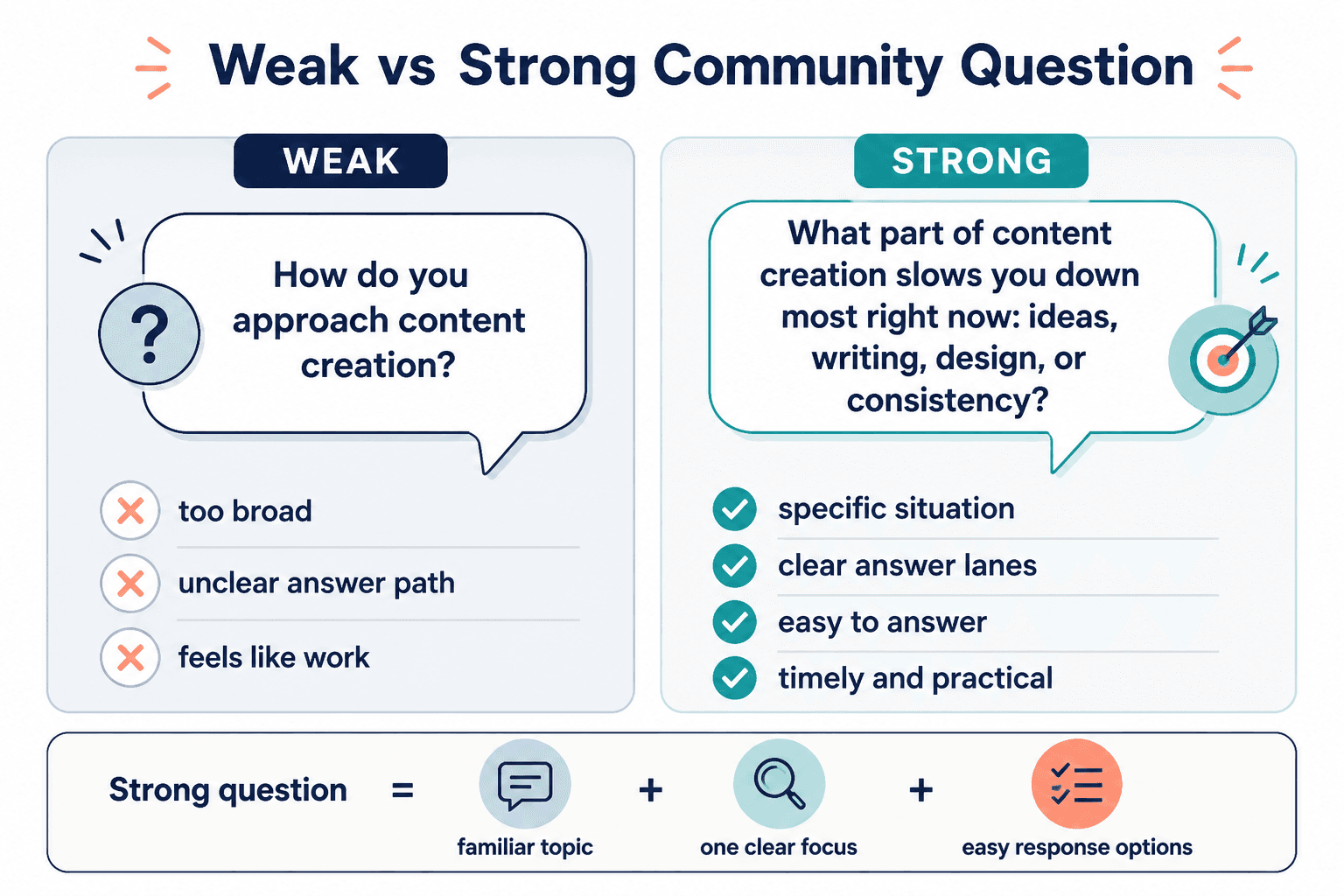
Before the templates, here is the core rule: people answer questions that feel easy, relevant, and safe to answer.
That means your question should usually do at least one of these things:
- Ask about a familiar experience
- Offer clear answer lanes
- Focus on one situation, not five
- Invite opinion without requiring an essay
- Make the topic feel timely or practical
- Sound like a human asking, not a brand extracting comments
Compare these two:
Weak: “How do you approach content creation?”
Stronger: “What part of content creation eats the most time for you right now: ideas, writing, design, or posting?”
The second one wins because it gives people handles. They do not have to build their response from scratch. They can just step into the conversation.
A quick filter before you post
If your question can be answered with “it depends” and nothing else, tighten it.
If it sounds like market research in a blazer, loosen it.
If it asks for too much effort, lower the friction.
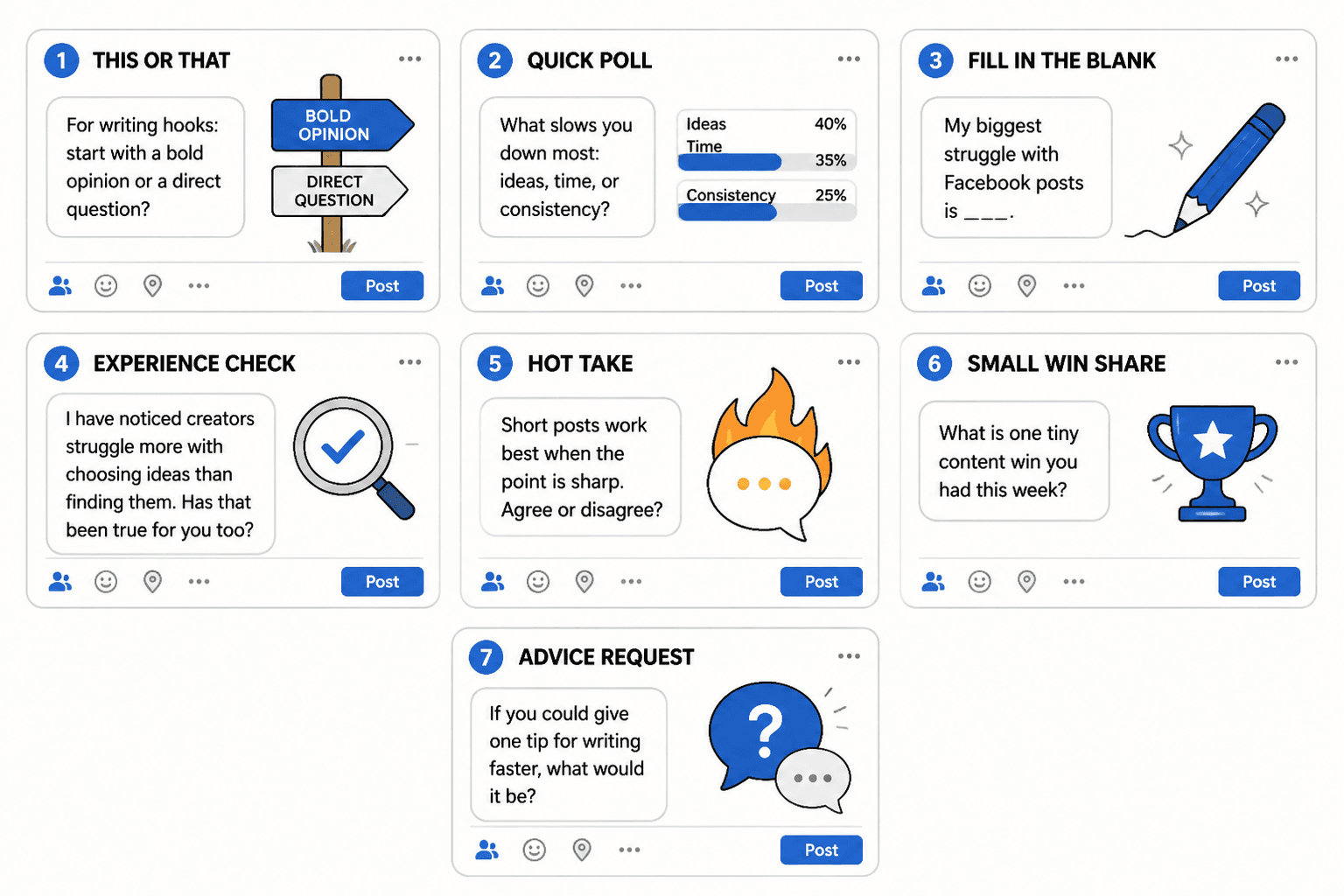
7 types of simple Facebook community question templates for busy creators
You do not need fifty formats. You need a handful that are easy to repeat without sounding repetitive. These are the ones worth keeping in rotation.
1. The quick-choice question
This is one of the easiest wins because people can answer fast. Great for busy feeds, sleepy audiences, or days when you need comments without writing a novella.
Template: Which one is harder right now: [option A], [option B], or [option C]?
Examples:
- Which part feels harder right now: getting ideas, finishing drafts, or posting consistently?
- What drains you faster on Facebook: writing the post, finding the angle, or replying to comments?
- For your business, what takes more energy at the moment: content, sales, or follow-up?
Why it works: It reduces the mental load. People can answer in three words and still feel included.
2. The “small struggle” question
These work well because they feel specific and low-pressure. You are not asking someone to reveal their deepest business wound. You are asking about the annoying little thing they are already mildly irritated by.
Template: What is one small but annoying thing about [topic] that keeps getting in your way?
Examples:
- What is one small but annoying thing about writing Facebook posts that slows you down?
- What is one tiny content task you keep putting off for no good reason?
- What is one part of showing up online that should be simple but somehow never is?
This type of question often produces excellent language from your audience. Their exact words can become future hooks, offers, and post ideas. Very handy if you also create educational or conversion-focused posts.
3. The opinion split question
If you want comments with a bit more energy, ask a question with a clean contrast. Not fake controversy. Just a real choice people can take a side on.
Template: Are you more [approach A] or [approach B] when it comes to [topic]?
Examples:
- Are you more “post fast and refine later” or “think too long and post late” when it comes to content?
- On Facebook, do you prefer short punchy posts or longer story-style ones?
- Are you more likely to comment on practical tips or strong opinions?
These questions work because they invite identity. People like recognizing themselves in a pattern.
4. The “finish this sentence” question
This is a strong format when you want fast participation and slightly more personality.
Template: Finish this sentence: “[starter phrase]”
Examples:
- Finish this sentence: “A Facebook post flops when…”
- Finish this sentence: “I would post more often if…”
- Finish this sentence: “The most overrated content advice is…”
Good for creators with communities that enjoy chiming in with opinions, observations, or mildly spicy takes.
5. The practical recommendation question
People love sharing what helped them, especially if the ask is narrow.
Template: What is one [tool/resource/habit] that has helped you with [specific task]?
Examples:
- What is one tool that has genuinely helped you write faster?
- What is one habit that makes posting on Facebook easier for you?
- What is one content workflow tweak that saved you time this year?
This format tends to attract useful comments instead of fluff. It also gives you material for future roundup posts. If that is your thing, you might also like these Facebook post templates and tools.
6. The audience-check question
These help you understand where people are in their process without sounding like a funnel gremlin.
Template: Right now, are you trying to get better at [stage 1], [stage 2], or [stage 3]?
Examples:
- Right now, are you trying to get better at idea generation, writing, or converting content into leads?
- What are you focused on most this month: reach, consistency, or better client quality?
- At this stage, are you trying to grow faster, post better, or simplify your workflow?
Useful when you want market insight and engagement at the same time. Fancy that.
7. The story-light question
Sometimes the best question starts with a tiny observation from you. Not a giant personal saga. Just enough context to warm up the room.
Template: I have noticed [brief observation]. Has that been true for you too, or not really?
Examples:
- I have noticed that a lot of creators do not struggle with ideas. They struggle with choosing one. Has that been true for you too, or not really?
- I have noticed short Facebook posts work well when the point is sharp, and badly when they are just undercooked. Has that matched your experience?
- I have noticed people often know what they want to say but cannot find a clean opening line. Is that your issue too, or is it something else?
This format feels more conversational than cold-question posts. It also gives you a subtle way to position your expertise without turning the post into a lecture.
How to make these templates sound like you, not a content spreadsheet
Templates are useful. Template voice is not.
If you use the exact same sentence shape every time, people feel it. Your posts start sounding like lightly rearranged furniture. Still technically functional, but nobody is impressed.
So keep the structure, but vary the delivery:
- Sometimes ask the question directly
- Sometimes add a one-line opinion first
- Sometimes make it playful
- Sometimes keep it very practical
- Sometimes give answer options, sometimes leave it open
For example, instead of always saying:
What is one thing you struggle with in content creation?
You could write:
- Content is often less blocked by talent than by friction. What part of the process keeps snagging for you?
- Quick one: what part of posting feels more annoying than it should?
- If you could delete one part of your content workflow this week, what would it be?
Same basic idea. Much less copy-paste energy.
Simple posting formula for busy creators
If you want a repeatable structure, use this:
- Start with a quick observation, tension, or relatable truth
- Ask one clear question
- If helpful, give 2 to 4 answer lanes
- End cleanly and stop typing
That is enough. You do not need a dramatic setup, five emojis, and a desperate “drop your thoughts below.” People know where the comments are.
Example:
A lot of creators are not short on ideas. They are short on decision-making.
What slows you down more right now: choosing a topic, writing the post, or hitting publish?
Short. Clear. Easy to answer.
Common mistakes that kill Facebook community questions
Asking giant abstract questions
“What does success mean to you?” is not a community question. It is a hostage situation.
Keep the topic grounded in a real context, problem, habit, preference, or decision.
Asking questions nobody wants to answer publicly
Some things are too personal, too embarrassing, or too complex for a casual Facebook thread. If it requires vulnerability, make sure the payoff and tone earn that ask.
Stacking three questions in one post
Pick one. If you ask for thoughts on tools, strategy, confidence, and consistency all at once, most people will answer none of them.
Sounding needy
If the post feels like it was written mainly to force engagement, people can smell it. And they do not love that.
The bigger point is simple: clearer structure and clearer writing make the piece more useful. That is usually what makes the ending land better too.