
Most Facebook short posts do not fail because they are short.
They fail because they are empty, overpolished, or written like someone copied a LinkedIn post, removed the spacing, and hoped community magic would happen anyway.
Short Facebook posts can work ridiculously well for creators, coaches, consultants, writers, and solo business owners. They are fast to publish, easier to read, and often better at starting conversations than long, tidy mini-essays. But only if they actually give people something to react to.
This is where a lot of people go wrong. They post a vague thought, ask a limp question, and then wonder why the comments section looks like a quiet waiting room.
Here’s how to make Facebook short post ideas examples creators can adapt fast actually useful: sharper angles, better post types, concrete examples, and simple templates you can steal without sounding like a template in public.
For the main guide behind this topic, visit the parent guide.
What makes a short Facebook post work
On Facebook, short posts tend to work best when they feel conversational, specific, and easy to answer.
That means your post does not need to be profound. It needs to be alive. It should feel like something a real person would naturally comment on, not a carefully sterilized thought leadership crumb.
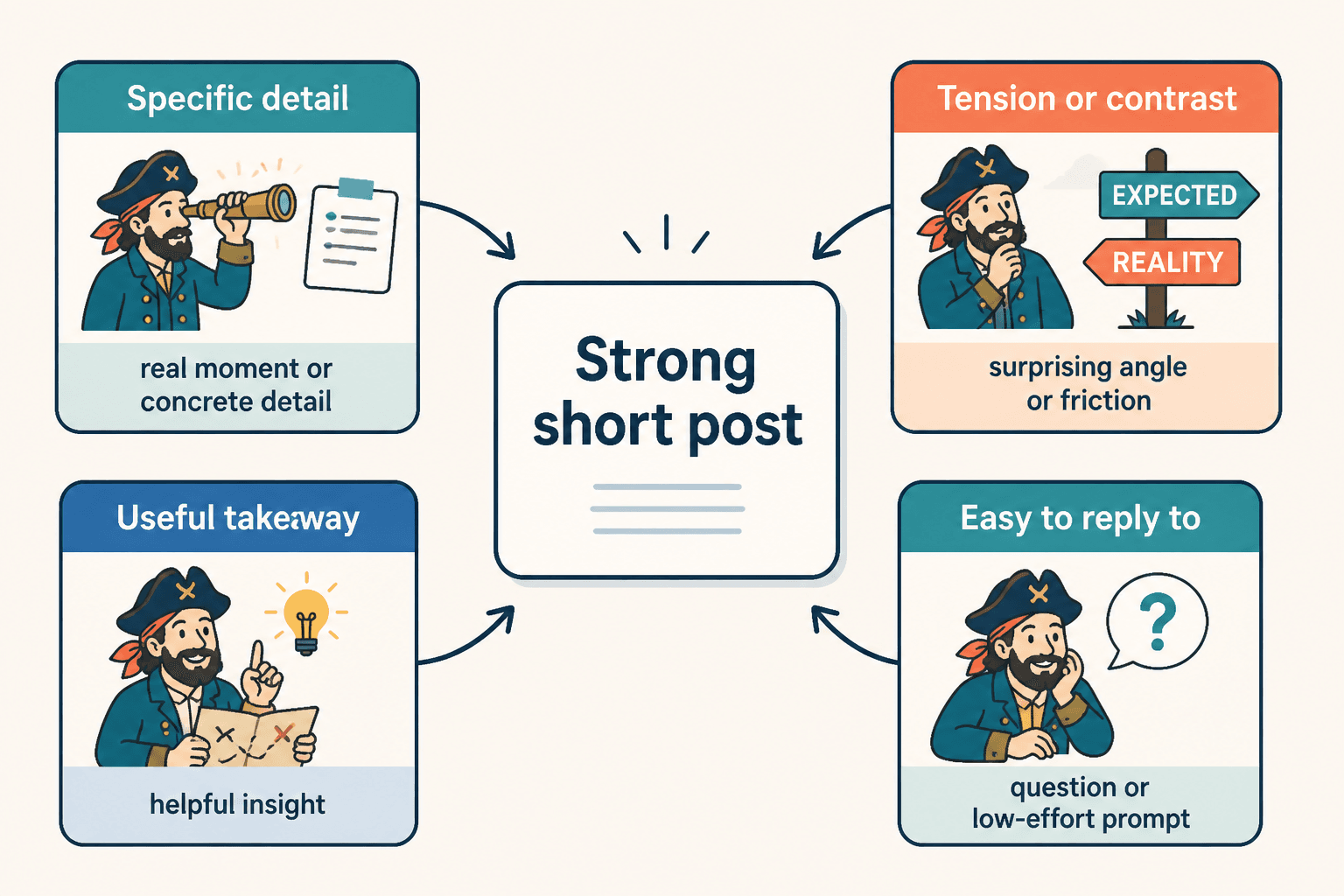
A strong short Facebook post usually has at least one of these:
- A clear opinion
- A relatable moment
- A useful observation
- A simple question people can answer fast
- A small tension or contrast
- A specific detail that makes it feel real
A weak one usually sounds like this:
Consistency matters. Keep showing up.
That is not wrong. It is also not a post. It is wallpaper.
A better version would be:
The hardest part of content is not writing it. It is posting again after a post flops and acting like you still have self-respect. What helps you keep going when a post gets ignored?
Now there is tension. There is personality. There is something to respond to.
Best short Facebook post types for creators
If you want fast, adaptable ideas, do not try to invent a new content format every morning. Use a handful of post types that naturally fit Facebook and rotate them.
1. The quick opinion post
People respond to opinions when they are clear, grounded, and not trying too hard to start a fight.
Template: I think [common belief] is overrated. What matters more is [better point].
Example: I think posting every day is overrated for most creators. Posting things people actually want to respond to matters more.
2. The tiny behind-the-scenes post
Short posts can build trust when they show process, not performance. Keep it simple.
Template: Small thing I’m working on today: [specific thing]. It looks boring, but it usually improves [result].
Example: Small thing I’m fixing today: my call booking page headline. Not glamorous, but it probably matters more than posting another motivational paragraph.
3. The relatable frustration post
This works well because Facebook still rewards posts that feel human and invite stories back.
Template: One mildly irritating part of running a creator business: [specific annoyance].
Example: One mildly irritating part of running a content business: spending 40 minutes making a post clear, then watching the rushed one outperform it.
4. The this-or-that post
Short comparison posts are easy to answer and good for comments.
Template: Pick one: [option A] or [option B]?
Example: Pick one for creator growth: better writing or better positioning?
If you use this format, make the options interesting. “Coffee or tea?” is fine if your page is about being a person. It is less fine if your business depends on people remembering your expertise.
5. The micro-lesson post
This is one of the best formats for coaches, consultants, and service providers who want short content that still signals expertise.
Template: Quick reminder: [useful point]. Most people do [mistake]. Better move: [clear fix].
Example: Quick reminder: a call to action does not need to sound polished. Most people make it weirdly formal. Better move: ask for one simple next step in normal language.
6. The short story spark
You do not need a full storytelling arc every time. Sometimes one moment is enough.
Template: Today I noticed [small moment]. It reminded me that [takeaway].
Example: Today I noticed I rewrote the first line of a post six times. It reminded me that most weak content problems start before the second sentence even exists.
7. The audience check-in post
This is not the same as random engagement bait. Good check-ins ask something relevant to your audience’s work, habits, or frustrations.
Template: Curious: what are you working on that is taking more effort than expected?
Example: Curious: what part of your content process keeps taking longer than it should right now?
15 Facebook short post ideas examples creators can adapt fast
Here are swipeable ideas you can customize quickly. Change the wording, add your niche, and make them sound like you. Please do not copy them word for word unless you enjoy sounding faintly borrowed.
- I’m increasingly convinced that [common tactic] matters less than [better leverage point].
- What is one part of your business that looks simple from the outside but is weirdly annoying in real life?
- Hot take: not every piece of content needs a lesson. Some posts just need a pulse.
- One thing I am editing out of my work more often: [fluff, jargon, long intros, too many ideas].
- The most useful content skill is not writing more. It is noticing what people actually react to.
- What are you overcomplicating right now?
- I trust creators more when they sound clear than when they sound impressive.
- Very underrated business skill: being able to explain what you do without using fog machine words.
- What kind of post are you tired of seeing in your feed right now?
- One reason short posts flop: they are short and vague. That combo is brutal.
- I’d rather read a slightly messy real opinion than another polished non-thought.
- What is one tool you use all the time that is helpful but not magical?
- Sometimes the problem is not the offer. It is that the content around it says absolutely nothing memorable.
- What do you wish more people understood about your work?
- Current content mood: trying to be clearer, not louder.
These are useful because they are open enough to adapt, but specific enough to trigger a response. That middle ground matters.
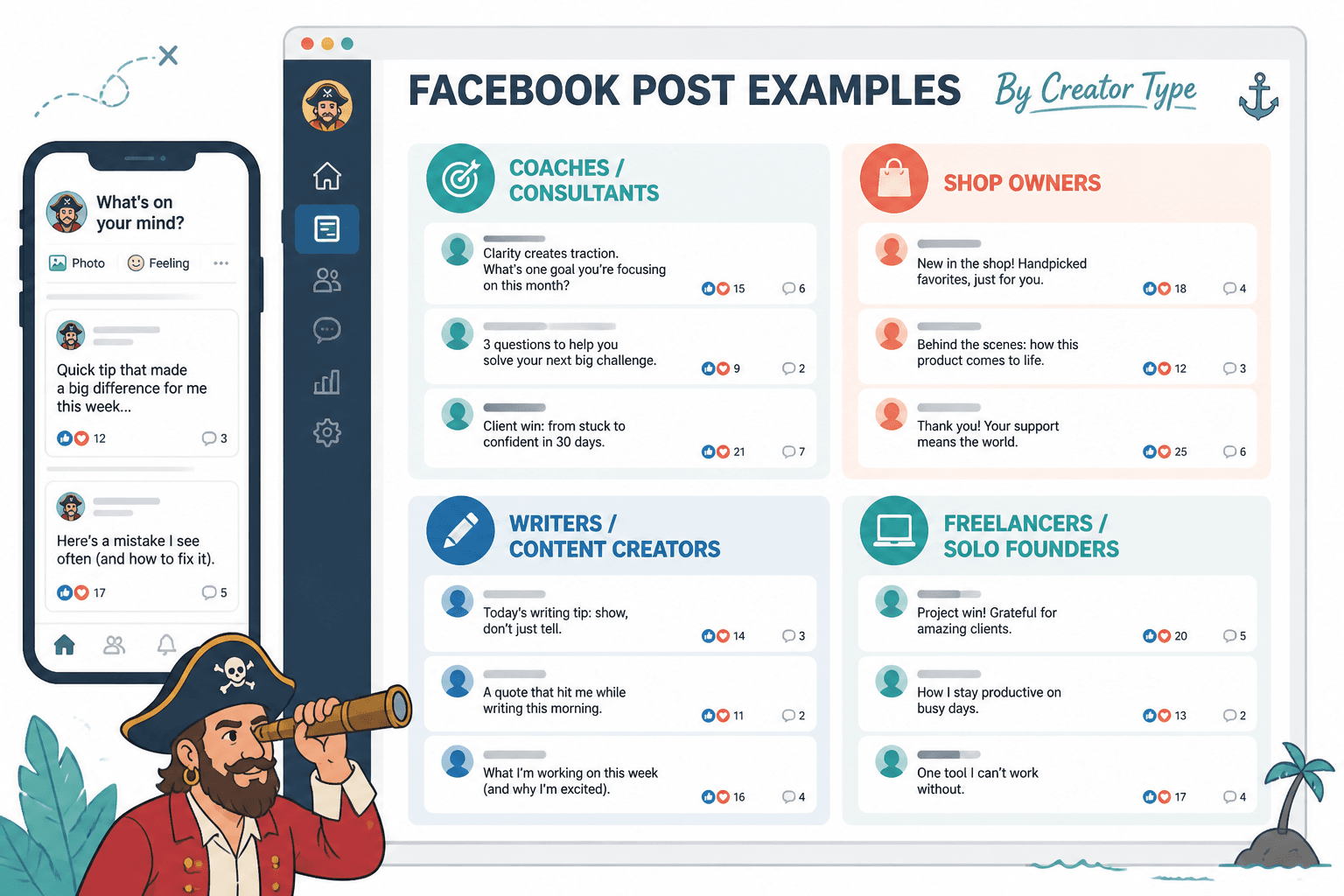
Short Facebook post examples by creator type
Different businesses need different angles. A writing coach does not need the same kind of short post as a designer or fitness creator. The structure can stay simple, but the point should fit your work.
For coaches
- A lot of people do not need more advice. They need a simpler way to apply the advice they already have.
- What part of staying consistent is hardest for you: planning, confidence, or follow-through?
- Gentle reminder: clarity usually beats intensity.
For consultants
- I can usually tell in five minutes whether a business has a traffic problem or a messaging problem. It is often messaging.
- Most service pages are trying to sound credible and accidentally become unreadable.
- What is one business process you wish you had fixed sooner?
For writers and content creators
- Bad hooks are rarely too short. They are usually too vague.
- The first sentence does more heavy lifting than people want to admit.
- What kind of post do you write fastest: opinion, story, list, or question?
For freelancers and solo founders
- One underrated part of freelancing: learning to explain your value without sounding like a brochure.
- I think a lot of small businesses have enough ideas. They need better packaging.
- What part of client work takes energy even when you are good at it?
How to adapt short post ideas fast without sounding generic
The fastest way to ruin a decent prompt is to leave it too generic.
If you want these posts to feel like yours, add one or two pieces of real texture. That could be a detail, a stronger opinion, a clearer audience, or a more specific frustration.
Use this simple tweak process:
- Start with the base idea. Example: “Most people overcomplicate content.”
- Add your audience. “Most consultants overcomplicate content.”
- Add the real issue. “Most consultants overcomplicate content because they try to sound senior instead of useful.”
- Add a question or payoff. “Most consultants overcomplicate content because they try to sound senior instead of useful. Have you noticed that in your niche too?”
That tiny bit of specificity changes everything. It gives the post shape. It gives people something to agree with, push back on, or build on.
Short post formulas that are actually worth using
Most formulas become awful when people use them like paint-by-numbers. Still, a few are genuinely useful when you need speed and do not want to stare at the screen until your coffee turns judgmental.
The opinion + reason formula
Structure: [Opinion]. [Reason].
Example: I think polished content is overrated on Facebook. People respond better when the post sounds like someone they would actually talk to.
The observation + question formula
Structure: [Observation]. [Relevant question].
Example: A lot of creators are sitting on useful ideas and posting only the safest ones. What kind of post are you hesitating to share right now?
The mistake + fix formula
Structure: [Common mistake]. [Better move].
Example: Common content mistake: writing a short post that says nothing specific. Better move: make one clear point and leave room for people to respond.
The small truth formula
Structure: [Simple truth that feels real].
Example: Sometimes your content is not underperforming because it is bad. It is underperforming because it sounds too careful to be memorable.
What to avoid with short Facebook posts
Short posts are easy to publish. That is nice. It also means they are easy to publish badly.
Watch out for these:
- Vague life advice. If it could live on a beige mug, it probably is not a post yet.
- Forced engagement bait. “Agree?” is not a strategy.
- LinkedIn cosplay. Facebook usually responds better to warmth and conversation than polished professional posing.
- Over-branding. Not every post needs to sound like a tiny sales page.
- Questions with no texture. “How is everyone doing today?” is kind, but weak.
- Trying to teach too much. A short post should make one point well, not seven points badly.
The bigger point is simple: clearer structure and clearer writing make the piece more useful. That is usually what makes the ending land better too.