
Facebook Posts for Creators With Small Audiences usually do not fail because the audience is too small. They fail because the post is too generic, too polished, too needy, or too obviously trying to perform “content” instead of starting a real conversation.
A small audience on Facebook is not a death sentence. In a lot of cases, it is actually an advantage. You can be more direct. More specific. More human. You do not need to post like a celebrity creator with 80,000 followers and a comment section full of “great insight.” You need posts that make the right people stop, react, reply, remember you, and gradually trust what you do.
That is the real job.
Here’s how to write Facebook posts that work when your audience is still small, your reach is not always cute, and you would still like your content to do something useful for your business.
For the main guide behind this topic, visit the parent guide.
Small audiences need better posts, not louder ones
A lot of creators make the same bad trade.
They assume a small audience means they need to be broader, safer, and more “relatable” to everyone. So they water down their point, strip out the personality, and post bland observations that nobody feels strongly enough to respond to.
That is exactly backwards.
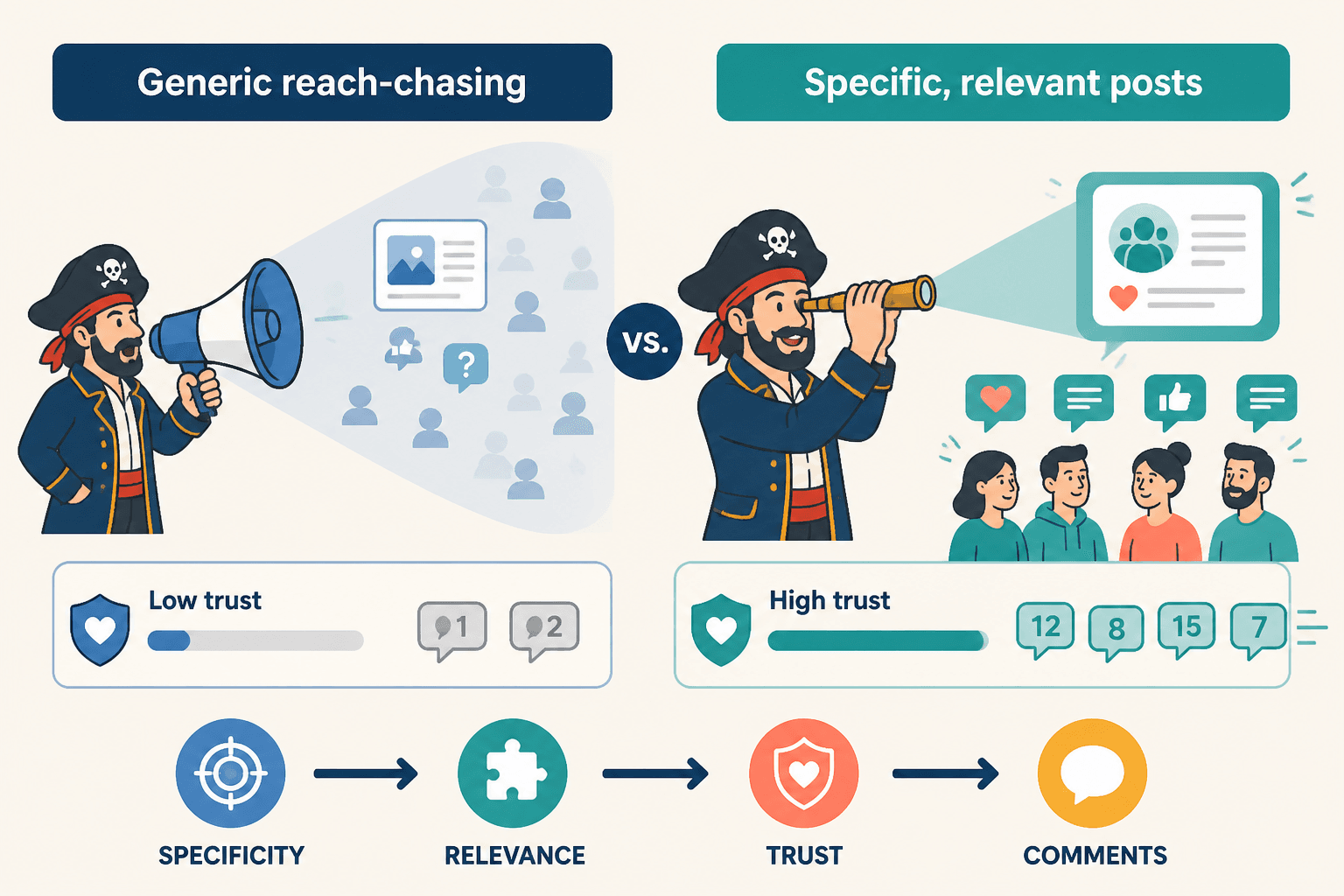
When your audience is small, specificity matters more. Sharpness matters more. Relevance matters more. Your post does not need 1,000 reactions. It needs a few right people to think, “Oh, this person gets it.”
That is how small creators grow on Facebook without becoming unbearable.
Good Facebook posts for creators with small audiences tend to do one or more of these things:
- Say something specific enough to spark a response
- Tell a short story with an actual point
- Share a useful observation people want to add to
- Name a common frustration clearly
- Ask a question worth answering
- Show your thinking, not just your conclusion
Not everything has to be deep. But it should feel alive.
What Facebook is better for than other platforms
If you copy your LinkedIn voice onto Facebook, the whole thing often feels like a blazer at a backyard barbecue. Technically allowed. Socially weird.
Facebook usually rewards a more conversational style. Not sloppy. Not random. Just less polished in that “I ironed this thought leadership post for 45 minutes” way.
People on Facebook are more likely to respond to posts that feel discussable. That means:
- Stories with tension
- Useful opinions
- Relatable moments with a clear takeaway
- Questions people can answer from experience
- Posts that sound like a person, not a content machine
That does not mean you should ramble. It means the post should feel like it has a pulse.
If you want the broader context for platform-specific strategy, it helps to browse the main social media writing section and the wider Facebook posts hub. But the short version is this: Facebook likes posts people can enter. Not just admire from a distance.
The 5 types of Facebook posts that work especially well for small creators
1. The useful observation post
This is one clear idea about your industry, audience, process, or common mistake.
Example:
Most creators do not need more content ideas.
They need a better filter for which ideas are worth posting.If a post is not useful, interesting, specific, or discussable, it is just another paragraph asking the algorithm for pocket change.
Why it works: it is short, opinionated, and easy to respond to. Someone can agree, disagree, add nuance, or share their own version.
2. The short story with a takeaway
Stories do well on Facebook, but only when they actually go somewhere. A decent post is not “here is a thing that happened.” It is “here is what happened, why it mattered, and what you should notice about it.”
Simple structure:
- Start with the moment
- Show the tension or lesson
- End with a point people can react to
Example:
I spent 40 minutes writing a post last week that was technically “good.”
Clean structure. Smart points. Nice phrasing.It landed like a folding chair.
Then I posted a much simpler thought about why creators hide behind overexplaining when they do not trust their point yet.
That one got real comments.Useful reminder: clarity usually beats polish, especially on Facebook.
3. The community question post
Questions still work. Bad questions do not.
Weak question:
What’s everyone working on today?
Fine if your audience already loves you. Not great if they barely know you exist.
Better question:
What is one part of content creation you are good at, but weirdly still procrastinate on?
That gives people something real to answer.
If you want more of these, these Facebook community question templates are a useful next stop.
4. The opinion post with controlled edge
You do not need hot takes. You need clear takes.
Something like:
Not every creator needs a content calendar.
Some need a repeatable posting rhythm and 10 better ideas.
Color-coded planning will not save a weak point.
This works because it has tension without turning into internet theater.
5. The short punchy post
Short posts can work beautifully on Facebook when the idea is sharp.
If your post only makes sense after the fifth line, the first line is doing a terrible job.
That is a complete post. No fluff required.
For more quick formats, see these short Facebook post ideas and examples.
What small creators keep doing wrong on Facebook
Some mistakes are common because they feel safe. Safe usually means forgettable.
- Posting vague inspiration. People do not know what to do with “Keep going, your time is coming.”
- Sounding too polished. If the post reads like brand-approved paste, it will probably die like brand-approved paste.
- Asking weak questions. “Anyone else?” is not a discussion strategy.
- Making every post about yourself. Your experience matters. But the reader still needs a reason to care.
- Selling too early. A small audience needs trust before it needs your booking link.
- Copying big creators. Their style often depends on existing attention. Yours needs to earn it.
One of the weirdest habits is writing Facebook posts like mini press releases. You can almost hear the posture in them. A creator says something mildly true in a strangely formal tone, then wonders why nobody comments.
Your post should sound like a smart person talking to other humans. Not a laminated quote card with punctuation.
How to write Facebook posts for creators with small audiences that actually get responses
Use this simple process.
Start with something people can react to
Do not open with three lines of context before you arrive at the point. Lead with the interesting part.
Weak opening:
I have been thinking a lot lately about social media and how people show up online.
Better opening:
Most creators are not inconsistent because they are lazy.
They are inconsistent because their content process is annoying.
Make the post about a live idea, not a flat topic
“Content creation” is a topic.
“Why creators keep overexplaining simple ideas because they do not trust clarity yet” is a live idea.
One gets skimmed. One gets discussed.
Give people an entry point
If you want comments, the post should invite participation naturally.
That can be done through:
- A strong question
- A relatable tension
- A debatable opinion
- A shared frustration
- A specific prompt
You do not need to beg for engagement. You just need to leave the conversational door open.
Trim the parts that only exist to sound thoughtful
This matters more than people think.
A lot of Facebook posts are 30 percent actual point and 70 percent throat-clearing, softening, summarizing, and “as I reflect on this journey” material. Cut that and the post usually improves fast.
Ask:
- What is the actual point here?
- Which sentence says it best?
- Can that sentence move to the top?
- What can I remove without losing meaning?
Usually, a lot.
A simple post formula that works surprisingly well
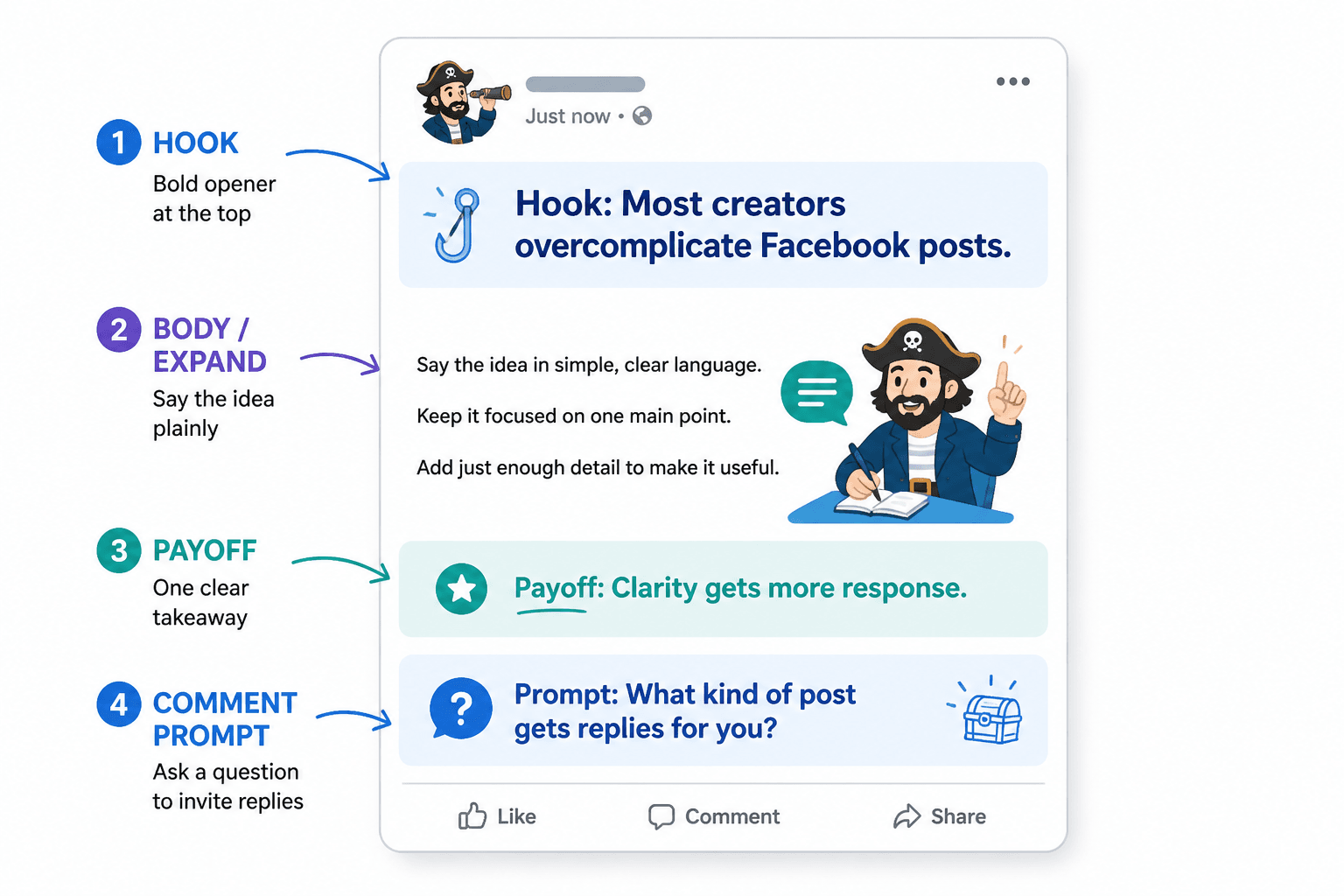
If you want one dependable structure, use this:
- Hook: Lead with an opinion, moment, or tension
- Expand: Explain the idea in plain language
- Payoff: Share the takeaway, lesson, or implication
- Prompt: End with a clean question or response-worthy line
Example:
A lot of creators say they want to be consistent, but their posting process requires them to feel inspired, fully focused, and emotionally balanced at the same time.
Which is adorable.
Consistency usually comes from making the process lighter, not from becoming a discipline wizard.
What part of your content process creates the most friction right now?
That post has a point, some personality, and a question that is easy to answer.
Facebook post ideas that are better than “tips”
Tips are fine. But if all you post is tip content, people may learn from you without really feeling connected to you. On Facebook, connection and conversation matter more.
Try rotating through these instead:
- A belief you have about your industry
- A mistake you keep seeing people make
- A behind-the-scenes process that changed your results
- A small story that reveals how you think
- A client pattern or audience pattern you have noticed
- A tool or tactic that is overrated
- A simple question with real texture
- A before-and-after shift in your approach
For a broader bank of ideas, these Facebook post ideas and examples for creators will help.
How often should small creators post on Facebook?
Not every day by default. Not “as often as possible.” Not based on guilt.
The better question is: how often can you post while keeping the quality, voice, and usefulness intact?
The bigger point is simple: clearer structure and clearer writing make the piece more useful. That is usually what makes the ending land better too.