
A draft sits open with three possible hooks, one version that sounds too polished, and another that sounds like it was written during a caffeine argument. The post is technically “done,” but it still feels like it could use a map and a flashlight. That is where examples help: they turn vague posting advice into something a creator can actually use without wandering around in content fog.
For a broader framework on structure and tone, see how to write better Facebook posts. If you want to branch out into tools later, the sibling guide on best AI tools for Facebook posts may be useful too.
What makes a Facebook post work for creators
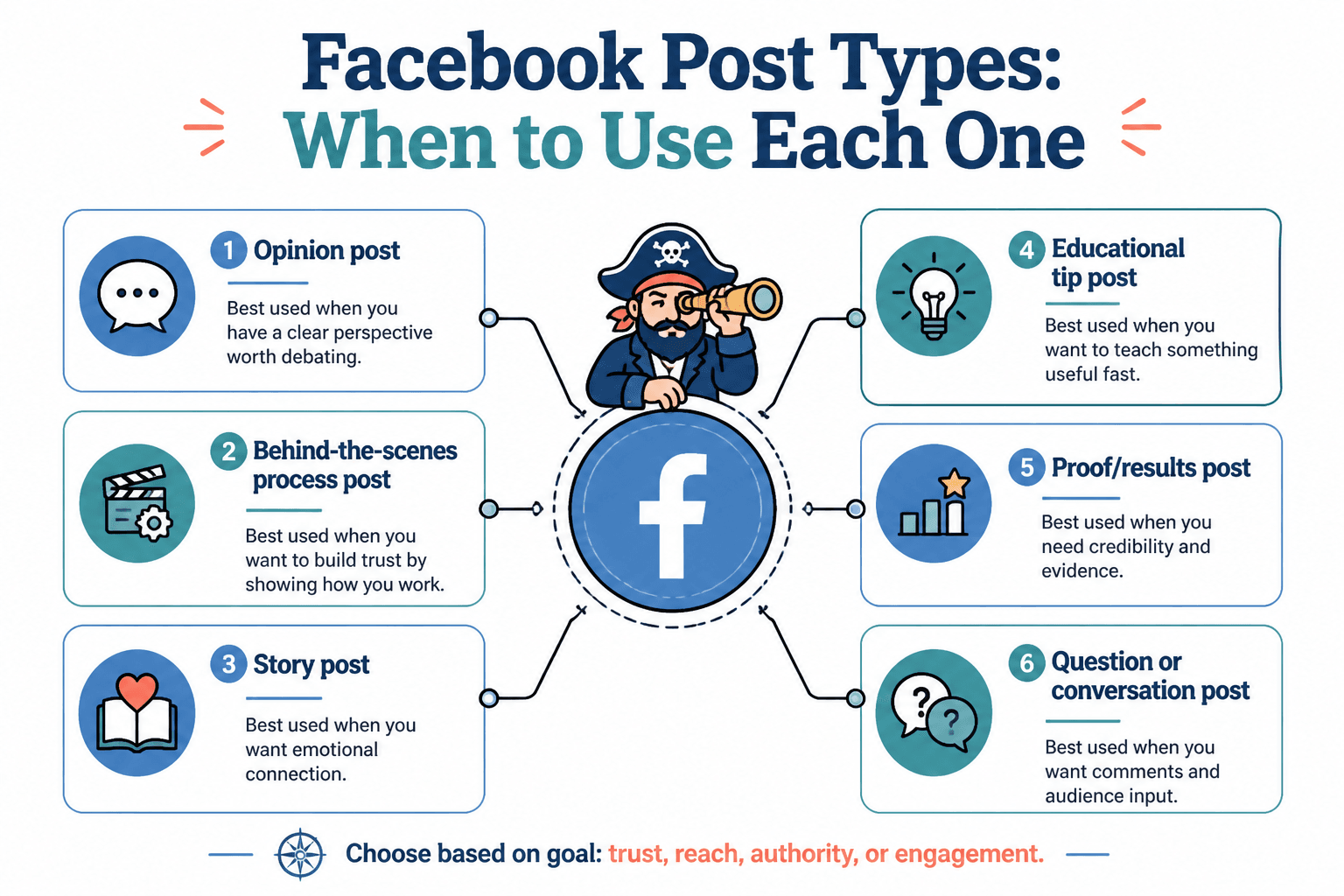
The best posts usually do three things:
- They have a clear point. The reader should know what this post is doing within a few lines.
- They feel specific. “Here’s a thing that happened” beats “here’s a generic lesson” almost every time.
- They give the reader a reason to keep going. That can be curiosity, usefulness, disagreement, relief, or a clean question at the end.
That is also why Facebook posts for creators tend to work better when they are written like small decisions, not miniature essays. One point. One angle. One useful payoff.
A quick way to choose the right post type
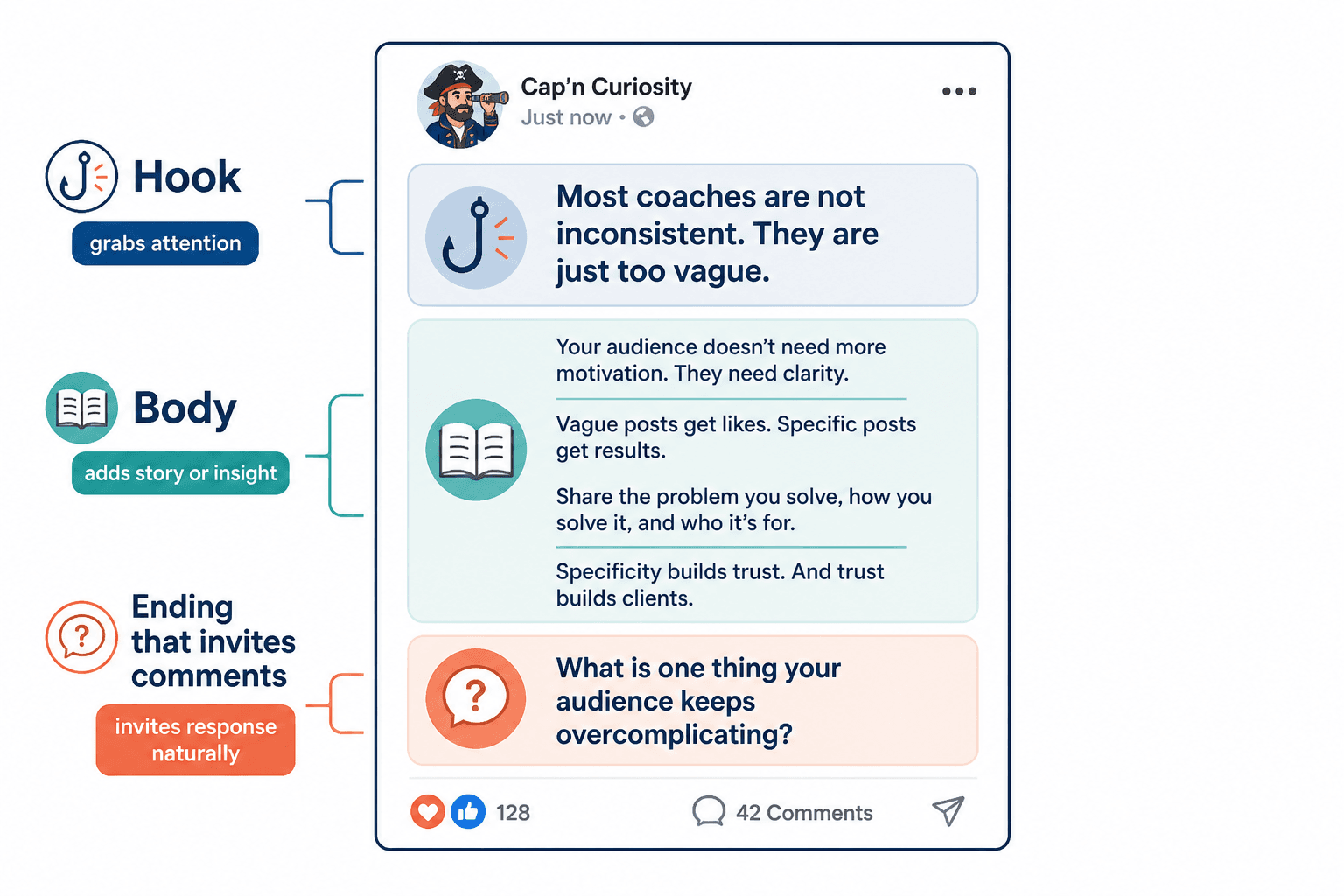
Before you draft anything, pick the job the post needs to do. Not every post should teach, persuade, entertain, and start a debate in the same breath. That is how posts become overworked and slightly haunted.
- Want attention fast? Use a short opinion, sharp observation, or myth-busting post.
- Want trust? Use a behind-the-scenes post or a short story with a lesson.
- Want replies? Use a community question or this-or-that post.
- Want saves or shares? Use a micro-lesson or practical tip post.
The point is not to squeeze every post into the same mold. It is to match the format to the job.
Facebook post ideas and examples for creators
1. The quick opinion post
A quick opinion post is just a clear stance without a lot of ceremony. It works when the opinion is specific enough to matter.
Example: “Creators do not need more content ideas. They need fewer ideas with stronger hooks.”
That is short, but not empty. It gives the reader something to agree with, push against, or steal for their own post draft.
2. The tiny behind-the-scenes post
Behind-the-scenes posts work because they make the process visible. The trick is to show one detail, not the entire production archive.
Example: “Today’s post started as a bad headline, got rewritten twice, and finally worked when I stopped trying to sound clever and started trying to sound clear.”
That kind of post earns trust because it feels human and useful at the same time.
3. The relatable frustration post
This one names a friction point the audience already knows. The key is to be specific enough that it feels true, not performative.
Example: “Nothing humbles a creator faster than spending 40 minutes on a Facebook post and getting one reaction from your cousin.”
A little dry humor helps here. So does not overexplain the joke.
4. The this-or-that post
This-or-that posts are simple, but they work because they lower the effort needed to respond.
Example: “For a Facebook post: do you prefer a bold opinion first, or a quick story first?”
These posts are especially useful when you want lightweight engagement without forcing people into essay mode.
5. The micro-lesson post
A micro-lesson gives one useful takeaway without turning into a lecture.
Example: “If your Facebook post needs a hook, try starting with the part that feels slightly uncomfortable to say out loud. That is often the part people actually want to read.”
Small, specific, and easy to apply. That is the whole job.
6. The short story spark
Short story posts work when they move from moment to meaning fast.
Example: “I almost deleted a post this morning because it felt too plain. Then I realized plain was the point. Clear beats decorative when the audience is busy.”
This format is useful when you want a post to feel lived-in without becoming self-indulgent.
7. The sharp observation post
Observation posts point at something the audience has seen but may not have articulated.
Example: “A lot of ‘engagement tips’ are really just instructions for how to ask strangers to do unpaid emotional labor in the comments.”
That one has edge. Use it when the insight is worth the risk.
8. The myth-busting post
Myth-busting works well for creators because it gives the post a clean spine: what people believe, what is actually true, and why that matters.
Example: “Myth: a Facebook post has to be long to work. Reality: it has to earn attention, and sometimes the shortest version does that better.”
If you want a fuller system for that style, the sibling page on short Facebook post ideas and examples is a good companion.
9. The community question post
Questions work best when they are easy to answer. Not “tell me your life story in the comments,” unless your audience has unusually generous free time.
Example: “What is harder for you right now: writing the hook, choosing the topic, or ending the post without sounding like a robot?”
That gives people a real foothold. For more templates, see simple Facebook community question templates.
10. The practical promo post
Promo posts work better when they focus on a problem and a next step, not just a product announcement wearing cologne.
Example: “If your Facebook posts get attention but not clicks, the issue may be the bridge between the post and the offer. That is where I would fix first.”
A practical promo post makes the offer feel like a solution, not a detour.
Simple formulas you can reuse
If you are stuck, use a structure instead of waiting for inspiration to arrive with a clipboard.
Formula 1: Point + tension + payoff
Example: “Creators do not need more post ideas. They need ideas that create enough tension to make someone keep reading.”
Formula 2: Problem + small truth + next step
Example: “If your posts feel flat, the issue is often that the first line is too broad. Make it more specific, and the rest usually gets easier.”
Formula 3: Observation + example + question
Example: “Some of the best Facebook posts are the ones that sound like a real person thought them through once. What post format gives you the most room to do that?”
Formula 4: Myth + reality + implication
Example: “Myth: more posting fixes weak results. Reality: clearer posts usually do more than louder posting ever will.”
Common mistakes that make Facebook posts flatter than they should
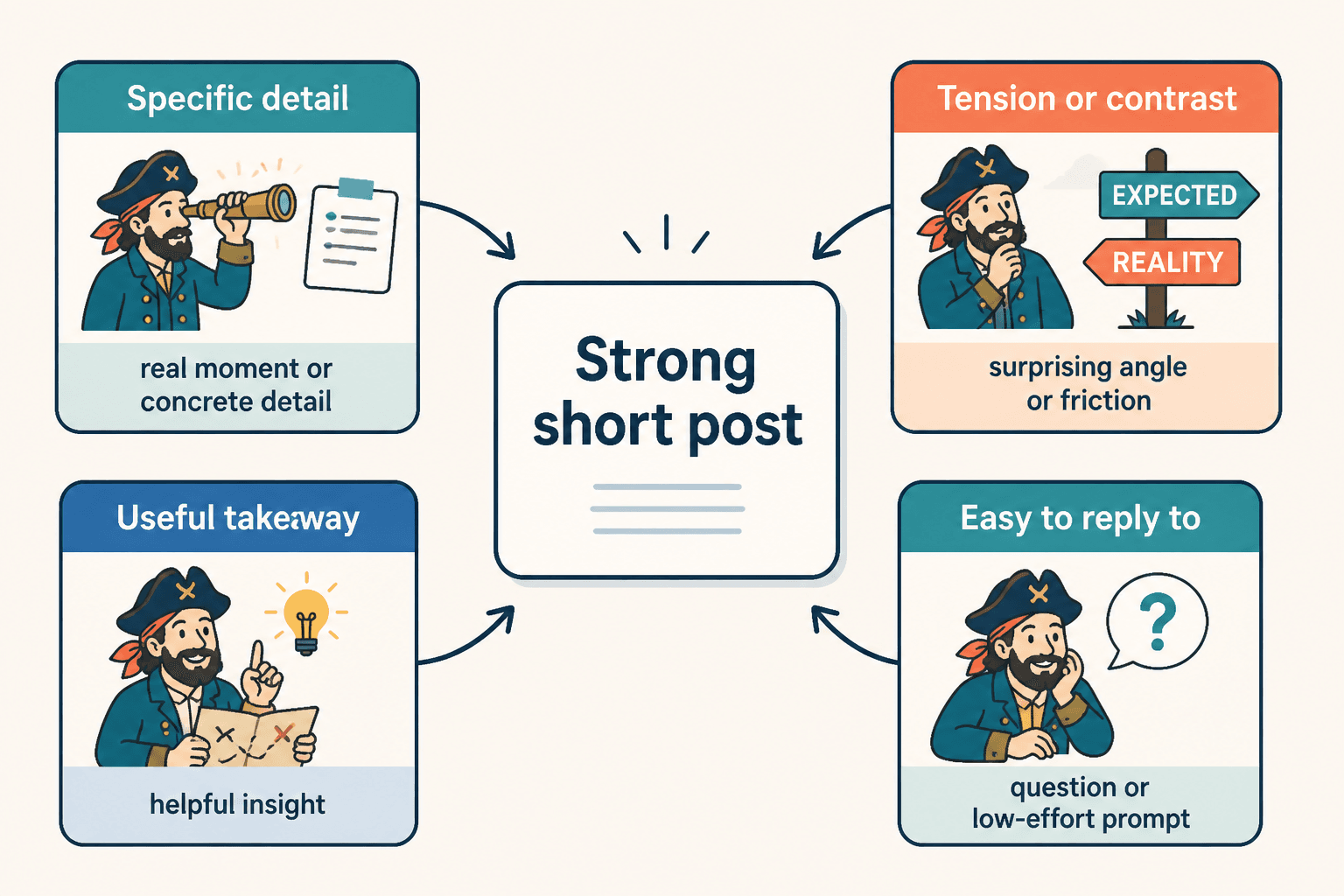
- Starting too vaguely. If the opening could apply to anything, it will usually stick to nothing.
- Trying to do too much. One post can teach, provoke, or invite replies. It does not need to do all three at once.
- Using “content voice” instead of normal voice. Readers can smell that from a mile away.
- Forcing engagement. A question at the end is not a personality. It is just a tool.
- Skipping the point. If the post takes three paragraphs to get to the actual idea, the actual idea is doing unpaid overtime.
If you want to improve the mechanics underneath the post, the parent guide on Facebook posts is the best place to start.
How to turn one idea into three different posts
One useful creator habit is squeezing more life out of a single idea. Not by recycling the same post with different shoes on, but by changing the angle.
- Version 1: a short opinion post
- Version 2: a micro-lesson post
- Version 3: a community question post
Example topic: weak Facebook hooks.
- Opinion: “Most weak hooks are not boring because they are short. They are boring because they are generic.”
- Lesson: “A stronger Facebook hook usually names the exact friction the reader already feels.”
- Question: “What is harder for you in Facebook posts: the first line, the middle, or the ending?”
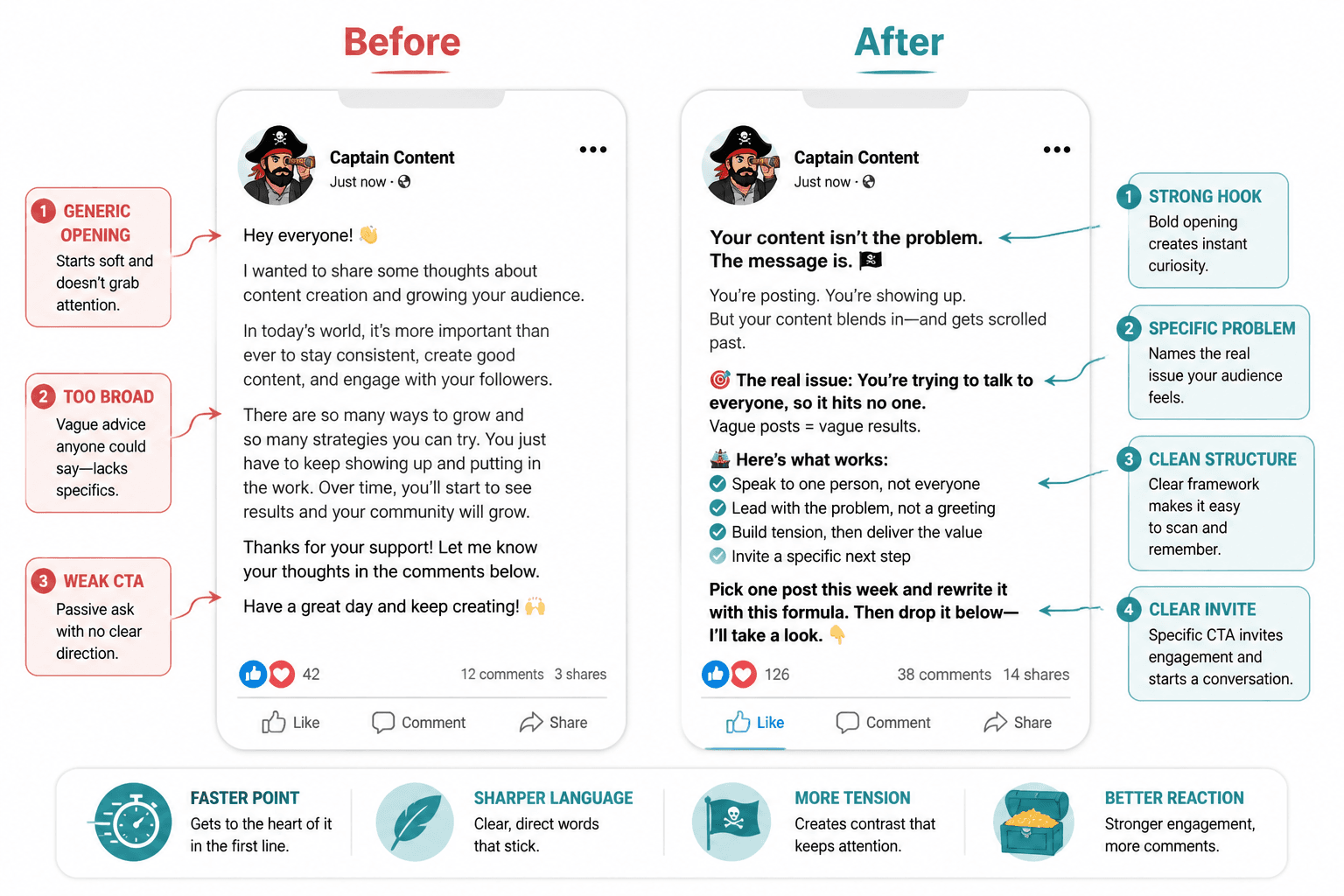
This is also a good place to use the existing rewrite image as a reference point.
When to keep it short and when to add more context
Short posts work well when the idea is sharp and the payoff is immediate. Longer posts work when the reader needs a little more setup to care.
A good rule: if the value is obvious, stay short. If the value needs a brief runway, add just enough context to make the landing feel easy.
That balance is also why the strongest Facebook posts for creators often look simple after the fact. The simplicity is the result, not the starting point.
Wrap-up
The best Facebook post ideas are not the flashiest ones. They are the ones that give the reader a clear angle, a real point, and a reason to keep moving through the post. That can look like a quick opinion, a tiny story, a question, or a sharper rewrite of something you almost posted in a weaker form.
If you want to keep building from here, the sibling guide on turning Facebook posts into more leads or sales is a natural next step.
And if you are working inside a broader content system, the parent guide on Facebook posts keeps the structure in view instead of letting every draft become a tiny wilderness expedition.