
Most creators do not have an audience problem. They have a journey problem.
People find your content, maybe follow you, maybe like a post, maybe even reply once, and then… nothing. No clear next step. No stronger relationship. No movement toward the offer. Just a polite little content limbo where attention goes to die.
That is exactly why an Audience-to-Offer Journeys Guide for Better Results matters. If your content gets attention but doesn’t turn that attention into trust, leads, conversations, or sales, the missing piece usually is not “post more.” It is building a cleaner path from stranger to buyer.
This guide will help you map that path without turning your brand into a greasy funnel machine. You’ll see how to connect content, profile, lead magnets, conversations, offers, and follow-up so people can actually move somewhere useful instead of just orbiting your posts forever.
To see how this fits into the wider strategy, open the parent guide.
What an audience-to-offer journey actually is
An audience-to-offer journey is the path someone takes from discovering you to taking a meaningful action with your business.
That action could be joining your email list, booking a call, downloading a resource, replying to a message, applying for your service, or buying a product. The exact endpoint depends on your business. The point is not to force everyone into the same funnel. The point is to stop making people guess what happens next.
A good journey answers a few basic questions fast:
- How do people discover you?
- What makes them trust you?
- What action should they take next?
- What offer fits that stage of awareness?
- What happens if they are interested but not ready yet?
If you cannot answer those clearly, your audience is probably getting stuck between “this person seems smart” and “I have no idea what they want me to do.” That gap costs creators a ridiculous amount of revenue.
And no, the solution is not to cram a hard pitch into every post. That is how you train people to ignore you while quietly muttering “here we go again.”
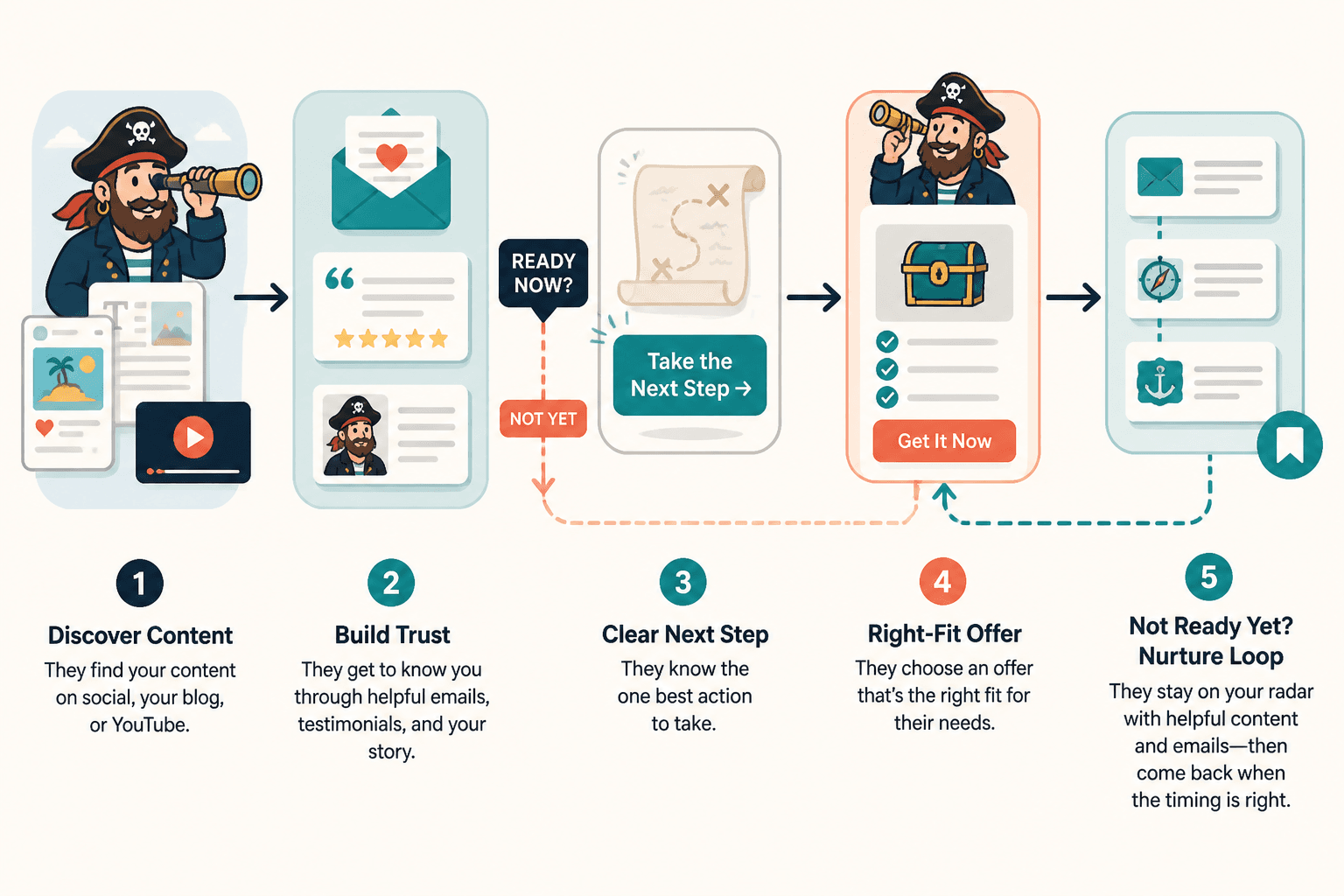
Why most audience-to-offer journeys fail
Most broken journeys fail in very boring ways. Not dramatic ways. Not mysterious algorithm ways. Just basic friction, vagueness, and mismatched steps.
1. The content and the offer do not match
If you post productivity tips for freelancers but sell high-ticket messaging strategy for coaches, do not be shocked when the audience is confused. People need to see a logical bridge between the content they consume and the thing you eventually sell.
2. The profile gives no next step
A lot of creators treat the profile like a mini résumé instead of a conversion point. Nice credentials. Lovely buzzwords. Zero direction. If someone lands there after liking your content, they should know who you help, what you help with, and what to do next.
3. The ask comes too early
Someone reads one post and suddenly gets invited to a premium offer, a sales call, a mastermind, and possibly a spiritual transformation. Relax.
Trust has stages. If the first meaningful interaction with your brand feels like a closing script, people back away. Rightly.
4. There is no middle step
Creators often build for two audiences only: strangers and buyers. But the people in the middle are usually where the money is.
They are interested. They are watching. They might even be a very good fit. They just need one more proof point, one clearer explanation, one lower-friction step, or one useful nudge.
5. Everything relies on one post “converting”
This is one of the weirdest creator habits online. People expect a single post to do awareness, positioning, trust-building, proof, and sales all at once. Then they wonder why it reads like a sandwich made by committee.
Better journeys spread the work. One piece earns attention. Another builds trust. Another points to the next step. Another supports the sale.
The 5 stages of a strong audience-to-offer journey
You do not need a giant funnel map with 42 automations and a migraine. You need a simple path with clean logic. For most creators, the journey works well when it has these five stages.
1. Discovery
This is where people first encounter you. Usually through posts, articles, threads, comments, collaborations, podcast appearances, search, or referrals.
Your job here is not to sell hard. It is to earn attention with relevance.
- Speak to a real problem
- Show a clear point of view
- Make your expertise visible
- Give people a reason to remember you
2. Trust
Once someone notices you, they need evidence that you are credible, useful, and sane. This is where consistency, clarity, examples, case studies, sharp thinking, and proof do the heavy lifting.
Trust is often built through repeated exposure. Not because repetition is magical, but because people need enough context to feel safe taking the next step.
3. Transition
This is the step most creators skip. Transition is the bridge between “I like your content” and “I want your help.”
That bridge might be:
- A lead magnet
- A newsletter signup
- A free workshop
- A diagnostic quiz
- A DM prompt
- A low-ticket product
- A case study article
- A profile CTA to a useful resource
The best transition steps feel like the obvious next move, not a trap door into a funnel basement.
4. Offer
Now you can present the paid thing. Service, course, membership, audit, consulting package, workshop, product, whatever fits your business.
At this stage, your offer should feel connected to the earlier content and trust-building. The buyer should be able to think, “Yes, this solves the problem I already know they understand.”
5. Follow-up
Not everyone buys on first contact. Shocking, I know.
Follow-up matters because interest is not always immediate action. People get busy. Budgets shift. Timing changes. Questions linger. Good follow-up keeps the relationship alive without becoming clingy.
This can include:
- Email nurture sequences
- Useful follow-up content
- Retargeted ideas through recurring content themes
- Soft personal outreach after genuine interest
- Case studies that reduce hesitation
- FAQs that answer obvious objections
How to map your own audience-to-offer journey
If you want better results, map the journey backwards from the offer. Start with the action you want, then identify what someone needs to believe, understand, or do before they get there.
This is where a lot of creators make things harder than they need to be. They start with content ideas. That is backwards. Content should support the journey, not replace one.
Step 1: Define the offer clearly
Before mapping anything, get specific about the offer itself.
- What exactly are you selling?
- Who is it for?
- What problem does it solve?
- What objections usually come up?
- What action counts as conversion: purchase, application, call, reply?
If the offer is fuzzy, the journey will be fuzzy too.
Step 2: Identify the entry points
Where do people first find you?
- LinkedIn posts
- X threads
- Facebook posts
- Search traffic
- Guest appearances
- Referrals
- Newsletter shares
Different entry points often need slightly different journeys. Someone from search may want deeper educational content. Someone from social may need faster clarity and a stronger profile CTA.
Step 3: Choose one bridge step
Do not give people six options unless you enjoy making decisions harder for them.
Pick one primary bridge between audience and offer. One. You can always build more later.
Examples:
- Content → newsletter → service inquiry
- Content → free template → nurture emails → paid workshop
- Thread → case study → booking page
- Post → profile CTA → low-ticket product → upsell
- Article → related lead magnet → consultation call
Step 4: Match content to each stage
Not all content should do the same job. You need different content for different stages.
| Stage | Content that fits | Main goal |
|---|---|---|
| Discovery | Sharp posts, hooks, opinion pieces, useful threads | Earn attention |
| Trust | Examples, case studies, deeper articles, practical breakdowns | Build credibility |
| Transition | Lead magnets, email CTA posts, profile CTAs, soft DM prompts | Move to next step |
| Offer | Sales page, booking page, offer post, launch email, consultation invite | Convert |
| Follow-up | Nurture emails, objection-handling posts, testimonials, FAQs | Reduce hesitation |
Once you see content by job instead of by platform alone, your strategy gets much less chaotic.
Step 5: Remove friction
Now test the journey like a mildly impatient stranger. Because that is what many people are.
- Is the next step obvious?
- Does the profile explain the offer clearly?
- Does the landing page match the promise from the content?
- Is the CTA too vague?
- Are you asking for too much too soon?
- Would someone know why they should care within seconds?
If a person has to assemble your business model like flat-pack furniture, the journey needs work.
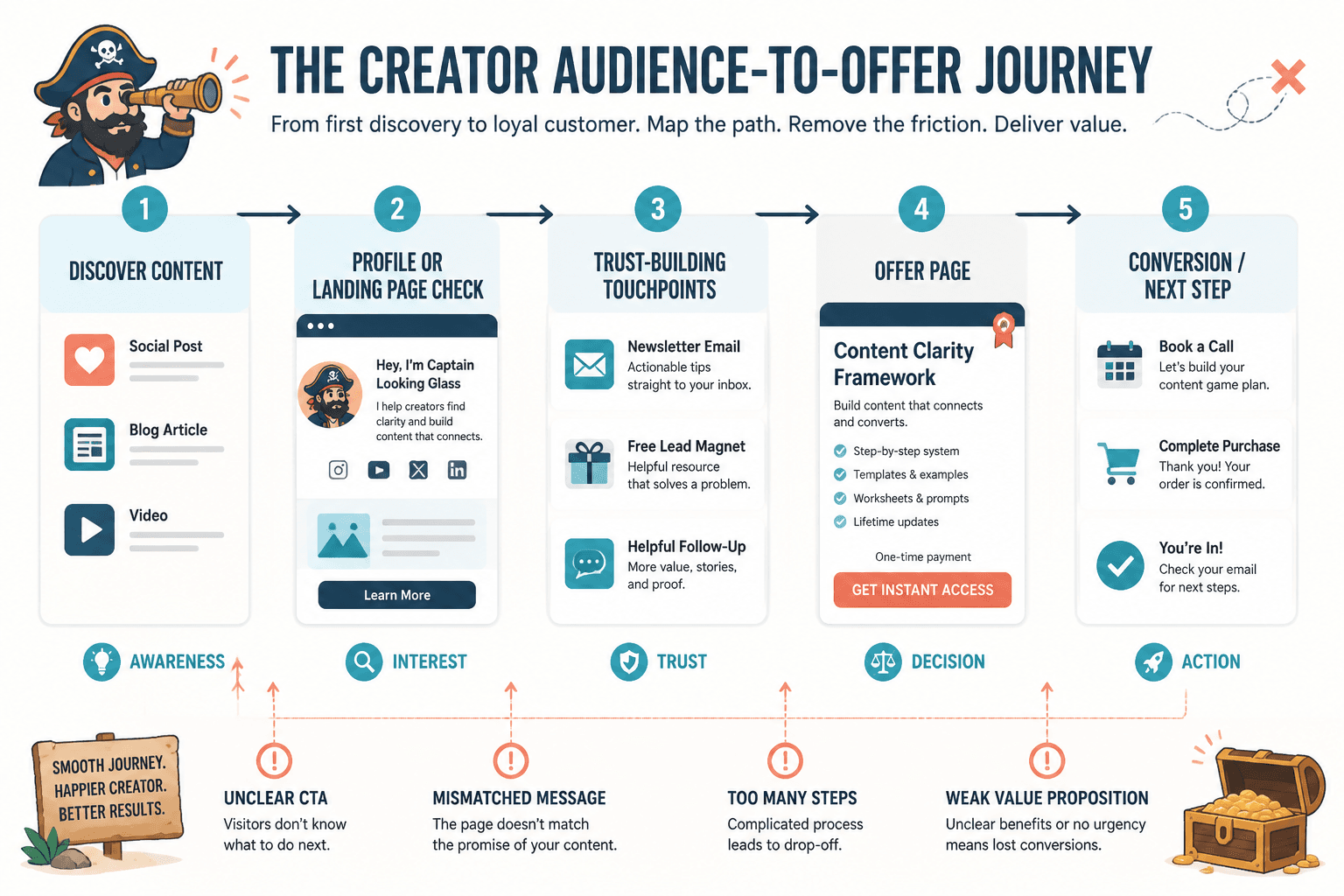
Simple audience-to-offer journey models that actually work
You do not need to invent a whole new system. Most creator businesses can start with a handful of clean journey models and refine from there.
1. Content to newsletter to offer
This is one of the strongest models for consultants, writers, coaches, and educators.
- Post useful content regularly
- Use the profile and selective CTAs to grow the email list
- Send helpful emails that deepen trust
- Present the offer when relevance is high
This works because email gives you a steadier trust environment than rented social reach. It also lets you build context over time instead of trying to close everything in a public feed.
2. Content to lead magnet to nurture to service
Good if you sell a higher-trust service and need more qualification before the sale.
- Create content around one painful problem
- Offer a useful free resource tied to that problem
- Use follow-up emails to educate and qualify
- Invite the right people to book or apply
The key is relevance. A random checklist that has nothing to do with your offer will attract random people. Then you’ll wonder why the lead quality is weird. It is not weird. The setup is weird.
3. Content to profile to direct booking
This works best when the offer is clear, the audience is problem-aware, and the buying process is simple.
- Publish content that makes the problem and your approach clear
- Use a profile bio that positions the offer cleanly
- Link directly to a booking or inquiry page
It is simple, but it only works well if your profile does serious trust-building work. Otherwise it feels abrupt.
4. Article to case study to consultation
Ideal for deeper expertise-led businesses. Think consultants, strategists, B2B service providers, and niche specialists.
- Publish educational articles that answer strong-intent questions
- Link to a relevant case study or proof asset
- Invite the reader to book a conversation
This creates a quieter but often more qualified journey, especially for buyers who need evidence before they act.
5. Content to low-ticket offer to premium offer
Useful if you have productized expertise or want to qualify buyers through a smaller purchase first.
- Use content to solve smaller visible problems
- Offer a paid template, workshop, or mini-product
- Upsell buyers into a premium product or service
This can work nicely, but only if the low-ticket offer is genuinely helpful. If it feels like paid bait, people notice.
How to know which journey fits your business
The right journey depends less on platform trends and more on four practical variables.
Your offer complexity
The more expensive, custom, or trust-heavy the offer is, the more journey support it usually needs. A $29 template can often sell with a direct path. A $5,000 consulting package usually needs more context, proof, and follow-up.
Your audience awareness
If the audience already knows they have the problem, you can move faster. If they barely understand the issue, your content has to do more education before the offer makes sense.
Your traffic source
Warm referrals behave differently from cold social traffic. Search traffic often shows stronger intent. Social audiences may need more repeated touchpoints before they act. Build for the quality and temperature of your traffic, not for some fantasy version of “the audience.”
Your capacity
If you are a solo creator, do not build a funnel that needs six automations, daily DMs, custom onboarding, a CRM circus, and your remaining life force. Build the simplest journey you can run consistently.
Simple beats impressive-looking mess almost every time.
Common mistakes that quietly wreck results
You can have decent content and still get poor results if the journey around it is sloppy. Here are the mistakes that show up constantly.
- Posting without a conversion path: useful content with nowhere useful to go
- Weak profile positioning: people cannot tell what you do or who it is for
- Mismatched lead magnets: freebie attracts people who will never buy
- Too many CTAs: follow, subscribe, DM, book, comment, share, click, pray
- No proof: claims everywhere, evidence nowhere
- Hard selling too early: trying to monetize attention before earning trust
- No follow-up: assuming interest automatically becomes action
- Overcomplicated flows: a journey so clever nobody finishes it
If results feel patchy, check these before blaming your niche, your platform, or the moon.
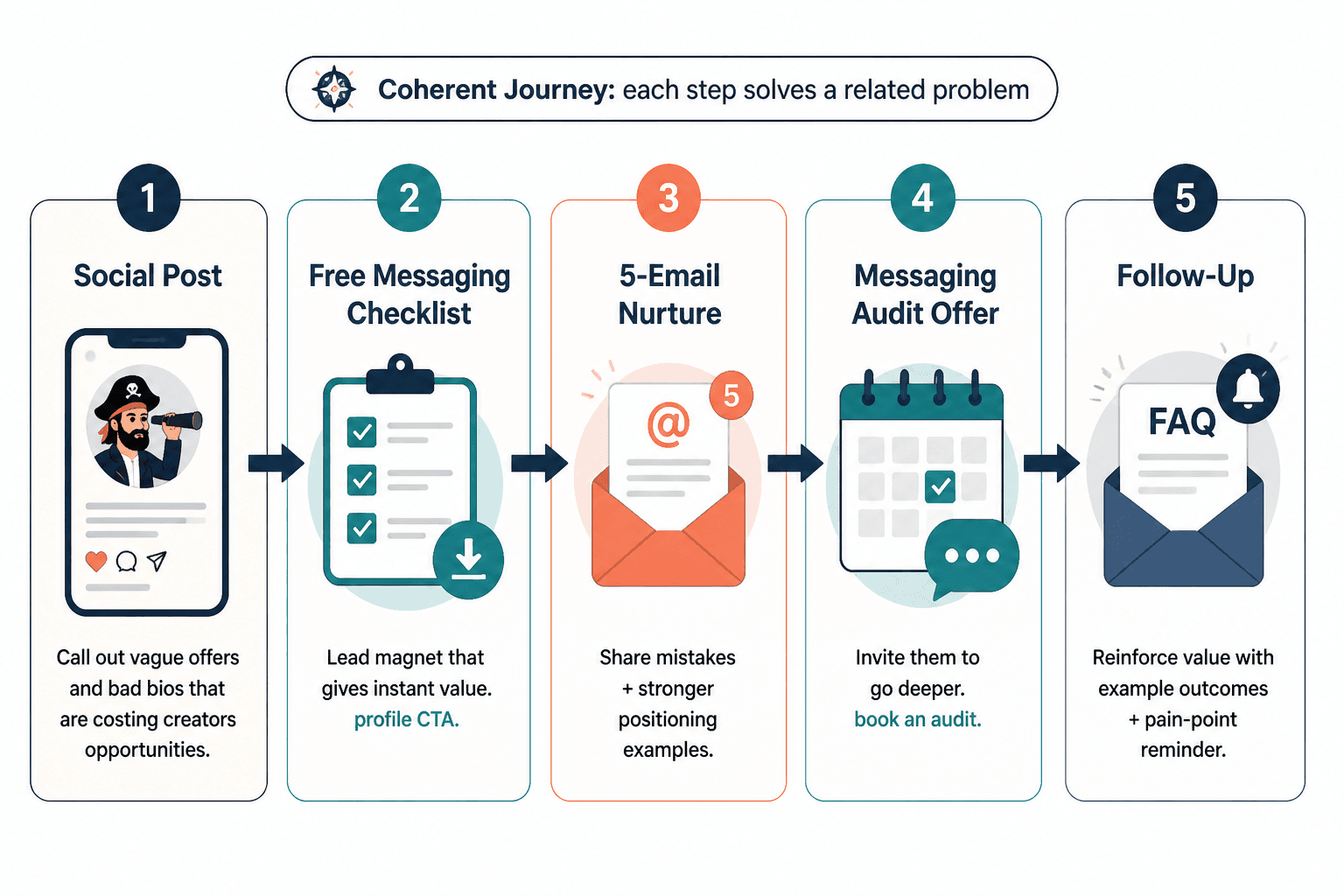
A practical example of an audience-to-offer journey
Say you are a messaging consultant helping coaches tighten their positioning and sell more clearly.
A clean journey could look like this:
- Discovery: LinkedIn posts about weak messaging, vague offers, and bad bios
- Trust: before-and-after rewrites, client examples, short case studies, practical articles
- Transition: profile CTA to a free messaging checklist
- Nurture: 5-email sequence showing common mistakes and stronger positioning examples
- Offer: invitation to book a messaging audit
- Follow-up: email with FAQ, example outcomes, and a reminder tied to a common pain point
Notice what is happening here. The content, the free resource, and the offer all solve related problems. The person does not need to make a giant mental leap from “helpful post” to “paid audit.” The logic is clean.
That is what you are aiming for. Not complexity. Coherence.
What to improve first if your journey is underperforming
If your current setup is not getting the results you want, start with the highest-leverage fixes.
- Clarify the offer: make sure it solves a clear problem for a clear audience
- Tighten the profile: make the next step obvious
- Choose one main CTA: stop scattering attention
- Create one bridge asset: newsletter, lead magnet, case study, or low-ticket step
- Publish more trust content: examples, proof, breakdowns, and useful specificity
- Add follow-up: simple email nurture or structured outreach after genuine interest
You do not need to rebuild everything at once. A better audience-to-offer journey often comes from fixing one weak handoff. The post to profile handoff. The profile to email handoff. The lead magnet to offer handoff. Those small leaks add up.
If you want more structure, the main audience-to-offer journeys hub is a good next stop. You can also explore broader monetization funnel resources if you want the wider system around the journey itself.
And if you need more specific help, these related guides will make this article more useful in practice:
- best audience-to-offer journeys ideas and examples for creators
- audience-to-offer journeys for creators with small audiences
- simple audience-to-offer journeys journey mapping templates for busy creators
- how to write better audience-to-offer journeys
FAQ
Do all creators need an audience-to-offer journey?
If you want content to lead somewhere useful, yes. It does not need to be elaborate, but it should exist.
What is the best first step for beginners?
Start with one offer, one content theme tied to that offer, one profile CTA, and one bridge step like an email list or consultation page.
Should every post include a CTA?
No. Every post should know its job. Some posts earn attention. Some build trust. Some move people forward. Not all of them need to ask for action directly.
What if I have a small audience?
That is fine. A small, relevant audience with a clean journey often outperforms a larger vague one. The quality of the path matters more than vanity metrics.
How long should the journey be?
As short as trust allows. If people can buy with little friction, keep it short. If your offer needs more education or proof, add support without making the path messy.
Build the path, not just the content
The best content in the world cannot save a broken journey.
If people like what you make but do not take the next step, your business probably does not need more noise. It needs better handoffs. A stronger bridge. A clearer ask. A journey that respects how trust actually works.
That is the real point of an Audience-to-Offer Journeys Guide for Better Results. Not to make your brand feel more automated. To make it easier for the right people to move from interest to action without confusion, pressure, or unnecessary nonsense.
Fix that, and your content stops being a pile of disconnected good intentions. It starts doing its job.
The bigger point is simple: clearer structure and clearer writing make the piece more useful. That is usually what makes the ending land better too.