
Most creators do not need a more complicated funnel. They need a clearer path.
That is the whole job of simple audience-to-offer journeys: take a stranger, reader, follower, subscriber, or quiet lurker and move them toward the next useful step without making the whole thing feel like a sticky sales maze built by a man who says “value ladder” too often.
If your content gets attention but does not lead anywhere, or your offer exists but people rarely seem ready for it, the problem usually is not effort. It is the missing bridge between interest and action.
This guide gives you simple audience-to-offer journeys journey mapping templates for busy creators who want something practical, not a 47-box funnel diagram that looks like an airport evacuation plan. You will get easy journey structures, when to use each one, and how to map them fast without overengineering the life out of your business.
For the broader learning path, visit our parent guide.
What an audience-to-offer journey actually is
An audience-to-offer journey is the sequence between someone discovering you and someone taking an action that matters to your business.
That action might be:
- joining your email list
- downloading a free resource
- replying to a post
- booking a consult
- buying a low-ticket product
- applying for coaching
- joining a paid membership
Simple enough. But people make this weird by assuming the journey should be long, heavily automated, and dressed up in funnel jargon. It does not have to be.
For most creators, a good journey is just:
- one relevant entry point
- one useful trust-building step
- one clear offer or next action
That is often enough. Not glamorous. Very effective.
If you want the bigger picture behind these systems, the main audience-to-offer journeys hub is a solid next stop after this.
Why busy creators need simpler journey maps
When you are creating content, serving clients, handling admin, maybe building products, and trying to have some faint memory of a personal life, complexity becomes expensive fast.
A simple journey map helps because it forces a few useful questions:
- How do people first find me?
- What makes them trust me enough to keep paying attention?
- What step makes sense before the offer?
- What offer fits that level of trust?
- Where are people dropping off?
That is strategy. Not “posting consistently” and hoping the universe sorts the rest out.
A good map also saves you from two classic creator mistakes:
- Pitching too early. Someone reads one post and immediately gets asked to buy a premium service. Bold. Also usually bad.
- Never pitching at all. You build trust forever, become “so helpful,” and somehow forget you run a business.
The right journey keeps trust and conversion in the same room without making either one unbearable.
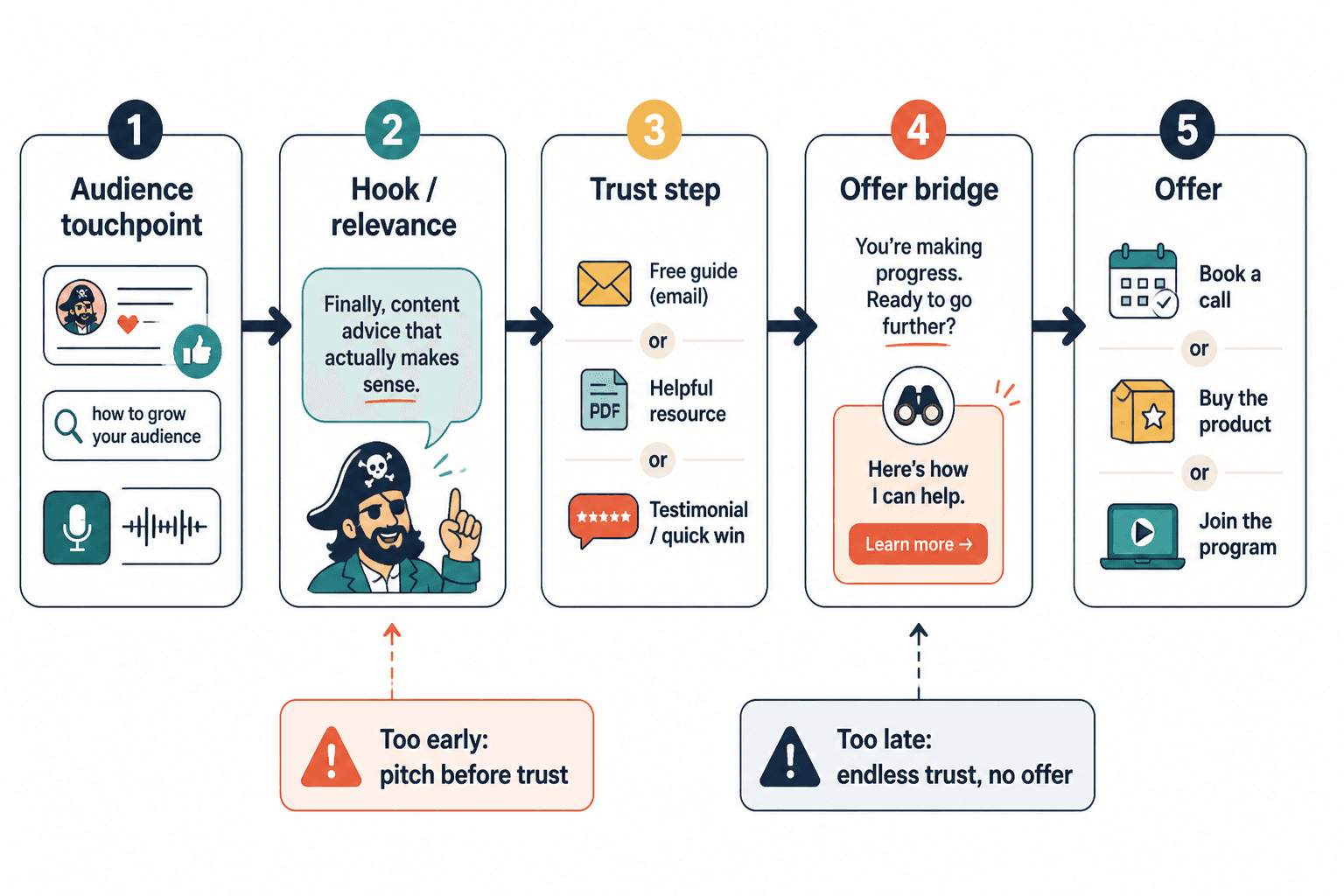
The 5-part journey map that works for most creators
Before the templates, use this simple frame. Almost every audience-to-offer path can be mapped with these five parts:
- Entry point — where people first see you
- Hook or relevance — why they care enough to continue
- Trust step — what builds confidence in your expertise or fit
- Offer bridge — the transition into a next action
- Conversion point — where they subscribe, reply, book, buy, or apply
That is it. Five parts. Not seventeen.
Here is what that might look like in plain English:
| Stage | Question to answer | Example |
|---|---|---|
| Entry point | How do they find you? | LinkedIn post, thread, referral, article |
| Hook or relevance | Why do they care? | The topic matches a pain they already feel |
| Trust step | Why trust you? | Case study, useful email, strong profile, free resource |
| Offer bridge | What is the natural next step? | Invitation to book, join, buy, or reply |
| Conversion point | Where do they act? | Booking page, email opt-in, checkout, DM conversation |
If a journey feels messy, weak, or random, one of these five parts is usually missing or badly matched.
Simple audience-to-offer journey mapping templates for busy creators
These templates are designed for people who want useful structure without becoming full-time funnel mechanics.
1. Content to lead magnet to nurture to offer
This is the classic one, and for good reason. It works well when your audience needs a bit more education or trust before buying.
Template:
- Audience sees a useful post, article, or thread
- They click through to a relevant free resource
- They join your email list
- They receive a short nurture sequence
- They are invited to a paid offer
Best for: coaches, consultants, educators, service providers, and creators selling expertise-based offers
Good example:
- Post: “Why most content does not convert even when it gets engagement”
- Lead magnet: “Content-to-client journey worksheet”
- Nurture emails: common mistakes, short case study, quick framework
- Offer: strategy session or audit
What people get wrong: the lead magnet has nothing to do with the post, the emails wander around for six days, and the offer arrives like an uninvited salesman at dinner.
Keep the chain tight. Each step should feel like the obvious next thing.
2. Content to profile to booking page
This is one of the cleanest audience-to-offer journeys if you sell a service and your profile does some actual work.
Template:
- Audience sees a strong post
- They check your profile
- Your profile makes your positioning clear
- Your CTA points to a booking page
- They book a call or inquiry
Best for: consultants, freelancers, fractional experts, coaches with simple service offers
This works especially well when the post itself demonstrates your thinking. The post earns curiosity. The profile confirms fit. The CTA gives direction.
If you are posting sharp insights but your profile still says something like “Helping ambitious leaders unlock transformation,” that is not a journey. That is sabotage with a headshot.
3. Content to email list to low-ticket offer
Useful when your audience is interested but not ready for a high-trust purchase.
Template:
- Audience finds you through content
- They opt into your list for a focused resource
- You send useful, relevant emails
- You introduce a low-ticket product
- Some buyers later move to a larger offer
Best for: template sellers, educators, digital product creators, writers with paid mini-offers
The low-ticket offer should solve a real problem fast. Not exist merely as a tripwire because some funnel bro on the internet said every business needs one.
Good low-ticket offers include:
- template packs
- mini-workshops
- swipe files
- audits
- short implementation guides
- toolkits
4. Content to DM conversation to service offer
This one works when your audience is relatively warm and your service is high-trust or customized.
Template:
- You publish a post that speaks to a clear problem
- The CTA invites replies, comments, or a keyword DM
- A real conversation starts
- You qualify fit naturally
- You move the right people to a call or direct offer
Best for: high-ticket services, consulting, done-for-you work, coaching with a strong fit component
The key word here is real. If your DM flow feels copy-pasted, manipulative, or suspiciously eager, people can smell it. And yes, they hate it.
This journey works because conversation reduces friction. It fails when the “conversation” is clearly a trapdoor into a pitch sequence.
5. Article to case study to consultation
This is a stronger authority path for creators with more nuanced expertise.
Template:
- Audience finds a search-friendly article or deep post
- They read a concrete case study or proof asset
- They see how you think and what results you help create
- They book a consultation
Best for: B2B consultants, strategists, ghostwriters, brand experts, conversion specialists
This journey often attracts better-fit leads because it filters out people who want shallow tips and brings in people actively evaluating expertise.
If you want supporting examples for these paths, this roundup of audience-to-offer journey ideas and examples is worth keeping open in another tab.
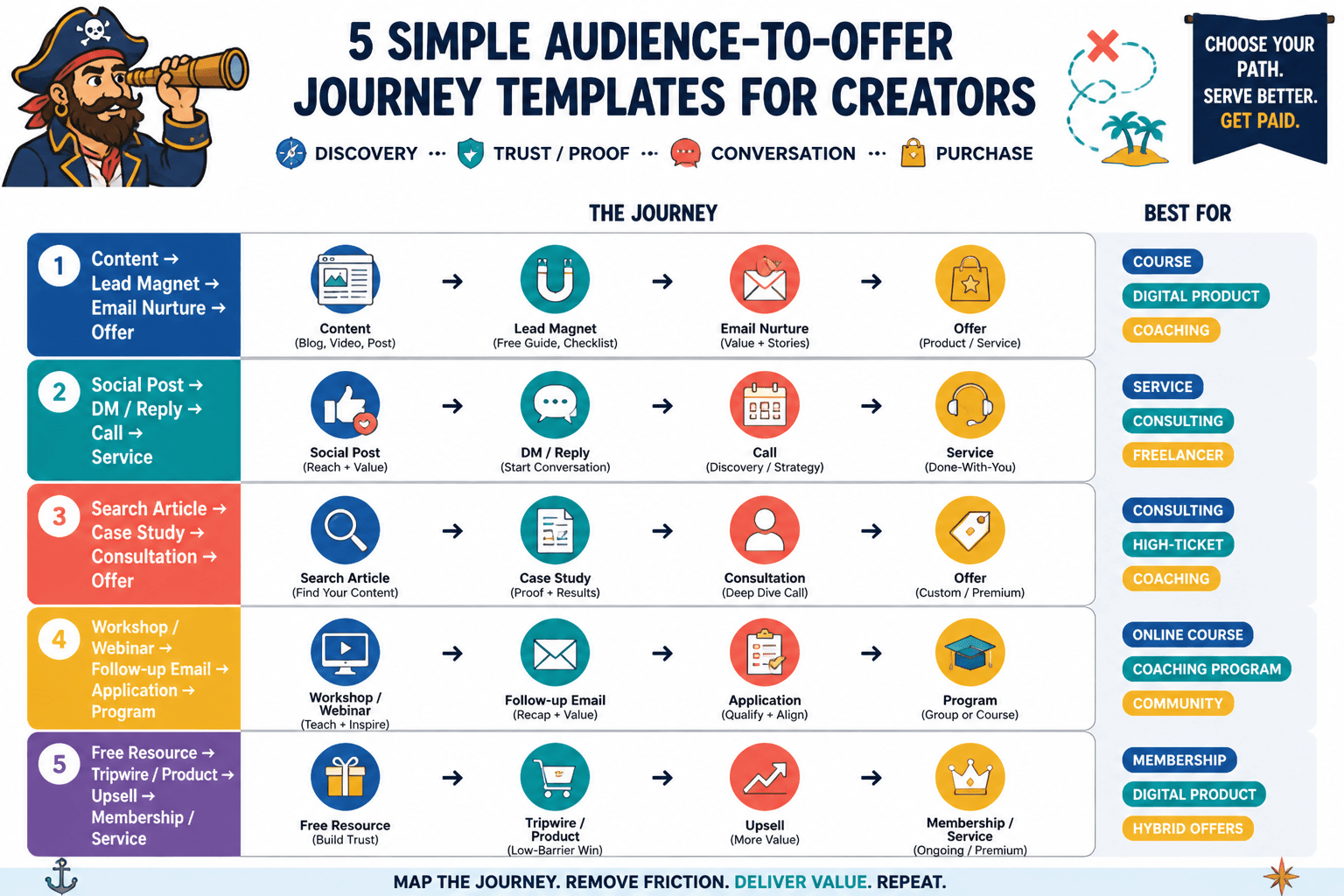
How to map your journey in 15 minutes
You do not need a giant whiteboard session. Use this quick process instead.
Step 1: Pick one offer
Not three. One.
Choose the offer you actually want more people moving toward right now. If you try to build a journey for every offer at once, you will produce a map that pleases no one and converts nothing.
Step 2: Identify the audience starting point
Ask:
- Are they cold, warm, or already familiar with me?
- What problem do they know they have?
- What do they need before they are ready for my offer?
This matters because a cold reader usually needs a different journey from a newsletter subscriber or repeat follower.
Step 3: Choose one trust-building step
Pick the fastest, clearest thing that makes the next step more likely.
That could be:
- a lead magnet
- a short email sequence
- a case study
- a strong profile
- a free audit
- a reply-based conversation
One trust step is enough to start. You are building a path, not a museum exhibit.
Step 4: Define the next action clearly
Your CTA should match the relationship stage.
| If they are… | Better CTA | Usually too early |
|---|---|---|
| Cold audience | Read this, get this, subscribe here | Book a premium consult now |
| Warm audience | Reply, join, watch, apply, book | Hard pitch with no context |
| Highly engaged audience | Buy, apply, book, inquire | Endless nurturing with no ask |
Step 5: Write the journey in one line
If you cannot summarize the journey in one sentence, it is probably too messy.
Examples:
- LinkedIn post → profile visit → booking link → strategy call
- Article → checklist opt-in → 5-email sequence → mini-course
- X thread → DM reply → qualification chat → consulting offer
That sentence becomes your map.
A fill-in journey mapping template you can actually use
Here is a simple template. Copy it into your notes app, doc, or project board and fill in the blanks.
Offer: What am I trying to sell?
Audience: Who is this for?
Starting point: Where do they first encounter me?
Main pain/problem: What do they already want help with?
Trust step: What helps them believe I can help?
Bridge CTA: What is the next action before the offer?
Offer CTA: What action leads to the sale?
Friction point: What could stop them?
Fix: What can I simplify, clarify, or strengthen?
And here is a filled-in example for a consultant:
Offer: Messaging strategy sprint
Audience: Coaches and consultants with weak website messaging
Starting point: LinkedIn posts about positioning mistakes
Main pain/problem: They sound generic and are not converting leads well
Trust step: Free messaging teardown checklist
Bridge CTA: Download the checklist from profile link
Offer CTA: Book a sprint consult call
Friction point: They are interested but unsure if they are the right fit
Fix: Add clearer profile proof, examples, and “who this is for” language
Clean. Useful. No need to summon a funnel software demo for this.
How to choose the right journey template for your business
Different journeys fit different offers. The right one depends on trust level, offer price, complexity, and how your audience likes to buy.
| If you sell… | Usually use… | Why it fits |
|---|---|---|
| Done-for-you services | Content → profile → booking or DM → call | Buyers want to assess fit and credibility |
| Coaching or consulting | Content → lead magnet or case study → consult | Trust and proof matter before commitment |
| Digital products | Content → email list → low-ticket offer | Lower friction, easier entry point |
| Memberships or communities | Content → nurture → invite | People often need to understand the value first |
| High-ticket strategy work | Article or thought leadership → proof asset → consultation | Authority and specificity filter better leads |
The bigger point is simple: clearer structure and clearer writing make the piece more useful. That is usually what makes the ending land better too.