
If you have a small audience, you do not need a bigger funnel. You need a cleaner path.
That is where most creators get this wrong. They post for attention, maybe collect a few likes, maybe get a reply or two, and then wonder why none of it turns into leads or sales. The issue usually is not that their audience is too small. It is that the journey from audience to offer is vague, clunky, or nonexistent.
Audience-to-Offer Journeys for Creators With Small Audiences are not about fancy automation or pretending your content is a full-blown sales machine. They are about helping the right people move from “this is interesting” to “this might help me” to “I should probably work with this person.” Quietly. Clearly. Without weird pressure.
If your audience is still growing, that matters even more. You cannot afford friction. You cannot afford generic messaging. And you definitely cannot afford content that earns polite engagement from the wrong people while your offer sits in the corner like an ignored folding chair.
Here is how to build audience-to-offer journeys that actually fit a small creator business: simple paths, relevant content, clear next steps, and offers that do not appear out of nowhere like a surprise invoice.
For the full path around this topic, head to the parent guide.
What an audience-to-offer journey actually is
An audience-to-offer journey is the path someone takes from first noticing your content to taking a meaningful business action.
That action could be:
- joining your email list
- downloading a resource
- replying to a post
- booking a call
- asking about your service
- buying a product
It is not just a funnel in the broad, vague, internet-marketing sense. It is the actual sequence of touchpoints that helps a person trust you enough to move forward.
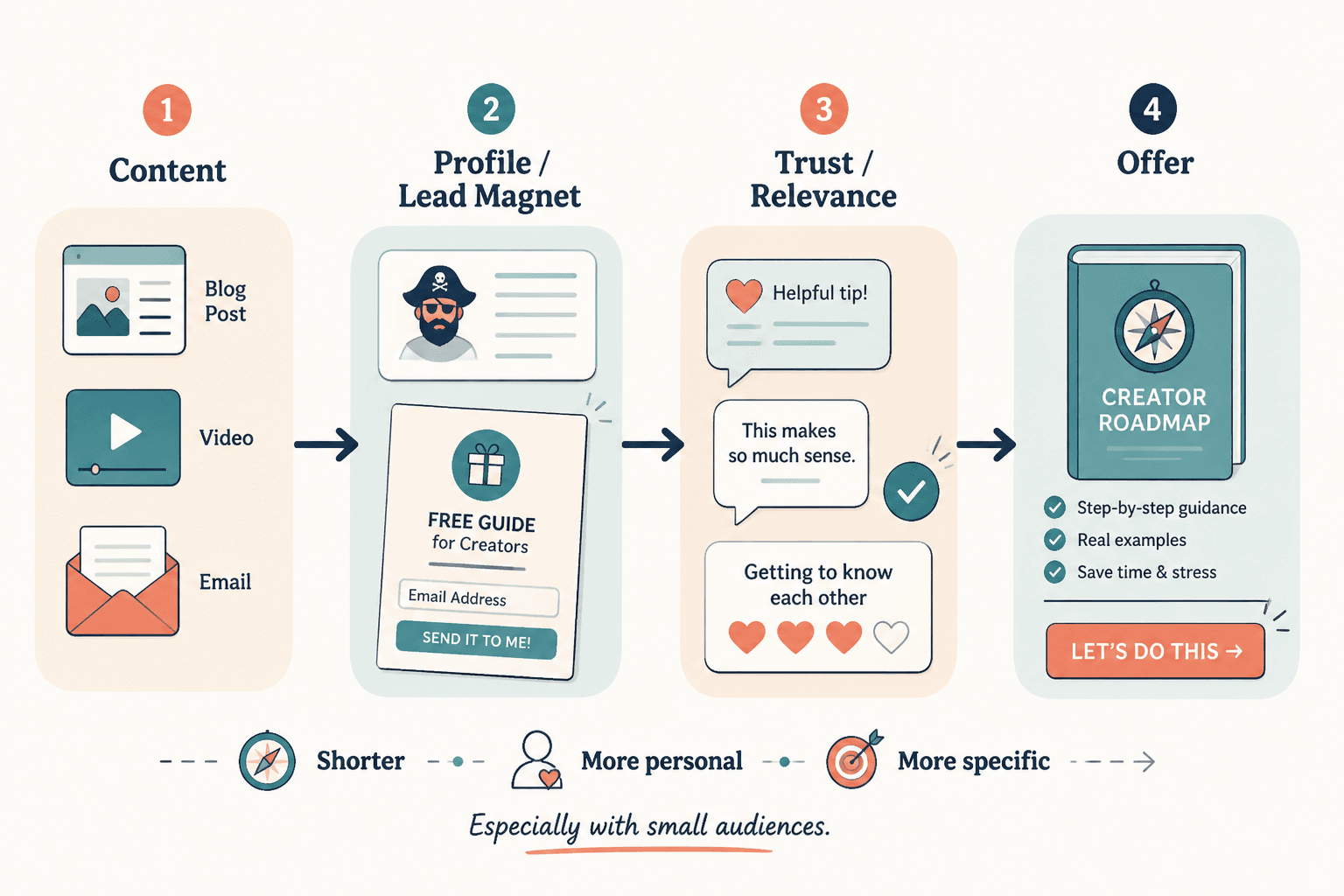
For small audiences, this sequence usually needs to be shorter, more personal, and more specific than what big creators can get away with. A massive audience can absorb lazy content, broad offers, and weak transitions because volume covers a lot of sins. A small audience cannot. If only a handful of right-fit people see your work each week, every step needs to make sense.
That means your content, profile, lead magnet, calls to action, and offer positioning should feel connected. Not identical. Connected.
Why small audiences need better journeys, not louder promotion
When creators have small audiences, they often panic and overcorrect in one of two directions.
- They become too passive and “just focus on value” forever, with no business path attached.
- They become too aggressive and start pitching in every post like rent is due in 14 minutes.
Neither works very well.
The first creates warm feelings and no movement. The second creates movement in the opposite direction.
A good journey sits in the middle. It gives people useful content, builds relevance and trust, then offers a logical next step when the person is ready. That next step should feel like continuation, not interruption.
This is one reason audience quality matters more than audience size. A small audience of aligned readers, clients, peers, and potential buyers can outperform a much larger audience of random lurkers who enjoy your content but would never pay you. Vanity metrics are fun right up until they need to become revenue. Then things get awkward.
If you want more background on how these journeys work as part of a broader funnel system, the main audience-to-offer journeys hub is worth bookmarking.
The 5 stages of strong Audience-to-Offer Journeys for Creators With Small Audiences
You do not need a 17-step nurture labyrinth. Most creator businesses can work with five simple stages.
1. Attention
This is where someone first finds you: a post, thread, article, podcast clip, comment, referral, or profile visit.
Your job here is not to explain everything. It is to earn enough interest for the right person to keep going.
Good attention content usually has one or more of these:
- a sharp opinion
- a useful insight
- a specific problem
- a relevant example
- a clear point of view
Bad attention content tends to sound impressive while saying very little. You have seen it. “Show up consistently and be authentic.” Lovely. That narrows it down to absolutely nothing.
2. Relevance
Now the person needs to see that your work is actually for them.
This is where many creators lose momentum. Their content may be smart, but it is too broad. It attracts attention from people who think, “Interesting,” but not from people who think, “This solves the exact problem I have.”
Relevance comes from specifics:
- naming the audience clearly
- talking about real problems they recognize
- using examples from their world
- showing you understand their constraints
If you help consultants get better leads from content, say that. Do not hide behind “I help businesses grow online.” That kind of line sounds polished and empty at the same time, which is honestly a difficult trick.
3. Trust
Once someone sees that you are relevant, they need a reason to believe you.
Trust is built through proof, clarity, consistency, and sane messaging. Not by posting your morning mindset routine over a stock photo of a mountain.
Trust signals can include:
- useful educational content
- clear frameworks
- before-and-after examples
- case studies
- client results with context
- smart answers in comments or DMs
- a profile that explains what you actually do
Small audiences often build trust faster through direct interaction. That is an advantage, not a weakness. A good comment conversation, DM exchange, or email reply can do more than a week of performative posting.
4. Transition
This is the step most people forget.
The transition is how someone moves from consuming your content to entering a more intentional part of your world. That might be your email list, a free resource, a consultation page, a low-ticket product, or a reply-based conversation.
If your content says one thing, your bio says another, and your offer page says something else entirely, people stall here. Not because they hate you. Because they are confused.
Good transitions feel natural:
- “If you want the full framework, grab the guide in my bio.”
- “If this is the bottleneck in your business, send me the word ‘audit’ and I’ll point you to the right resource.”
- “I wrote a deeper walkthrough here if you want the full process.”
5. Offer
Finally, the person reaches an offer that matches the problem your content has been helping them think about.
The offer should feel like the logical next step, not a random switch from “Here are three practical content fixes” to “By the way, I also do wedding photography and sell a leadership mastermind.”
Alignment matters. If your audience journey attracts one type of person and your offer serves another, the whole thing gets expensive and weird.
What a simple small-audience journey can look like
Here are a few examples that make sense for creators with smaller but relevant audiences.
| Content entry point | Next step | Offer |
|---|---|---|
| LinkedIn post on a common client mistake | Profile visit to free checklist | Strategy call or service inquiry |
| X thread breaking down a framework | Email opt-in for full template | Workshop or consulting offer |
| Facebook post sharing a client lesson | Comment conversation or DM | Done-with-you package |
| Article explaining a process | Related guide or case study | Audit, retainer, or advisory offer |
| Short post with a strong opinion | Bio click to focused landing page | Low-ticket starter product |
Notice what these examples do not include: twelve tools, six automations, and an email sequence that sounds like it was assembled by a dehydrated webinar ghost.
Simple works when the path is clear.
If you want more practical structures, these audience-to-offer journey ideas and examples can help you map a version that fits your business model.
How to build your journey without overcomplicating it
You do not need to start with software. Start with a whiteboard, notes app, or one mildly abused Google Doc.
Step 1: Pick one audience segment
Not “everyone who wants to grow.” Not “coaches, consultants, founders, creators, agencies, and service businesses.” Pick one segment with one meaningful problem.
Example:
- freelance copywriters who need more inbound leads
- executive coaches who want a clearer LinkedIn funnel
- solo consultants selling strategy retainers
Step 2: Define the problem that leads to the offer
Your content should create a bridge to the offer, which means it should revolve around the problem your offer solves.
If your offer is profile optimization for coaches, but your content is mostly generic productivity tips, your audience journey is drifting off-road.
Write down:
- the problem they know they have
- the deeper problem behind it
- the result they want
- the result your offer helps deliver
Step 3: Choose one transition point
What do you want interested people to do next?
Choose one primary transition:
- join your email list
- download a free resource
- book a call
- send a DM keyword
- read a deeper article
One is enough to start. Multiple next steps often reduce action, especially when your audience is small and your messaging still needs tightening.
Step 4: Match content types to each stage
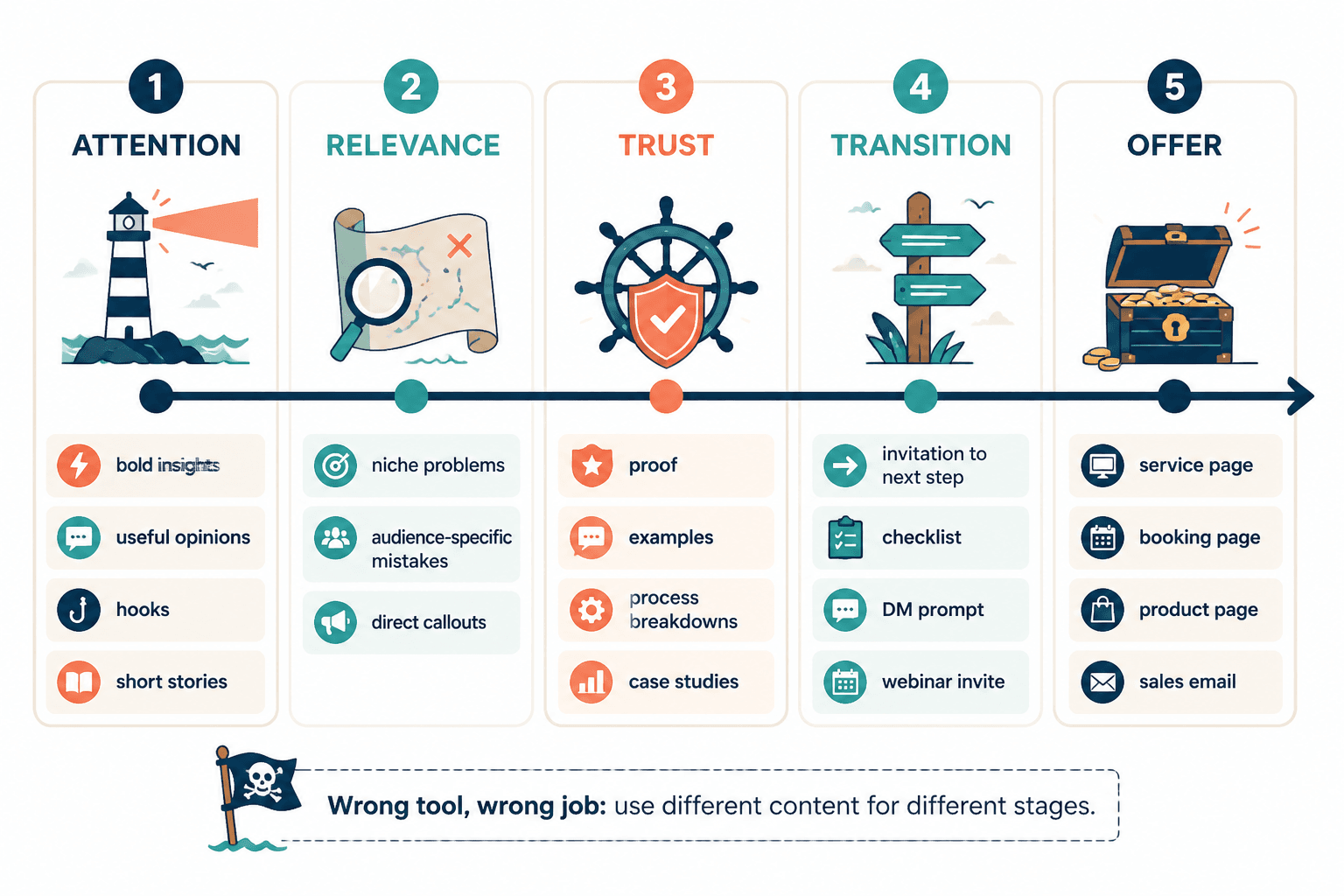
You need different content for different jobs.
- Attention content: bold insights, useful opinions, hooks, short stories
- Relevance content: niche problems, audience-specific mistakes, direct callouts
- Trust content: proof, examples, process breakdowns, case studies
- Transition content: invitations to a useful next step
- Offer content: service pages, booking pages, product pages, sales emails
One reason content feels ineffective is that creators keep using one type of post for every stage. They try to build trust with vague awareness posts. Or they try to sell from top-of-funnel hot takes. Wrong tool, wrong job.
Step 5: Tighten the profile and landing point
If your post works but your profile is unclear, the journey breaks.
Your profile should quickly answer:
- who you help
- what you help them do
- why they should trust you
- what they should do next
Then your landing point needs to continue the same message. Not restart from zero with a bunch of abstract branding copy.
If you need help mapping this cleanly, these journey mapping templates for busy creators make the process less messy.
Common mistakes that wreck small-audience conversion
These are the usual suspects.
Talking to everyone
Broad content may get more surface-level engagement, but it often produces weaker buyer intent. Small audiences need higher relevance, not lower standards.
Making the offer appear too late
If people consume your content for months and still do not know what you sell, that is not subtle marketing. That is unclear positioning.
Pitching too early
On the other hand, if every useful post immediately swerves into “DM me to work together,” people start treating your content like a trap.
No proof
Useful ideas are good. Useful ideas with proof are much better. Show examples, outcomes, client patterns, process screenshots, or sharp observations from real work.
Too many steps
A small audience does not need a maze. If people have to click five times, read three vague pages, and decode your offer from brand poetry, they will leave.
Mismatched content and offer
If your audience grows around one topic and your revenue depends on another, conversion will feel harder than it should. The journey needs continuity.
Three practical audience-to-offer journey models for small creators
You do not need one universal model. You need one that matches your sales cycle, offer type, and audience behavior.
1. Content → profile → lead magnet → offer
Best for creators building trust over time and selling services, consulting, or courses.
This works well when your content sparks interest, your profile clarifies your positioning, and your free resource deepens trust before the offer appears.
Use it when the buyer needs a bit of warming up.
2. Content → conversation → soft DM → offer
Best for high-trust service businesses, especially if your audience is very targeted.
This often starts with a post that invites a specific kind of response. The conversation reveals fit. Then a DM or email moves things forward naturally.
The key word here is soft. If your “conversation strategy” is basically pouncing on everyone who comments, people notice. And not in a good way.
3. Content → article or resource → booking page
Best for consultants, strategists, and experts whose buyers want a little more depth before booking.
This model gives the reader a deeper layer of authority before asking for the next step. It is especially useful if your work requires more explanation or if your buyers are cautious, analytical, or simply tired of vague promises.
For more funnel pairings that make sense here, see these funnel ideas to pair with audience-to-offer journeys.
How to know if your journey is working
You do not need advanced analytics to spot whether the path makes sense. Start with basic signals.
- Are the right people engaging with your content?
- Are people visiting your profile after posts?
- Are they clicking your next-step link?
- Are they replying, commenting, or asking relevant questions?
- Are lead magnet subscribers or call bookers reasonably aligned?
- Are inquiries tied to the problem your content talks about?
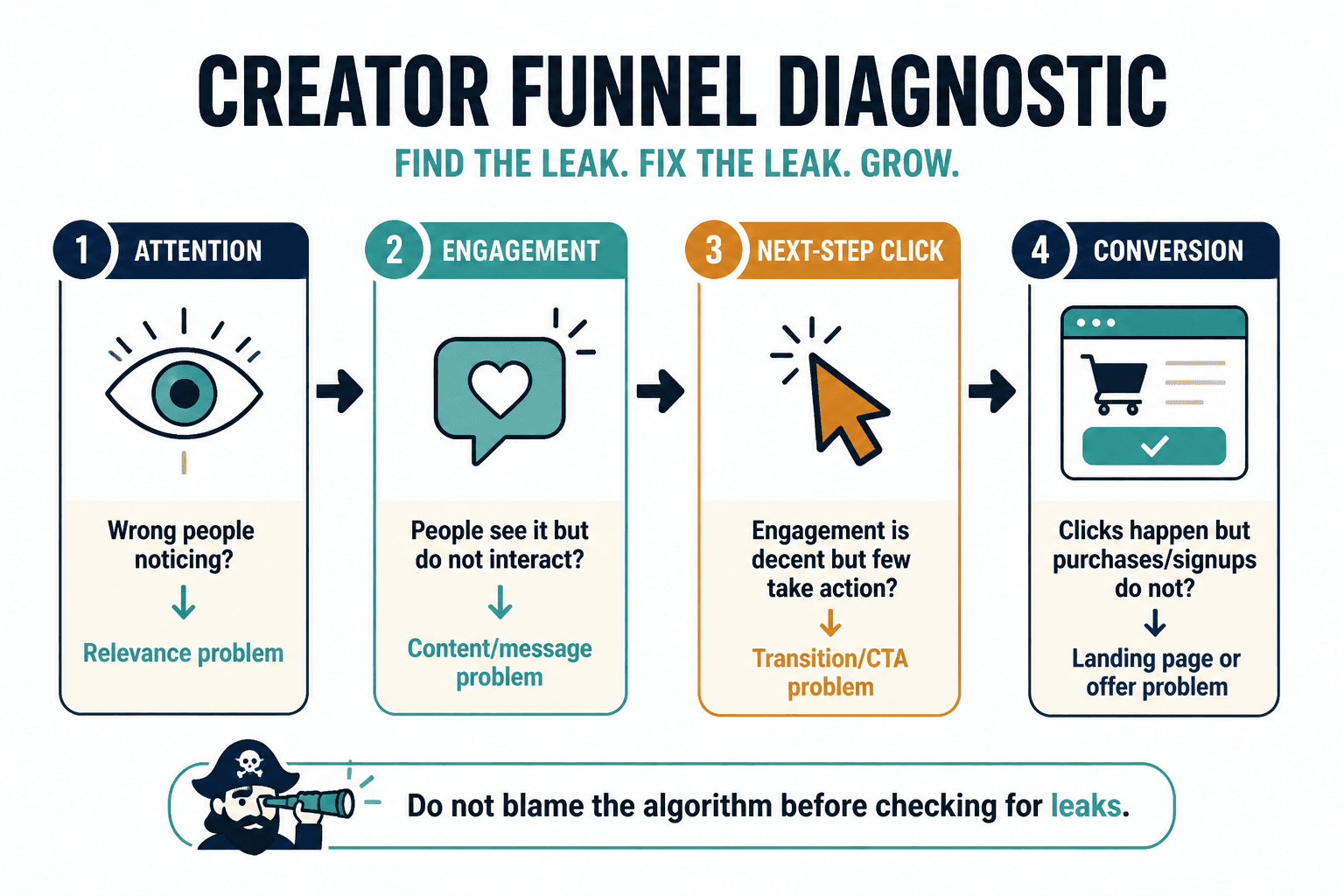
If engagement is decent but next-step action is weak, the transition may be the problem.
If clicks happen but conversions do not, the landing point or offer may be weak.
If you get attention from the wrong people, your relevance is off.
This is useful because it keeps you from blaming “the algorithm” every time your business system has a leak. Sometimes the platform is annoying. Sometimes your path is just blurry.
For a broader breakdown of how to improve weak spots, this guide for creators who want better results is a solid next read.
Keep the journey simple enough to actually use
There is a point where optimization becomes procrastination in nicer clothes.
If you have a small audience, your best move is usually not building more complexity. It is making your current path easier to understand and easier to follow. Better content focus. Better profile clarity. Better next steps. Better offer fit.
The bigger point is simple: clearer structure and clearer writing make the piece more useful. That is usually what makes the ending land better too.