Most About page mission statements do not fail because they are too short. They fail because they are too vague, too self-important, or too busy trying to sound meaningful to actually mean anything.
You have probably seen the type. “We exist to empower transformation through authentic innovation and human-centered excellence.” That sounds polished right up until someone asks the obvious question: what do you actually do, for whom, and why should I care?
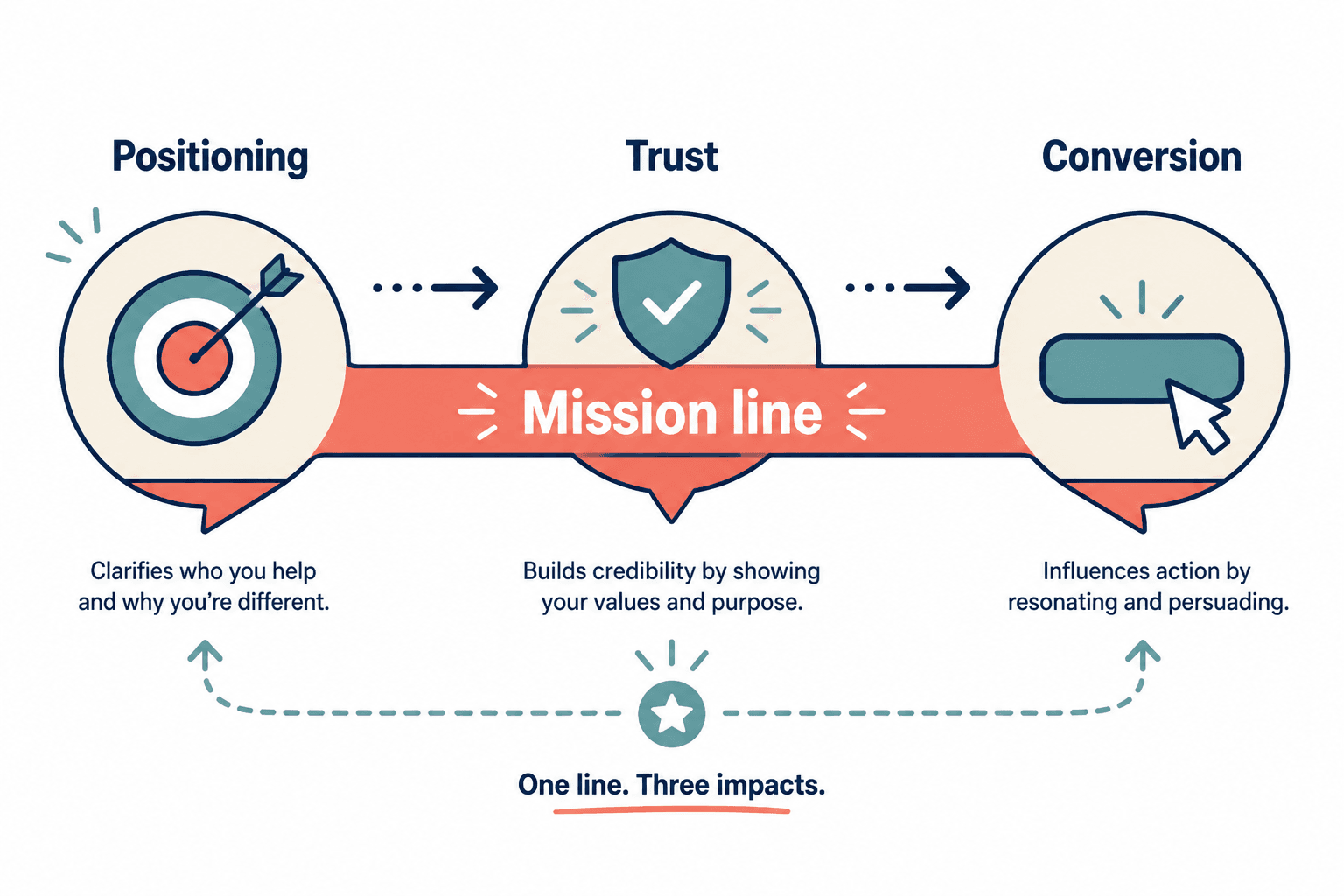
That is the real problem behind About Page Mission Statement Mistakes That Hurt Performance. A weak mission line does not just sit there looking slightly embarrassing. It muddies your positioning, weakens trust, confuses new visitors, and makes the rest of your About page work much harder than it should.
If your mission statement is supposed to help people get you faster, it should create clarity, not fog. Here’s how to spot the mission line mistakes hurting your About page, fix them, and write something that actually helps conversion instead of quietly sabotaging it.
For the broader learning path, visit our parent guide.
Why mission lines on About pages matter more than people think
A mission statement on an About page is not there to decorate the brand. It has a job.
That job is usually some combination of these:
- clarify what you stand for
- frame your work in a bigger but still believable way
- help the right people feel aligned
- support your positioning
- make the page feel coherent instead of random
What it is not supposed to do is float above reality like a scented cloud of brand ambition.
A good mission line helps a visitor think, “Yes, I understand what this person or business is about.” A bad one makes them skim faster. And on an About page, that matters. This page often gets visited by warm prospects, referrals, podcast listeners, buyers doing a final trust check, and people deciding whether to book, buy, subscribe, or bounce.
So no, your About page mission statement is not a tiny throwaway sentence. It is part positioning line, part trust signal, part filter.
About Page Mission Statement Mistakes That Hurt Performance
Let’s get into the mistakes people make constantly.
1. Writing a mission line that could belong to literally anyone
This is the classic problem. The sentence sounds noble, but it has no edges.
“Our mission is to help people live better lives through meaningful solutions.”
That could be a coach, a wellness brand, a consultant, a software company, a meal kit startup, or a yoga app with a beige Instagram grid.
If your mission statement works for six unrelated industries, it is not specific enough to help your About page perform.
Better approach: tie the mission to the actual audience, actual problem, or actual type of outcome.
“I help expert-led businesses turn unclear messaging into simple, trust-building copy that makes more of the right people say yes.”
Now we know what kind of work this is, who it is for, and why it matters.
2. Making it all about you instead of the reader
Yes, it is your About page. No, that does not mean visitors want three lines about your internal passion for excellence before they understand what you do.
A lot of mission statements sound like private self-affirmations:
“My mission is to share my voice, inspire change, and create impact through my work.”
Fine. Good for you. But visitors are still sitting there wondering how any of this relates to them.
Your mission line should connect your purpose to the reader’s world. It should answer the silent question every visitor has: why does this matter to me?
Stronger rewrite:
“My mission is to help smart founders explain what they do in plain English, so the right clients trust them faster.”
Still personal. Much more useful.
3. Using abstract words that sound important and say nothing
Words like empower, transform, elevate, impact, purpose, authenticity, and innovation are not always bad. But stack too many of them together and your mission line starts reading like it was assembled by a committee trapped in a keynote presentation.
Abstract language creates distance. Concrete language creates trust.
Compare these:
- Weak: “We empower businesses to unlock authentic growth through innovative brand alignment.”
- Stronger: “We help small service businesses clarify their brand message, so their website and content attract better-fit leads.”
The second one is not trying to sound profound. That is exactly why it works better.
4. Trying to sound big instead of sounding clear
Creators, consultants, and solo businesses often write mission statements as if they need to impersonate a global corporation to be taken seriously. So they inflate the language. They widen the scope. They start talking about “changing the future of business” when they mostly help clients fix their messaging, systems, offers, or marketing.
There is nothing wrong with ambition. But fake scale is a trust leak.
If you are a one-person business helping course creators write sharper sales pages, say that. The right people are not looking for theatrical importance. They are looking for relevance and competence.
Smaller, clearer, truer usually beats bigger, blurrier, louder.
5. Writing a mission statement with no tension, problem, or stakes
Good copy usually gets stronger when it acknowledges what is broken, hard, frustrating, or costly. Most weak mission lines skip that part entirely.
They talk about hopes. They do not talk about the mess.
But people connect faster when you show you understand the problem underneath the service.
For example:
- Flat: “My mission is to help experts share their knowledge online.”
- Better: “My mission is to help experts turn hard-to-explain knowledge into clear content people actually understand, trust, and buy from.”
The second version has tension built in. Hard-to-explain knowledge is the problem. Clear content is the fix. Trust and buying are the stakes.
6. Stuffing too much into one sentence
Another common mistake: the mission line tries to include your values, origin story, service list, audience, worldview, personal philosophy, and category-defying brilliance all at once.
That usually produces a mission statement that reads like it lost a fight with a blender.
If your line needs multiple commas, two dashes, and a deep breath halfway through, it is probably doing too much.
Your About page can carry nuance. Your mission line should carry clarity.
Think of it as the frame, not the whole painting.
7. Saying something nice but strategically useless
Some mission statements are pleasant. They are not offensive. They are not confusing. They are just not helpful.
“We believe everyone deserves support, clarity, and success.”
Okay. Most decent businesses would agree. But this does not strengthen positioning, build trust, or help a visitor decide if you are for them.
A mission line should earn its place. If you deleted it and nothing about the page became less clear, it was decorative copy.
8. Leading with values before establishing relevance
Values matter. But on an About page, timing matters too.
If a first-time visitor lands on your page and the first meaningful thing they read is a mission line about integrity, creativity, freedom, or human connection, they may still have no idea what you actually help with.
That is backwards.
Usually the reader needs this sequence:
- what you do
- who it is for
- why it matters
- then what you believe and how you do it
Values land better once relevance is established. Before that, they are just mood lighting.
9. Copying startup language that does not fit your business
Not every solo business needs a mission statement that sounds like a venture-backed company with a slide deck and a minor obsession with the word future.
If you are a coach, freelancer, consultant, educator, or service provider, your About page usually works better when it sounds human, direct, and specific. Corporate mission statement language often strips out the very thing that makes your business persuasive: your actual perspective.
This is one reason many creators get better results from a simple positioning line than a grand formal mission declaration.
If the word “mission” is making you write weird, use a different label internally. Call it your guiding point, core promise, or why-this-work-matters line. The job matters more than the label.
What a strong mission line usually includes
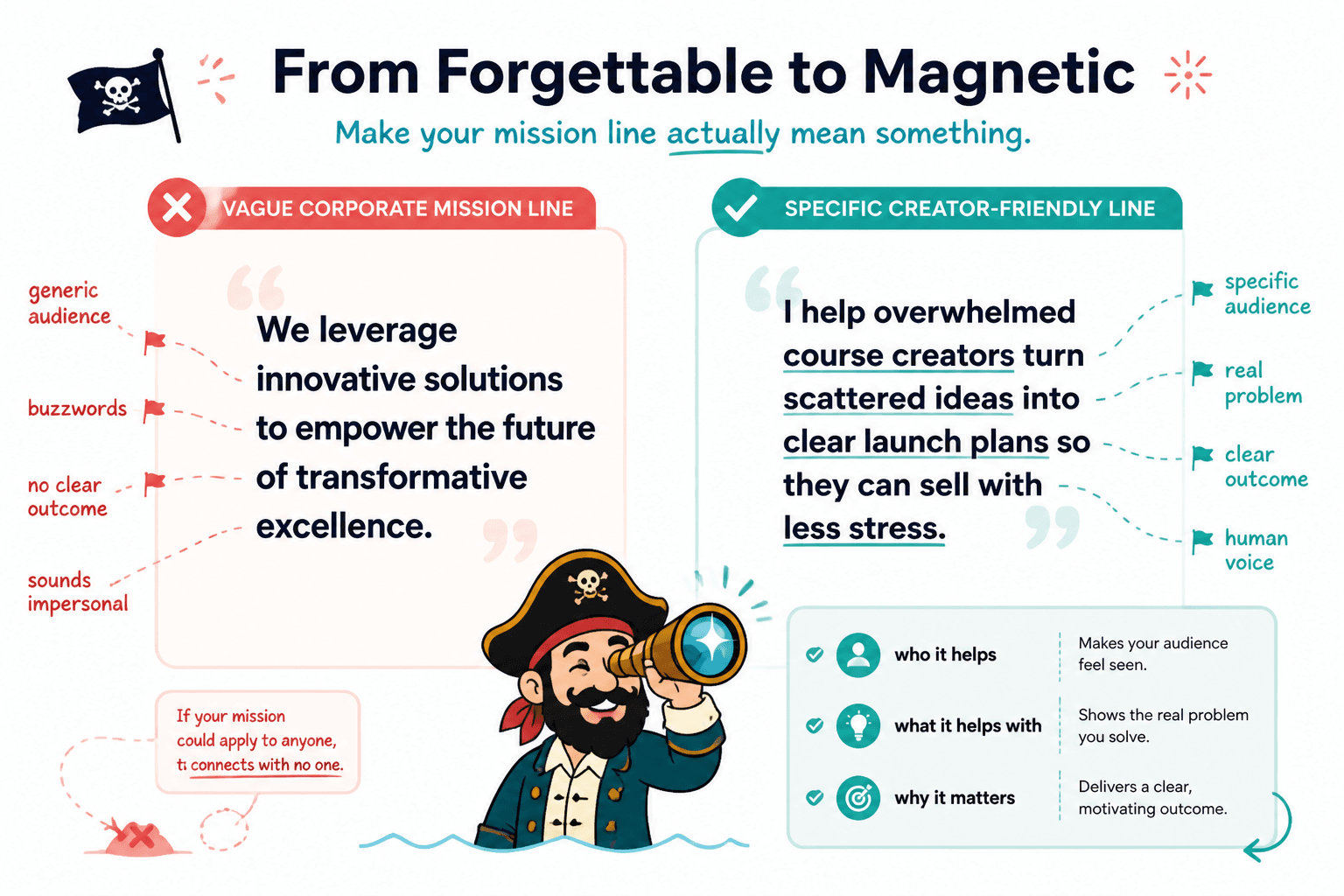
You do not need every one of these in a single sentence. But strong About page mission lines usually pull from a few of them:
- a clear audience
- a real problem or frustration
- the change or outcome you help create
- a believable perspective or value
- language that sounds like a person, not a boardroom wallpaper quote
Here is a simple formula that works surprisingly well:
We help [specific people] do [specific thing] so they can [meaningful outcome].
Or for a more personal brand voice:
I believe [audience] should not have to [painful thing] just to [goal], so I help them [solution].
These are not magical formulas. They are just clean ways to stop the sentence wandering into branded fog.
Before-and-after rewrites of weak About page mission statements
Here are a few practical rewrites to show what changing the structure can do.
Example 1: creator educator
- Before: “My mission is to empower creators to step into their authenticity and build aligned businesses.”
- After: “My mission is to help creators build simpler businesses around their real strengths, without turning their brand into exhausting online theater.”
The rewrite keeps personality, but adds specificity and a stronger point of view.
Example 2: copywriter
- Before: “We exist to elevate visionary brands through authentic messaging.”
- After: “We help expert-led brands explain what makes them different, so their website copy sounds clear, credible, and worth paying attention to.”
Now the reader knows what kind of messaging, for what kind of brand, and why it matters.
Example 3: coach or consultant
- Before: “My mission is to inspire transformation and support meaningful success.”
- After: “I help consultants build offers and messaging that make selling feel clearer, calmer, and a lot less awkward.”
The second one may sound less lofty. It also sounds far more hireable.
How to fix your mission line without rewriting your whole About page
You do not need to burn the page down and start over in a dramatic haze of copy regret. Usually, you can fix the mission line with a short editing process.
Step 1: Strip out the inflated words
Highlight every abstract, generic, or corporate-sounding word. Words like empower, transform, impact, innovation, excellence, and purpose are often where the mush starts.
You do not need to ban these words forever. Just make them earn their place.
Step 2: Ask four blunt questions
- Who is this for?
- What do they need help with?
- What change do I help create?
- Why does that matter in real life?
If your current mission statement does not answer at least two or three of these, it is probably too weak.
Step 3: Make it more concrete
Replace broad claims with real categories, real problems, and real outcomes.
Not “help businesses thrive.”
More like “help consultants explain their value clearly enough to win better clients.”
Step 4: Read it out loud
This catches a lot. If it sounds like you are auditioning to keynote a leadership summit no one asked for, rewrite it.
About pages work better when they build trust with clarity instead of biography theater. A stronger through-line usually matters more than extra detail.