Most About pages blow the CTA in one of two ways.
They either do nothing useful at the end, which leaves the reader thinking, “Cool, anyway,” or they lurch into a weirdly aggressive pitch that feels wildly out of step with the rest of the page. You were just building trust. Then suddenly it is “BOOK A CALL NOW” like a pop-up wearing a blazer.
Better About Page Soft CTAs for Personal Brands are not about being vague, timid, or allergic to selling. They are about matching the moment. Someone on your About page is usually interested, curious, and still deciding. They do not always need a hard close. They often need a smart next step.
That is the job of a soft CTA. It helps the right reader keep moving without feeling pushed. Done well, it makes your brand feel clear, confident, and easy to trust. Done badly, it sounds like copied funnel debris.
Here is how to write softer About page CTAs that still lead somewhere useful, earn more clicks, and do not make your page sound like it was assembled from old webinar scraps.
For the full path around this topic, head to the parent guide.
What a soft CTA actually is
A soft CTA is a low-pressure next step.
It does not try to force commitment before trust exists. It gives the reader an easy action that fits their level of interest. That might be reading another page, checking out your services, joining your email list, browsing examples, or sending a simple message.
The key point: soft does not mean weak. It means appropriate.
If someone lands on your About page from a search result, podcast, social profile, or referral, they are usually asking a quiet set of questions:
- Who are you really?
- Are you for someone like me?
- Can I trust your taste, experience, or process?
- What should I look at next?
A good soft CTA answers that last question cleanly.
Your About page is rarely the moment to apply sales pressure. It is usually the moment to reduce friction.
Why About page CTAs often feel awkward
A lot of personal brands write the About page like a story, then end it like a landing page. That tonal whiplash is the problem.
You spend the page sounding human, thoughtful, maybe even specific for once, and then finish with something like:
- Ready to transform your business?
- Book your free breakthrough call today
- Let’s unlock your next level
No. That is not a soft CTA. That is a borrowed internet voice trying on your shoes.
The About page works best when the CTA feels like a natural continuation of the page itself. If the page builds familiarity, the CTA should offer a next step that keeps building familiarity. If the page builds credibility, the CTA can move toward action, but it still needs to feel proportional.
That is why About page CTAs often improve when you stop asking, “How do I convert this person right now?” and start asking, “What is the most sensible next click for someone who is interested but not fully sold yet?”
That one shift fixes a lot.
What Better About Page Soft CTAs for Personal Brands need to do
A soft CTA on your About page should do at least one of these things:
- Help the reader learn more
- Help the reader see proof
- Help the reader understand your offer
- Help the reader stay connected
- Help the reader start a low-friction conversation
That means your CTA should not just “sound nice.” It should be tied to intent.
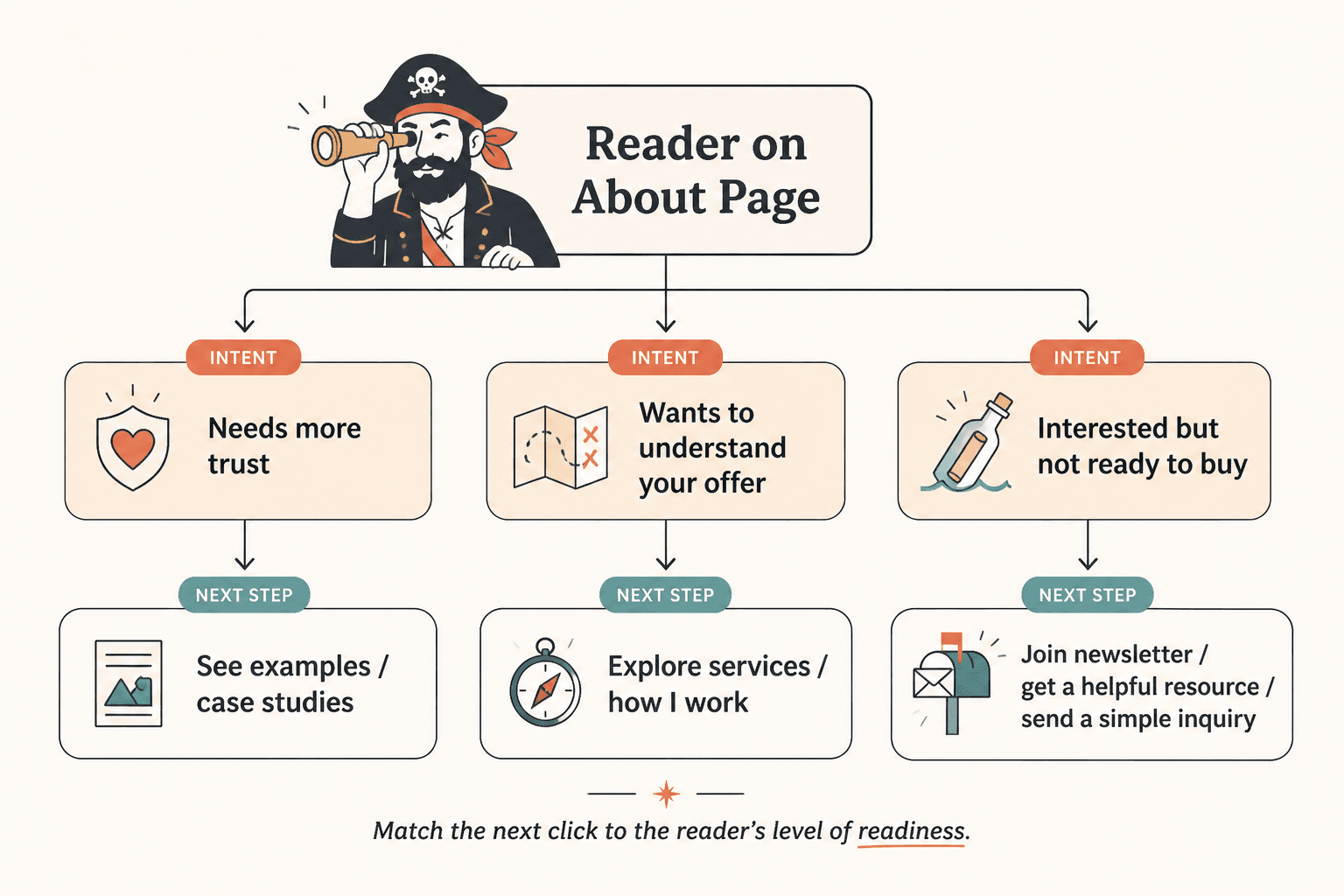
If your reader needs more trust, send them to examples, case studies, or a sharper service page. If they are not ready to buy but clearly interested, invite them to join your list or explore a practical resource. If they are warm already, a soft conversation CTA can work beautifully.
In other words, your CTA is not decoration. It is page strategy.
The four qualities that make soft CTAs work
- Clarity: The reader should know exactly what happens next.
- Relevance: The action should match what they probably need now.
- Low friction: It should feel easy to take the next step.
- Voice fit: It should sound like the same human who wrote the rest of the page.
Best soft CTA types for personal brand About pages
There is no single perfect CTA. The right one depends on your business model, audience temperature, and what your About page is supposed to do.
Still, some CTA types tend to work especially well for creators, coaches, consultants, solo founders, and service-based personal brands.
1. The “learn more” CTA
This is useful when your About page is doing a trust-building job and your service or offer page does the heavier conversion work.
- See how I work
- Read more about my approach
- Explore my services
- Take a look at what I help with
This type works well because it respects the reader’s pace. It does not pretend they are ready to commit after reading 600 words about your background and worldview.
2. The proof CTA
If your About page makes claims, your CTA can route readers to evidence.
- See examples of my work
- Read client results
- Browse case studies
- Check out a few projects
This is especially smart if your brand depends on credibility more than charisma. Personality helps. Proof closes the gap.
3. The content CTA
Great for creators, writers, educators, and consultants who build trust through ideas.
- Start with these articles
- Read my best writing on this topic
- Get the weekly newsletter
- Join for practical ideas and updates
This CTA works because it offers value before asking for commitment. It also helps if your sales cycle is longer and readers need a few more touchpoints.
4. The soft conversation CTA
This invites contact without making it feel like a high-stakes sales ritual.
- If this sounds like what you need, get in touch
- Got a project in mind? Send me a note
- If you think we might be a fit, reach out here
- Want to talk through it? Start here
Good for consultants, service providers, strategists, and anyone whose work usually starts with a conversation. Less good if your audience is cold and needs more warming first.
5. The resource CTA
If you have a useful freebie, guide, checklist, or starter resource, an About page can be a good place to offer it without making the entire page feel like a lead magnet trap.
- Grab the guide here
- Start with the free resource
- Want the shortcut version? Get the checklist
- Here is a practical place to start
Just make sure the resource actually fits the audience. Random PDF hoarding is not a strategy.
How to match the CTA to the reader’s stage
This is where a lot of About page copy improves fast.
Do not pick a CTA because it sounds polished. Pick it based on what your reader is likely ready for after reading your page.
| Reader state | What they need | Better soft CTA |
|---|---|---|
| Curious but cold | More context | Read more about how I work |
| Interested but cautious | Proof | See examples and results |
| Warm and aligned | Simple next step | Get in touch here |
| Not ready to buy | Ongoing value | Join the newsletter |
| Comparing options | Offer clarity | Explore services |
If your About page gets mixed traffic, you can also give readers two options instead of one. For example:
- Explore my services
- Or start with my best articles
That often works better than trying to force every reader into the same next action.
Soft CTA formulas that do not sound flimsy
Here are some simple formulas you can adapt. These are intentionally low on hype and high on usefulness.
Formula 1: If you want X, start here
- If you want sharper messaging, start with my services page.
- If you are figuring out your content strategy, these articles are a good place to start.
Formula 2: Learn more about how I do Y
- Learn more about how I help founders clarify their positioning.
- Read more about how I approach About page strategy and conversion copy.
Formula 3: See the work
- See examples of the kind of messaging work I do.
- Take a look at recent projects and results.
Formula 4: Stay in the loop without the pressure
- Join the newsletter for practical ideas on brand messaging, content, and conversion copy.
- Get weekly notes on writing clearer, sharper marketing that does not sound synthetic.
Formula 5: If it seems like a fit, reach out
- If this feels aligned with what you need, get in touch.
- If you have a project in mind, send me a note here.
The reason these work is simple: they are specific, readable, and not trying to seduce the reader with vague intensity.
That last part matters more than people think. Many weak CTAs are not underperforming because they are too soft. They are underperforming because they are generic. Readers do not avoid clicking because you were polite. They avoid clicking because the next step is unclear, boring, or suspiciously sales-scented.
Before-and-after rewrites for About page soft CTAs
Sometimes the easiest way to fix CTA copy is to see what is going wrong.
Example 1: Too salesy
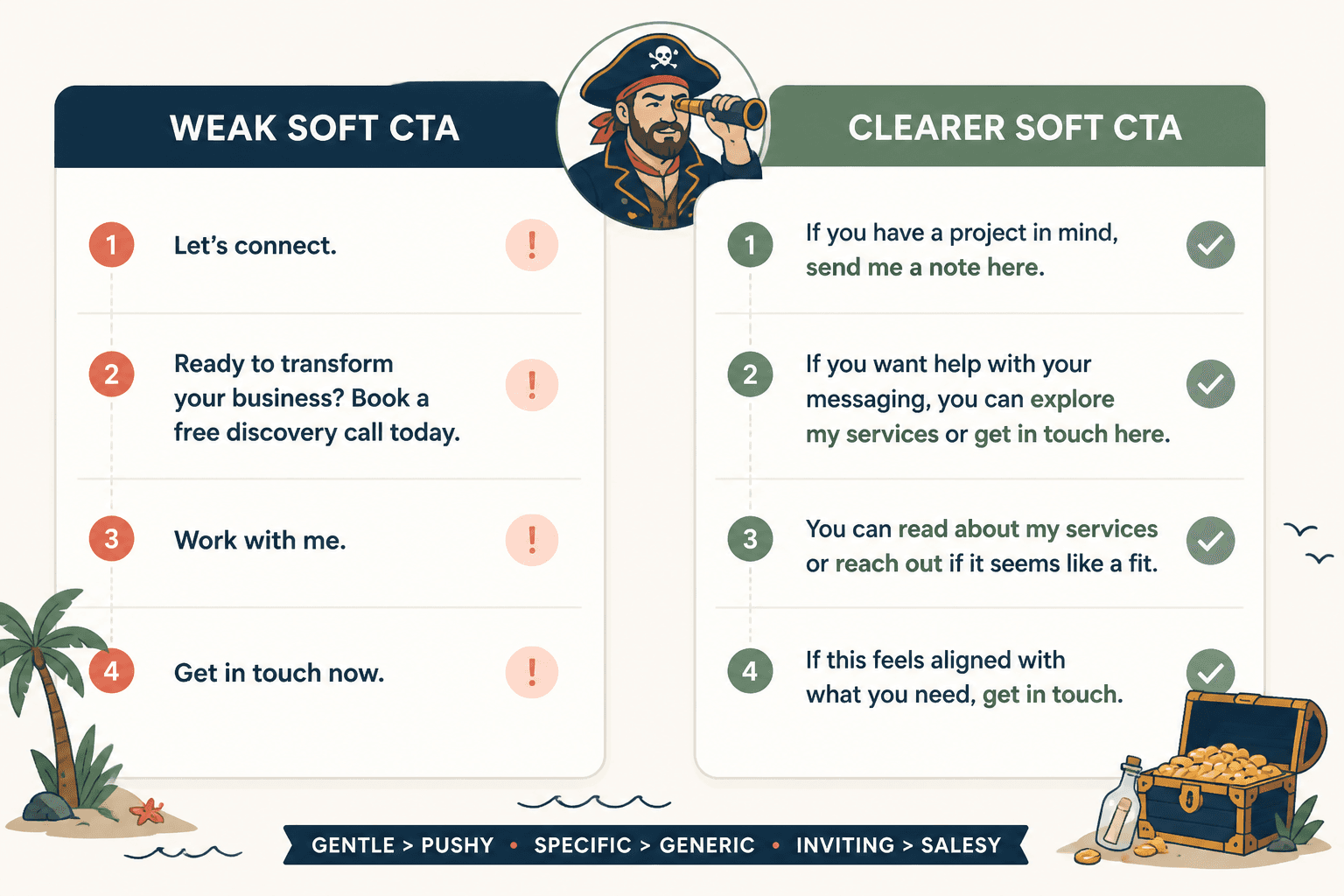
- Before: Ready to transform your business? Book a free discovery call today.
- After: If you want help with your messaging, you can explore my services or get in touch here.
The rewrite lowers pressure, gives options, and sounds like a person instead of a funnel template.
Example 2: Too vague
- Before: Let’s connect.
- After: Want to see if we are a fit? Here is where to learn more about how I work.
“Let’s connect” says almost nothing. About pages need more signal than that.
Example 3: Too needy
- Before: I would love for you to follow my journey and subscribe for updates.
- After: If you want practical notes on content and conversion copy, you can join the newsletter here.
The second version is better because it focuses on reader value, not your emotional wishlist.
Example 4: Too generic
- Before: Learn more
- After: Read the guide to better About page copy
Generic CTA labels can work in navigation. Inside body copy, a little more specificity usually helps.
Where soft CTAs should appear on the About page
You do not need to cram one lonely CTA at the very bottom and call it strategy.
Depending on page length, you can place soft CTAs in a few smart spots:
- Mid-page: after a section that explains what you do or who you help
- After proof: once trust is stronger
- At the end: the clean final next step
This is especially useful if your About page is doing several jobs at once: introducing you, clarifying your positioning, giving social proof, and nudging the reader onward.
For example, after a section on your approach, you might link to how to write better About page copy if the reader clearly wants more depth. After examples or proof, you might direct them to how to turn About page copy into more leads or sales if they are moving from curiosity toward outcomes.
And if you are still shaping the page itself, it helps to review the broader About page copy guidance here or the more practical About page copy guide for creators who want better results.
Common soft CTA mistakes to avoid
About pages work better when they build trust with clarity instead of biography theater. A stronger through-line usually matters more than extra detail.
About pages work better when they build trust with clarity instead of biography theater. A stronger through-line usually matters more than extra detail.