Most About pages are not too short.
They are too vague, too self-absorbed, or too padded with brand fog that says a lot of words and almost nothing useful.
So if you are asking, How Long Should About Page Copy Be in 2026? the honest answer is not “500 words” or “1,200 words” or any other suspiciously tidy number. The right length depends on what your reader needs in order to trust you, understand you, and take the next step without feeling like they just sat through a keynote from a human buzzword generator.
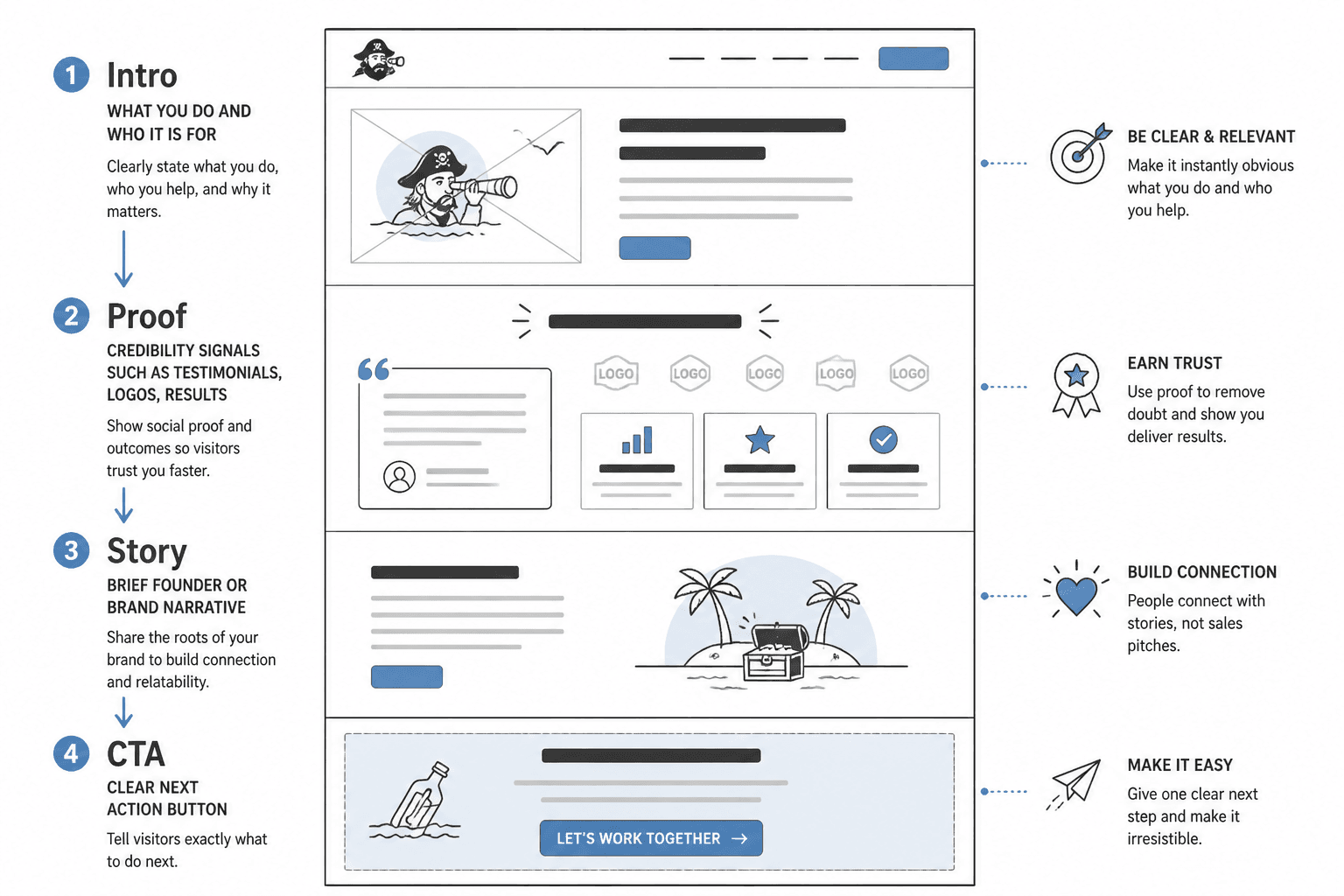
In practice, most About pages should be long enough to do four jobs well: explain who you help, make your work feel relevant, build credibility, and move the reader toward action. If your copy can do that in 300 words, great. If it needs 900, also fine. If it takes 2,000 words because you cannot stop talking about your journey, your values, and the life-changing moment you discovered color-coded planning, that is probably not strategy. That is autobiography with a call to action taped on at the end.
Here is how to decide the right About page length in 2026, what affects it, where people go wrong, and how to write a page that actually earns trust instead of politely asking for it.
For the main guide behind this topic, visit the parent guide.
How long should About page copy be in 2026? The practical answer
For most creators, consultants, coaches, freelancers, and service businesses, a strong About page usually lands somewhere between 400 and 1,000 words.
That range is broad on purpose. A one-person business with a clear offer and a specific audience may only need 400 to 600 words. A founder, agency, consultant, or expert with a more nuanced process, stronger proof, or a higher-trust sale may need 800 to 1,200.
What usually does not work:
- 150 words of vague fluff that says you are “passionate about helping people thrive”
- 2,000+ words of life story before the reader learns what you actually do
- A wall of text with no structure, no proof, and no next step
If you want a faster rule of thumb, use this:
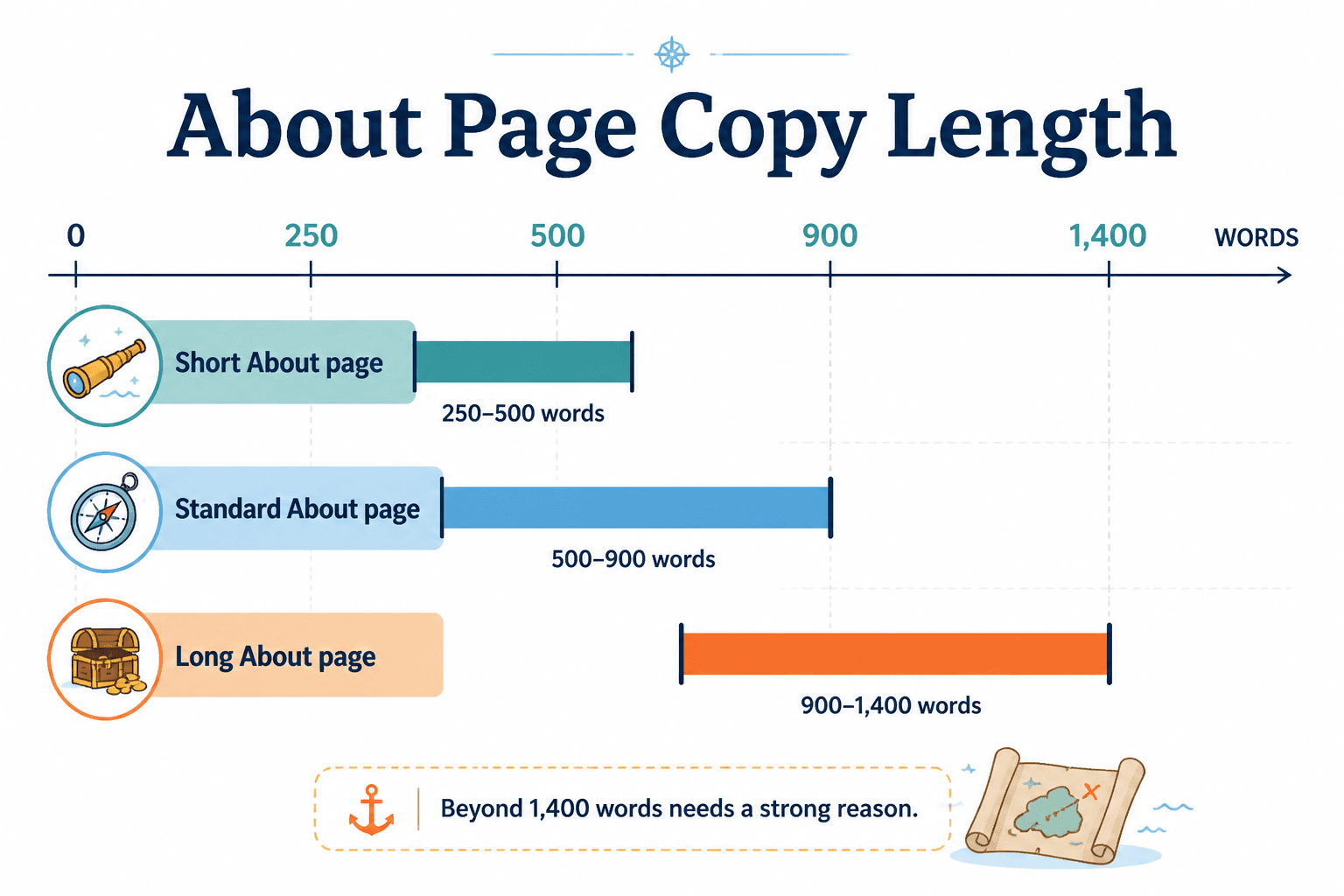
- Short About page: 250 to 500 words
- Standard About page: 500 to 900 words
- Long About page: 900 to 1,400 words
Beyond that, you should have a very good reason. “I have many thoughts” is not a good reason.
What your About page is actually supposed to do
A lot of people treat the About page like a biography page. That is the first mistake.
Your About page is not there just to tell your story. It exists to help the reader make a decision about you. Can you help them? Do you understand their problem? Are you credible? Do they like your approach enough to keep going?
That means your ideal page length is based on decision support, not on some universal copywriting law from 2016 that got repeated until everyone forgot to question it.
A good About page should answer questions like these fairly quickly:
- Who is this person or business for?
- What do they help with?
- What makes their approach different or useful?
- Why should I trust them?
- What should I do next?
If your copy answers those cleanly, the page is probably long enough. If it does not, adding more paragraphs will not save it.
If you want a deeper look at what strong About pages need to include, this About page copy guide for creators who want better results is a useful next read.
What determines the right About page length
There is no magic number because not every About page carries the same load. Some pages only need to reinforce a clear offer. Others need to build trust for a higher-ticket service, a personal brand, or a business where the person behind it matters quite a lot.
1. Your business model
If you sell a simple product with low friction, your About page can stay lean. If you sell consulting, coaching, strategy, done-for-you services, or anything expensive enough that people need to feel good about you, the page usually needs more depth.
Trust-heavy businesses often need more copy because the buyer is not just evaluating an offer. They are evaluating judgment, fit, personality, and credibility.
2. How aware your audience already is
If people already know what you do and why it matters, shorter copy can work beautifully. If your service is nuanced, unusual, or often misunderstood, you may need more explanation.
That extra length should go toward clarity. Not cleverness. Not scene-setting. Not “ever since I was young, I loved helping people.”
3. How personal the brand is
For personal brands, founder-led businesses, and expert businesses, readers usually want some story. They want context. They want a reason to trust your angle and your method. So yes, some personal detail can help.
But relevant personal detail is doing the work there. Random life timeline detail is not. Your About page should not read like someone clicked “expand” on your entire personality.
4. The stakes of the next step
The more expensive, intimate, or time-intensive the next step is, the more copy you may need. Booking a strategy session, hiring a copywriter, joining a mastermind, or choosing a coach all involve more risk than downloading a checklist.
Higher stakes usually require more proof, more clarity, and more reassurance. That can mean a longer page, though not necessarily a bloated one.
5. The strength of your proof
Strong proof can shorten your page. Weak proof often forces people to over-explain.
If you can say, “I help consultants turn unclear websites into lead-generating ones, and here are three relevant outcomes,” you need fewer paragraphs than someone trying to sound trustworthy through vibes alone.
When short About page copy works best
Short About pages work when the offer is clear, the audience is specific, and the credibility is easy to communicate fast.
A shorter page is often a smart move if:
- You have one clear service or offer
- Your homepage already does a lot of the selling
- Your audience already understands the problem you solve
- Your credibility is easy to show in a few lines
- You want the About page to support conversion, not become a content swamp
Short does not mean thin. It means focused.
A sharp short About page might include:
- A positioning line
- A short paragraph about who you help and how
- A few credibility points
- A small personal note for warmth
- A clear next-step CTA
If you are leaning short, this article on when short About page copy beat long ones will help you decide if brevity is actually the right move.
When longer About page copy makes more sense
Longer About pages are useful when readers need more context to trust your work.
This tends to be true when:
- You sell high-ticket services
- Your process or philosophy is a meaningful differentiator
- You are the product, in part, because people are hiring your judgment
- You have a story that helps explain why your approach works
- Your audience needs more reassurance before contacting you
Here is the key: longer About page copy should create more confidence, not just more reading.
A good long About page often uses sections like these:
- Clear intro and audience fit
- What you do and why it matters
- Your story or background, edited for relevance
- Your approach or philosophy
- Proof, results, or credibility markers
- A direct CTA
Notice what is missing: three paragraphs about your mission to empower visionary humans to rise. Strange omission, I know.
The real mistake: confusing length with effectiveness
People often ask how long About page copy should be because they want a measurable target. Fair enough. Length feels easier to control than quality.
But the stronger question is this: How much copy does this reader need before they trust me enough to keep moving?
Sometimes that answer is surprisingly little. Sometimes it takes more. The deciding factor is not your attachment to your own story. It is the reader’s need for clarity and confidence.
If your page is underperforming, the issue is usually one of these:
- The opening does not tell people quickly enough what you do
- The copy talks about you without making you relevant to them
- The page is generic and sounds like everyone else
- There is no proof
- The CTA is weak, hidden, or absent
- The story section goes on forever and says very little
Length is often blamed for problems that are really about structure, positioning, and clarity.
A better way to choose your About page length
If you want a practical method, use this simple filter.
Step 1: Define the next action
What do you want readers to do after reading your About page?
- Book a call
- Read a service page
- Join your email list
- Buy a product
- Reply or get in touch
The harder that action feels, the more trust your page probably needs to build.
Step 2: List what the reader needs to believe first
Before someone takes that step, what do they need to understand or feel confident about?
- You understand their world
- You have a useful way of solving the problem
- You are credible
- You are not a bad fit
- The next step is clear and low-friction enough
That list tells you what your About page needs to cover. It also tells you what to cut.
Step 3: Keep only what supports the decision
This is where a lot of pages improve fast. If a paragraph does not help the reader understand, trust, or act, it probably does not belong.
Lovely sentence. Wrong page. It happens.
Step 4: Structure for scanning
Even a long About page should feel easy to move through. Use clear subheads, short paragraphs, bullets where helpful, and occasional bolding for emphasis. People scan first. Then they decide whether to read more closely.
A 900-word page with clean structure can feel shorter than a 350-word block of mush.
Recommended length by business type
| Business type | Suggested range | Why |
|---|---|---|
| Freelancer with one core service | 300–600 words | Usually needs clarity, a bit of proof, and one CTA |
| Coach or consultant | 600–1,000 words | Trust, fit, and approach matter more |
| Personal brand creator | 400–900 words | Needs positioning plus some personality and credibility |
| Agency or studio | 500–900 words | Should explain expertise without drowning the reader |
| Founder-led high-ticket business | 800–1,400 words | Often needs more depth, story, and reassurance |
| Product business with low-friction sales | 200–500 words | About page supports the brand but does not need to do all the selling |
These are not laws. They are sane starting points.
What to include instead of adding random extra paragraphs
If your About page feels short, do not automatically make it longer by adding more abstract brand language. Add substance.
Here are better ways to strengthen the page:
- A clearer opening: Say who you help and what you help with sooner
- A sharper positioning line: Explain what makes your angle different
- Relevant proof: client results, recognizable experience, useful credentials, or practical examples
- A brief founder story: only if it helps the reader trust your approach
- A “how I work” section: especially helpful for service providers
- A stronger CTA: tell people exactly what to do next
If your page currently leans on mission statements, values jargon, or broad declarations about impact, this piece on About page mission lines mistakes that hurt performance will probably save you from yourself a little.
How to tell if your About page is too long
Your About page is probably too long if:
- The core point does not appear near the top
- Readers have to work too hard to figure out what you actually do
- Your story is more detailed than your offer
- You repeat the same claim in different outfits
- The CTA comes after a marathon
- You wrote it mainly to feel complete, not to help someone decide
About pages work better when they build trust with clarity instead of biography theater. A stronger through-line usually matters more than extra detail.