
If you’re asking how long should X posts be in 2026, the annoying but correct answer is: long enough to say something sharp, short enough to keep moving.
A lot of people still treat post length like there’s some magic character count hiding in a cave somewhere. There isn’t. X is still a platform that rewards clarity, speed, and punch. A post that lands in 18 words will beat a bloated 220-word mini-essay every time. But a longer post can absolutely work when the idea actually needs the space.
The real question is not “What length does the algorithm like?” It’s “What length helps this specific idea get read, understood, and acted on?” Different question. Much better answers.
Here’s how to choose the right length for X posts in 2026 based on your goal, your idea, and the kind of response you want, without writing either cryptic little nothing-burgers or full-blown timeline furniture.
For the full path around this topic, head to the parent guide.
How long should X posts be in 2026? Start with the job of the post
The best length depends on what the post is trying to do. Reach post? Different length. Opinion post? Different length. Lead-generation post? Different length. Reply bait? Different length again.
Most weak posts are not weak because they are too short or too long. They are weak because the writer never decided what the post was for. So they keep typing. Or they stop too early. Same problem in different outfits.
- Short posts are best for punch, contrast, strong opinions, quotable lines, and fast engagement.
- Medium-length posts are best for context, mini-lessons, sharper credibility, and practical takeaways.
- Longer single posts are best when the reader needs setup, nuance, or a stronger argument before they care.
If your post only needs one clean idea, do not drag it into a six-paragraph custody battle.
On X, compression is a feature. But forced brevity is not the same thing as good writing.
Practical length ranges that actually help
No, there’s no perfect number. Yes, ranges are still useful. Think of these as working guidelines, not holy law carved into the platform.
| Post type | Suggested length | Best for |
|---|---|---|
| Punchy one-liner | 8–25 words | Strong opinions, quotable insight, contrast |
| Short standard post | 25–60 words | Quick lessons, reactions, conversation starters |
| Medium single post | 60–140 words | Mini frameworks, stronger context, practical value |
| Long single post | 140–250 words | Nuance, story setup, argument, trust-building |
| Beyond that | Usually thread territory | Multi-step teaching, examples, deeper breakdowns |
If you keep crossing into “one more paragraph and now this should’ve been a thread,” that is your cue. Take the cue.
Also worth saying: just because X allows longer posts doesn’t mean your audience wants every opinion delivered like a Victorian letter.
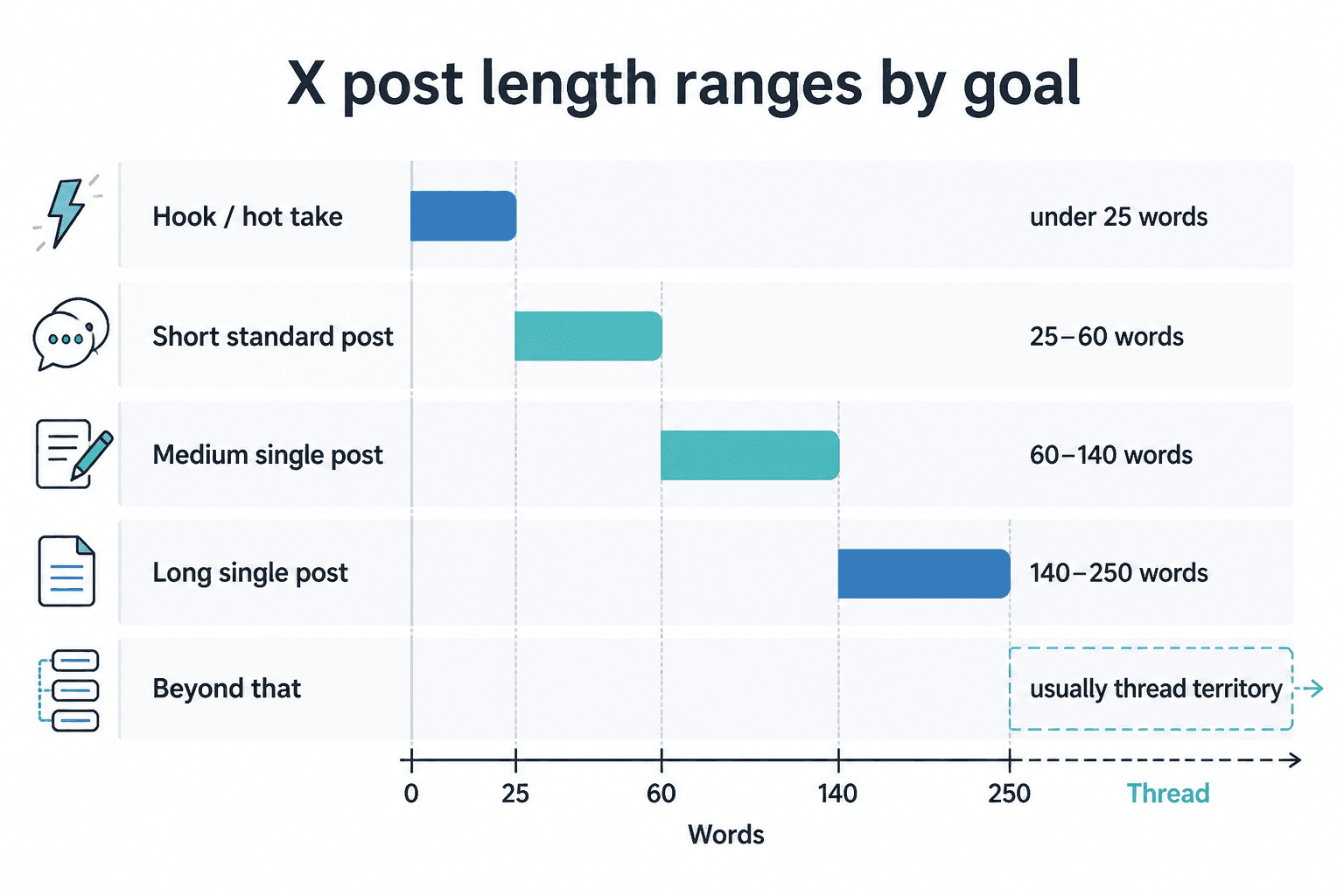
Short X posts work best when the idea is already sharp
Short posts tend to perform well because they are easy to process, easy to share, and easy to react to. But that only helps if the thought is actually worth reading.
A short post is not automatically good because it is short. It still needs tension, contrast, specificity, or a clean observation. Otherwise it just looks like you hit publish before the thought finished loading.
Use short posts when you have one clean point
- A strong opinion
- A fast insight
- A crisp rewrite of conventional wisdom
- A line people want to quote or reply to
- A single useful observation with bite
Weak short post: Consistency is really important in content creation.
Stronger short post: Most people do not need more content ideas. They need fewer half-baked ones making it to publish.
The second one has tension. It says something. It risks being disagreed with, which is often a sign there’s actual substance there.
When short posts fail
- They are vague
- They sound like recycled productivity wallpaper
- They hint at meaning instead of delivering it
- They try to be profound and end up foggy
Fake depth is one of the fastest ways to make an X post feel dead on arrival.
Medium-length X posts are usually the sweet spot
For most creators, consultants, founders, and personal brands, medium-length posts are the most useful format on X. They give you enough room to say something meaningful without draining the pace out of the post.
This is where a lot of strong content lives: a clear point, one layer of explanation, and a payoff. Not too thin. Not weirdly overcommitted. Just enough to be useful.
That middle range also gives you room to sound like a person. You can make a claim, explain why it matters, and end with a line that invites a reaction or next step.
A simple structure for medium posts
- Line 1: Strong claim or observation
- Line 2: Why that claim matters
- Line 3: Specific example, contrast, or consequence
- Line 4: Short takeaway or reply-worthy ending
Example:
Most X posts flop because they open too softly.
People do not owe your thought a warm-up lap.
If the first line is generic, the rest of the post rarely gets the chance to matter.
Lead with the sharp part.
If weak openings are part of the problem, it’s worth reading how to start X posts without a weak opening. The first line does a ridiculous amount of heavy lifting on this platform.
Longer X posts can work, but they need a reason to exist
Longer single posts are not bad. They’re just easier to mess up.
If you’re writing 180 to 250 words in one post, every extra sentence needs to justify itself. That usually means one of three things is happening:
- You are telling a short story with an actual point
- You are making an argument that needs setup
- You are teaching something that loses value if compressed too hard
What does not justify length? Repetition. Fluff. Long scene-setting. Self-important throat-clearing. The classic “I’ve been reflecting lately…” opening that sends people directly to another tab.
Good reasons to go longer
- You need to challenge a common belief and explain why
- You have a concrete story that earns a takeaway
- You’re giving a practical mini-breakdown with substance
- The post builds trust because your thinking is the product
Bad reasons to go longer
- You are trying to sound smarter
- You cannot choose the main point
- You’re stuffing three ideas into one post
- You’re afraid of being too direct
That last one gets people a lot. They bury the real point under context because they don’t want to come off too strong. On X, softening everything usually just makes the post easier to ignore.
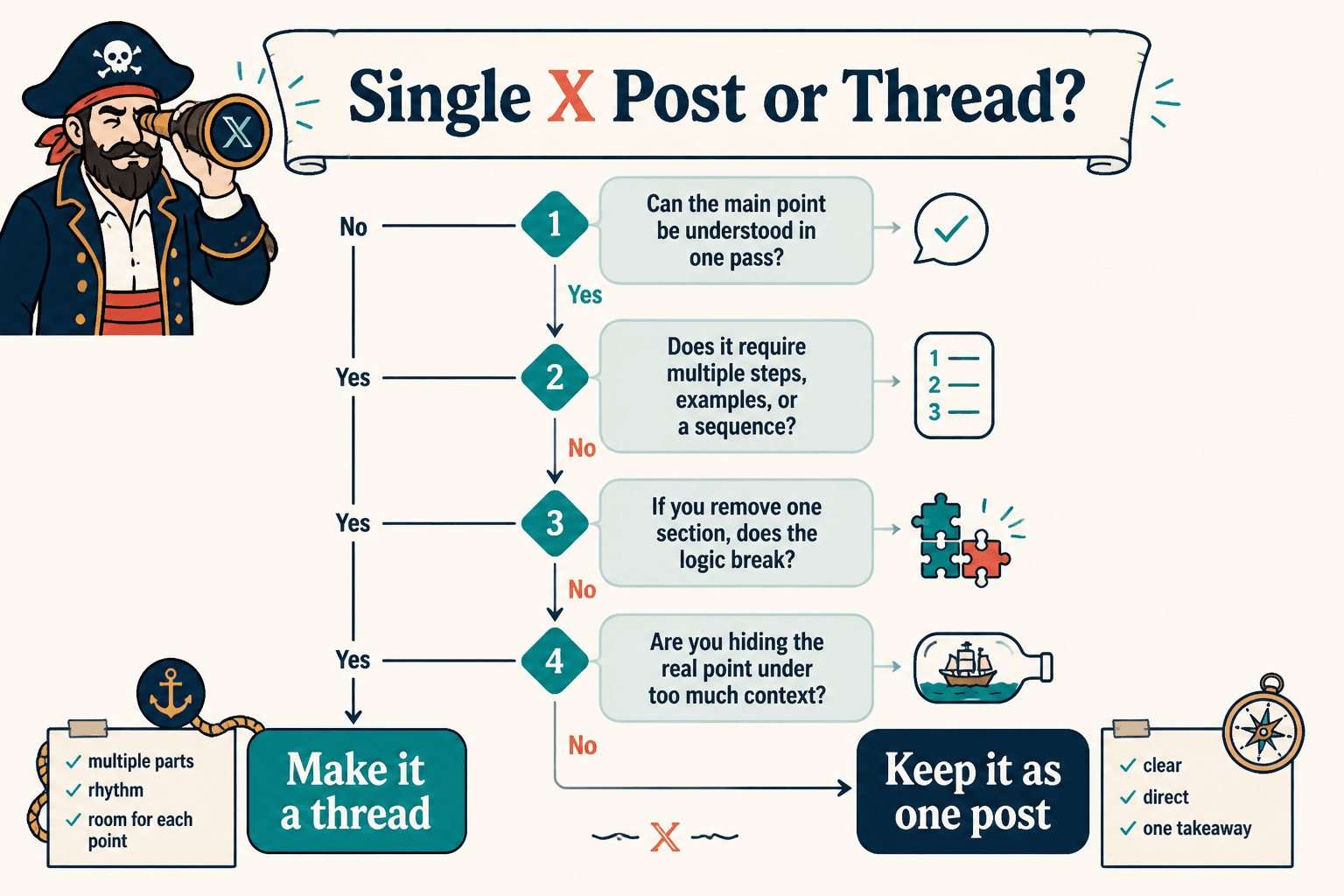
When your X post should become a thread instead
If the post contains multiple steps, multiple examples, or a sequence the reader has to follow, it probably wants to be a thread.
Trying to cram a full argument into one long post can work, but often the better move is to break it into clean pieces. Threads create rhythm. They give each point room. They also stop your post from turning into a dense blob of “please care about all of this at once.”
A good rule: if removing one section makes the post much stronger, cut it. If removing that section breaks the logic, thread it.
- Keep it as one post if the idea can be understood in one pass
- Make it a thread if the reader needs progression, proof, or several connected points
If X is part of your broader content strategy, you may also want to browse the site’s X posts guide collection for post structures, examples, and format choices that fit different goals better.
Length should match the goal, not your habit
Some people always write short because they think short means clever. Some always write long because they think long means valuable. Both habits can get stale fast.
Better question: what do you want this post to produce?
| Goal | Usually best length | What to focus on |
|---|---|---|
| Reach | Short to medium | Clarity, punch, strong first line |
| Replies | Short to medium | Opinion, tension, conversation angle |
| Trust | Medium to long | Useful explanation, substance, proof |
| Leads | Medium | Clear pain point, useful insight, soft CTA |
| Authority | Medium to long | Sharp thinking, examples, differentiated view |
This is why copying someone else’s ideal length is usually pointless. Their audience, writing style, positioning, and goal may be completely different from yours.
How to tell if your X post is too short
Your post is probably too short if:
- The reader has to guess what you mean
- The claim sounds obvious because there’s no angle
- The post could apply to literally anyone
- It feels like a fragment instead of a finished thought
- You cut the explanation that made the idea useful
Short is good. Underwritten is not. There’s a difference.
How to tell if your X post is too long
Your post is probably too long if:
- The first point arrives late
- You repeated the takeaway in three slightly different outfits
- It contains side points that deserve separate posts
- The ending drifts instead of landing
- You can remove 30 percent and lose nothing important
A good editing pass on X is brutal in a healthy way. Cut setup. Tighten transitions. Remove the sentence that only exists because you were trying to sound careful and complete. Most readers do not reward complete. They reward clear.
A fast editing test for choosing the right length
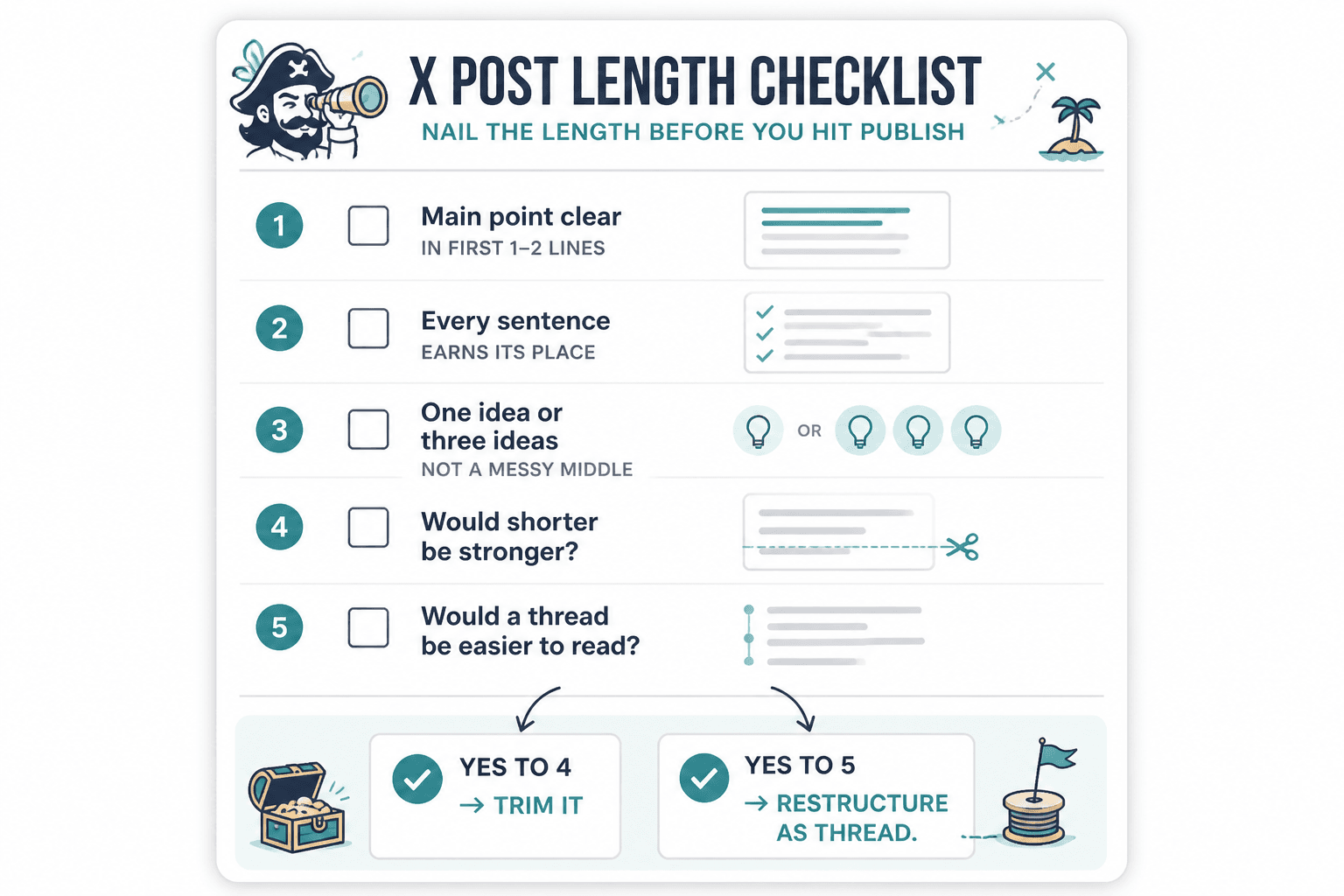
Before you publish, run the post through this quick test:
- Can someone understand the main point from the first line or two?
- Does every sentence earn its place?
- Is this one idea or secretly three?
- Would a shorter version be stronger?
- Would a thread make this easier to read?
If the answer to number four is yes, trim it. If the answer to number five is yes, restructure it. Do not just leave the post sitting awkwardly between formats like it missed its train.
Examples of the same idea at different lengths
Here’s where this gets practical. Same topic. Different lengths. Different effect.
Short version
Most content does not need more effort.
It needs a clearer point.
Why it works: Fast, quotable, clean contrast.
Medium version
The bigger point is simple: clearer structure and clearer writing make the piece more useful. That is usually what makes the ending land better too.
X posts tend to work better when the line gets sharper and the ending earns the reaction. Cleaner payoff usually beats louder phrasing.