
Most weak X posts do not die because the idea was bad.
They die because the ending gives people nothing clean to do with the idea.
A decent post can still stall out if it lands with a shrug, a needy question, or one of those tired “Thoughts?” endings that feels like you tossed the burden onto the reader and wandered off. If you want better X engagement endings for personal brands, the job is not to beg for replies. It is to make replying feel easy, relevant, and worth the effort.
X is fast. People scroll hard. Your ending has to do one of three things quickly: invite a reaction, direct attention, or create a reason to respond. Preferably without sounding like a growth thread from 2021 that still thinks “Agree?” is a personality.
Here’s how to write endings that fit the post, suit your brand, and get more actual engagement from the right people, not just drive-by noise.
For the full path around this topic, head to the parent guide.
What an engagement ending is actually supposed to do
People often treat the last line like an afterthought. Big mistake. On X, the ending is where you shape the response.
A good ending helps the reader make a tiny decision. Not a huge one. Just enough to keep momentum going.
- Reply with an opinion
- Pick a side
- Add an example
- Share their own experience
- Click through to your profile or next resource
- Remember you as someone worth following
That means the best endings are usually specific, low-friction, and connected to the post.
The worst ones do the opposite. They feel generic, detached, or weirdly desperate. If your post is about pricing strategy and you end with “What do you think?” you have not created a conversation starter. You have created vague administrative paperwork for the reader.
Good X endings do not ask for engagement in general. They ask for one useful kind of engagement.
Why most personal brands get X post endings wrong
Personal brands tend to make one of four mistakes at the end of a post.
1. They ask questions that are too broad
“Thoughts?” is lazy. “What do you think?” is barely better. Broad questions make people work too hard to figure out what kind of answer you want.
2. They ask for engagement that the post did not earn
If the post gave no real point, no tension, and no clear angle, the ending cannot save it. A weak post with a comment-bait CTA is still a weak post. Just now with extra cologne.
3. They force a sales move too early
Not every post should end in “DM me” or “book a call.” Sometimes the next right move is a reply. Sometimes it is a profile visit. Sometimes it is simply making the reader trust your taste a little more.
4. They use the same ending on every post
If every post ends with “Agree or disagree?” you do not have a strategy. You have a verbal twitch.
The ending should match the kind of post you wrote. Opinion post. Story post. Contrarian post. Tip post. Mini-rant. Each one benefits from a different kind of close.
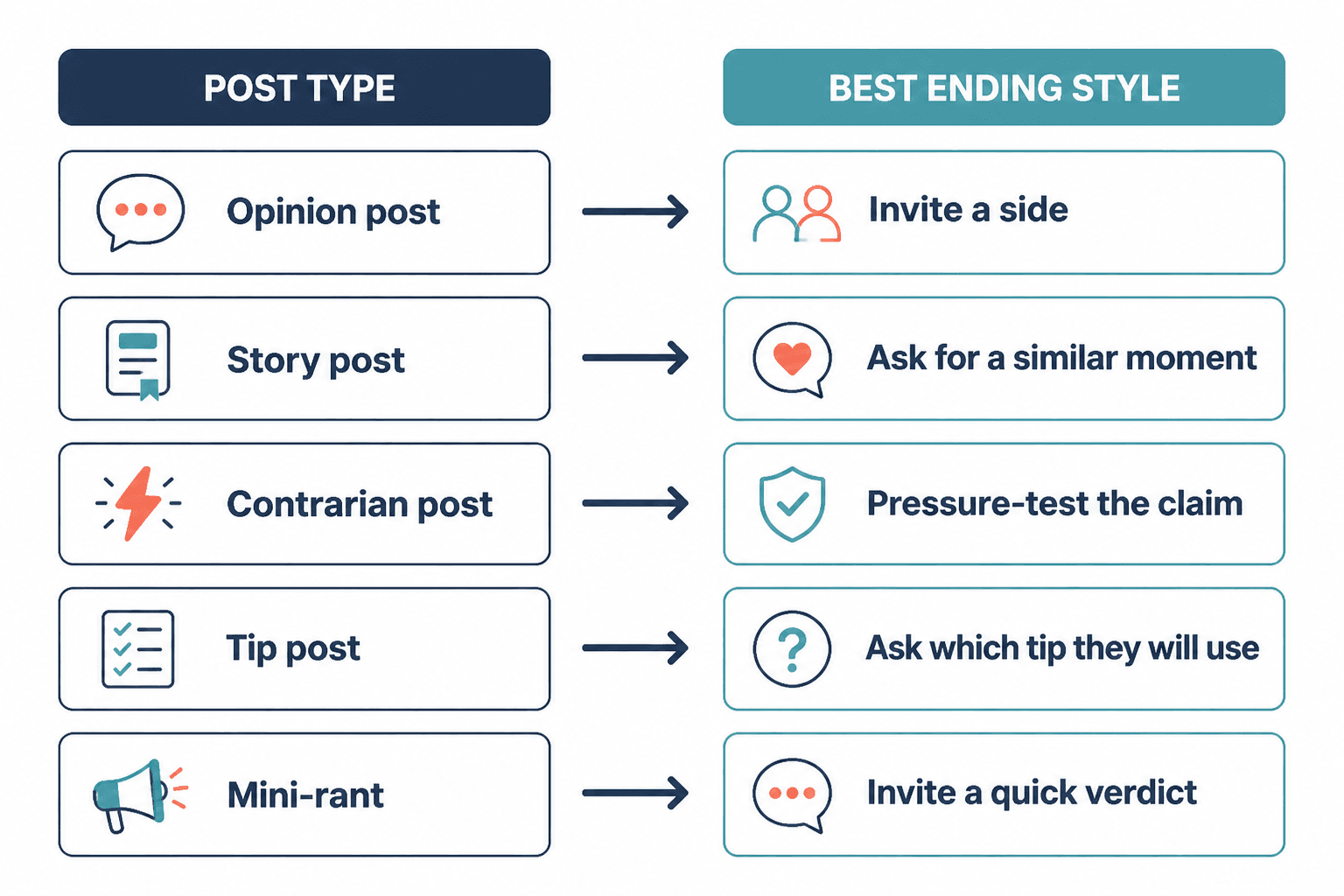
Better X engagement endings for personal brands start with post type
If you want better X engagement endings for personal brands, stop looking for one magic CTA. Match the ending to the post’s job.
For opinion posts: invite a side, not a speech
Opinion posts work best when the reply path is obvious. Give people a clean angle to respond to.
Weak ending: What do you think?
Better endings:
- What gets better results for you: consistency or sharpness?
- Worth saying out loud, or too harsh?
- Which part do people in your niche still get wrong?
- Do you agree with the principle, even if you’d word it differently?
These work because they narrow the lane. People know how to enter the conversation.
For story posts: ask for a related experience
If you shared a quick story, the best ending often invites the reader to connect it to their own world. Not in a therapy-circle way. Just enough to create resonance.
Weak ending: Can anyone relate?
Better endings:
- What changed your mind on this the hard way?
- When did this finally click for you?
- What’s a lesson you had to learn twice before it stuck?
- Seen this happen in your own business too?
That kind of ending gives people a shape for their reply instead of asking them to invent one from scratch.
For tip posts: prompt application
Useful posts do well when the ending nudges action or specificity.
Weak ending: Hope this helps.
Better endings:
- Which of these are you fixing first?
- What part of this is hardest to do consistently?
- Steal one of these and use it today.
- If you already do this well, what would you add?
That last one is especially good when you want knowledgeable replies instead of empty applause.
For contrarian posts: invite pressure-testing
If you say something sharp, earn the right to say it. Then let people challenge it intelligently.
Weak ending: Unpopular opinion, but yeah.
Better endings:
- Where does this break down in your world?
- What’s the strongest argument against this?
- What am I missing here?
- Does this hold up outside my niche, or not really?
These endings make you sound thoughtful, not just loud.
For authority posts: direct the next step softly
Some posts are not mainly for comments. They are for trust. In that case, the ending can point people toward the next useful place.
Examples:
- If you’re working on this, the examples in my profile will help more than hot takes.
- I write a lot about this because most people overcomplicate it.
- If this is your current bottleneck, I’ve posted a few practical breakdowns on it.
This is subtle, but useful. You are not shoving a funnel in their face. You are giving the right reader a sensible next click.
Five engagement ending formats that actually work on X
You do not need dozens. You need a handful you can use intentionally.
1. The binary choice
Make the reader choose between two options.
- Better hook or better insight: which matters more on X?
- Would you rather post more often or post sharper?
- Short and punchy, or longer with proof?
Why it works: low friction. People can answer fast.
2. The experience pull
Ask for a relevant example from the reader’s own work or business.
- What’s a version of this you’ve seen in your niche?
- Where has this shown up in your content lately?
- What did this look like before you figured it out?
Why it works: people like talking about their own case when the prompt is focused.
3. The pressure-test
Invite disagreement in a way that does not feel performative.
- Fair take, or too simplistic?
- What’s the strongest pushback here?
- Where do you think this advice falls apart?
Why it works: thoughtful disagreement often beats shallow agreement for visibility and credibility.
4. The application nudge
Push the reader toward using the idea now.
- Take one line from this and test it on your next post.
- If you’re posting today, steal the structure.
- Try rewriting your last line with this in mind.
Why it works: not every good ending needs comments. Some should improve behavior.
5. The soft path forward
Give interested readers a next move without sounding like a pitch goblin.
- If this is the part you’re stuck on, I’ve written more on X post structure.
- I break this down more deeply in a few other posts if you’re refining your content strategy.
- If this topic matters to your business, start with the examples pinned in my profile.
Why it works: it channels intent instead of demanding it.
Before-and-after rewrites for better X post endings
Sometimes the fastest way to improve your endings is to see what bad ones look like once they’ve been cleaned up.
| Weak ending | Better rewrite | Why it works |
|---|---|---|
| Thoughts? | Which part of this do you agree with most? | Gives the reader a clear angle |
| Do you agree? | Fair take, or too harsh? | Adds tension and invites reaction |
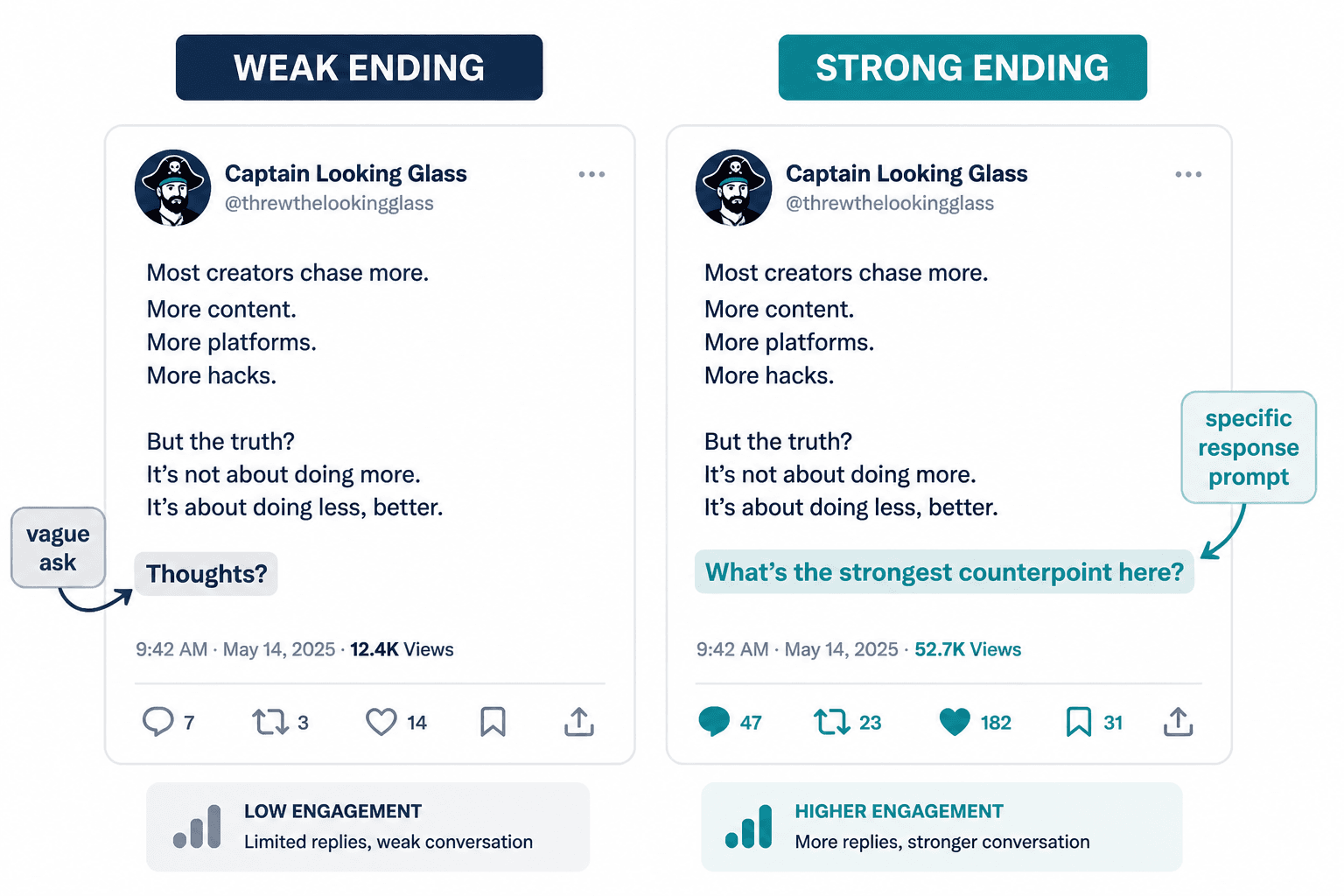
| What do you think? | What’s the strongest counterpoint here? | Prompts smarter replies |
| Hope this helps. | If you post today, test one of these lines. | Encourages action |
| DM me if you need help. | If this is your bottleneck, I’ve shared more examples on this. | Softer next step, less friction |
| Anyone else? | What’s your version of this problem? | Makes the question specific |
Notice the pattern. The better versions do not just ask for “engagement.” They suggest the type of response you want.
That matters because people on X make split-second decisions. If your closing line is vague, they move on. If it gives them an easy handle, they are much more likely to grab it.
How to choose the right ending for your personal brand
Not every creator should use the same close. Your ending should sound like it belongs to the rest of your voice.
If your brand is analytical, ask sharper diagnostic questions. If your brand is more conversational, lean into experience-based prompts. If you are more authority-driven, use low-pressure directional closes that move people toward your profile, examples, or deeper resources.
Here is a simple way to decide.
- Ask what the post is trying to earn. Replies? Trust? Profile visits? Follows?
- Pick one ending style that supports that goal.
- Make the prompt narrow enough to answer quickly.
- Read it out loud. If it sounds like borrowed creator jargon, kill it.
This is also where a lot of people overdo “engagement strategy” and underdo voice. A post can be technically optimized and still sound like a stranger wrote it. Bad trade.
What to avoid if you want more real engagement
The bigger point is simple: clearer structure and clearer writing make the piece more useful. That is usually what makes the ending land better too.
X posts tend to work better when the line gets sharper and the ending earns the reaction. Cleaner payoff usually beats louder phrasing.