
Most About page openings fail for one simple reason: they spend too long warming up.
You get a soft little welcome. A vague mission. A dramatic personal statement. Maybe a “wearer of many hats” situation nobody asked for. Meanwhile, the visitor is trying to answer three basic questions: who are you, who are you for, and should they keep reading?
If you want better About page copy, the opening matters more than people think. It sets the tone, frames your value, and decides whether the rest of the page feels worth the scroll. A strong opening does not need to be clever. It needs to be clear, specific, and human.
This guide gives you About page openings examples creators can adapt fast, plus the patterns behind them so you are not just copying lines and hoping for the best. If your current opening sounds like a polite fog machine, this should help.
If you want the broader strategy behind the page itself, start with this About page copy guide for creators who want better results or browse the wider About page copy section.
To see how this fits into the wider strategy, open the parent guide.
What a good About page opening actually needs to do
Your opening is not there to tell your life story. It is there to orient the reader fast enough that they do not bounce.
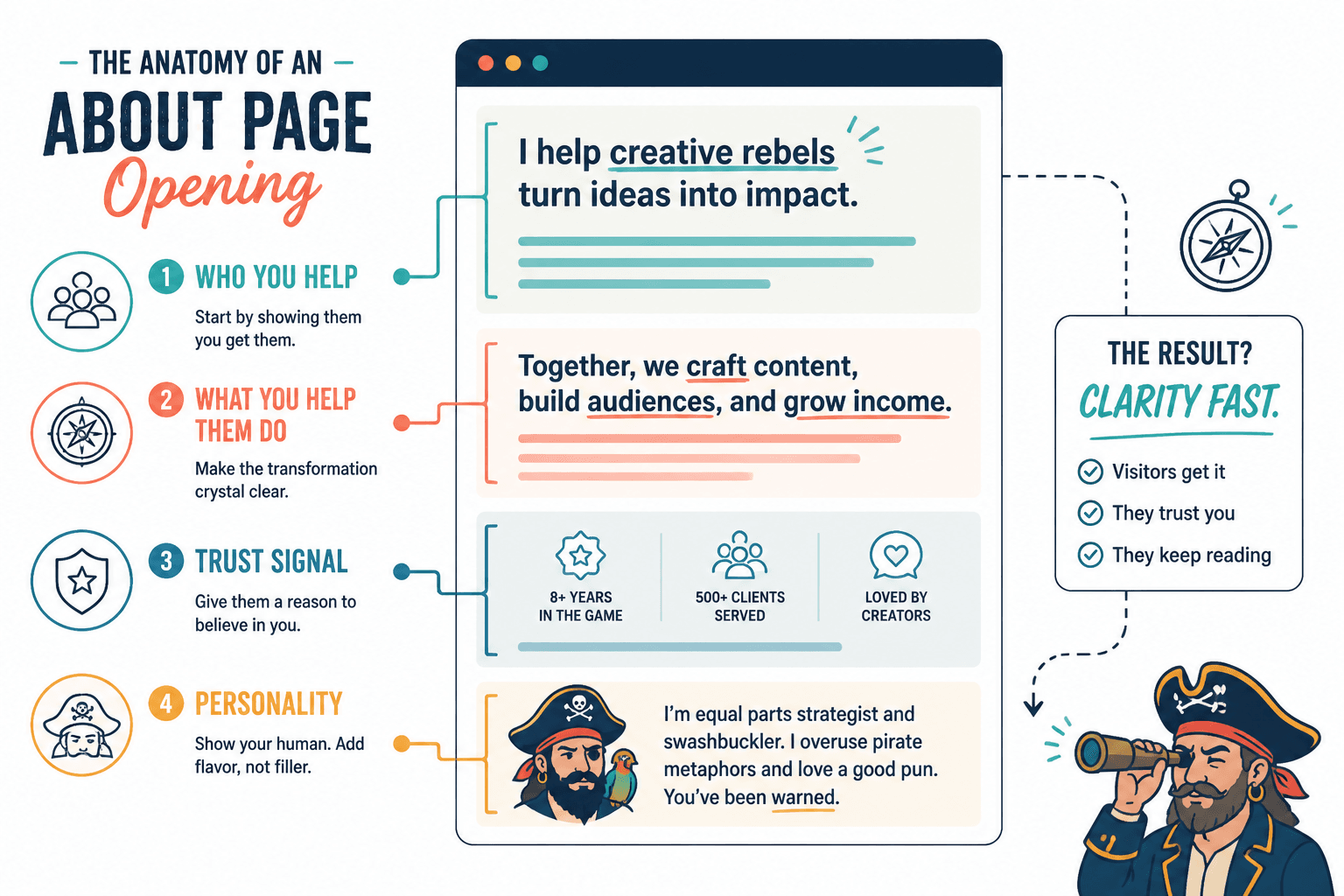
At minimum, a strong About page opening should do most of these things within the first few lines:
- Say who you help
- Hint at what you help them do
- Show a little personality
- Give a reason to trust you
- Create momentum into the rest of the page
That does not mean you need to cram everything into one sentence like it is trying to board a train. It means the opening should quickly reduce confusion.
A lot of creators make the mistake of writing their About page opening for themselves. They want it to feel profound, polished, and identity-rich. Fair enough. But the visitor is not grading your inner world. They are deciding if you are relevant to theirs.
That is the standard.
Five opening styles that work better than the generic “Hi, I’m…” intro
“Hi, I’m Sarah, and I’m passionate about helping people live their best lives” is not illegal. It is just doing absolutely no heavy lifting.
Here are five stronger opening styles, when to use them, and examples you can adapt fast.
1. The clear positioning opening
Best for creators, consultants, coaches, and service providers who need visitors to understand their niche immediately.
I help independent consultants turn scattered expertise into clear content, sharper positioning, and a website that does not sound like it was assembled by committee.
Why it works: it says who it is for, what the outcome is, and adds just enough voice to sound human.
Adapt it like this:
- I help [specific audience] do [specific result] with [your method, angle, or category].
- I work with [audience] who want [goal] without [common frustration].
- I help [audience] turn [mess/problem] into [clear outcome].
Example variations:
- I help creators turn decent ideas into sharper content, stronger offers, and more useful websites.
- I work with coaches who want cleaner messaging, better client-fit leads, and less vague copy.
- I help solo founders turn hard-to-explain expertise into marketing people can actually understand.
2. The audience-problem opening
Best when your audience already feels a specific frustration and you want instant resonance.
If your website sounds respectable but not persuasive, you are probably not dealing with a talent problem. You are dealing with a clarity problem. That is the part I help fix.
This works because it names the pain without melodrama, then positions you as the practical answer.
Adapt it like this:
- If you are [common struggle], the real issue may be [deeper issue]. I help with that.
- [Pain point] usually is not a [assumed cause] problem. It is a [real cause] problem.
- If [frustrating scenario], you probably need [what you offer].
Example variations:
- If your content is useful but still getting ignored, the issue may not be the advice. It is probably the packaging, positioning, or both.
- If your About page tells your story but still does not convert, it likely is not too short. It is just not doing enough work.
- If your brand voice disappears the second you try to sound professional, that is usually a copy problem, not a personality problem.
3. The point-of-view opening
Best for creators with a clear opinion, strong taste, or a more distinct brand voice.
I do not think your website needs more buzzwords, a softer mission statement, or another paragraph about authenticity. I think it needs clearer copy that tells the right people why you matter.
This style works well when your business is partly built on how you think, not just what you sell. It establishes your lens fast.
Used well, this feels confident. Used badly, it feels like a TED Talk audition. So keep it grounded.
Adapt it like this:
- I do not believe [common industry cliché]. I believe [your practical view].
- Most people think [common belief]. I think [better framing].
- You do not need [overrated thing]. You need [useful thing].
Example variations:
- You do not need a prettier brand message if nobody can tell what you actually do. You need clarity first.
- Most personal brands do not have a visibility problem. They have a relevance problem.
- I am less interested in “showing up consistently” than in helping you say something worth showing up with.
4. The credibility-first opening
Best when you have meaningful proof, notable experience, or strong credentials that genuinely matter to the buyer.
Over the last six years, I have helped B2B founders, consultants, and educators sharpen their messaging, improve website conversion copy, and turn unclear positioning into cleaner growth.
This approach works when trust is the first hurdle. It is especially useful if your audience is comparison-shopping and wants a reason to take you seriously quickly.
The trick is not to sound like a walking résumé. Lead with proof that supports relevance.
Adapt it like this:
- Over the last [time period], I have helped [audience] do [result].
- I have worked with [types of clients] to help them [outcome].
- My work focuses on helping [audience] solve [specific problem].
Example variations:
- I have worked with coaches, consultants, and solo business owners who needed sharper copy and less website drift.
- For the past decade, I have helped experts explain what they do in a way clients can understand and act on.
- My work sits at the intersection of strategy, messaging, and conversion copy for small brands that need more than nice words.
5. The story-lean opening
Best when your personal journey is relevant, distinctive, and directly connected to the problem you solve now.
I started writing better About pages after seeing how many brilliant people were introducing themselves like nervous interns on their own websites. The problem was not their experience. It was the copy.
This style gives you a more human opening without disappearing into autobiography. Good. Because nobody needs 600 words before the point arrives.
Adapt it like this:
- I started doing this work because [relevant trigger or realization].
- After years of [experience], I noticed [problem]. Now I help [audience] fix it.
- I got into [field] when I realized [specific insight].
Example variations:
- I got obsessed with website copy after realizing how many smart businesses were losing trust in the first ten seconds.
- After years of seeing great ideas buried under vague messaging, I started helping creators say what they mean faster and better.
- I began this work after watching too many websites confuse being polished with being persuasive.
About page openings examples creators can adapt fast
Below are plug-and-play examples for different kinds of creators and personal brands. Steal the structure, not the exact personality. If you copy someone else’s rhythm too closely, your About page starts sounding like borrowed clothes.
For a business coach
I help service-based business owners simplify their offers, sharpen their messaging, and build businesses that are easier to sell without becoming full-time content goblins.
For a copywriter
I write website copy for experts and small brands that have outgrown vague messaging, bloated pages, and the illusion that sounding professional is the same as being persuasive.
For a designer
I help thoughtful brands look as credible as they actually are, with visual identities and websites that feel clear, sharp, and built for real business goals.
For a content strategist
If your content calendar is full but your pipeline is not, the issue probably is not effort. I help creators and small brands build content systems that attract attention and move people somewhere useful.
For a consultant
I work with founders and expert-led businesses that know their work is valuable but struggle to explain it clearly enough to win better-fit clients.
For a writer or creator brand
I create practical writing, sharp content ideas, and useful resources for people building audience-based businesses without wanting their brand voice sandblasted into corporate mush.
A simple formula for writing your own opening faster
If writing from scratch makes your brain leave the building, use this:
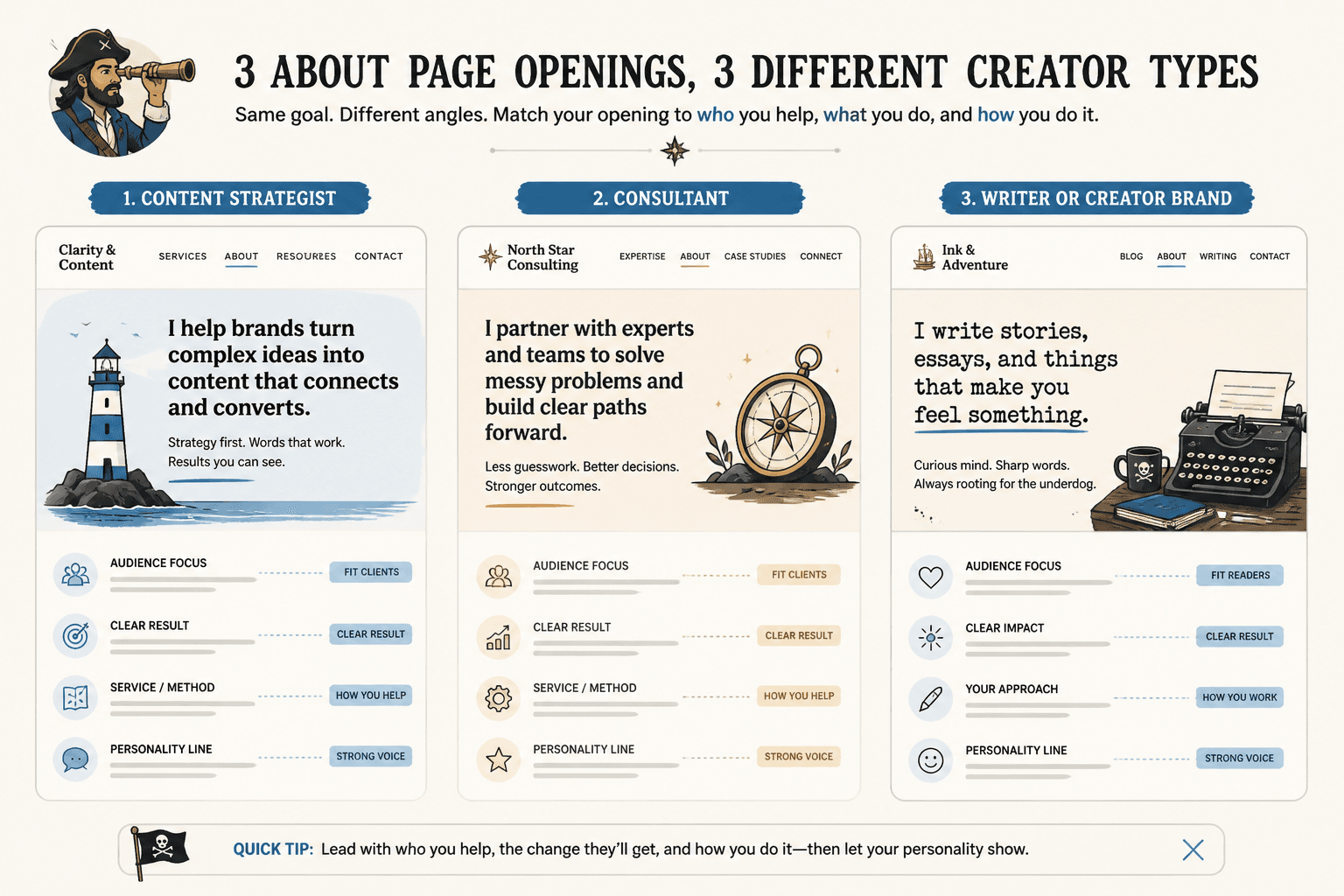
I help [specific audience] do [specific result] through [service, method, or angle], with [optional proof, opinion, or personality line].
Here is the plain version:
- Name the audience.
- Name the result.
- Name the category of what you do.
- Add one line that sounds like an actual person wrote it.
Example:
I help online experts turn unclear messaging into cleaner websites, stronger content, and better conversion paths. In other words, I fix the part where people almost get what you do, then leave.
That second sentence matters. Not always, but often. It gives the opening shape and tone. A lot of weak About page intros are technically clear, but dead behind the eyes.
You do not need to become a poet. You do need a pulse.
Before-and-after rewrites
Sometimes the easiest way to improve your opening is to see what changed.
Example 1
Before: Welcome to my page. I am passionate about helping people achieve success through mindset, strategy, and authentic alignment.
After: I help coaches and service providers clarify their message, strengthen their offers, and market themselves without sounding like they swallowed a webinar funnel.
What improved:
- Specific audience
- Specific outcomes
- Clearer voice
- Less abstract fluff
Example 2
Before: Hi, I’m Jason. I wear many hats as an entrepreneur, father, creative, and leader.
After: I work with founder-led brands that need sharper messaging, better website copy, and a clearer way to explain why their offer is worth buying.
What improved:
- Removed self-focused filler
- Made the business relevant fast
- Shifted from identity list to value statement
Example 3
Before: My journey has been one of growth, learning, and transformation, and I am excited to share it with you.
After: After years of watching smart creators bury strong work under weak copy, I started helping them write clearer pages, stronger bios, and content that earns attention faster.
What improved:
About pages work better when they build trust with clarity instead of biography theater. A stronger through-line usually matters more than extra detail.