Most About pages do one of two deeply unhelpful things.
They either read like a résumé wearing a blazer, or they turn into a dramatic “here’s my journey” monologue that forgets the reader showed up with a question: why should I trust you, and is this for me?
That is usually the real problem behind bad About page copy story arcs. It is not that the writing is too short or too plain. It is that the story has no job. It wanders around your past, collects a few vague lessons, then hopes the reader will somehow connect the dots.
If you want to learn How to Improve About Page Story Arcs Without Sounding Generic, the fix is not to make your page more dramatic. It is to make it more useful, more specific, and better structured. A good About page story arc builds trust, shows relevance, and gives your experience a shape that leads somewhere. Preferably toward a clear next step, not polite confusion.
This article will show you how to build an About page arc that feels human without becoming mushy, personal without becoming self-absorbed, and strategic without sounding like a consultant built in a lab.
For the main guide behind this topic, visit the parent guide.
What an About page story arc is actually supposed to do
An About page story arc is not there to tell your entire life story in chronological order. Nobody needs the director’s cut.
Its job is simpler than that. It should help the reader understand:
- who you help
- what shaped your approach
- why your perspective is credible
- what makes your way of doing things different or effective
- what they should do next
That means the story arc has to support trust and conversion, not compete with them.
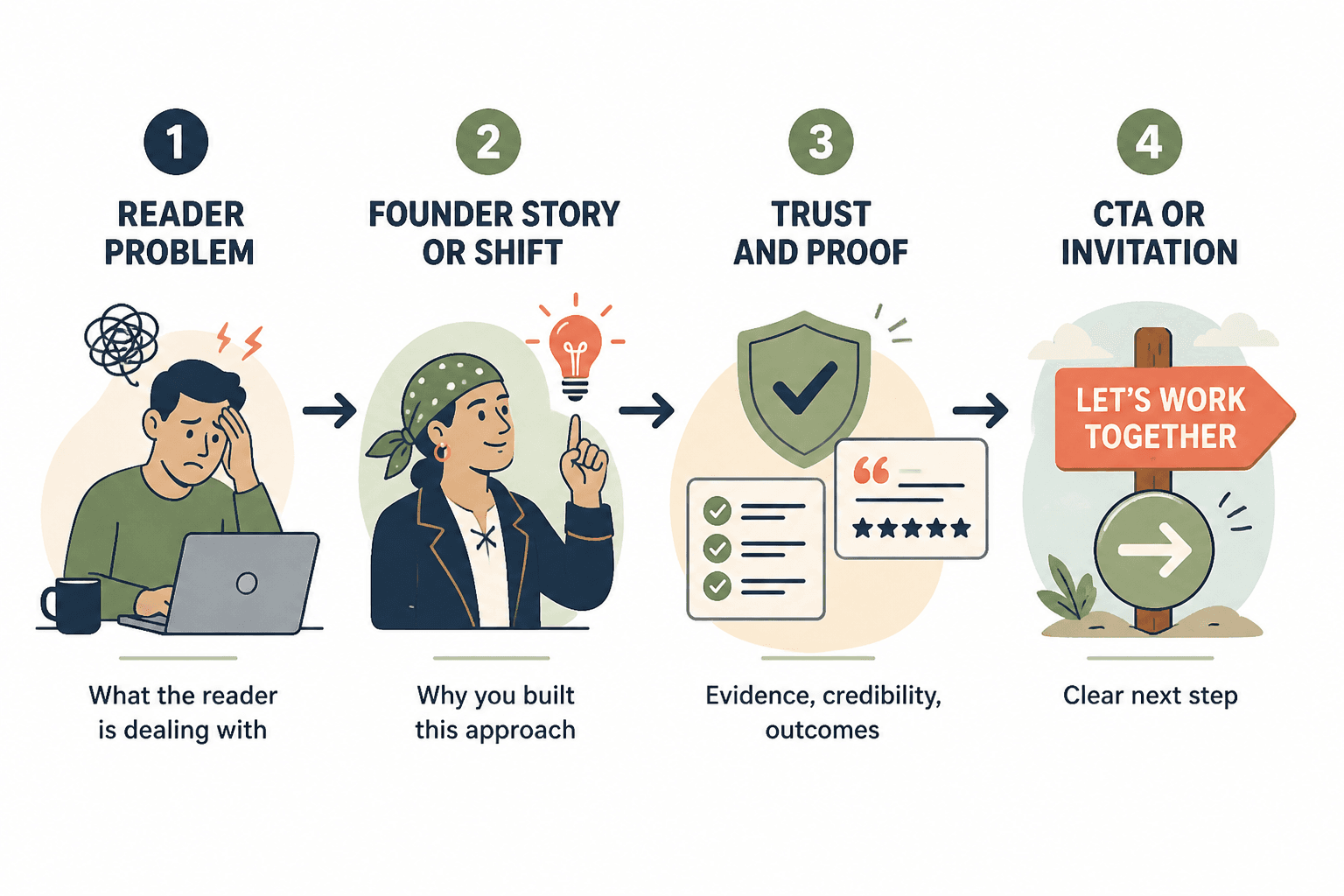
A strong About page usually moves through a few simple stages: context, tension, shift, approach, proof, invitation. Not every page needs those exact labels on the page, but the logic should be there underneath. The reader should feel like they are being guided, not trapped inside your autobiography.
If you want the broader foundation first, this About page copy section and this About page copy guide for creators who want better results are good places to build from.
Why most About page arcs sound generic
Generic About page storytelling usually comes from one of four habits.
1. Starting too far back
Readers do not need your full origin myth. They need the part that explains your current work.
If your About page starts with childhood, college, or “I always knew I wanted to help people,” you are probably opening too early. That kind of setup often creates distance instead of interest.
2. Using vague transformation language
Lines like “I discovered my true passion” or “I realized there had to be a better way” are not wrong because they are emotional. They are weak because they could belong to almost anyone.
Generic language erases credibility. Specificity creates it.
3. Making the story about you and only you
Your About page is allowed to be personal. It is not allowed to be irrelevant.
The best About pages connect your experience to the reader’s situation. The worst ones read like a memoir excerpt with a booking link stapled on at the end.
4. Ending with no useful payoff
Plenty of About pages tell a decent story, then stop right when the reader needs direction. No offer context. No explanation of how you work. No invitation. Just vibes and a headshot.
That is not a story arc. That is a stalled landing.
How to Improve About Page Story Arcs Without Sounding Generic
The easiest way to improve your About page is to stop thinking in terms of “my story” and start thinking in terms of “the most relevant story path for this reader.”
That shift matters. Because once your story has a job, it gets easier to cut fluff, choose the right details, and avoid those beige little lines that make every founder sound like they attended the same branding retreat.
Here is a practical framework that works well for creators, consultants, coaches, freelancers, and service businesses.
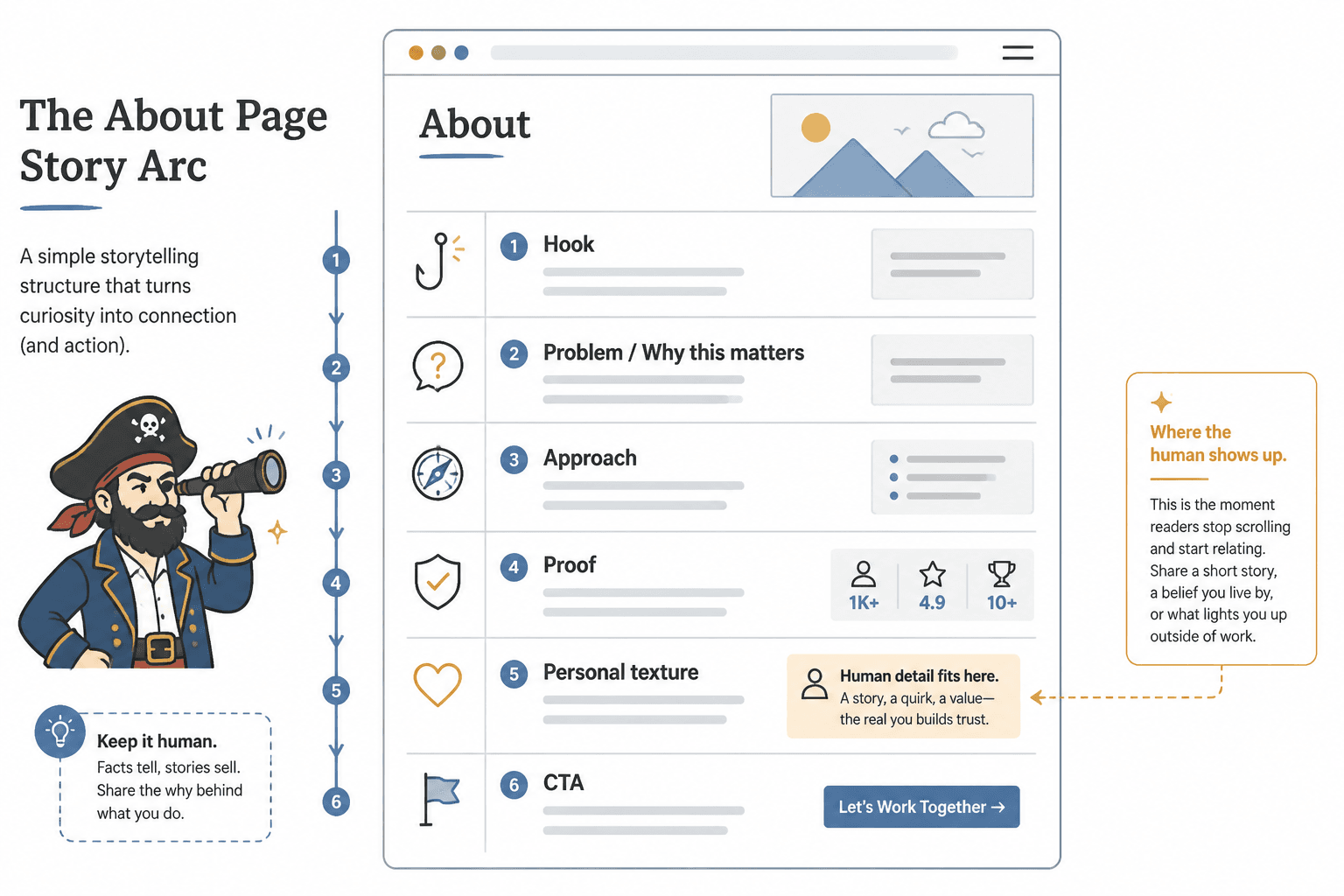
Use this 6-part About page arc
- Reader context: Show the world your reader is in.
- Your tension point: Name the frustration, gap, or pattern that shaped your thinking.
- The shift: Explain what changed in your approach or perspective.
- Your method or philosophy: Show how that shift affects the way you work now.
- Proof: Back it up with outcomes, experience, examples, or credibility markers.
- Next step: Tell the reader what to do if they want help.
That gives you movement. More importantly, it gives the reader a reason to keep reading.
Start with the part of your story that matters to the reader
Your opening does not need to be clever. It needs to be relevant.
A lot of About pages open with some version of: “Hi, I’m Sam, and I’m passionate about helping business owners grow.” Which is nice, in the same way plain rice is technically food.
A better opening usually does one of three things:
- names the kind of person you help
- calls out the problem you understand well
- frames the belief or approach that makes your work different
For deeper help on this part, read how to start About page copy without a weak opening.
Weak opening
I’m a strategist, writer, and entrepreneur with a passion for helping brands tell their story.
Stronger opening
Most experts do not have a visibility problem. They have a clarity problem. I help consultants and creator-led businesses turn hard-to-explain expertise into sharp website copy that earns trust faster.
The second one gives the story somewhere to go. It tells the reader what world they are in, what problem matters here, and what role you play in solving it.
Cut the life story. Keep the turning point.
You do not need every chapter. You need the chapter that explains your current point of view.
This is where a lot of About page copy gets mushy. People try to prove they are human by sharing more backstory than the page can carry. But story works because of selection. The details matter because of what you leave out, not because you included every internship and identity shift since 2012.
Find the turning point that shaped your way of working. That is usually enough.
Example: too broad vs better focused
Too broad: After years of working across marketing, branding, customer service, and entrepreneurship, I learned the importance of authentic communication and meaningful connection.
Better focused: After watching smart service businesses hide behind vague copy and lose good-fit leads, I stopped treating brand messaging like a style exercise. Now I build About pages that make expertise easier to trust and easier to buy from.
The second version has an actual point. It names what you saw, what changed, and how that affects your work now. That is what readers care about.
Replace generic emotions with specific observations
If your About page says you felt “called,” “inspired,” or “driven to make an impact,” that may be true. It also may be too vague to earn trust.
Specific observations are almost always stronger than abstract feelings. They make your story feel grounded. They also help readers see that your work comes from pattern recognition, not just nice intentions.
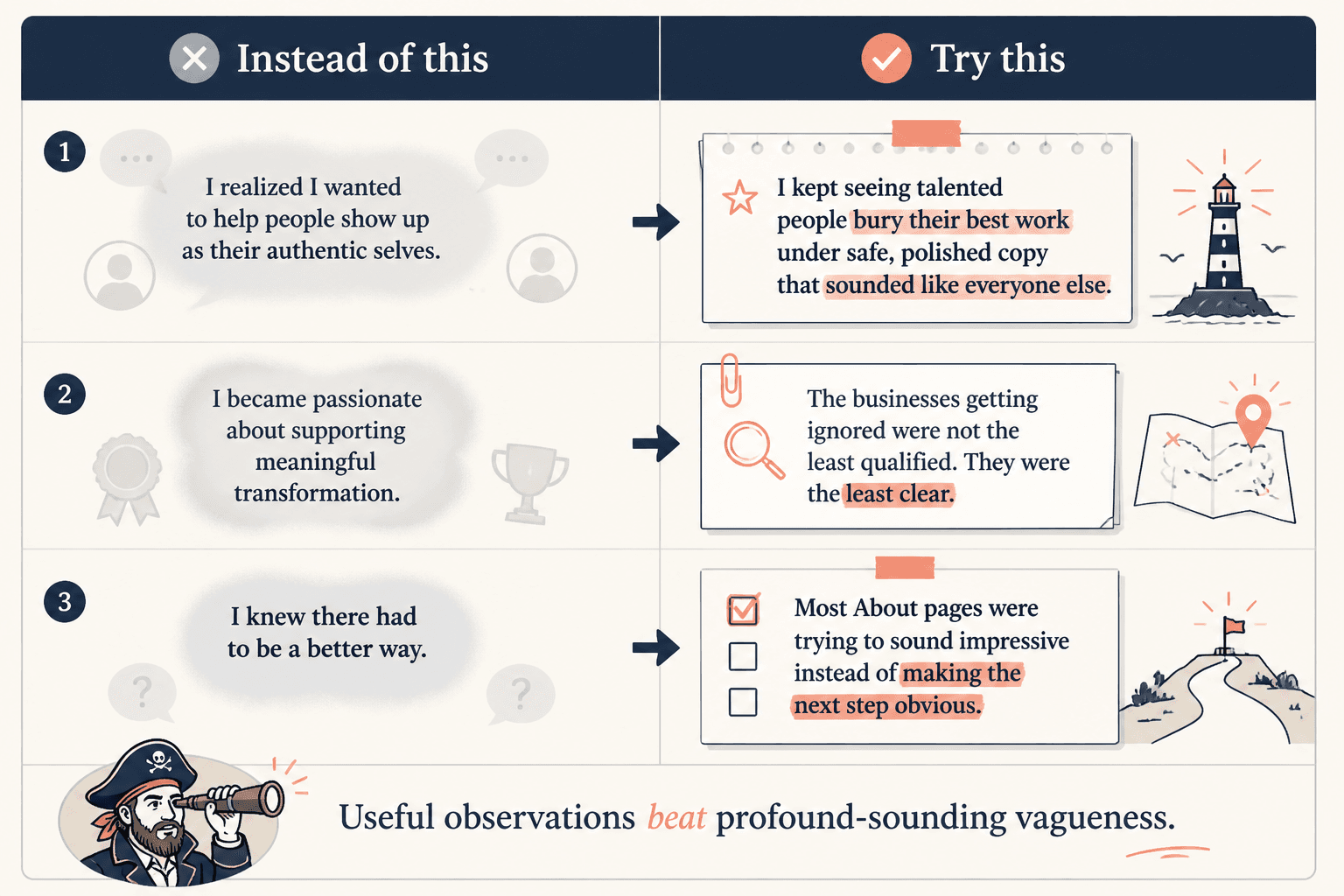
Instead of this
- I realized I wanted to help people show up as their authentic selves.
- I became passionate about supporting meaningful transformation.
- I knew there had to be a better way.
Try this
- I kept seeing talented people bury their best work under safe, polished copy that sounded like everyone else.
- The businesses getting ignored were not the least qualified. They were the least clear.
- Most About pages were trying to sound impressive instead of making the next step obvious.
Notice the difference. These are not grand declarations. They are useful observations. And useful beats profound-looking nonsense almost every time.
Make the reader part of the arc without pretending the page is about them alone
There is some bad advice floating around that says your About page should not really be about you at all. That gets repeated because it contains one useful truth wrapped in a dumb oversimplification.
Yes, the page should be reader-aware. No, it should not erase you from the story. People hire people. They want to know how you think, why you work the way you do, and what kind of perspective they are buying into.
The trick is to connect your story to their stakes.
A simple way to do that
When you mention your experience, follow it with one of these bridges:
- Which means for you: turns your story into reader benefit
- That is why I now: links your past to your current process
- So if you are: helps the reader self-identify
- What that taught me: extracts the practical lesson
Example:
I spent years watching smart experts lose work because their websites sounded polished but empty. What that taught me is that trust does not come from sounding bigger. It comes from being clearer, more specific, and more believable.
That one bridge line can rescue a whole section from becoming self-indulgent.
Give your approach a shape, not just a personality
A good About page does not just say who you are. It shows how you think.
That means your story arc should lead into a clear approach, philosophy, or method. Not because every business needs a trademarked framework with suspicious capitalization. It does not. But readers should leave knowing what makes your way of working distinct.
You can do this with a short section that spells out a few principles.
Example approach section
- I do not write copy to sound “premium.” I write it to make the right people trust you faster.
- I care more about clarity than cleverness.
- I would rather give your expertise a sharp shape than coat it in brand perfume.
- I build pages that sound like a real human with standards, not a template with confidence issues.
Now the reader is not just hearing your story. They are understanding your lens.
If you want to tighten the voice across the whole page, how to write About page copy without sounding salesy or robotic will help.
Use proof to stop the story from floating away
Story alone is not proof. It is context.
At some point, your About page needs to show evidence that your perspective is grounded in real work, real results, or real experience. Otherwise the whole thing can feel beautifully phrased but strangely unconvincing.
Proof can include:
- years of relevant experience
- types of clients served
- specific outcomes
- published work or recognizable credibility markers
- mini case-study style examples
- a few strong testimonials or trust cues
The key is to place proof after the story has created interest, not before. A wall of logos at the top may impress some people, but it does not do much to create narrative momentum.
Quick before and after
Before: I believe in the power of clear messaging to transform brands.
After: I have helped service businesses, consultants, and personal brands turn vague website messaging into clearer positioning, stronger About pages, and conversion-focused copy that gives the right visitors a reason to stay.
Not flashy. Just sturdier.
A practical About page arc template you can adapt
If your current page is a mess of decent paragraphs with no clear shape, use this.
- Opening: Name the kind of reader you help and the problem you understand.
- Backstory: Share the one turning point or pattern that shaped your perspective.
- Shift: Explain what that made you believe or do differently.
- Approach: Describe how you work now and what you care about.
- Proof: Add outcomes, experience, or examples.
- Personal texture: Include a small detail or two that makes you feel human, if it supports the brand.
- CTA: Invite the reader to the next step.
That “personal texture” part matters more than some people think. You do not need quirky filler for the sake of being relatable. But one or two grounded details can help the page feel less synthetic. The trick is not to let those details hijack the page.
For example, “I write from a small studio full of sticky notes and overcaffeinated drafts” can work if the rest of the page is clear and credible. A whole paragraph about your dog’s emotional support qualities probably does not, unless your audience has a very specific reason to care.
What to cut if your About page still feels generic
- empty passion statements
- full chronological biographies
- vague “better way” language with no specifics
- adjectives doing the job of proof
- personality filler that does not support trust or fit
- big philosophical claims that never land in practical value
- CTAs that suddenly shift into hard sell mode
A useful test: if a sentence could be copied onto 500 other websites with almost no changes, it probably needs work.
How to revise your About page story arc in one pass
If you already have a draft, here is a simple editing process.
About pages work better when they build trust with clarity instead of biography theater. A stronger through-line usually matters more than extra detail.