
Most About pages sound like one of two bad options: a stiff corporate bio in a blazer, or a pitchy “here’s why I’m amazing” monologue with a few feelings sprinkled on top. Neither works very well.
If you are trying to figure out how to write About page copy without sounding salesy or robotic, the fix is not to make it more polished. It is to make it more human, more specific, and more useful to the person reading it.
Your About page is not just a place to dump your origin story, list your credentials, and hope people feel something. It is a trust page. People land there when they are thinking, “Okay, but who are you really, and can I trust you with my time, money, project, or problem?”
So the job is simple, even if the writing is not: help people understand who you help, what you care about, how you work, and why you are a credible choice, without sounding like you swallowed a funnel template.
This is where a lot of About pages go sideways. They confuse personality with rambling, confidence with self-importance, and professionalism with beige robot language. You do not need any of that. You need clarity, texture, and a page that sounds like a real person who knows what they are doing.
If you want the bigger picture, start with the parent guide.
Why About page copy gets weird so fast
About pages make people weird because they sit in an awkward middle ground.
- It is about you, but it cannot only be about you.
- It should build trust, but it should not read like a sales page in disguise.
- It needs personality, but too much navel-gazing gets tiring fast.
- It should sound polished, but not like ChatGPT got dressed for a board meeting.
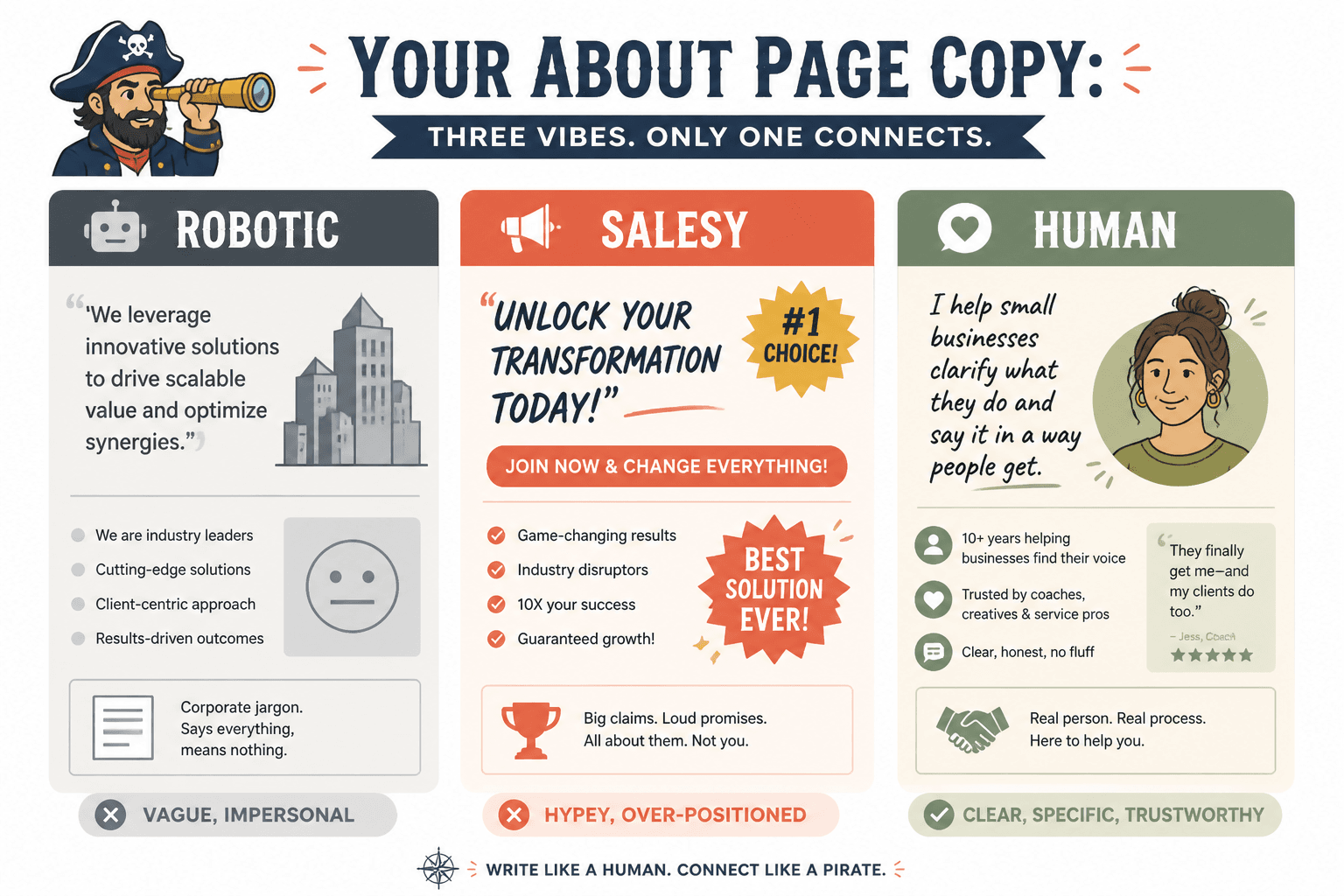
That tension makes people default to one of three things:
- vague mission statements
- chronological life stories no one asked for
- hypey copy trying very hard to “position” them
The better approach is less dramatic. Write like a real person with a point. Your About page should answer the reader’s actual questions, not perform your brand identity like it is auditioning for a keynote slot.
If your current page feels stiff, overdone, or suspiciously buzzwordy, start with the basics in this About page copy guide, then come back and sharpen the tone.
What readers actually want from your About page
People do not visit your About page because they are desperate to know where you went to school in 2012 or that you are “passionate about empowering transformation.” They visit because they are trying to reduce risk.
They want a fast read on four things:
- Who is this for?
- What does this person actually do?
- Can they be trusted?
- Do I like their style enough to take the next step?
That means good About page copy is not a pure autobiography. It is a selective story shaped around relevance. You are not reporting every fact. You are choosing the details that help the right person think, “Ah, this is probably for me.”
That is the real trick behind sounding natural. You stop writing to impress strangers in general and start writing to reassure the right reader in particular.
How to write About page copy without sounding salesy or robotic
Here is the cleanest way to do it: stop trying to sound like a brand and start trying to sound understandable.
That does not mean casual for the sake of casual. It means your copy should feel like a smart, clear explanation from a person with taste and experience. Not a corporate intern. Not a motivational speaker. Not a conversion copy template wearing your name tag.
1. Lead with what the reader cares about
A lot of About pages open with “Hi, I’m Sarah” followed by a long personal backstory. Fine in theory. Weak in practice.
Your opening should quickly connect your story or positioning to the reader’s world. Give them a reason to keep going.
Weak: I am a passionate brand strategist dedicated to helping visionary entrepreneurs unlock their authentic voice.
Better: If your brand sounds polished but forgettable, I help fix that. I work with founders and experts who need clearer messaging, sharper positioning, and copy that sounds like an actual human, not a workshop handout.
The second version is not trying so hard to sound impressive. It is trying to be useful. That is why it works.
If your intro is currently dragging its feet, this will help: how to start About page copy without a weak opening.
2. Use your story selectively, not as a diary entry
Yes, your story matters. No, readers do not need every chapter.
The best About page stories do three things:
- explain why you do this work
- show that you understand the reader’s problem
- support your credibility or approach
That is it. If a detail does not help with one of those, it probably belongs somewhere else.
This matters because oversharing is not the same as connection. A long winding story about your personal evolution can feel self-absorbed if the reader has to work hard to figure out why any of it matters to them.
Good story structure helps. There should be a reason the story appears, a tension point, and a clear payoff. If yours currently sounds generic, read how to improve About page copy story arcs without sounding generic.
3. Replace vague adjectives with proof and specifics
Robotic copy loves adjectives because adjectives are easy. Strategic. Passionate. Innovative. Authentic. Results-driven. None of these are doing much heavy lifting.
Specifics do the work better.
| Vague copy | Stronger copy |
|---|---|
| I help businesses grow online. | I help consultants and small agencies tighten their messaging so their websites turn more visitors into qualified leads. |
| I am known for my authentic approach. | My work tends to be direct, practical, and low on fluff. Clients usually come to me when they are tired of polished copy that says very little. |
| I have years of experience. | I have spent the last 8 years writing conversion copy for service businesses, personal brands, and online offers that need more trust and less noise. |
If you want to sound human, say things a human would actually say. Not sloppy. Just specific.
4. Write with a voice, not a costume
A lot of people hear “show personality” and immediately lunge into quirky overkill. Suddenly the About page sounds like a stand-up set, or a very determined indie newsletter.
You do not need to become A Character. You just need tonal texture. A little rhythm. A little opinion. A sentence here and there that sounds recognizably like you.
For example:
Robotic: My mission is to deliver high-quality solutions that empower clients to reach their goals with confidence.
Human: I like clear strategy, clean messaging, and offers that do not need six paragraphs of throat-clearing before they make sense.
The second one has a point of view. It sounds like someone. That is often what people mean when they say copy feels “authentic.” Not that it is emotional. That it is distinct enough to trust.
5. Keep the focus on the reader often enough
An About page can absolutely use first person. It should. But if every paragraph starts with “I,” “I,” “I,” the page starts to feel inward-facing.
One easy fix is to regularly pivot back to the reader’s situation.
- What are they probably struggling with?
- What kind of help are they looking for?
- What do they want to feel after working with you?
This creates balance. You are still talking about yourself, but in a way that remains relevant.
For example:
Too self-focused: I created this business after years of refining my process and developing my expertise across multiple disciplines.
Better: After years of refining my process, I built this business for clients who are done with vague advice and want clear messaging they can actually use.
Same core idea. Better orientation.
6. Drop the hard sell and use a calm next step
One reason About pages sound salesy is that they panic near the end. The copy is reasonably normal, then suddenly it starts barking commands about transformation and action.
Your CTA does not need to leap out wearing sequins. It needs to feel like the natural next move.
- If you want to see how I think, read a few articles.
- If you are considering working together, start here.
- If you need help with your messaging, book a call.
- If you are not ready yet, join the newsletter and lurk politely.
Calm confidence converts better than performative urgency on an About page. People are already checking your credibility. They do not need a closing pitch that sounds like it escaped from a webinar funnel.
A simple About page structure that feels human
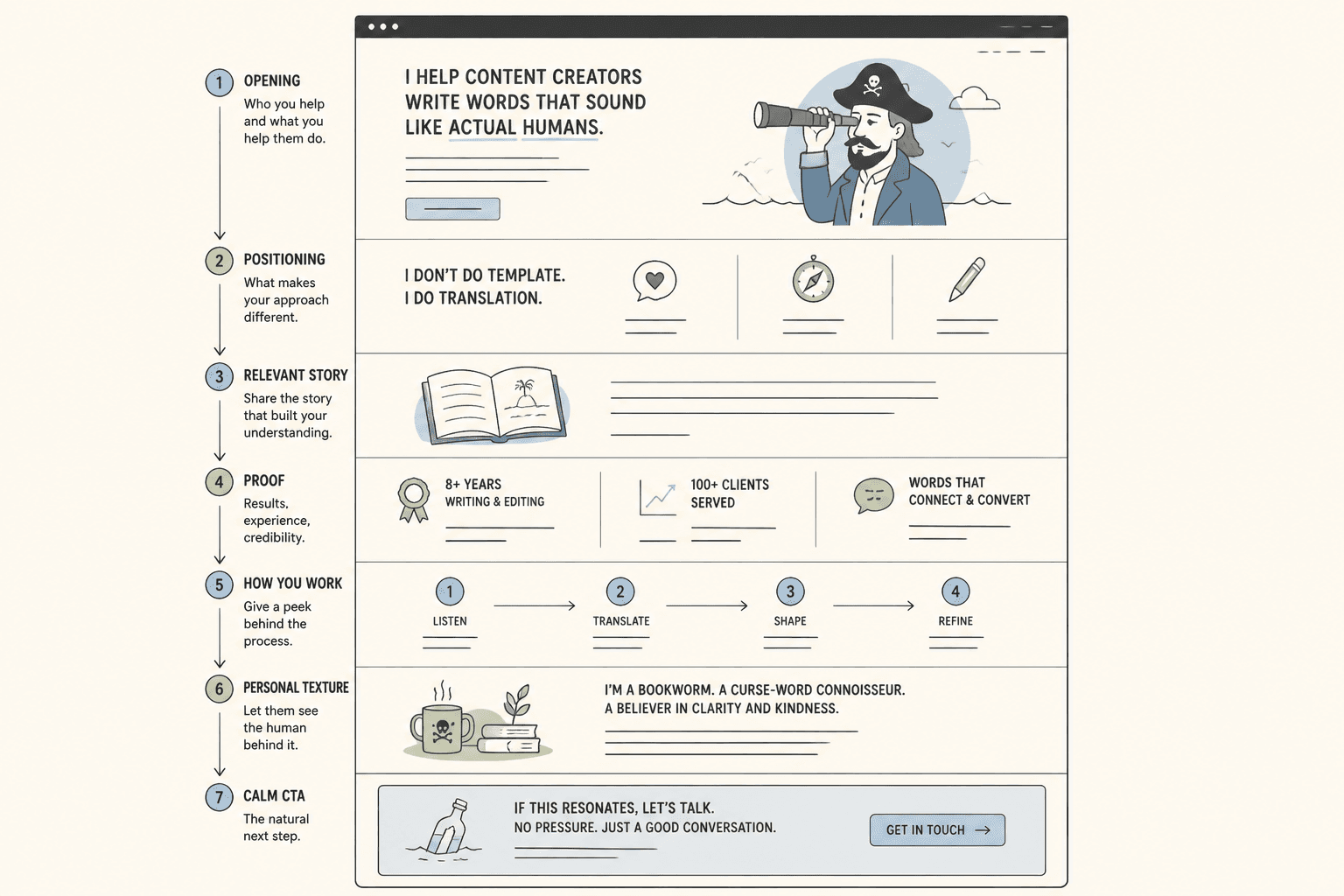
If you tend to freeze when writing about yourself, structure helps. Here is a practical flow that usually works well for coaches, consultants, service providers, creators, and personal brands.
- Opening: Who you help and what you help them do
- Short positioning section: What makes your approach different or useful
- Relevant story: Why you do this work or how you got here
- Proof: experience, results, client context, process, or credibility markers
- How you work: what clients can expect
- Personal texture: a few details that make you feel real, not manufactured
- CTA: the next step
This keeps the page grounded. It gives your personality somewhere to live without letting the whole thing drift into autobiography or sales fog.
If you want a stronger foundation before refining the tone, read how to write better About page copy.
What to cut if your About page sounds robotic
If your draft feels stiff, there is a good chance it is carrying too many dead phrases. Cut those first. The page usually gets better fast.
- mission statements that say nothing concrete
- abstract claims like “empowering transformation”
- stacks of adjectives with no proof
- third-person bios unless there is a very good reason
- forced brand phrases you would never say out loud
- generic origin stories with no tension or relevance
- big promises that feel copied from sales pages
One useful test: read your About page aloud. If a sentence makes you sound like a keynote speaker trapped in a software brochure, rewrite it.
What to cut if your About page sounds salesy
Salesy About pages usually have one main problem: they try to convert before they establish trust.
That means removing things like:
- aggressive CTA buttons in every section
- overblown transformation language
- fake scarcity or urgency
- too much emphasis on your offer too early
- copy that talks like every visitor is one nudge away from buying
The About page sits closer to trust-building than hard conversion. It can absolutely support sales. It should. But usually by making the reader feel more certain, not more pressured.
That distinction matters. Confidence says, “Here is what I do, who it helps, and what to do next if it fits.” Salesiness says, “Please validate this business model immediately.” Readers can feel the difference.
Before and after: a quick rewrite example
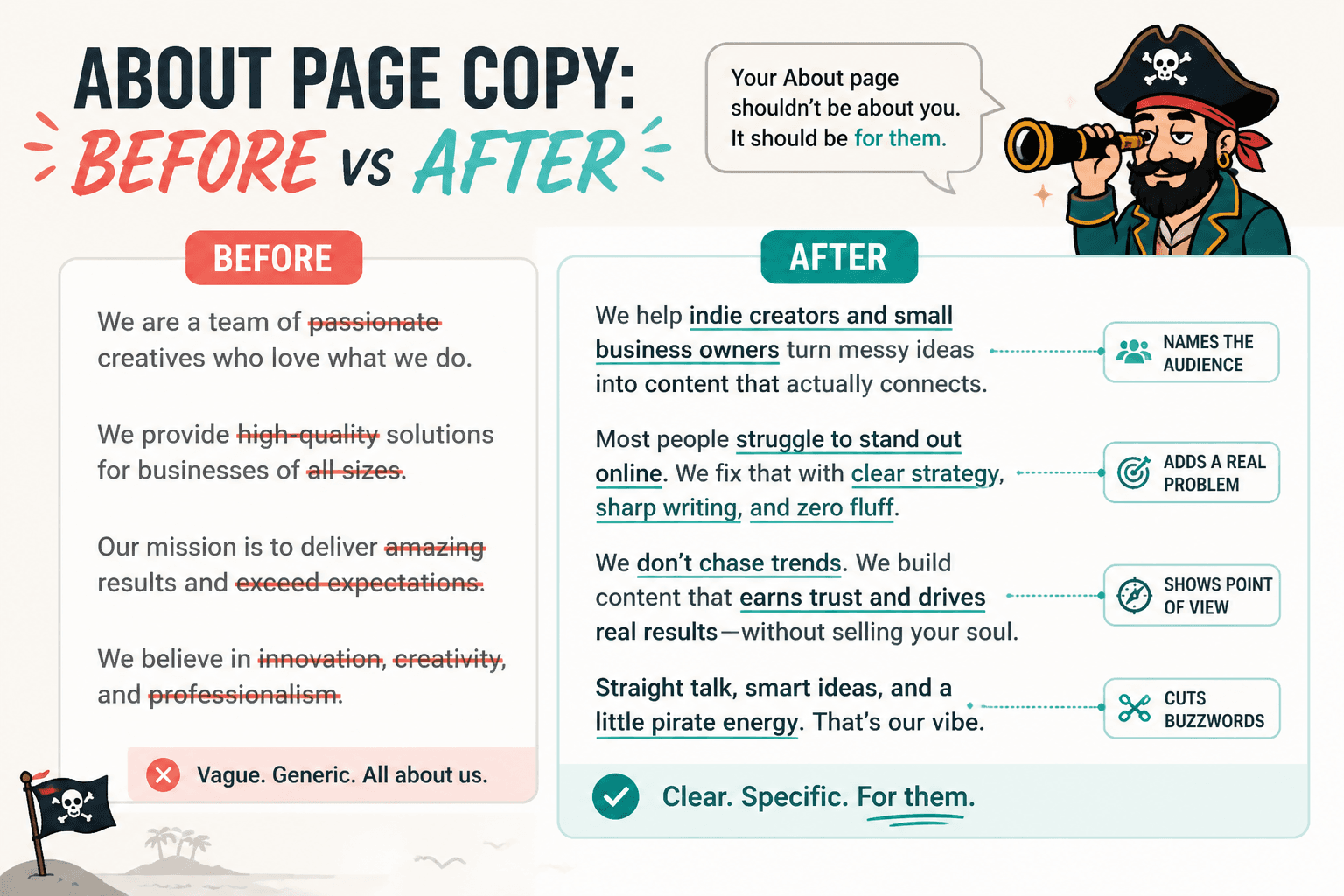
Here is a typical robotic-sounding About page intro:
I am a dedicated copywriter and strategist passionate about helping entrepreneurs elevate their brands through compelling messaging solutions. With a unique approach rooted in authenticity and innovation, I empower clients to connect with their audiences and scale with confidence.
That is technically English. It is also fluff in a blazer.
Here is a stronger version:
I help service businesses and personal brands say what they do more clearly, so their websites sound sharper and convert better. Most of my clients come to me when their messaging feels polished but bland, or competent but forgettable. I fix that with strategy-first copy that sounds like them on a good day.
Why this works better:
- It says who the work is for.
- It names an actual problem.
- It has a point of view.
- It avoids empty buzzwords.
- It sounds like a person, not a positioning worksheet.
If your current draft is flat, the easiest path is often a full rewrite, not endless tinkering. This may help: how to rewrite boring About page copy.
A quick editing checklist before you publish
About pages work better when they build trust with clarity instead of biography theater. A stronger through-line usually matters more than extra detail.