
Most About pages are not bad because the person has nothing interesting to say. They are bad because they read like someone tried to sound professional and accidentally removed every trace of clarity, specificity, and pulse.
You have probably seen the usual version: a vague origin story, a few polished claims, a list of values nobody asked for, and a headshot staring into the middle distance like trust is supposed to happen by osmosis.
If you want to know how to rewrite boring About page copy, the job is not to make it cuter or longer. The job is to make it useful. Your About page should help the right person quickly understand who you help, what you do, why your way is worth paying attention to, and what to do next.
That means less autobiographical fog. More relevance. Less “ever since I was young…” More “here is what I help with, who it is for, and why people trust me.”
Here is a practical rewrite process that turns a sleepy About page into one that actually supports trust, positioning, and conversion without sounding like a resume in soft lighting.
For the broader learning path, visit our parent guide.
Why most About page copy gets boring fast
Boring About pages usually have one core problem: they are written from the writer’s point of view, not the reader’s decision-making process.
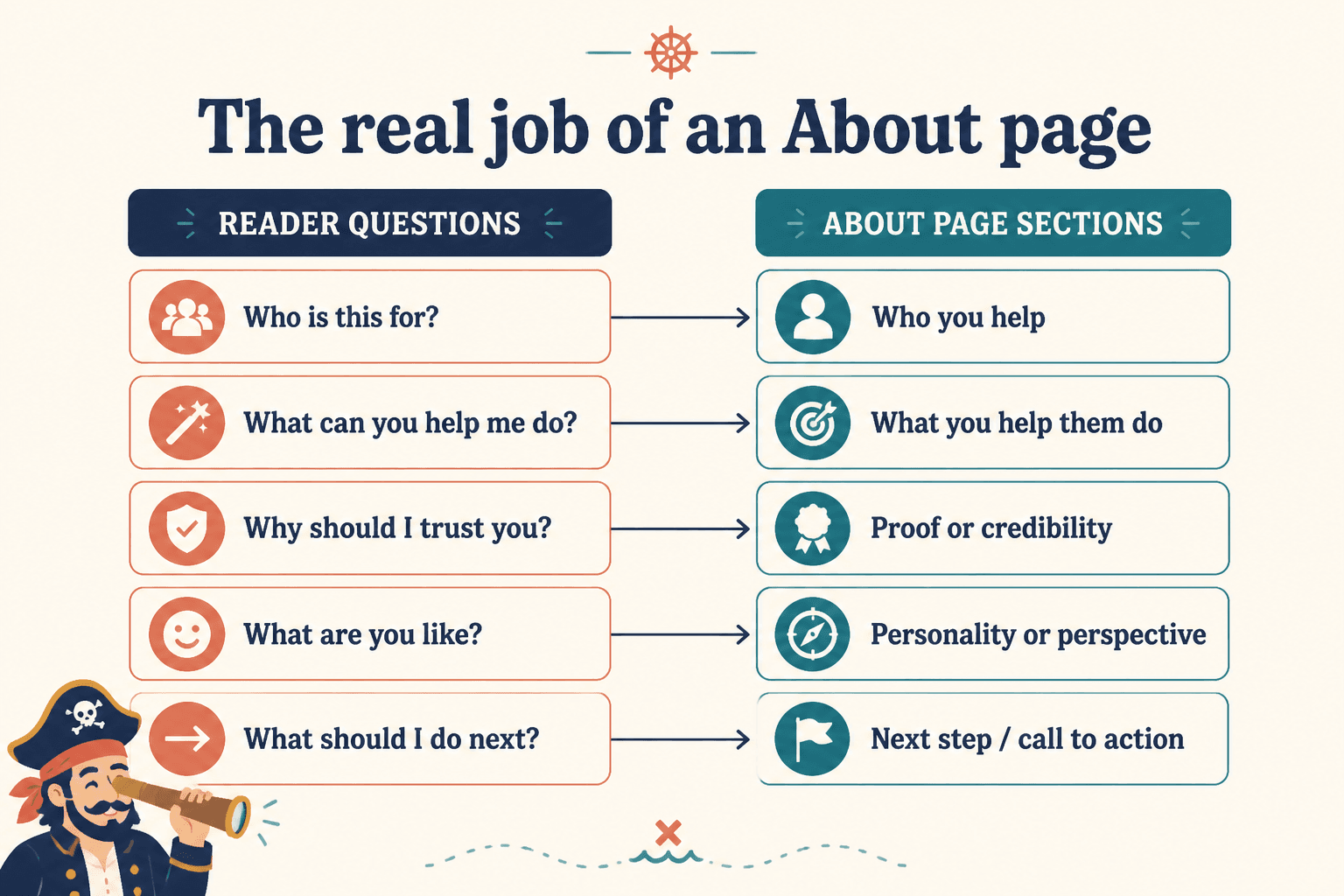
The visitor is not asking, “What is your complete life journey?” They are asking quieter, more useful questions:
- Am I in the right place?
- Is this person relevant to my problem?
- Do they seem credible?
- Do I like how they think?
- What should I do next if I want help?
Most About pages answer none of that cleanly. Instead, they wander through generic backstory, inflated adjectives, and abstract mission language. The page becomes technically readable but strategically useless.
That is the thing people miss. An About page is not just biography. It is conversion copy wearing a slightly more personal outfit.
Your About page does not need to impress everyone. It needs to reassure the right person fast.
What strong About page copy actually needs to do
Before you rewrite anything, get clear on the real job of the page. Good About page copy usually does five things:
- Explains who you help
- Shows what you help them do
- Gives a believable reason to trust you
- Shows some personality or perspective
- Moves the reader toward a next step
That is it. Not a memoir. Not a TED Talk transcript. Not an identity collage featuring every role you have ever held.
If you need a deeper foundation first, this broader guide on About page copy is a useful place to anchor your thinking before you start editing line by line.
How to rewrite boring About page copy step by step
There is no need to stare at the page and hope for magic. Use a process. Here is the one that works.
1. Find the actual point of the page
Before rewriting, answer these four questions in plain English:
- Who is this page for?
- What do I help them with?
- Why am I credible or different?
- What do I want them to do next?
If you cannot answer those clearly, the copy problem is not really a copy problem. It is a positioning problem.
For example, this is vague:
I help ambitious businesses grow through strategic solutions, authentic storytelling, and transformative marketing support.
This is stronger:
I help coaches, consultants, and service businesses turn unclear messaging into website copy that attracts better-fit leads and makes the next step obvious.
The second version tells the reader who it is for, what it helps with, and what kind of outcome to expect. Much less fog. Much more traction.
2. Cut the throat-clearing
Boring About pages often begin with a ceremonial fog machine.
Things like:
- Welcome to my website
- I am so glad you are here
- Ever since I was young
- I have always had a passion for helping people
- My journey has been anything but traditional
None of these lines help the visitor decide anything. They simply delay the useful part.
Start closer to the value instead. If your opening is weak, fix that first. This guide on how to start About page copy without a weak opening goes deeper on the mechanics, but the short version is simple: open with relevance, not ceremony.
Weak opening:
Hi, I’m Sarah, and I’m so excited to share a little bit about my story and how I got here.
Better opening:
If your website sounds polished but still does not convince the right people to take the next step, your copy probably has a clarity problem, not a traffic problem.
That second version creates immediate relevance. It earns attention because it speaks to an actual problem.
3. Replace vague claims with specifics
Vagueness is one of the fastest ways to make decent expertise sound forgettable.
Boring copy loves phrases like:
- personalized solutions
- authentic brand voice
- results-driven approach
- empowering clients
- holistic support
These phrases are not evil. They are just overworked and under-informative.
Specificity does not mean making wild claims. It means showing what your work actually looks like.
For example:
| Vague version | Stronger rewrite |
|---|---|
| I create authentic messaging for purpose-driven brands. | I help service businesses simplify their homepage, About page, and offer messaging so visitors understand the value in under a minute. |
| I support clients through transformational coaching. | I help new coaches turn scattered expertise into a clear offer, a sharper profile, and content people actually respond to. |
| I take a strategic, personalized approach. | I do not use copy templates blindly. I look at your audience, offer, objections, and buying friction before rewriting the page. |
Notice the difference. The stronger versions are easier to picture. They sound more believable because they are more concrete.
4. Stop listing your values like decorative throw pillows
A lot of About pages include a section that says some version of this:
I believe in authenticity, integrity, collaboration, excellence, and passion.
Fine. So does everyone else with a Canva brand board.
If a value matters, show it through the way you work, the way you explain your process, or the kind of clients you are best for. Values are more persuasive when they appear as behavior, not wall art.
Instead of this:
I value honesty and simplicity.
Try this:
I am not the right fit if you want your website to sound impressive but say very little. I care more about clear decisions than clever fluff.
That tells me something real about how you think. Which is the point.
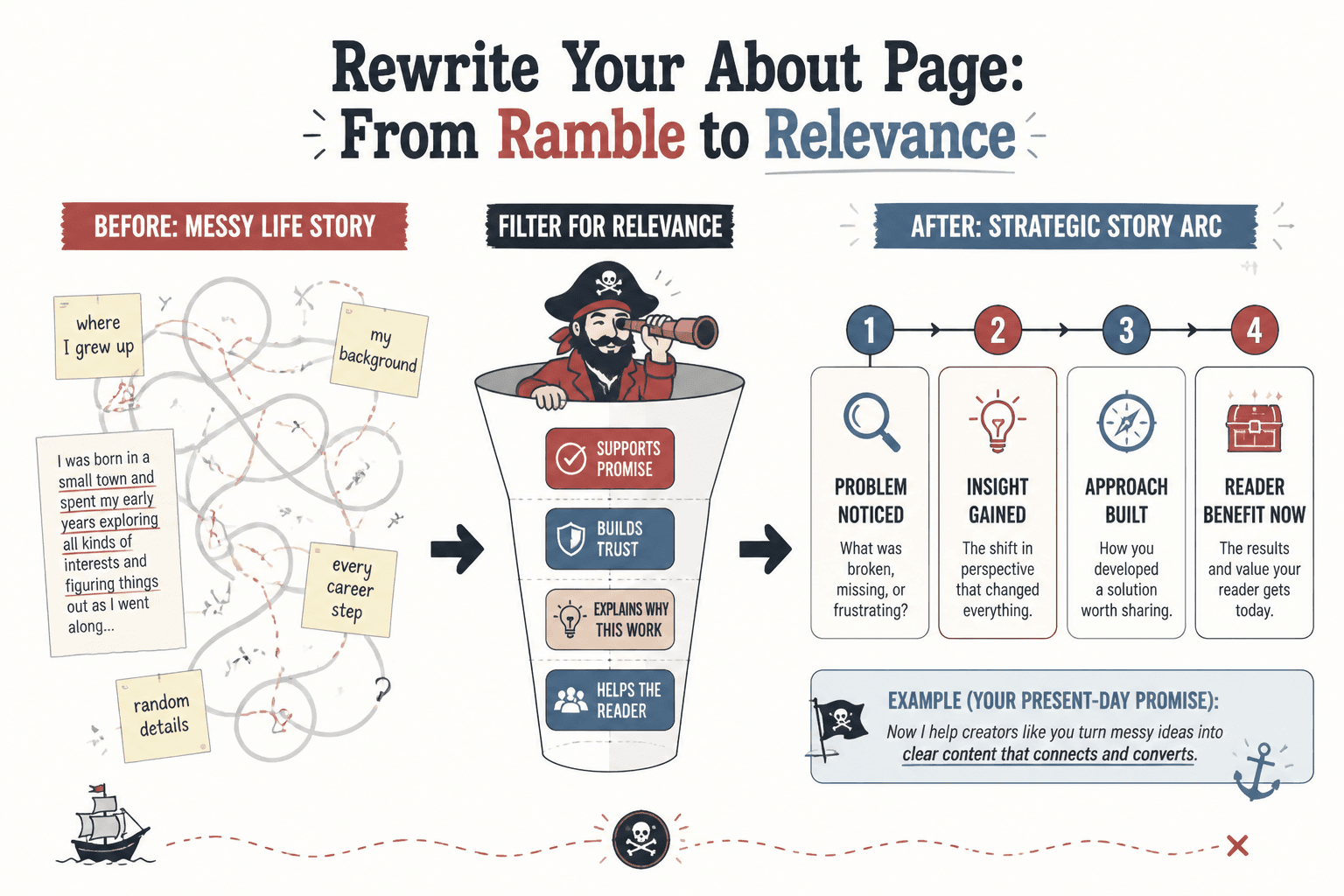
5. Make the story serve the reader
Yes, your story can belong on an About page. No, it should not be there just because it happened to you.
The best personal story sections do one of three things:
- Explain why you care about the problem
- Show how you developed your method or point of view
- Help the reader feel understood
That means your story needs selection and shape. Not every chapter deserves page time.
Weak version:
My journey started in corporate, then I moved abroad, then I freelanced, then I discovered mindset work, and over time everything aligned.
Stronger version:
After years of watching smart service businesses lose leads because their websites sounded polished but unclear, I built my process around one thing: making the right message easier to trust fast.
The second version uses experience to support the current promise. It is not autobiography for autobiography’s sake.
If your current story section rambles or sounds generic, read how to improve About page copy story arcs without sounding generic. It will help you keep the humanity without turning the page into a life documentary.
6. Add proof before the reader has to ask for it
One reason About pages feel flat is that they make claims with no ballast. You say you are experienced, strategic, trusted, insightful, or good at what you do. Great. According to whom.
Proof does not need to be loud. It just needs to be present.
You can use:
- brief client results
- years or volume of experience
- notable project types
- recognizable categories of clients
- a short testimonial line
- your process or methodology
For example:
Over the past three years, I have helped consultants, coaches, and solo service brands tighten the pages that usually do the heaviest lifting: homepage, About, offer, and email opt-in copy.
That is simple. But it grounds the pitch in something real.
7. Give the page a structure people can actually scan
Sometimes the copy is not terrible. It is just trapped inside a giant slab of text with no hierarchy, no pacing, and no obvious path through the page.
A good About page usually includes some version of these sections:
- A strong opening that frames the problem or promise
- A quick explanation of who you help and what you do
- A short story or perspective section
- Proof, credibility, or approach
- A “who this is for” or “how I work” section
- A clear CTA
You do not need all of these in the same order. But you do need shape.
If your page currently feels messy, rewrite it section by section rather than trying to line-edit the whole thing in one pass. That is usually where people get stuck. They polish a weak paragraph instead of fixing the page logic.
8. Rewrite for voice last, not first
People often try to make an About page “sound more like them” before they have made it clear. That is backwards.
First get the message right. Then adjust the voice.
Voice matters, yes. But “friendly” is not a strategy. “Warm and professional” is not enough to rescue copy that still says nothing.
Once the structure and message are solid, then you can sharpen the phrasing:
- Cut overly formal wording
- Use contractions where natural
- Swap generic verbs for direct ones
- Keep one or two lines with personality
- Remove anything that sounds imported from a brand workshop PDF
If you want examples of what stronger writing sounds like across the page, how to write better About page copy pairs nicely with this rewrite process.
A before-and-after About page rewrite example
Here is a condensed example of how to rewrite boring About page copy in practice.
Before:
Hello and welcome. I’m a passionate entrepreneur and creative thinker dedicated to helping people step into their fullest potential through authentic branding, aligned messaging, and purpose-driven strategy. My journey has been shaped by a love for storytelling, human connection, and empowering others to shine.
The problems:
- No clear audience
- No concrete outcome
- No proof
- Too many abstract phrases
- Reads like everybody else
After:
I help independent coaches and consultants fix the website copy that keeps good prospects circling without taking action.
Most of the time, the problem is not effort. It is messaging that sounds polished but never gets specific enough to build trust.
That is where I come in. I rewrite the core pages that shape first impressions, clarify offers, and make the next step easier to say yes to.
That version is cleaner because it makes decisions. It chooses a reader. It names the problem. It explains the work. It sounds like someone with a point of view, not just a fondness for adjectives.
A simple rewrite checklist for your About page
Use this when editing your page.
- Can a stranger tell who the page is for within a few seconds?
- Does the opening lead with relevance instead of pleasantries?
- Have you cut generic claims and replaced them with specifics?
- Does the story support the offer, rather than distract from it?
- Is there proof somewhere on the page?
- Does the structure feel easy to scan?
- Does the voice sound human without getting fuzzy?
- Is the CTA clear and appropriate?
If several of those answers are no, good. That means you know what to fix next instead of vaguely “improving the copy” for three hours.
About pages work better when they build trust with clarity instead of biography theater. A stronger through-line usually matters more than extra detail.