
If you have a small audience, your bio has one job: make the right person think, “Oh, this is for me.”
That is it. Not impress strangers. Not stack vague titles until you sound important. Not cosplay as a thought leader with “helping visionary founders unlock aligned growth” pasted into your profile like it escaped a cursed workshop slide deck.
Creator Bios & Profile Copy for Creators With Small Audiences matters more than most people think because small audiences do not give you much room to be fuzzy. When fewer people land on your profile, each visit matters more. If your bio is vague, cluttered, or trying to appeal to everybody, you lose the tiny, valuable window where trust could have started.
A strong profile does not need to make you look famous. It needs to make you look relevant. There is a big difference. Relevance gets follows, replies, clicks, and inquiries. Fake polish gets polite nothing.
Here’s how to write profile copy that makes a small audience work harder for you, not against you.
Want the broader roadmap? Start with the parent guide.
Why small creators need sharper bios, not fancier ones
Big creators can get away with bad bios because their audience already knows who they are. Their content carries them. Their reputation fills in the gaps. Their comments section does half the persuasion for them.
Small creators do not have that luxury. If someone sees one post, one comment, or one thread and clicks through to your profile, your bio has to do actual work.
- It should explain who you help.
- It should suggest what kind of problem you solve.
- It should give a reason to trust you.
- It should make the next step obvious.
That means the best bios for small creators are usually clearer, narrower, and more useful than the bios people copy from bigger accounts.
A small audience is not a branding emergency. It just means you should stop trying to sound broadly impressive and start trying to be specifically helpful.
What a good creator bio needs to answer fast
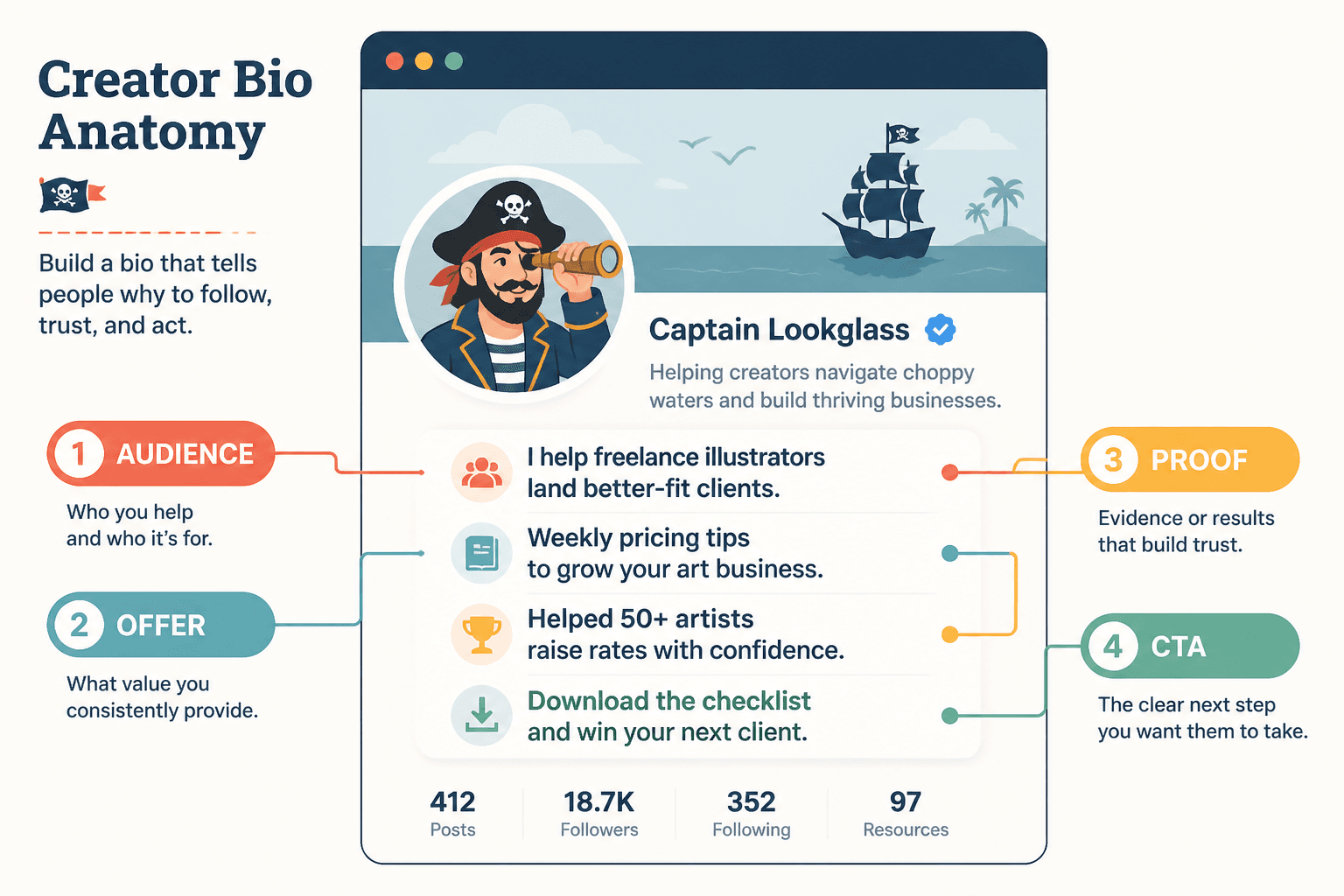
Before you write anything, make sure your profile copy answers four basic questions quickly.
- Who are you for?
Not “everyone who wants to grow.” Be specific enough that the right people can recognize themselves. - What do you help them do?
Say the result in plain English. Skip the fog. - Why should they trust you?
Proof can be client results, experience, niche expertise, a method, a body of work, or even a sharp point of view backed by consistency. - What should they do next?
Follow, read, download, message, book, subscribe. Pick one.
If your bio misses two or three of those, it is probably making people do too much interpretation. And people do not like homework from a stranger.
The biggest bio mistakes small creators keep making
1. Trying to sound big instead of sounding clear
Plenty of small creators write bios like they are preparing for a Forbes panel introduction.
Founder | Strategist | Speaker | Mentor | Educator | Helping brands scale impact through authentic storytelling
That sounds polished, sure. It also tells me almost nothing. What kind of brands? What kind of storytelling? What kind of outcomes? Why you?
“Professional” is not the same thing as persuasive. A lot of profile copy gets worse the moment it tries to look expensive.
2. Listing too many roles
Writer. Coach. Consultant. Speaker. Creator. Podcaster. Investor. Community builder. Thought partner. Human being. Occasional coffee enjoyer.
You get maybe a few seconds of attention. Do not spend them making people sort through your identity pile. Lead with the role that is most relevant to the audience you want.
3. Using vague transformation language
Words like unlock, elevate, empower, align, amplify, thrive, scale your truth tend to make bios weaker, not stronger. They sound ambitious and mean almost nothing.
Specific beats uplifting. “I help coaches turn messy expertise into clear content that gets inquiries” is much stronger than “I empower experts to amplify their authentic voice.” One sounds like a real service. The other sounds like a scented candle with Wi-Fi.
4. Having no proof because the audience is still small
This is where people freeze. They think, “I do not have a huge audience, so I cannot show credibility yet.” Not true.
If you are small, your proof just needs to be honest and relevant. You can use client type, years of work, specific outcomes, recognizable problems you solve, a repeatable process, or the fact that your content consistently teaches something useful. You do not need to fake authority. You need to frame the authority you actually have.
5. Forgetting the next step
A surprising number of bios stop right before the part that matters. They describe the creator, then leave the visitor standing there like someone forgot to open the door.
If your profile matters to your business, your bio should point somewhere. Follow for practical breakdowns. Grab the guide. Read the pinned post. Message me “audit.” Book a consult. Pick a next action that fits the platform and your offer.
A simple bio formula that works for small audiences
You do not need a genius one-liner. You need a structure that is easy to understand.
Use this:
I help [specific audience] do [specific outcome] without [pain/friction].
[Proof, credibility, or distinctive angle].
[Clear next step].
That formula works because it covers positioning, outcome, trust, and action without trying to be clever for sport.
Example 1: Coach
Weak: Mindset coach helping ambitious women step into alignment and abundance.
Stronger: I help self-employed women stop overcomplicating their offers and sell them with clearer messaging. Former brand strategist. Practical content and positioning tips here.
Example 2: Writer
Weak: Sharing thoughts on writing, creativity, and life.
Stronger: I help creators write sharper posts, bios, and articles that sound human and sell quietly. 10+ years in content. Follow for practical rewrites and templates.
Example 3: Consultant
Weak: Consultant for founders building better brands.
Stronger: I help early-stage founders clarify their positioning so their site, pitch, and content stop sounding interchangeable. Messaging consultant for B2B service brands. Bookings in pinned post.
If you want more starting points, it makes sense to explore simple creator bios and profile copy one-liners and templates for busy creators and this broader collection of creator bio ideas and examples.
How to write a bio when you do not have huge proof yet
This is the part a lot of small creators mishandle. They think the only acceptable proof is some giant metric.
It is not.
If you do not have “helped 10,000 people” or “grew to 500K followers,” use smaller proof that still signals competence. Good proof is anything that reduces uncertainty for the reader.
- Your niche or industry experience
- Your role in previous work
- The type of clients you help
- The kind of outcomes you focus on
- A named framework or method, if it is real and useful
- A body of work people can inspect
- Specific content topics you consistently cover
For example:
- “Email strategist for course creators”
- “Ex-agency copywriter helping consultants simplify their websites”
- “Helping therapists write less generic Instagram content”
- “Content systems for solo founders who hate posting every day”
Notice what those do well. They narrow the field. They sound lived-in. They do not need inflated numbers to feel credible.
And if you truly are early, lean on clarity and consistency. A sharp, specific bio plus solid content can outperform a more impressive-looking profile with no actual focus behind it.
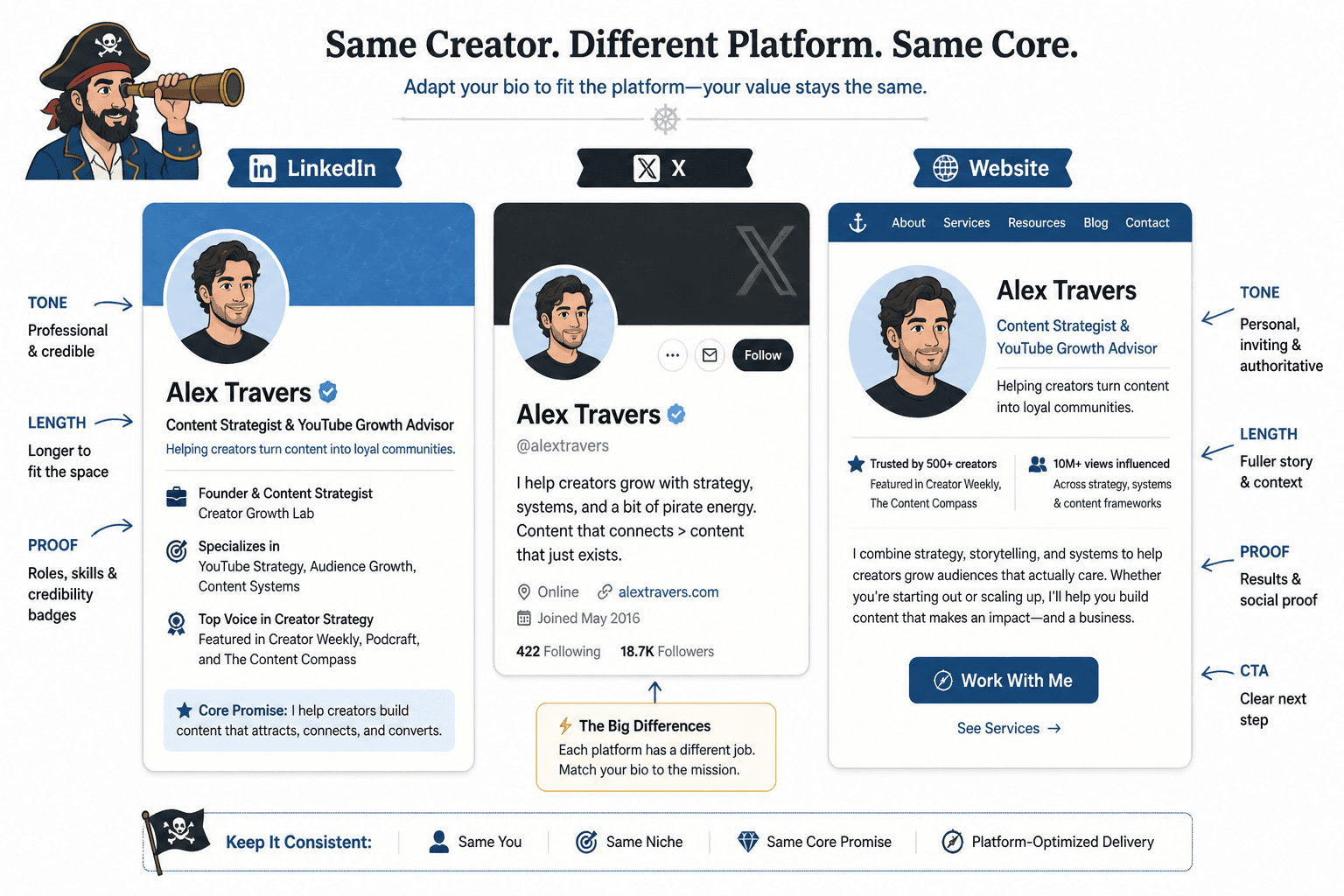
Profile copy should match the platform, not fight it
Your bio is not floating in a vacuum. It sits inside a platform with its own habits, limits, and expectations. Small creators often make the mistake of pasting the exact same copy everywhere.
That is convenient. It is also usually lazy.
Keep it credible, clear, and professionally useful. Lead with who you help and what you help them do. Add proof or experience. Then point to a resource, offer, or reason to connect.
LinkedIn can support slightly more direct expertise language because people expect professional positioning there. If you want a broader foundation first, this creator bios and profile copy guide is a useful next read.
X / Twitter
Shorter. Punchier. More voice. You still need clarity, but the wording should feel tighter and more memorable. Keep the audience and outcome visible, then use the rest of the space for proof, angle, or personality.
You can be a little warmer and more conversational, especially if your content style is community-driven. But do not turn the bio into a life story. Facebook rewards relatability, not rambling.
Website or creator profile page
This is where you can expand. You have more room for positioning, proof, a stronger promise, and a cleaner CTA. If social bios are billboards, your website profile is the front desk. It should help people know where to go next.
A practical rewrite process for fixing a weak bio
If your current bio is not pulling its weight, do not start by trying to make it cuter. Start by making it more useful.
- Circle the vague words.
Words like empowering, passionate, authentic, transformative, impactful, visionary. If they could describe 80,000 other profiles, they are probably dead weight. - Name the audience more clearly.
Not “business owners.” Try coaches, consultants, local service businesses, first-time founders, authors, course creators. - Name the outcome more clearly.
What changes because of your work? More leads, clearer messaging, better posts, stronger sales pages, easier consistency, cleaner positioning. - Add one form of trust.
Experience, niche, client type, body of work, method, or result. - Add one next step.
Follow, message, read, click, book. - Cut anything that exists only to sound impressive.
Here is a quick before-and-after.
Before:
Helping purpose-driven entrepreneurs amplify their brand message with authentic storytelling and aligned marketing.
After:
I help coaches and consultants turn fuzzy expertise into clear content that attracts better-fit clients. Brand messaging and profile copy. Start with the pinned guide.
The second one is not trying to win a poetry contest. Good. It is trying to get understood.
Bio templates for creators with small audiences
Use these as starting points, not sacred text.
Template 1: Clear and direct
I help [audience] do [result].
[Relevant proof or specialty].
[Next step].
Example:
I help service-based founders write clearer websites that convert better.
Conversion copywriter for small B2B brands.
Follow for practical rewrites.
Template 2: Problem and outcome
The bigger point is simple: clearer structure and clearer writing make the piece more useful. That is usually what makes the ending land better too.
The bigger point is simple: clearer structure and clearer writing make the piece more useful. That is usually what makes the ending land better too.