
Most homepage hooks are not bad because they are too short. They are bad because they sound like they were assembled from leftover website words: clear, confident, conversion-focused, human-centered, results-driven. Very polished. Very vague. Very forgettable.
If your homepage opens with something like “We help brands grow with strategic solutions” or “Helping founders scale with clarity and confidence,” the problem is not grammar. The problem is that nobody can tell, quickly, why you matter, who you are for, or why they should keep reading.
A better homepage hook does one job first: it makes the right person feel like they are in the right place. Not mildly interested. Not professionally acknowledged. Clear.
Here’s how to write better homepage hooks without sounding generic, overcooked, or like your site was ghostwritten by a networking event.
For the broader learning path, visit our parent guide.
What a homepage hook is actually supposed to do
Your homepage hook is usually the opening message in the hero section: headline, subheadline, maybe a button. It does not need to explain your whole business. It does need to make the next click or scroll feel worth it.
A strong hook usually answers some version of these questions fast:
- Who is this for?
- What do they get?
- What problem gets solved?
- Why this offer instead of the 40 equally beige ones next door?
If the opening is too broad, too clever, or too stuffed with nice-sounding abstractions, people do what people always do: they bounce.
Your hook is not there to impress everyone. It is there to quickly sort the right people from the wrong ones.
Why homepage hooks sound generic in the first place
Most generic homepage hooks come from one of three habits.
1. You’re describing qualities instead of outcomes
Words like strategic, authentic, premium, holistic, tailored, impactful, and innovative sound useful until you notice they could apply to almost anyone. They are not proof. They are decoration.
People don’t buy “tailored solutions.” They buy specific help with a real problem.
2. You’re trying to sound credible by sounding broad
This is a common mistake, especially for consultants, coaches, and service businesses. They worry that specificity will make them seem smaller, so they write copy that sounds wider and more “professional.” The result is usually weaker, not stronger.
Broad copy does not make you look established. It makes you look hard to place.
3. You’re copying homepage structure without copying clarity
A lot of people model their homepage after sites they like, but they copy the surface layer: short headline, airy spacing, a few polished phrases. What they miss is that the better sites usually have sharper positioning underneath.
Minimal copy only works when the idea is doing actual work. Otherwise it just sits there looking expensive.
How to write better homepage hooks without sounding generic
If you want a practical fix, stop trying to write a “good headline” and start extracting the sharpest truth about what you do.
That usually means getting clearer in five areas: audience, problem, result, mechanism, and tone.
Start with who it is for
“Business owners” is weak. “Creative founders” is slightly better. “Coaches who need a homepage that sells without sounding like a webinar funnel” is much harder to ignore if that is exactly the reader.
You do not always need to name the audience in the headline itself, but you do need to know it clearly while writing. If your hook could fit seven different markets, it is probably too loose.
Name the real problem, not the polite version
People rarely go looking for “brand clarity.” They go looking for fixes to messier things:
- My homepage sounds bland
- People visit but do not inquire
- I sound too formal online
- My offer makes sense in my head but not on my site
- I’m attracting the wrong leads
Use the problem language people would actually say to a friend or type into search when mildly annoyed and slightly desperate. That language tends to convert better because it feels real.
Show the result in concrete terms
“Grow your business” is a fog machine. “Turn homepage visitors into better-fit inquiries” is clearer. “Make your offer easier to understand in the first five seconds” is clearer. “Get rid of homepage copy that sounds smart but says nothing” is clearer and, frankly, more useful.
The more visible the result, the stronger the hook tends to be.
Add a mechanism if it helps
A mechanism is the how. Not the full process. Just enough to make the promise believable.
For example:
- Homepage copy rooted in positioning
- Conversion copy for service businesses
- Brand messaging built for experts with complex offers
- Sharp website copy for creators who need trust before the pitch
This helps your hook sound less like a slogan and more like a real offer.
Use plain language before clever language
Clever can work. But clear has to win first.
If someone has to decode your headline, your homepage is making them do admin before they even trust you. Not ideal.
If you want to sound smart, be specific. Specificity sounds more confident than wordplay nine times out of ten.
A simple formula for better homepage hooks
You do not need one perfect formula forever, but this one works well when your homepage copy is drifting into generic territory:
I help [specific audience] do [specific result] without [painful/frustrating obstacle].
Or, if you want something less direct and more polished:
[Specific result] for [specific audience] who are tired of [specific problem].
These are not final copy formulas. They are drafting tools. Use them to force clarity, then tighten the language until it sounds like an actual human wrote it.
Examples
- Weak: Strategic copy for modern brands
Better: Homepage copy for service brands that need to sound clear, credible, and worth contacting - Weak: Helping entrepreneurs grow online
Better: Website messaging that helps coaches and consultants turn confused visitors into qualified leads - Weak: Build a brand that stands out
Better: Clarify your message so people understand what you do before they lose interest
Notice what changed. The better versions are less dreamy, more usable. They trade mood for meaning.
Before-and-after homepage hook rewrites
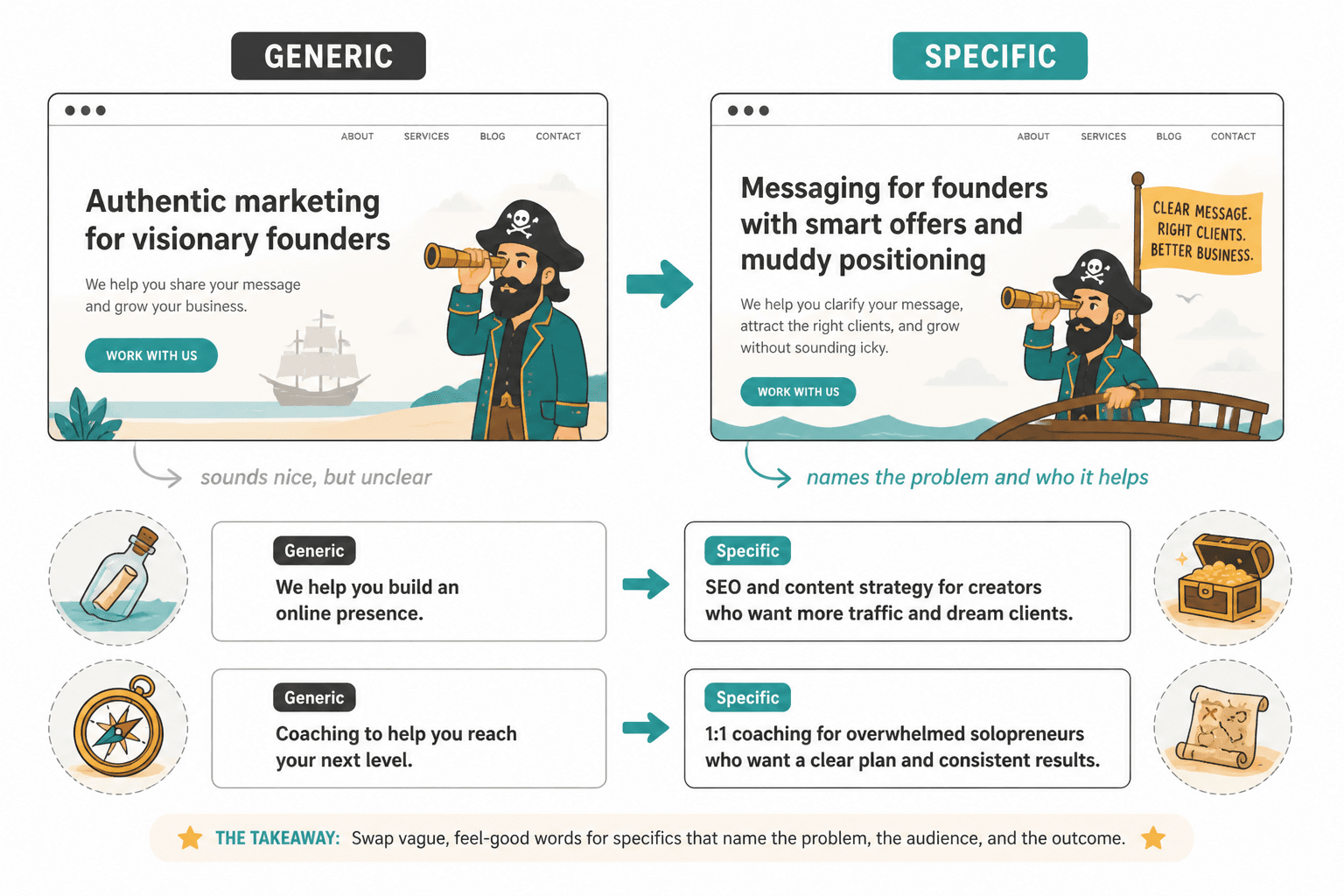
Sometimes the easiest way to improve homepage copy is to see exactly where generic phrasing collapses.
| Before | After | Why it works better |
|---|---|---|
| Helping purpose-driven brands make an impact | Homepage and brand copy for creative businesses that need clearer messaging and better-fit leads | Specific audience, specific deliverable, visible business outcome |
| Elevate your online presence with strategic storytelling | Make your website easier to trust, understand, and act on | Less fluff, more direct reader benefit |
| Authentic marketing for visionary founders | Messaging for founders with smart offers and muddy positioning | Names the real problem instead of flattering the reader |
| Conversion-focused copy that connects | Website copy that sounds like you and helps more visitors inquire | Specific conversion action, less agency-speak |
A small note here: you do not need to cram every selling point into the hook. A homepage hero is not a suitcase. If you overload it, clarity dies first.
Your job is to make the core offer legible. The rest can happen in the supporting copy underneath.
What to include under the hook so it doesn’t have to do everything
One reason homepage hooks get bloated is that people expect the headline to carry the entire conversion job. It can’t. That is what the rest of the hero section is for.
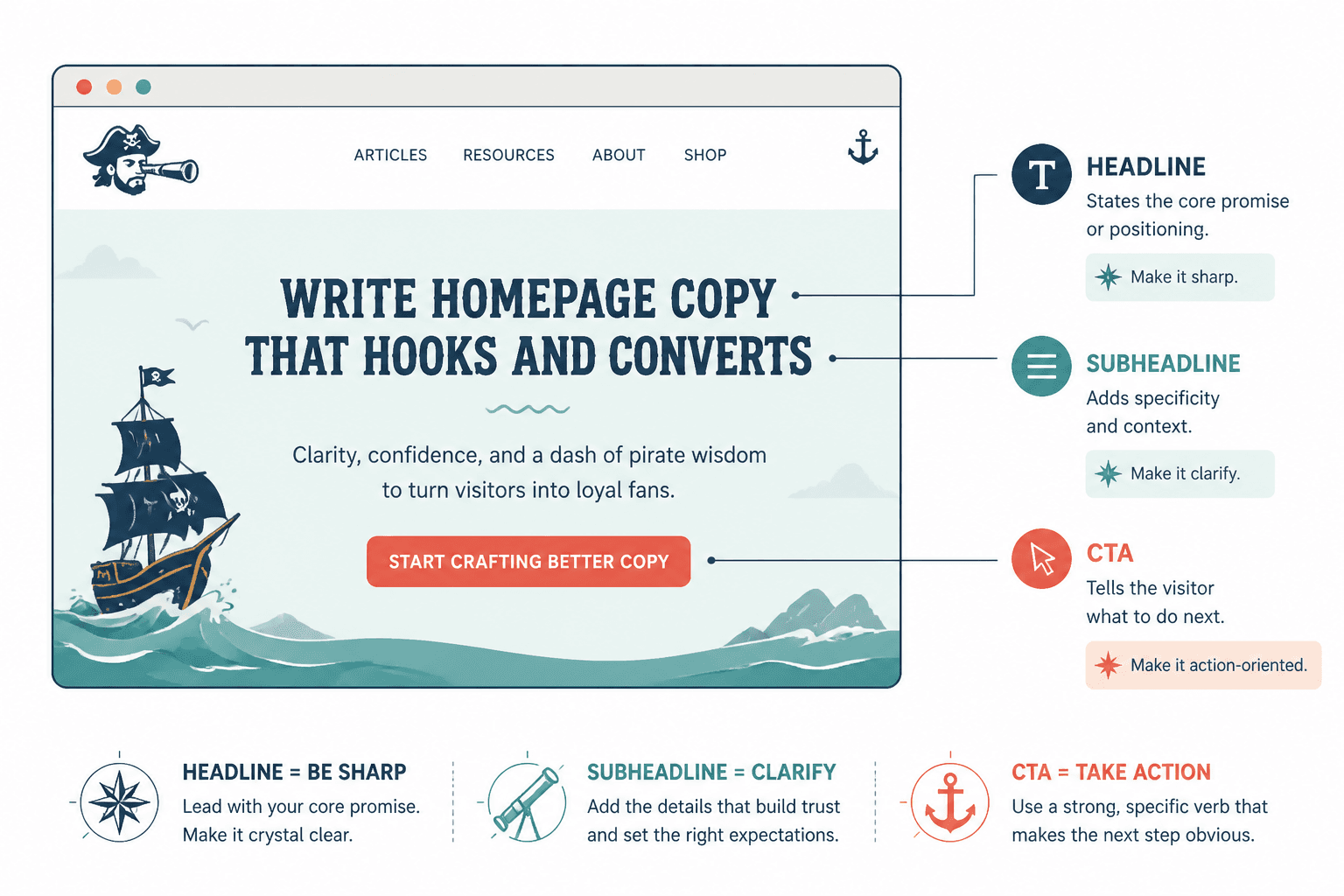
A clean homepage opening often works like this:
- Headline: sharp core promise
- Subheadline: a little more detail, context, or audience fit
- CTA: the next obvious action
For example:
Headline: Homepage copy that makes your offer easier to trust
Subheadline: For coaches, consultants, and service businesses tired of vague messaging, polite traffic, and weak inquiries.
CTA: See how I write homepage copy
That is much stronger than stuffing all of it into one dramatic sentence and hoping for the best.
If your opening still feels weak, this piece on how to start homepage copy without a weak opening will help you tighten the first impression fast.
Common homepage hook mistakes that make you sound like everyone else
Leading with your values instead of your value
“Honest marketing.” “Human-centered design.” “Authentic storytelling.” Fine qualities. Not enough on their own.
Values can support the message, but they rarely work as the message.
Trying too hard to sound premium
Some homepage hooks sound like they are wearing a blazer indoors. Everything is elevated, bespoke, refined, intentional, transformative. Meanwhile the reader still has no idea what is being sold.
Premium does not come from fancy adjectives. It comes from clarity, confidence, and proof.
Using filler verbs
Words like empower, elevate, unlock, transform, support, and amplify often appear when the writer has not picked a sharper action yet.
Replace them with verbs people can picture:
- clarify
- rewrite
- position
- simplify
- book
- sell
- explain
- convert
- attract
Writing for approval instead of response
A lot of generic website copy exists because the writer wants it to sound “nice” to peers, collaborators, or former corporate colleagues. But homepage copy is not there to earn polite nods. It is there to move the right person forward.
That means being clearer than feels elegant sometimes. Good. Elegant confusion is still confusion.
If your whole page has this problem, not just the opening, read how to write homepage copy without sounding salesy or robotic. It tackles the broader voice issue.
How to test if your homepage hook is specific enough
Run your hook through these quick checks.
- Could a competitor in a different niche use this exact line? If yes, too generic.
- Would your ideal client understand it in five seconds? If no, too clever or too vague.
- Does it name a real result or real problem? If no, it probably sounds nice without saying much.
- Could a stranger tell what kind of business you are? If no, add more signal.
- Does it sound like something a human would actually say? If no, remove the brochure glaze.
You can also use a brutally simple test: hide your logo, show the homepage opening to someone who does not know your business, and ask, “What do you think this person helps with?” If they answer with confidence, you are getting somewhere. If they squint and say “branding?” in a tone of emotional guesswork, more work is needed.
A practical process to improve your current homepage hook
If you already have a homepage headline and it feels weak, do this.
The bigger point is simple: clearer structure and clearer writing make the piece more useful. That is usually what makes the ending land better too.