
Most About page openings fail for a very simple reason: they start by warming up instead of saying something useful.
You’ve seen them. “Hi, I’m Sarah, and I’m so glad you’re here.” Or: “Ever since I was young, I’ve had a passion for helping people.” Or the all-time beige classic: “Welcome to my little corner of the internet.”
None of that tells the reader why they should keep reading. It just announces that words are happening.
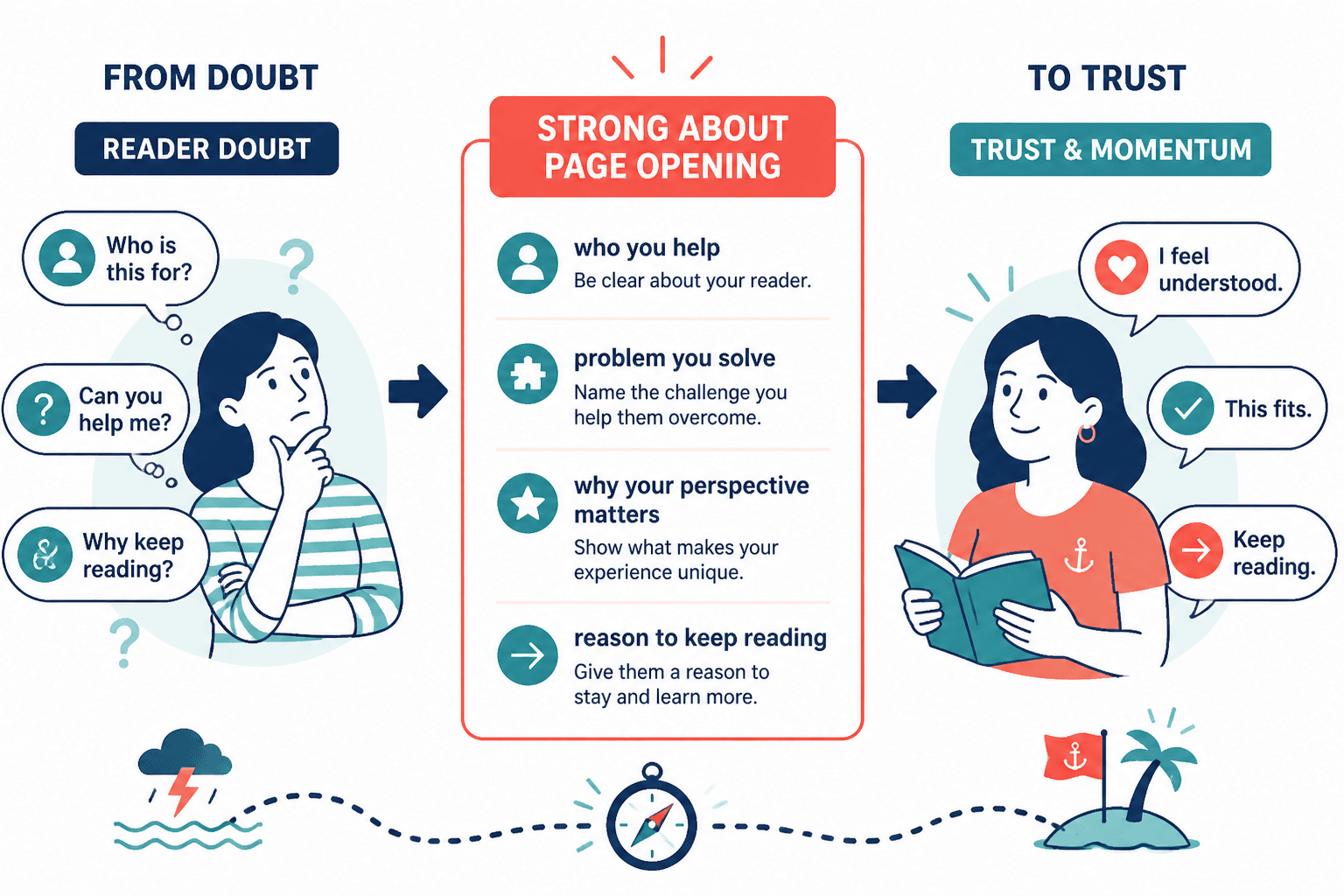
If you want to know how to start About page copy without a weak opening, the fix is not making it louder, longer, or more dramatic. It’s making it clearer. Your opening needs to quickly answer the silent question in your reader’s head: Is this person for me, and is this page worth my time?
This is where a lot of otherwise smart creators, consultants, coaches, and service providers lose people. They treat the About page like a personal introduction, when really it’s a trust page. Personal matters, yes. But relevance comes first.
Here’s how to open your About page in a way that feels human, sounds credible, and doesn’t collapse into vague autobiography by line three.
Want the broader roadmap? Start with the parent guide.
What a strong About page opening actually needs to do
Your About page opening is not there to tell your whole life story. It has a job. A very specific one.
It should help the right reader quickly understand:
- who you help
- what kind of problem you help solve
- what makes your perspective, process, or experience worth listening to
- why they should keep reading
That’s it. Not a TED Talk. Not a memoir opening. Not a dramatic fog machine.
A good opening earns attention by being relevant fast. It gives the page momentum. It creates the feeling of, “Okay, this person gets it,” which is much more useful than, “This person seems nice.” Nice is fine. Clear converts better.
If you’re still shaping the rest of the page, it helps to understand how About pages work as part of your broader website conversion copy and core website copy. The opening sets the tone for everything that follows.
Why weak About page openings keep happening
Weak openings usually come from one of three bad instincts.
1. Starting with politeness instead of substance
There’s nothing wrong with warmth. The problem is when warmth replaces clarity.
“I’m so glad you’re here” is pleasant, but it says nothing. Readers do not arrive on your About page hoping for manners. They want orientation. They want to know if your work fits their needs, goals, tastes, and problems.
2. Starting with yourself instead of the overlap
Yes, it is your About page. No, that does not mean the opening should begin with a generic biography line.
The best About page intros often start at the intersection of your work and their need. That overlap is where trust starts. If you begin too inwardly, the reader has to work too hard to figure out why any of it matters to them.
3. Mistaking vagueness for elegance
People get weirdly poetic on About pages. Suddenly they are “holding space for transformation” and “guiding purpose-driven visionaries toward aligned growth.” Which sounds important until you try to explain what it means to an actual person.
Specificity beats mystique. Every time.
How to start About page copy without a weak opening
If you want the simple version, here it is: open with a relevant truth, a clear positioning line, or a sharp statement of what you help with. Then build from there.
You do not need to cram everything into one sentence. But the first few lines should establish footing. Readers should know where they are, who this is for, and why your page is different from 8,000 other About pages written in soft-focus startup oatmeal.
A strong opening usually includes at least two of these four elements:
- Audience: who you work with
- Problem: what they need help solving
- Approach: how you think or work differently
- Credibility: why your perspective has weight
You do not need all four immediately, but you do need enough to create traction.
Five opening approaches that work better than “Hi, I’m…”
There is no single perfect formula, but there are opening styles that consistently work well because they orient the reader fast.
1. Start with who you help and what you help them do
This is the cleanest option for most service providers and personal brands.
I help B2B consultants turn vague expertise into clear website copy that earns trust and leads.
Why it works: the reader instantly understands the audience, the outcome, and the category of work.
This style is especially useful if your business depends on clarity more than personality-first branding. It is hard to go badly wrong with a direct opening like this.
2. Start with the problem your audience keeps running into
This works well when your readers are frustrated, skeptical, or tired of bad advice.
Most service businesses do not have an expertise problem. They have a messaging problem. Their work is solid. Their website just makes it harder to trust them.
Why it works: it creates recognition. It tells the reader you understand the gap between what they do well and what their current copy fails to communicate.
3. Start with a point of view
If your brand is built around a distinct perspective, say it early.
Your About page does not need to sound impressive. It needs to make the right people trust you faster.
Why it works: it gives the page personality and positioning at the same time. It is especially useful for copywriters, strategists, consultants, and creators whose thinking is part of the product.
4. Start with the change you help create
This is useful when outcomes are easier to understand than process.
I help experts turn messy ideas into clear offers, sharper messaging, and content that actually pulls business forward.
Why it works: it focuses on what improves for the client, not just what you call yourself.
5. Start with a concise credibility line
If your experience is a major reason people should trust you, lead with it. Just do not make it sound like an awards banquet introduction.
After years of helping founders, consultants, and creators tighten their messaging, one thing keeps showing up: smart people routinely hide their value behind weak copy.
Why it works: it combines credibility and insight instead of just listing credentials like fridge magnets.
What to avoid in your first three lines
If your opening keeps feeling flat, there is a decent chance one of these is sitting in it like a brick.
- Empty welcomes: “I’m so glad you’re here.”
- Generic passion lines: “I’ve always loved helping people.”
- Overblown mission language: “I empower visionaries to step into alignment.”
- Throat-clearing: “A little bit about me…”
- Random autobiography: details that do not connect to the reader yet
- Title soup: listing every role you have ever had instead of saying what you actually do now
The easiest way to test an opening is this: if you removed your name, would the line still help the reader understand what this page is about? If not, it probably needs work.
Before-and-after rewrites
Sometimes the fastest way to improve an About page opening is to see weak copy turned into something sturdier.
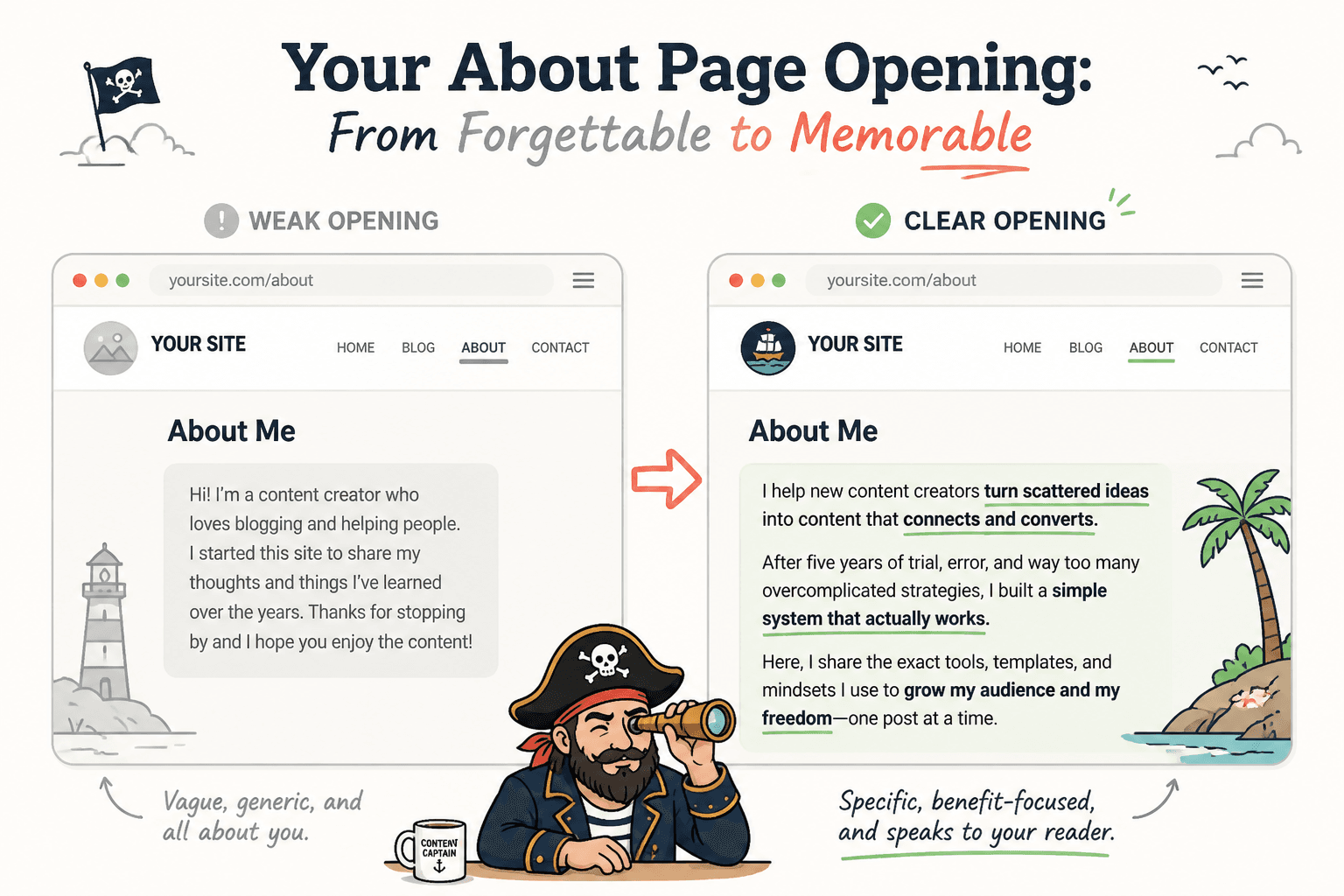
| Weak opening | Stronger rewrite |
|---|---|
| Hi, I’m Jenna, and welcome to my website. | I help small service businesses turn unclear messaging into website copy that feels sharper, more credible, and easier to trust. |
| Ever since I was young, I’ve had a passion for storytelling and helping others succeed. | Good storytelling is not fluff. It is often the difference between a brand people skim and one they remember. |
| I’m a coach, speaker, consultant, creator, and entrepreneur with a heart for impact. | I work with founders and experts who have strong ideas but weak positioning, then help them say what they actually do in a way people understand. |
| I believe everyone has a unique journey and purpose. | If your About page sounds nice but says very little, trust drops fast. I help fix that. |
Notice what changed. The stronger versions are more specific. They create relevance faster. They stop trying to sound profound and start trying to be useful.
For more practical models, see these About page opening examples creators can adapt fast.
A simple framework for writing your opening
If you want a repeatable way to write a better opening, use this:
- Start with the reader’s problem, goal, or context.
- Connect it to the work you do.
- Add a point of view or credibility cue.
- Lead naturally into the rest of the page.
Here’s what that can look like in practice:
Most About pages are trying too hard to sound polished and not hard enough to sound clear. I help creators and service businesses write copy that feels human, credible, and easy to trust—without sanding all the personality off in the process.
That opening works because it:
- names the problem
- positions the writer
- suggests a specific benefit
- sets up the voice of the page
You can also follow it with a short paragraph that transitions into your story, method, or background. That part matters. Strong openings are not isolated lines. They are the front edge of a sequence.
If the rest of your page tends to drift into generic personal story territory, this guide on improving About page story arcs without sounding generic will help.
How personal should the opening be?
Personal is good. Self-absorbed is not. There is a difference.
Your opening can absolutely include personality, voice, even a bit of personal context. But it should not force the reader to wait through three sentimental paragraphs before they learn what you actually do.
A cleaner approach is this: start with relevance, then layer in personality. That order matters.
For example, instead of opening with your life story, you might open with your perspective on the problem you solve, then use the next section to explain why that perspective exists. That way, your story earns its place. It is connected to the reader’s interest instead of asking for attention upfront just because it is your page.
This is one of the biggest differences between strong and weak About pages. The strong ones understand that personal details are supporting evidence, not the opening act by default.
Three About page opening templates you can adapt
Template 1: Direct and clear
I help [specific audience] do [specific outcome] without [common frustration or obstacle].
Example:
I help expert-led businesses write clearer About pages without sounding stiff, generic, or weirdly self-important.
Template 2: Problem-first
[Common problem] is usually not caused by [wrong assumption]. It is caused by [real issue].
Example:
A weak About page is usually not a design problem. It is a clarity problem. If the opening is vague, the rest of the page has to work much harder than it should.
Template 3: Point-of-view opening
[Contrarian or useful belief]. I help [audience] turn that into [outcome].
Example:
Your About page does not need a dramatic founder story to work. It needs a clearer opening. I help service brands write pages that build trust before the reader gets bored or confused.
Use these as scaffolding, not permanent furniture. The goal is not to sound templated. It is to stop defaulting to weak openings that make readers do all the interpretive labor themselves.
How your opening should connect to the rest of the page
A strong opening is not just a nice first line. It sets up the whole page.
Once you open clearly, the next sections should support and deepen that first impression. Usually that means moving into some mix of:
- a short explanation of what you do and who it is for
- a relevant backstory or perspective
- proof, experience, or credibility markers
- your approach or values
- a soft next step or CTA
If the opening says one thing and the rest of the page wanders off into unrelated memoir fragments, the page still feels weak. The intro cannot save a page with no structure.
That is why it helps to think of the About page as one coherent trust-building sequence. If you need help tightening the whole thing, start with how to write better About page copy, then review the broader About page copy guidance here.
If you want warmth, add it after clarity
About pages work better when they build trust with clarity instead of biography theater. A stronger through-line usually matters more than extra detail.
About pages work better when they build trust with clarity instead of biography theater. A stronger through-line usually matters more than extra detail.