
Most About pages do one of two annoying things.
They either read like a résumé in paragraph form, or they get so busy trying to sound warm and inspiring that they forget to answer the one question every visitor has: why should I trust you?
That is where credibility blocks come in. Not as chest-thumping. Not as “featured in” wallpaper slapped on top of thin copy. Just clear, useful proof placed in the right spots so your About page does not feel like a polite fiction.
If you want Simple About Page Credibility Block Templates for Busy Creators, the job is not to make your page feel more impressive. It is to make it easier for the right person to believe you are legit, relevant, and worth the next click.
This article will help you do exactly that. You will get practical credibility block types, where to place them, what to write, and plug-and-play templates you can adapt without spending half your week staring at your own bio like it owes you money.
For the broader learning path, visit our parent guide.
What a credibility block actually is
A credibility block is a short section on your About page that gives the reader a reason to trust your claims.
That proof can be:
- experience
- results
- specific clients or audiences served
- recognisable features or credentials
- testimonials
- numbers with context
- a clear working method
- a believable origin story tied to expertise
The important bit is this: credibility is not just “look how accomplished I am.” Good credibility says, here is why I can help someone like you with this specific problem.
That means a useful credibility block is relevant. A random award from 2016 that has nothing to do with your offer is decoration. A short line showing you helped 40 consultants simplify their messaging is actual proof.
Strong About page credibility is less about status and more about removing doubt.
Why most About pages still feel unconvincing
Because they make the reader work too hard.
The page says things like “I’m passionate about helping people shine” or “I’ve always loved storytelling” or “I take a holistic approach.” Fine. Lovely. None of that tells me whether you are experienced, effective, or a fit.
Busy creators often know they need more proof, but then they overcorrect and dump everything onto the page: every podcast appearance, every credential, every role, every brand logo, every personal turning point since age 14. Now the page has proof, technically, but no shape.
A smarter About page uses a few well-placed credibility blocks that support the page’s main job: move the visitor from mild curiosity to clear trust.
If you need the bigger About page structure around those proof sections, this About page copy guide for creators who want better results will help. And if you want a broader library of supporting sections, this roundup of best templates and tools for About page copy is worth bookmarking.
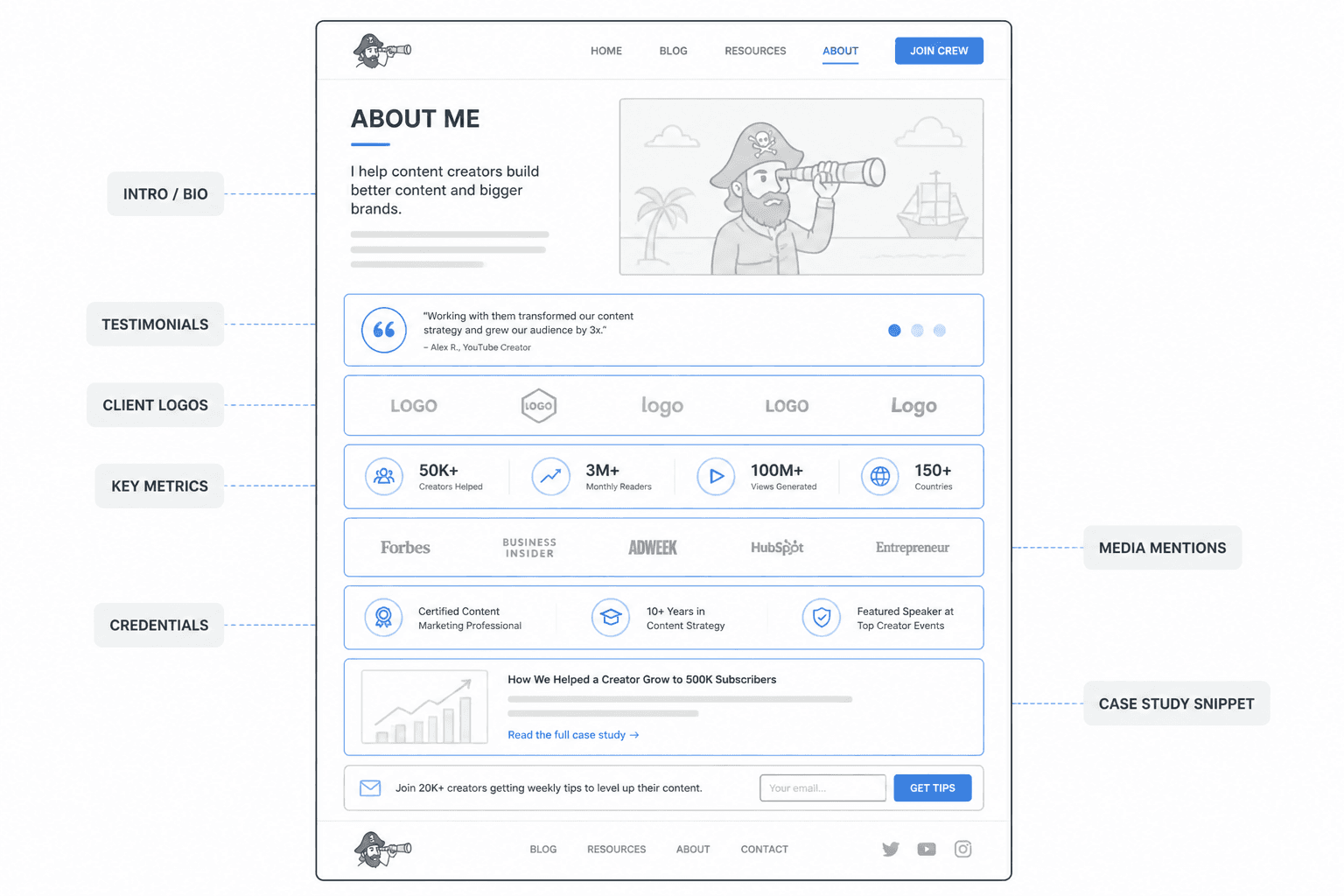
The 7 best credibility blocks for busy creators
You do not need all seven. Two to four is often enough. The right mix depends on your experience, audience, and offer.
1. The specific experience block
This is the cleanest way to establish that you have done the work, not just posted about the work.
Use it when you have years of experience, repeated client work, or strong niche familiarity.
Template:
Over the past [time period], I’ve helped [specific audience] do [specific outcome] through [service, process, or area of expertise].
Example:
Over the past 5 years, I’ve helped coaches, consultants, and solo founders simplify their messaging, sharpen their website copy, and turn confused visitors into better-fit leads.
What makes this work is specificity. “Helped businesses grow” is mush. “Helped 60 B2B consultants clarify their positioning and website messaging” is believable.
2. The audience-fit block
Sometimes the strongest credibility signal is not a huge number. It is showing that you deeply understand a particular kind of client.
This works especially well for creators with smaller audiences or less flashy credentials. Relevance beats vague prestige more often than people think.
Template:
My work is built for [specific audience] who are tired of [common frustration] and want [clear result] without [undesired approach].
Example:
My work is built for creators with solid expertise and messy messaging who are tired of sounding generic online and want copy that feels clear, credible, and actually like them.
That is a credibility move because it shows positioning. And positioning is proof of thought, not just proof of existence.
3. The proof-by-results block
If you have results, use them. Just do not spray random numbers around like confetti and expect them to do all the work.
Numbers need context. “Generated 2M views” can mean almost anything. “Helped clients improve lead quality after rewriting service and About pages” is often more persuasive, even if the number is smaller.
Template:
Clients have used this work to [result 1], [result 2], and [result 3].
Example:
Clients have used this work to clarify their offers, improve inquiry quality, shorten sales conversations, and publish content that sounds like a human instead of a pitch deck with Wi-Fi.
Notice that not every result needs to be numeric. Concrete business outcomes still count.
4. The recognisable proof block
This is where you mention publications, clients, platforms, credentials, certifications, or notable appearances. Useful, yes. But only if they support the thing you want to be hired for.
Template:
My work has been featured in [publication/platform], and I’ve worked with [type of clients or notable names] across [industry or scope].
Example:
My work has been featured in industry publications, and I’ve supported coaches, consultants, and service brands across personal branding, messaging, and website conversion copy.
If your recognisable proof is thin, do not stretch it into a whole parade. Keep it short and pair it with more grounded proof, like testimonials or methodology.
5. The mini-testimonial block
A few well-chosen lines from clients can do more than a giant wall of praise. The best About page testimonials are short, specific, and close to the claims you are making in the copy.
Template structure:
- One line about the problem or hesitation
- One line about the result or shift
- Name, role, or level of identification if appropriate
Example:
“I knew my site was underselling what I do, but I could not see where. After the rewrite, the messaging felt sharper immediately, and inquiries got noticeably more aligned.”
— Business coach
Short beats bloated here. Nobody needs a testimonial that reads like a hostage note written at conference length.
6. The method block
This one is underrated. A clear method creates credibility because it signals that your work is not random instinct and vibes.
You do not need some trademarked five-phase framework with suspiciously capitalised words. You just need a process clear enough that a reader thinks, okay, this person has done this before.
Template:
My approach focuses on [step 1], [step 2], and [step 3] so your [asset/content/page] is not just polished, but clearer, more useful, and easier to trust.
Example:
My approach focuses on audience clarity, sharper positioning, and conversion-aware messaging so your About page does not just sound nicer. It actually helps people understand why they should stick around.
7. The grounded personal story block
Yes, your About page can be personal. No, it should not read like a dramatic memoir if the visitor just wants to know if you can help them.
The best personal story blocks connect your background to your current expertise. They show how your perspective was formed. They do not wander around hoping emotional sincerity will count as authority.
Template:
After years of [relevant experience or frustration], I noticed [important insight]. That shaped how I now help [audience] do [specific outcome] with more clarity and less wasted effort.
Example:
After years of watching smart service businesses bury their best work under vague copy, I noticed the problem usually was not expertise. It was translation. That is what shaped how I now help creators and consultants turn scattered ideas into sharper pages that actually build trust.
Where to place credibility blocks on your About page
Placement matters. The same proof can feel strong or awkward depending on where it shows up.
A simple About page flow often looks like this:
- Clear opening: who you help and what you help with
- Short positioning or perspective section
- Credibility block
- Brief story or method section
- Another credibility block if useful
- CTA
That structure works because it answers the visitor’s questions in the right order:
- Am I in the right place?
- Does this person understand what I need?
- Can I trust them?
- How do they work?
- What should I do next?
If your About page is currently all story and no proof, add a credibility block after the opening. If it is all credentials and no warmth, add a brief personal or methodological section between proof and CTA so the page does not feel like a corporate plaque.
For more examples of how different creators handle this balance, see these About page copy examples for coaches, consultants, and personal brands.
Simple About Page Credibility Block Templates for Busy Creators
Here are plug-and-play versions you can lift, tweak, and use.
Template 1: The clean expert block
I help [specific audience] [specific result]. Over the past [time period], I’ve worked with [audience/client type] on [service or expertise area], with a focus on [key strengths or outcomes].
Filled example:
I help service-based creators clarify their message and improve website conversion. Over the past 4 years, I’ve worked with coaches, consultants, and solo business owners on positioning, About pages, and conversion-focused website copy.
Template 2: The proof-without-bragging block
This work has helped clients [result], [result], and [result]. I care less about sounding impressive and more about making sure the right people quickly understand what makes your work worth paying for.
This works well if you want to sound credible without drifting into puffed-up “authority” copy.
Template 3: The small-audience credibility block
I may not be the loudest name in [industry], but my work is built for [specific audience] who need [specific result]. I focus on [strength 1], [strength 2], and [strength 3] so your message is clearer, more credible, and easier to act on.
This is especially useful if you are still building visibility. You do not need fake scale. You need useful specificity. If that is your situation, this guide on About page copy for creators with small audiences will help you avoid trying to cosplay as a bigger brand.
Template 4: The method credibility block
My process is simple: [step 1], [step 2], and [step 3]. That means you do not get vague advice or copy that sounds polished but empty. You get messaging built to make sense to real people.
Template 5: The credibility + CTA block
I’ve helped [audience] with [specific work], and if you want your own [page/profile/message] to feel clearer and more convincing, start here: [CTA].
This one is handy near the end of the page when you want to connect proof to next action without making the CTA feel abrupt.
What to include in a credibility block and what to leave out
| Include | Leave out |
|---|---|
| Specific audience served | Vague “helping people thrive” language |
| Relevant experience | Every job you have ever had |
| Clear results or outcomes | Big numbers with no context |
| Short testimonials with substance | Long testimonials full of generic praise |
| A recognisable credential if relevant | Irrelevant badges and logo clutter |
| A simple method or approach | Overbuilt frameworks with no explanation |
| Proof that supports your offer | Random achievements that do not connect |
If you are choosing between sounding impressive and sounding useful, choose useful. Every time.
Quick rewrites: weak credibility copy vs better credibility copy
Weak
About pages work better when they build trust with clarity instead of biography theater. A stronger through-line usually matters more than extra detail.
About pages work better when they build trust with clarity instead of biography theater. A stronger through-line usually matters more than extra detail.