
Most About pages are trying so hard to sound credible that they forget to be useful.
You get a polished founder story, a few foggy claims about passion and purpose, and maybe a headshot next to a paragraph that reads like it was approved by a committee of beige blazers. Meanwhile, the reader still does not know who the site is for, what makes this person worth trusting, or what to do next.
That is why the best templates and tools for About page copy are not the ones that help you sound more impressive. They are the ones that help you get clearer, sharper, and easier to trust.
If you are building your About page from scratch or fixing one that feels limp, generic, or suspiciously AI-polished, this guide will help you choose templates that actually structure the page well and tools that make the writing process faster without turning it into oatmeal. If you need broader context first, start with the main About page copy guide.
For the broader learning path, visit our parent guide.
What a good About page template actually needs to do
An About page template is not just a fill-in-the-blanks document with a few prompts like “tell your story” and “share your mission.” That is how people end up writing 600 words about their childhood, their coffee habits, and the exact moment they discovered they loved helping people thrive.
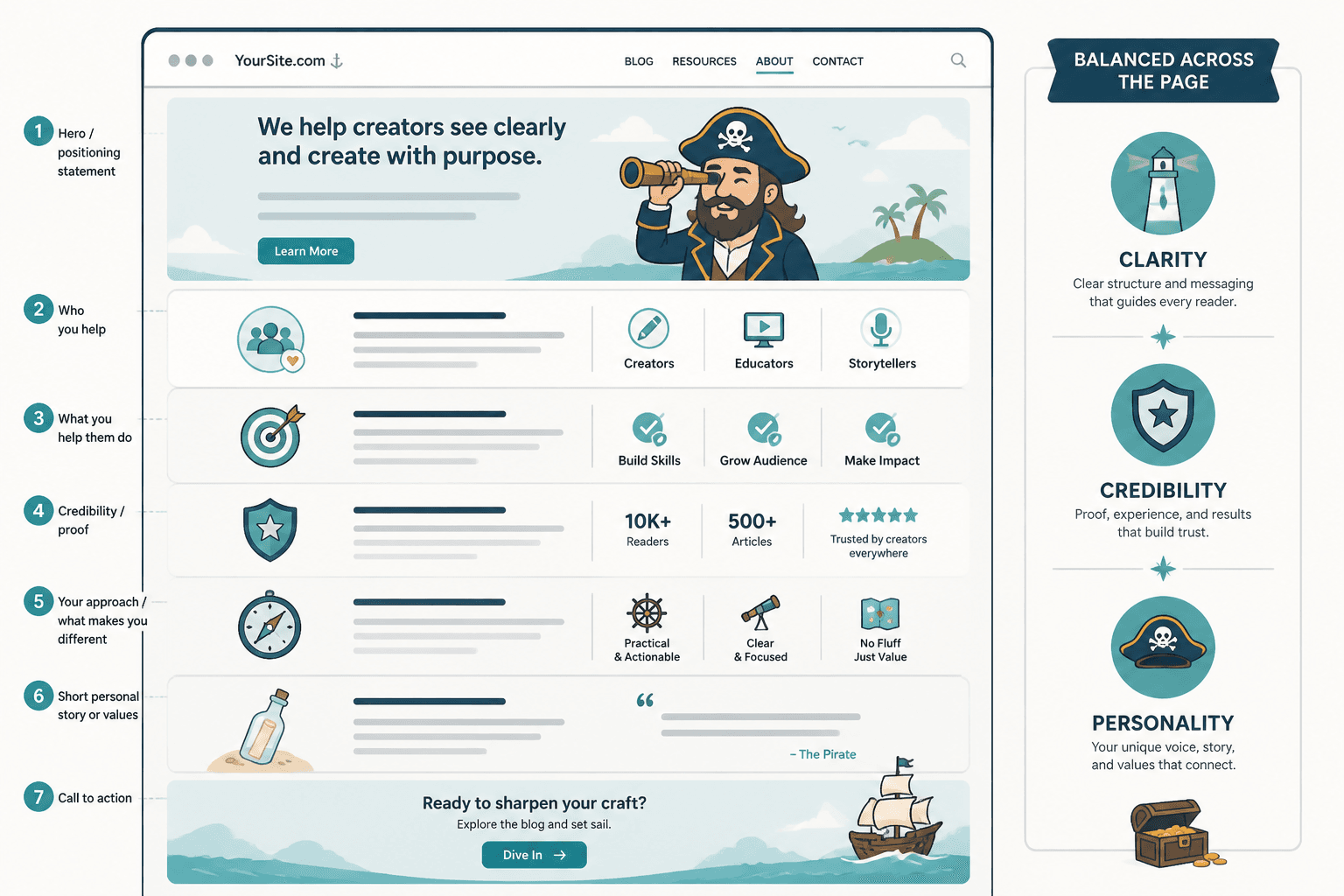
A useful template should help you answer the questions a real reader has when they land on your page. Usually those questions are brutally practical:
- Who are you?
- Who do you help?
- What do you help them do?
- Why should I trust you?
- What makes your approach different or relevant?
- What should I do next?
That is the bar. Not “did this sound heartfelt enough.”
The best About page copy tends to balance three things at once: clarity, credibility, and personality. Most pages overdo one and ignore the others. You get charming but vague. Or authoritative but robotic. Or personal but wildly self-indulgent. A solid template keeps the page from tipping into any of those ditches.
The best About page templates to use
You do not need 27 sections. You need a structure that matches your business model, trust level, and how your readers decide.
1. The clear personal brand template
Best for coaches, consultants, freelancers, solo founders, creators, and service businesses where you are a big part of the value.
- Opening positioning statement
Say who you help, what you help them do, and how. - Short credibility snapshot
Include experience, results, notable work, audience size if relevant, or a sharp proof point. - Your approach
Explain how you think, work, or solve the problem differently. - Brief background
Give enough story to make the page human, not enough to qualify as memoir. - Credibility block
Client results, features, testimonials, media mentions, case-study snippets, or specific outcomes. - Call to action
Book, browse offers, read a guide, join your list, or get in touch.
This is the safest and most useful template for most personal brands. It gives readers context without making them work too hard.
2. The expert-led business template
Best for agencies, boutique firms, and service businesses where the brand matters more than the founder personality, but expertise still drives trust.
- Brand-level positioning
- What you believe and how you work
- Who the service is built for
- Team or founder credibility
- Proof and outcomes
- Next-step CTA
This one works well when readers want reassurance that the business is not just one charismatic person with a Canva logo and a scheduling link.
3. The story-led template
Best for brands with a meaningful origin story, a strong philosophy, or an audience that buys partly because they connect with the person behind the work.
The trap here is obvious: too much story, not enough relevance.
- Start with present-day relevance
What you do now and who you do it for. - Tell the origin story briefly
Only include details that explain your perspective, values, or method. - Connect the story to the reader’s problem
- Show how that shaped your work
- Add proof
- End with a clear invitation
Story earns attention when it creates meaning. It loses attention when it becomes autobiography with a booking button taped on at the end.
4. The credibility-first template
Best for higher-ticket consultants, strategists, specialists, and anyone whose audience is skeptical and wants evidence before personality.
- Strong positioning headline
- Specific proof points
- What you help with
- How you think or work
- Short personal section
- CTA
This template works because it respects the reader’s time. Some audiences do not want your life story first. They want to know if you are good.
If you want examples of how these structures can sound in practice, the best companion read is best About page copy ideas and examples for creators.
Simple About page copy templates you can actually use
Below are practical templates. Not magical formulas. You will still need judgment, but at least you will not be starting from a blank screen and bad instincts.
Opening positioning template
I help [specific audience] do [specific outcome] through [service, approach, or expertise].
Example:
I help consultants and service-based founders turn vague website copy into sharper messaging that earns trust and drives better inquiries.
If your page currently opens with “Hi, I’m Sarah, and I’m so glad you’re here,” that is not fatal. It is just not doing enough work.
Credibility snapshot template
Over the past [timeframe], I’ve helped [audience] achieve [result], with work featured in [proof] or trusted by [type of clients].
Example:
Over the past five years, I’ve helped coaches, consultants, and creative businesses clarify their websites, tighten their offers, and turn more of the right visitors into leads.
Approach section template
My approach is simple: [principle 1], [principle 2], and [principle 3]. That means [practical implication for the client].
Example:
My approach is simple: clear positioning, honest copy, and enough proof to make trust easier. That means no inflated claims, no motivational fog, and no site copy that sounds like it came free with a funnel template.
Short founder story template
I started this work after noticing that [problem]. Too many [audience] were [mistake or frustration], even though they were genuinely good at what they did. I wanted to help them [better outcome].
That gives context without drifting into “ever since I was young, words have been my passion.”
CTA template
If you want [specific result], start here: [next step].
Example:
If you want a clearer About page that sounds like a real expert instead of a polished blur, start by exploring my copy services or getting in touch.
For stronger proof sections, you will probably want simple About page copy credibility blocks templates for busy creators. That part is where a lot of pages quietly fall apart.
The best tools for About page copy
Tools should help you think, organize, draft, and refine. They should not be expected to manufacture clarity out of thin air. If your positioning is muddy, no app is going to descend from the cloud and fix your business model.
Still, the right tools can save a lot of time.
1. Copy planning tools
These are useful before you write a single line. Think documents, whiteboards, research sheets, message maps, client-voice notes, and page planning frameworks.
Good for:
- Clarifying audience and goals
- Collecting phrases from testimonials or client calls
- Structuring sections before drafting
- Mapping proof, offers, and CTAs
If your current process is “open doc, panic softly, type random biography,” start with planning tools first. They solve more problems than most writing assistants.
For more on that side of the workflow, see best website tools and copy planning tools for About page copy.
2. AI drafting tools
Useful? Yes. Dangerous? Also yes, if you let them flatten your voice into generic consultant soup.
AI tools are good for:
- Generating rough section options
- Turning notes into first drafts
- Offering headline variations
- Condensing rambling text
- Helping you find missing logic or repetition
They are not good for:
- Creating actual positioning if you have not defined it
- Knowing which proof matters most
- Writing with taste by default
- Sounding like you without guidance
- Making weak business claims believable
A lot of people use AI to avoid thinking. Then they wonder why the page sounds like every other page. Tragic, but not mysterious.
If AI is part of your process, pair it with clear prompts, your own source material, and a ruthless editing pass. This article on best AI tools for About page copy goes deeper on how to use them without producing shiny nonsense.
3. Readability and editing tools
These help after drafting. They are useful for cutting bloat, checking flow, improving scannability, and spotting sentences that sound like they were inflated with helium.
Look for tools or workflows that help you:
- Shorten long sentences
- Remove repeated claims
- Tighten vague openings
- Improve rhythm and paragraph length
- Make CTAs more direct
Just remember that readability is not the same as personality. A page can be “easy to read” and still completely forgettable.
4. Voice and brand reference docs
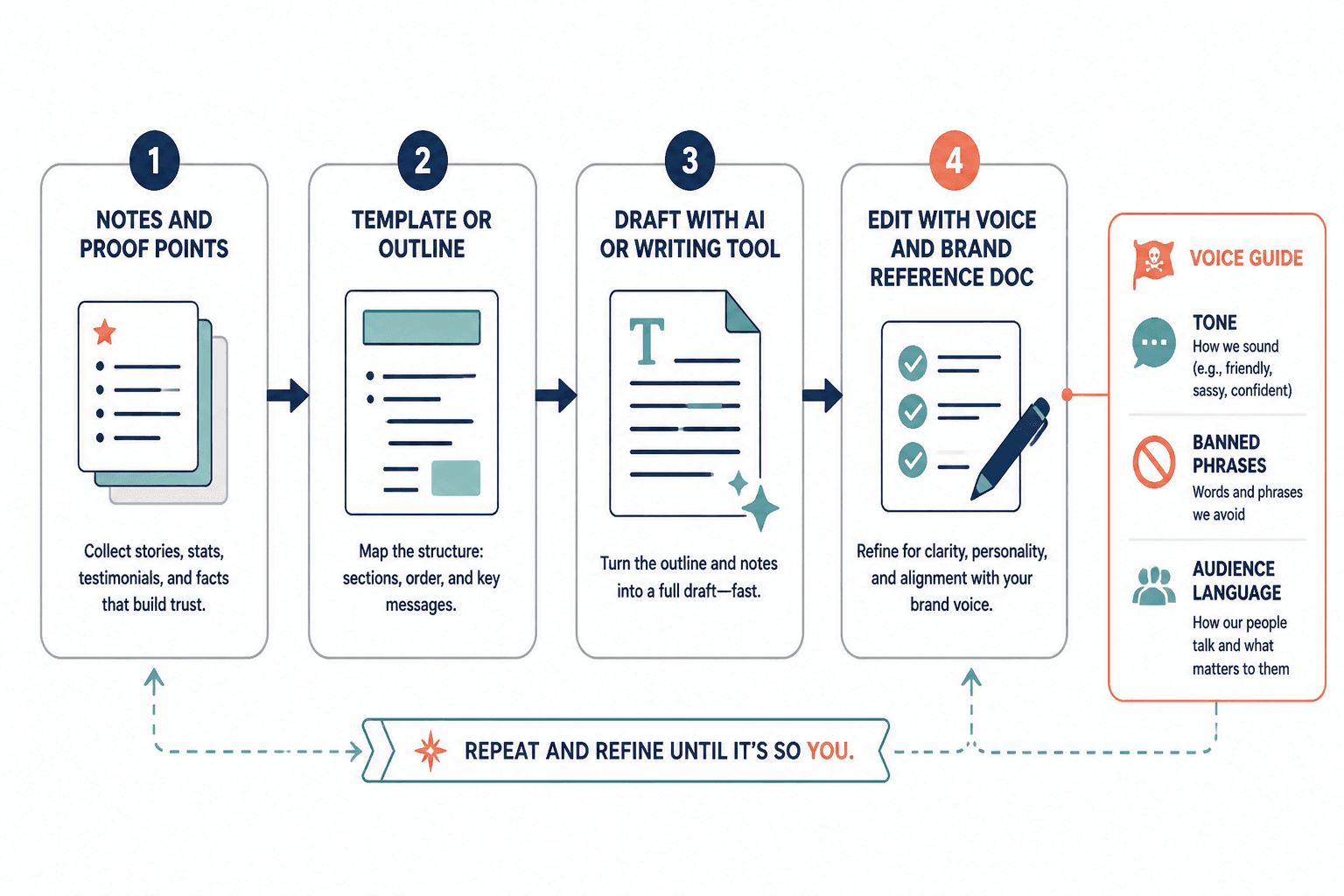
This is less glamorous, but honestly more useful than half the tools people keep recommending. A voice doc with examples of your tone, banned phrases, preferred sentence style, audience language, and proof points can keep your About page from drifting into fake-professional mode.
This matters even more if multiple people touch the copy or if you are using AI in the process. Otherwise the page starts as “friendly expert” and ends somewhere near “enterprise thought leader with a mindfulness newsletter.”
How to choose the right template and tool combo
The best templates and tools for About page copy depend on what kind of business you have and where your bottleneck is.
| If your problem is… | Use this template | Use these tools |
|---|---|---|
| You do not know what sections to include | Clear personal brand template | Page outline or copy planning tool |
| Your page sounds vague | Credibility-first template | Client-voice notes, testimonial bank, editing tool |
| Your page is too stiff | Story-led template | Voice reference doc, manual editing pass |
| You ramble when writing about yourself | Expert-led business template | Structured prompts, AI summarizing tool, ruthless trim |
| You have ideas but no draft | Any strong sectioned template | AI drafting tool plus planning notes |
If you are not sure where to start, do this:
- Pick the simplest template that fits your business model.
- Gather your proof before writing.
- Map your sections in a planning doc.
- Draft fast.
- Edit for clarity, credibility, and personality.
- Make sure the CTA is obvious.
That process is boring compared to “use this secret prompt to write your entire website in 8 minutes,” but it works much better in the real world, which is annoying but consistent.
Common mistakes when using About page templates and tools
Using a template too literally
Templates are scaffolding, not commandments. If the page reads like you filled in labeled boxes, readers can tell.
Letting AI write the most important parts cold
Your positioning, proof, and CTA should come from your actual business. AI can help shape them, but it should not invent them. That is how you end up sounding polished and unconvincing at the same time.
Writing too much story and too little relevance
Your About page is not a diary with better typography. Story only works when it helps the reader understand why you are the right fit.
Using proof that says nothing
“Trusted by amazing clients” is not proof. Neither is “years of experience” without context. Specificity does the work.
No clear next step
A surprising number of About pages just… end. After all that effort, the visitor gets no direction. Add the CTA. You are allowed.
For broader support across this topic cluster, you can also browse the website conversion copy resources.
A simple workflow for writing your About page faster
About pages work better when they build trust with clarity instead of biography theater. A stronger through-line usually matters more than extra detail.
About pages work better when they build trust with clarity instead of biography theater. A stronger through-line usually matters more than extra detail.