
Most weak blog titles are not failing because they are too short, too long, or not “SEO enough.” They fail because they sound like they were written by someone trying very hard to be acceptable.
Safe titles get ignored. Vague titles get skipped. Clever-but-empty titles make you feel smart for six seconds and then do absolutely nothing for clicks, trust, or search.
If you run a personal brand, this matters more than people admit. Your title is not just a label. It is positioning. It tells readers whether you are clear, useful, specific, and worth their time. Or whether you write posts with all the flavor of recycled webinar slides.
This guide will help you make better weak blog title fixes for personal brands by showing you what weak titles usually get wrong, how to rewrite them without sounding like a clickbait goblin, and how to create titles that pull in the right readers instead of polite drive-bys.
If your current titles sound broad, bland, generic, or like they were assembled from a box of business words, good. That is fixable.
To see how this fits into the wider strategy, open the parent guide.
Why personal brand blog titles go weak so fast
Personal brands tend to write weak titles for one of three reasons.
- They try to sound professional, so they drain out all specificity.
- They try to sound smart, so they hide the actual benefit.
- They try to rank, so they stuff in keywords and end up with a title no human would choose to read.
The result is usually some version of this:
Content Strategy Tips for Entrepreneurs
Technically fine. Practically useless.
It does not tell me what kind of tips, what kind of entrepreneurs, what problem gets solved, how specific the article is, or why I should care now. It just sits there like an unloved conference handout.
Strong titles do not need to be loud. They need to be clear, relevant, and a little sharper than the sea of generic sludge around them.
What a strong blog title actually needs
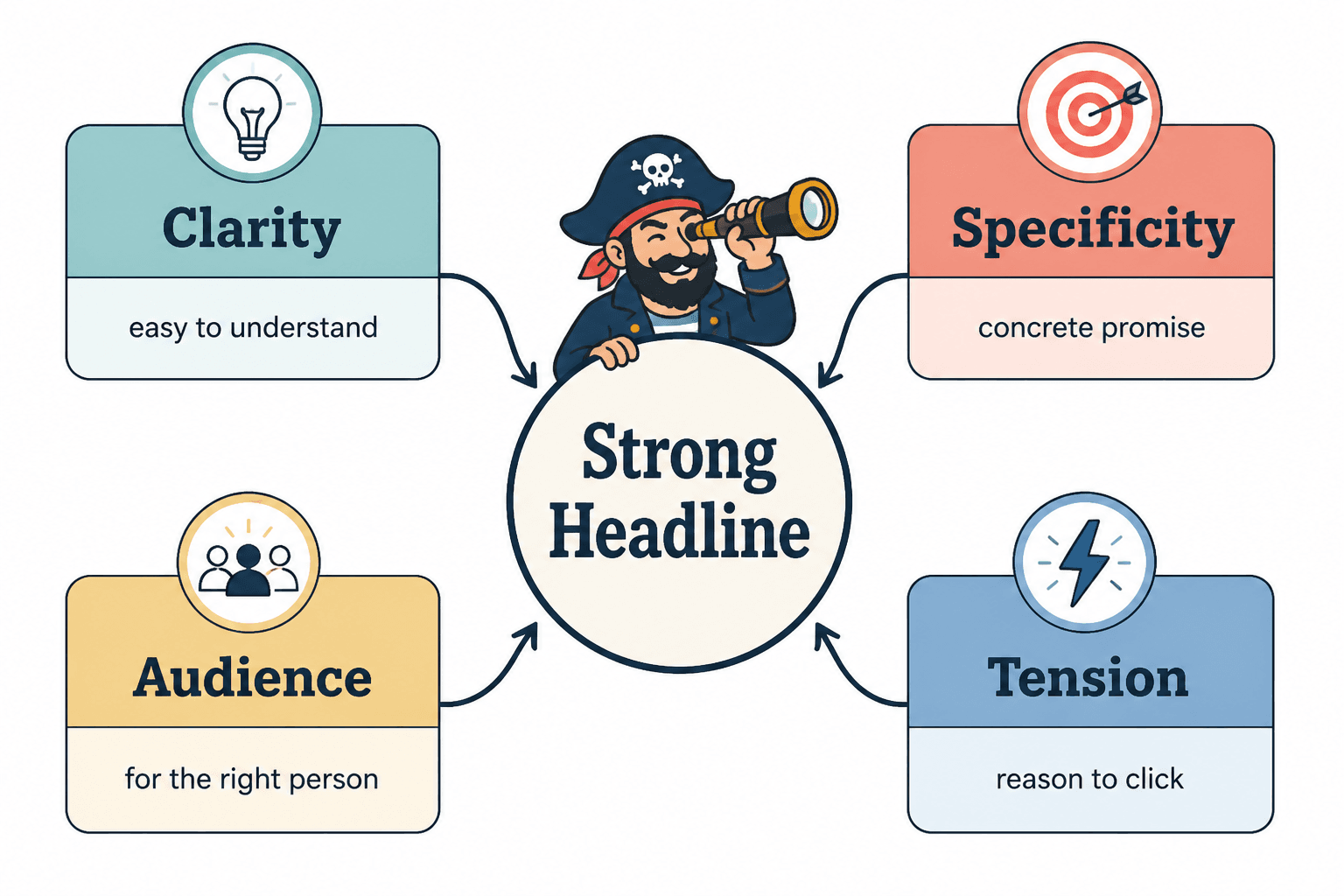
A good title usually does at least two of these four things:
- Names the topic clearly
- Signals a specific outcome
- Targets a particular reader
- Creates useful tension or contrast
You do not need all four every time. But if your title has none of them, it is probably weak.
Compare these:
| Weak | Better |
|---|---|
| Personal Branding Tips | Personal Branding Tips That Make You Easier to Trust, Not Just Easier to Notice |
| How to Write Better Blogs | How to Write Blog Posts That Sound Like You and Still Pull in Leads |
| Marketing Lessons for Coaches | 7 Marketing Lessons Coaches Learn After Posting Good Content to the Wrong Audience |
| Headline Writing Guide | How to Write Blog Headlines People Actually Want to Click |
The stronger versions are not “better” because they are longer. They are better because they do more work.
That is the whole game, really. Your title has one job: earn the next click from the right person. Not impress other writers. Not sound premium. Not gently hover over the page like a branded fog machine.
The 7 most common weak title patterns
If you want better blog titles and headlines, it helps to know the repeat offenders. Weak titles are usually weak in familiar ways.
1. The vague umbrella title
Example: Tips for Better Content
This is too broad to feel useful. Better content for what? Blog posts? LinkedIn? Sales pages? Better in what way? More readable? More persuasive? More shareable?
Fix: Narrow the promise.
- Tips for Better Blog Intros That Do Not Lose the Reader in Line One
- How to Write Better Content When You Know Too Much and Explain Too Little
- 5 Simple Ways to Make Your Content Clearer Without Dumbing It Down
2. The keyword pile-up
Example: Best Blog Titles and Headlines for SEO Content Writing Personal Branding
This is what happens when search intent gets treated like a hostage situation. Yes, keywords matter. No, you do not need to cram them in like socks in an overpacked suitcase.
Fix: Keep the core phrase, then make it readable.
- Better Blog Titles and Headlines for Personal Brands
- How Personal Brands Can Write Better Blog Titles Without Sounding Generic
- Blog Title Fixes for Personal Brands That Want More Clicks and Better Fit Readers
3. The polished nothingburger
Example: Elevating Your Brand Through Thoughtful Content Strategy
This sounds expensive and says almost nothing. It is full of nice words with no grip.
Fix: Replace abstraction with an actual result.
- How to Use Blog Content to Build Trust Before You Pitch
- Why Your Blog Sounds Smart but Still Does Not Bring in Clients
- How to Make Your Content Strategy More Useful and Less Corporate
4. The title with no audience
Example: How to Improve Your Online Presence
For whom? A freelance designer? A B2B consultant? A coach with a newsletter? The broader you go, the weaker the pull gets.
Fix: Name the reader when it helps qualify the click.
- How Coaches Can Improve Their Online Presence Without Posting Every Day
- How Consultants Can Make Their Personal Brand Look More Credible in Search
- Online Presence Fixes for Personal Brands That Feel Invisible
5. The clever title that hides the topic
Example: Stop Whispering Into the Internet
A little intrigue is fine. Total mystery is not. If the reader cannot tell what the article is about, the title is performing for itself.
Fix: Pair the interesting phrase with a clear topic.
- Stop Whispering Into the Internet: How to Write Blog Titles With a Stronger Promise
- Your Headlines Are Too Polite: Blog Title Fixes for Personal Brands
- Why Smart Personal Brands Keep Publishing Titles Nobody Clicks
6. The weak “how to”
Example: How to Write Better Headlines
This one is not bad. It is just underpowered. Better than what? For who? With what angle? If your article is specific, the title should not act shy about it.
Fix: Add context, tension, or audience.
- How to Write Better Headlines for a Personal Brand Blog
- How to Write Better Headlines When Your Drafts Keep Sounding Generic
- How to Write Better Blog Headlines Without Sounding Clickbait-y
7. The title that promises a topic instead of an outcome
Example: A Guide to Blog Titles
Readers do not usually want “a guide.” They want a result. More clicks. Better fit traffic. Clearer positioning. Faster writing. Stronger authority. Your title should point at that.
Fix: Make the payoff visible.
- How to Write Blog Titles That Pull in the Right Readers
- Blog Title Fixes That Make Your Articles Easier to Click and Easier to Trust
- How to Stop Publishing Blog Titles That Sound Fine but Do Nothing
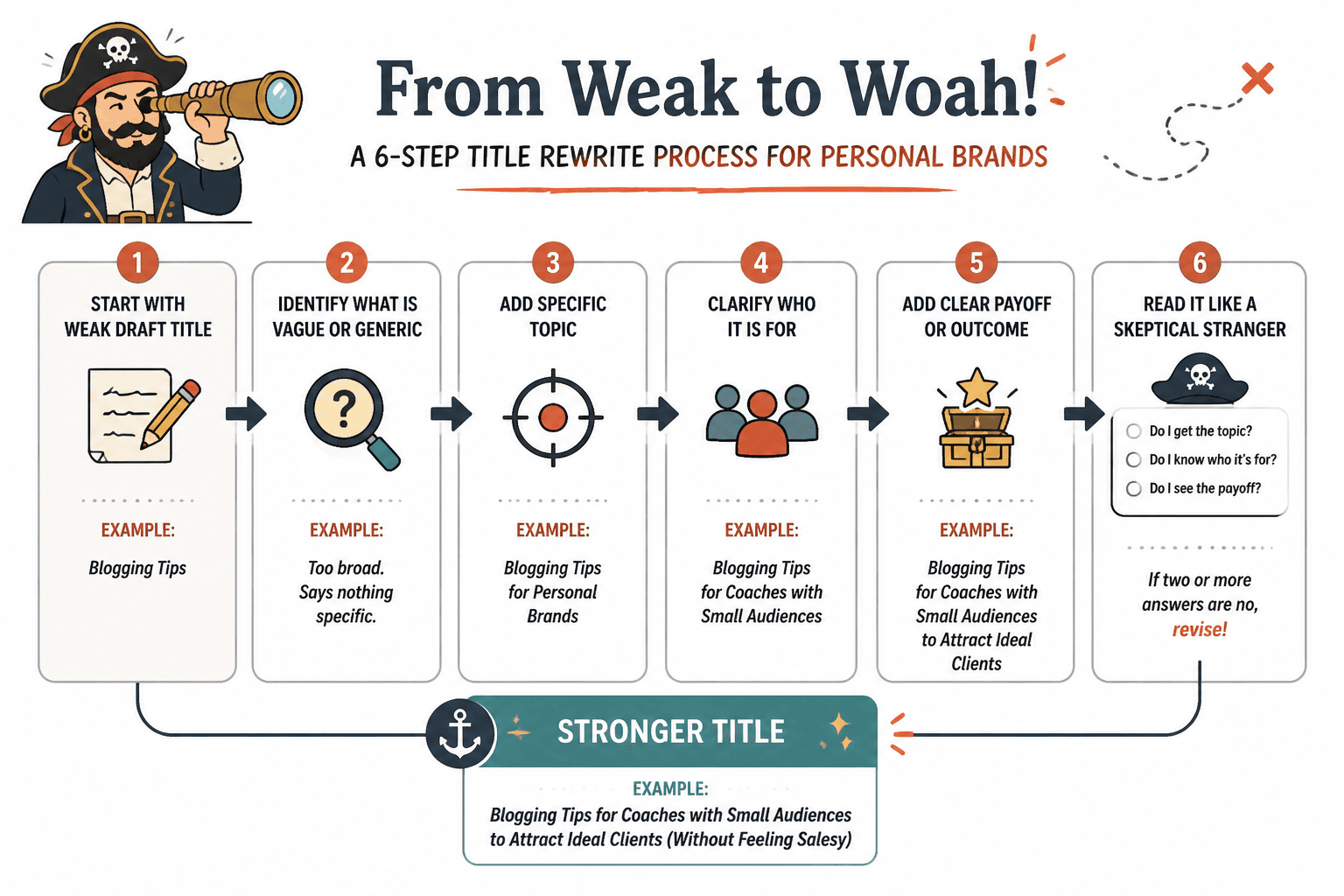
A simple rewrite process for weak titles
If your title feels off, do not immediately try to make it more dramatic. That is how people end up with weird pseudo-clickbait and a quiet sense of regret.
Instead, run it through this simple process.
Step 1: Find the real point of the article
Not the topic. The point.
“This article is about headlines” is a topic.
“This article helps personal brands fix weak blog headlines so they get more qualified clicks” is the point.
That one sentence usually gives you stronger title material than your original draft.
Step 2: Identify what makes the title weak
- Too broad?
- Too generic?
- No audience?
- No outcome?
- Too clever?
- Too stuffed with keywords?
- No tension or angle?
You do not need to fix everything. Usually one or two improvements change the whole title.
Step 3: Add one strength lever
Use one of these:
- A clearer audience
- A sharper outcome
- A visible contrast
- A more specific problem
- A stronger angle
For example:
| Original | Add one strength lever |
|---|---|
| Blog Headline Tips | Blog Headline Tips for Personal Brands That Want Better Clicks |
| Writing Better Titles | Writing Better Titles When Your Drafts Keep Sounding Generic |
| How to Create Headlines | How to Create Headlines That Sound Clear, Useful, and Worth Clicking |
Step 4: Read it like a skeptical stranger
Ask:
- Would I know what this article is about?
- Would I know if it is for me?
- Would I expect a useful payoff?
- Does it sound like a human wrote it?
If the answer to two or more is no, keep going.
For more hands-on rewrite practice, this pairs well with How to Rewrite Boring Blog Titles and Headlines.
Before-and-after weak title fixes for personal brands
Here is where this gets more useful. Let’s take weak titles and turn them into something stronger.
Example 1: Broad and forgettable
Before: Content Marketing Ideas for Entrepreneurs
Problems: broad topic, generic audience, no payoff, sounds like a hundred other posts
After: Content Marketing Ideas for Personal Brands That Need More Trust, Not Just More Traffic
Now the angle is clearer. This is not just “ideas.” It is for people trying to attract better attention, not random pageviews.
Example 2: Too polished
Before: Refining Your Digital Brand Voice Through Strategic Messaging
Problems: stuffed with abstractions, no obvious benefit, deeply beige
After: How to Make Your Brand Voice Sound Clearer, Sharper, and Less Like Everyone Else
Same general territory. Much better title.
Example 3: Weak “how to”
Before: How to Write Better Blog Titles
Problems: not terrible, but bland and underspecified
After: How to Write Better Blog Titles That Get Clicks Without Sounding Cheap
This version adds tension. It speaks to a real fear smart writers have: sounding clickbait-y.
Example 4: Topic with no result
Before: A Guide to Headline Writing for Coaches
Problems: passive, broad, no urgency, weak promise
After: Headline Writing for Coaches: How to Make the Right Readers Actually Click
That is much closer to what the reader wants.
Example 5: Interesting idea, weak packaging
Before: Why Your Blog Is Not Working
Problems: too broad, a little dramatic, gives no clue what the article covers
After: Why Your Blog Titles Are Not Working Even When the Content Is Good
Now the article’s focus is obvious, and the problem feels specific enough to matter.
If you want more title models, go read Blog Titles and Headlines Examples for Coaches, Consultants, and Personal Brands.
Title formulas that work without sounding like a template factory
Templates are useful until they start writing your personality out of the piece. Use these as structures, not uniforms.
1. How to + result + tension
- How to Write Better Blog Titles Without Falling Into Clickbait
- How to Make Your Headlines Stronger Without Stuffing Them With Keywords
2. Problem + audience + implied fix
- Weak Blog Titles Personal Brands Keep Publishing Without Realizing It
- Blog Headline Mistakes Coaches Make When They Try to Sound More Professional
3. Why + surprising issue + consequence
- Why Smart Personal Brands Still Write Blog Titles Nobody Clicks
- Why Your Headlines Sound Fine but Still Fail to Pull Readers In
4. Number + specific fix + audience
- 9 Blog Title Fixes for Personal Brands That Keep Sounding Generic
- 7 Headline Tweaks That Make Articles Easier to Click and Easier to Trust
5. Contrast title
- Better Blog Titles, Fewer Bland Clicks
- Clearer Headlines, Less Generic Content Packaging
If you want more structures and the mistakes attached to them, this is a good next read: Blog Titles and Headlines Title Templates Mistakes That Hurt Performance.
How to balance SEO with titles people actually want to click
This is where people get weird.
They either write titles only for search and end up with clunky phrase piles, or they write titles only for style and forget that search intent exists. Neither extreme is very useful.
A good SEO-aware title for a personal brand blog usually does three things:
- Includes the core phrase naturally
- Signals a clear angle or benefit
- Still sounds like something a human would choose
For example, if your target phrase is close to “better blog titles and headlines,” you do not need to force the exact phrase into every possible corner of the title. You can keep the concept intact while making the line stronger.
| Too SEO-stiff | Better balanced |
|---|---|
| Better Blog Titles and Headlines for SEO Personal Branding Content | Better Blog Titles and Headlines for Personal Brands |
| Best Blog Headline Writing Tips for Personal Brand SEO | How Personal Brands Can Write Better Blog Headlines |
| Blog Titles and Headlines Weak Title Fixes Personal Brands | Weak Blog Title Fixes for Personal Brands That Want Better Clicks |
The second column is not trying to win a keyword stuffing contest. It is trying to attract a real reader while staying aligned with search intent.
That is usually the better bet.
If you are building a fuller content system around this, the broader cluster at blog titles and headlines is worth keeping nearby.
How to know when your title is still too weak
Sometimes a title improves but still is not there yet. Here are the signs.
- You could swap it into a different niche without anyone noticing.
- The benefit feels generic instead of useful.
- The reader still cannot tell whether the article is for them.
That is usually the test. A title stops being weak when the right person can recognize the problem, the angle, and the likely payoff in one quick glance.