
Most boring blog titles are not boring because they are too simple.
They are boring because they hide the point, flatten the tension, and sound like they were approved by a committee that thinks “helpful” means “forgettable.”
If your post title says something vague like “Tips for Better Content” or “A Guide to Marketing Strategy,” the problem is not that readers are too distracted. The problem is that your headline gave them no good reason to care.
How to rewrite boring blog titles and headlines is really about one thing: making the value clearer without turning your title into clickbait sludge. You want sharper titles, not louder ones. Titles that signal relevance, usefulness, and a bit of tension. Titles that sound like a smart human wrote them on purpose.
Here’s how to do that, with a practical rewrite process, examples, and a few patterns worth stealing.
For the main guide behind this topic, visit the parent guide.
Why boring titles underperform
A weak title usually fails before anyone reads a word of the article. It does not matter how brilliant the post is if the headline sounds like every other beige blog post on the internet.
Readers make fast decisions. They scan. They compare. They pick the title that feels most specific, most relevant, or most likely to solve the problem they already have. A boring title gets politely ignored.
Here’s what weak titles usually get wrong:
- They are too broad
- They use generic wording instead of real language
- They describe a topic, not a payoff
- They lack tension, contrast, or specificity
- They sound safe in the worst possible way
That last one matters more than people think. Safe titles often feel “professional,” but they rarely feel compelling. Readers do not click because you behaved nicely. They click because the title promises something useful, interesting, timely, or sharp.
If this is a recurring problem, it helps to understand the broader system behind better headlines. The resources on blog titles and headlines and title templates and mistakes that hurt performance are worth keeping nearby while you work.
The real job of a blog title
A title does not need to be clever. It needs to do its job.
A strong blog title usually does at least two of these four things:
- Names a clear topic
- Promises a useful outcome
- Creates curiosity through contrast or tension
- Signals who the article is for
That is it. Not magic. Not “viral psychology.” Just clearer packaging.
For example, compare these:
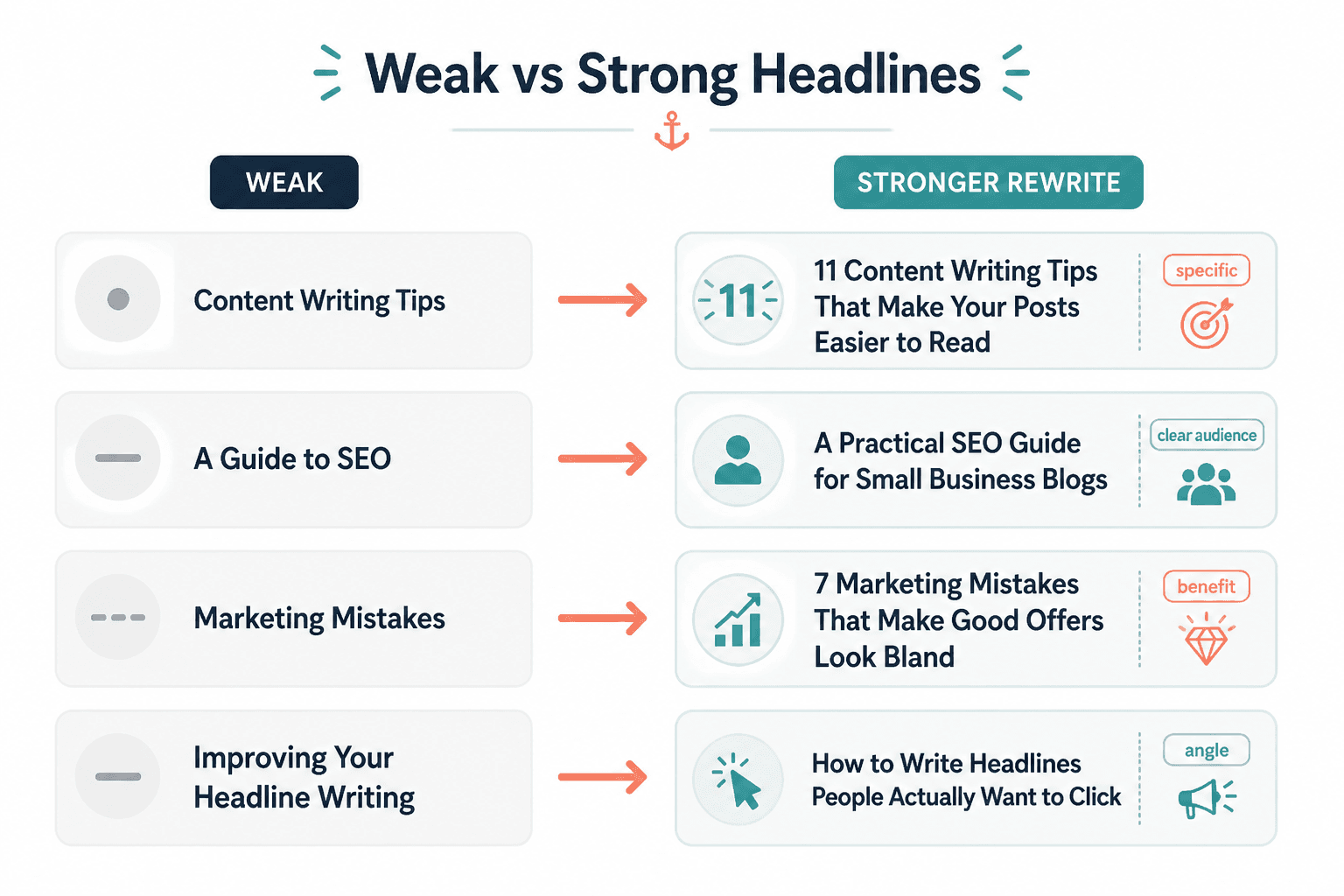
| Weak title | Why it falls flat | Stronger rewrite |
|---|---|---|
| Content Writing Tips | Too broad, no angle, no payoff | 11 Content Writing Tips That Make Your Posts Easier to Read |
| A Guide to SEO | Generic and shapeless | A Practical SEO Guide for Small Business Blogs |
| Marketing Mistakes | No context, no relevance | 7 Marketing Mistakes That Make Good Offers Look Bland |
| Improving Your Headline Writing | Sounds like a workshop handout | How to Write Headlines People Actually Want to Click |
Notice what changed. The stronger versions are not outrageous. They are just more useful. They tell the reader what kind of help is coming and why it matters.
How to rewrite boring blog titles and headlines step by step
If your current headline feels dull, do not just swap in bigger adjectives and hope for the best. Rewrite it in a sequence. That keeps you from drifting into clickbait nonsense or vague “improvement” language.
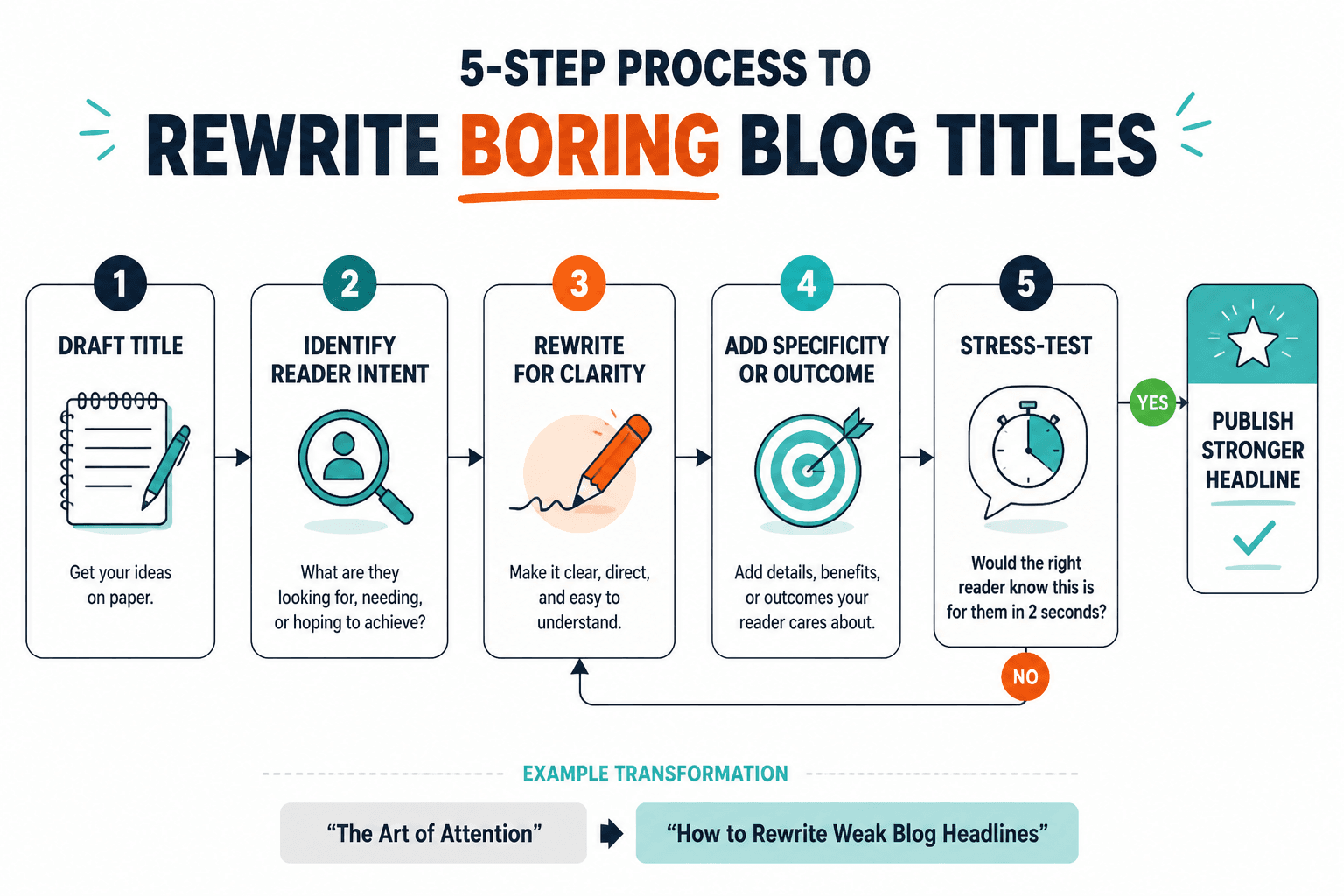
1. Find the actual point of the article
Start here because many boring titles are symptoms of fuzzy thinking. If the article has no sharp point, the title cannot magically save it.
Ask:
- What problem does this article solve?
- What changes for the reader after reading it?
- Who is this most useful for?
- What is the strongest idea or angle inside it?
If you cannot answer those cleanly, your title is not the first issue. Your article is still trying to be “about a topic” instead of “helpful for a reason.”
Bad title source material often sounds like this:
This article is about personal branding.
That is not a point. That is a category.
A sharper version might be:
This article helps consultants fix personal brand messaging that sounds polished but says nothing.
Now you have something to title.
2. Cut the broad, empty words
Words like better, effective, successful, powerful, essential, and ultimate often make titles worse, not stronger. They sound impressive, but they rarely add meaning.
For example:
- Better Content Strategy — better how?
- Effective Blogging Tips — effective for what?
- The Ultimate Guide to Headlines — says every blog post from 2016
Swap empty quality words for concrete outcomes, audiences, or problems.
| Vague wording | Stronger replacement |
|---|---|
| Better | Clearer, faster, more clickable, easier to skim |
| Effective | Gets replies, earns clicks, improves signups, builds trust |
| Successful | Converts, ranks, gets read, attracts leads |
| Essential | Common, important, worth fixing, often missed |
| Ultimate guide | Practical guide, step-by-step guide, no-fluff guide |
This is one of the simplest ways to rewrite boring blog titles and headlines. Strip out the inflated filler and replace it with language that actually tells the reader something.
3. Add specificity where it matters
Specificity makes titles feel real. It gives shape to the promise.
You can add specificity through:
- A target audience
- A format
- A clear result
- A mistake being fixed
- A timeframe
- A number, if it genuinely helps
Examples:
| Boring title | Sharper title |
|---|---|
| Email Marketing Advice | Email Marketing Advice for Coaches Who Hate “Nurture” Copy |
| Writing Better Intros | How to Write Blog Intros That Do Not Lose Readers in 3 Lines |
| Title Ideas for Articles | 27 Blog Title Ideas for Service Businesses and Personal Brands |
| Fixing Content Problems | How to Fix Content That Sounds Smart but Gets No Response |
Do not force every title to include a number or niche qualifier. But if your draft title feels mushy, adding one concrete detail usually helps.
4. Build in tension, contrast, or consequence
This is where many strong headlines separate themselves from bland ones.
People click when a title hints at a gap:
- What they are doing now vs what actually works
- What sounds good vs what performs well
- What they think is the problem vs the real problem
- What gets ignored vs what gets attention
That tension creates interest without needing cheap drama.
Examples:
- Why Your Blog Titles Sound Smart but Get Ignored
- How to Write Clear Headlines Without Sounding Robotic
- What Makes a Good Blog Title Actually Good
- How to Fix Headlines That Are Accurate but Unclickable
Notice the pattern. These titles do not just name a subject. They frame a problem the reader recognizes. That is often the difference between “nice article” and “I need this.”
If weak openings are part of the issue, pair this article with how to start blog titles and headlines without a weak opening. A dull first phrase can flatten the whole thing before it even gets moving.
5. Make the title sound like a human, not a content machine
Some titles are technically clear and still deeply unappealing because they sound automated. Too polished. Too template-heavy. Too “SEO intern trying not to get fired.”
Examples of robotic phrasing:
- Strategies for Optimizing Your Blog Title Performance
- Leveraging Headline Best Practices for Better Engagement
- Effective Solutions for Improving Content Discoverability
These are not titles. They are tax forms wearing a lanyard.
A better rewrite usually sounds simpler and more grounded:
- How to Write Blog Titles More People Actually Click
- Why Your Headlines Are Getting Ignored
- How to Make Blog Titles Clearer, Sharper, and Less Generic
If this is a pattern in your writing, read how to write blog titles and headlines without sounding salesy or robotic. It helps clean up the stuff that makes otherwise decent ideas sound artificial.
6. Stress-test the rewrite against real reader intent
Before you lock in a title, ask one unglamorous question:
Would the right reader know this article is for them in about two seconds?
If the answer is no, keep going.
A title can be clever, elegant, or stylish and still fail because it does not match what the reader is looking for. Search-driven titles especially need to respect intent. If someone wants help fixing weak headlines, a poetic title about “the art of attention” is probably not the move.
Clear usually beats clever. Not always. But often enough that it should be your default.
5 reliable rewrite angles that make titles stronger
If you are staring at a dull draft and need options fast, these rewrite angles tend to work well. They are not formulas to obey forever. They are useful ways to force clarity.
1. Problem-focused
Use this when the reader already feels the pain.
- Why Your Blog Titles Are Getting Ignored
- How to Fix Headlines That Sound Generic
- The Blog Title Mistakes Making Your Content Easier to Skip
2. Outcome-focused
Use this when the reader wants a clear result.
- How to Write Blog Titles That Earn More Clicks
- How to Create Headlines That Are Clear and Compelling
- How to Make Your Article Titles More Useful at a Glance
3. Mistake-and-fix
Use this when the reader may not realize what is going wrong.
- 7 Blog Title Mistakes That Make Good Content Look Weak
- Common Headline Problems and How to Fix Them
- Why Accurate Titles Still Fail and What to Do Instead
4. Contrast-based
Use this when you want more snap without getting cheesy.
- Smart-Sounding Headlines vs Clickable Headlines
- Clear Titles Beat Clever Ones Most of the Time
- What Readers Ignore in Blog Headlines and What They Notice Instead
5. Audience-specific
Use this when your article is clearly for a niche reader and relevance matters more than broad traffic.
- How Consultants Can Write Better Blog Titles Without Sounding Salesy
- Blog Headline Ideas for Personal Brands That Need More Trust, Not More Hype
- How Coaches Can Write Article Titles That Sound Clearer and More Credible
Pick one angle and write at least five versions. Most people stop after one “pretty decent” title and then wonder why it underperforms. Headline writing gets better when you compare options, not when you fall in love with your first draft.
Before-and-after examples of boring title rewrites
Let’s make this less theoretical. Here are some common weak title types and stronger rewrites.
Example 1: Too broad
Before: Social Media Tips
After: 9 Social Media Tips That Make Your Content Easier to Read and Share
Why it works: The rewrite narrows the promise and gives the reader a reason to care right now.
Example 2: Too polished and vague
Before: Enhancing Your Content Strategy for Improved Performance
After: How to Fix a Content Strategy That Looks Busy but Does Not Convert
Why it works: It replaces inflated language with a real problem and a sharper contrast.
Example 3: Topic without payoff
Before: Blog Headlines
After: How to Write Blog Headlines That Do Not Sound Like Filler
Why it works: It frames a recognizable frustration and promises improvement.
Example 4: Generic how-to
Before: How to Write Better Titles
After: How to Write Better Titles by Cutting Vague, Forgettable Wording
Why it works: “Better” finally gets defined.
Example 5: Boring list post
Before: 10 Tips for Headlines
After: 10 Headline Fixes for Posts That Are Useful but Easy to Ignore
Why it works: The rewrite adds context and identifies the real audience problem.
For more rewrite patterns, better blog titles and headlines: weak title fixes for personal brands goes deeper on how to sharpen titles without making them sound forced.
A simple rewrite formula you can use in minutes
If you need a quick working method, use this:
- Write the plain topic of the article.
- Write the specific problem it solves.
- Write the result the reader wants.
- Add one point of contrast, tension, or consequence.
- Turn that into 5 to 10 title options.
Here is that formula in action.
Plain topic: Writing blog headlines
Problem: The headlines sound generic and get ignored
Result: More clicks and better first impressions
Contrast: Smart-sounding vs clickable
Possible titles:
- How to Write Blog Headlines That Do Not Get Ignored
- How to Fix Blog Headlines That Sound Smart but Fail to Pull Readers In
- Why Your Blog Titles Feel Generic and How to Rewrite Them
- How to Make Blog Headlines Clearer, Sharper, and More Clickable
- How to Rewrite Boring Blog Titles and Headlines Without Using Clickbait
The point is not to find one magic formula. The point is to force the title to carry an actual message.
What to avoid when rewriting headlines
When people try to improve weak titles, they often overcorrect. Suddenly the title is stuffed with urgency, numbers, and promises it cannot cash. That is not improvement. That is a trust problem in progress.
Avoid these common mistakes:
- Overpromising in the headline. If the title promises transformation and the article delivers a checklist, the disconnect will hurt trust.
- Stuffing too many ideas into one line. A title should point clearly, not try to do six jobs at once.
Good rewrites feel sharper, not busier. The goal is to make the title easier to understand and easier to care about at the same time.