
For the main guide behind this topic, visit the parent guide.
Forgetting the profile handoff
The bigger point is simple: clearer structure and clearer writing make the piece more useful. That is usually what makes the ending land better too.
The bigger point is simple: clearer structure and clearer writing make the piece more useful. That is usually what makes the ending land better too.
Most LinkedIn funnel advice falls apart before the funnel even starts.
The post gets attention. The hook does its job. The formatting makes it readable. Then the reader clicks through and lands in a mess: vague profile, weak offer, random lead magnet, or a booking link showing up like a desperate handshake. That is not a funnel. That is a content leak.
If you want better results from LinkedIn, you need your hooks, formatting, and funnel path to work together. The post should earn attention. The structure should keep it. The next step should feel obvious, low-friction, and relevant to what the reader just cared about.
This is where most people get lazy. They write one decent post, slap “DM me” at the bottom, and wonder why nothing moves.
Here’s how to fix that. We’ll cover the best funnel ideas to pair with LinkedIn hooks and formatting, when each one works, what kind of post supports it best, and how to avoid turning your content into a thinly disguised sales brochure wearing a thought leadership hat.
Why hooks, formatting, and funnels need to match
A LinkedIn post is not just a piece of writing. It is an entry point.
Your hook gets the click or the pause. Your formatting helps the reader stay with you long enough to care. Your funnel gives that attention somewhere useful to go.
When those three pieces do not match, performance drops fast. A practical post with a dramatic hook feels manipulative. A thoughtful authority post with a pushy CTA feels off. A short insight post leading to a giant, complicated funnel usually dies on contact.
The cleaner move is this: match the next step to the promise of the post.
- If the hook promises a quick fix, offer a small next step.
- If the post builds authority, lead to a deeper asset.
- If the post surfaces a painful problem, point to a relevant resource or conversation.
- If the post shows proof, the next step can be closer to a sale.
That sounds obvious. It should be. And yet people still pair soft educational posts with hard sales asks like they are speedrunning trust damage.
If you need a stronger foundation on post structure first, start with LinkedIn hooks and formatting. You can also browse more platform-specific content in this related LinkedIn writing cluster.
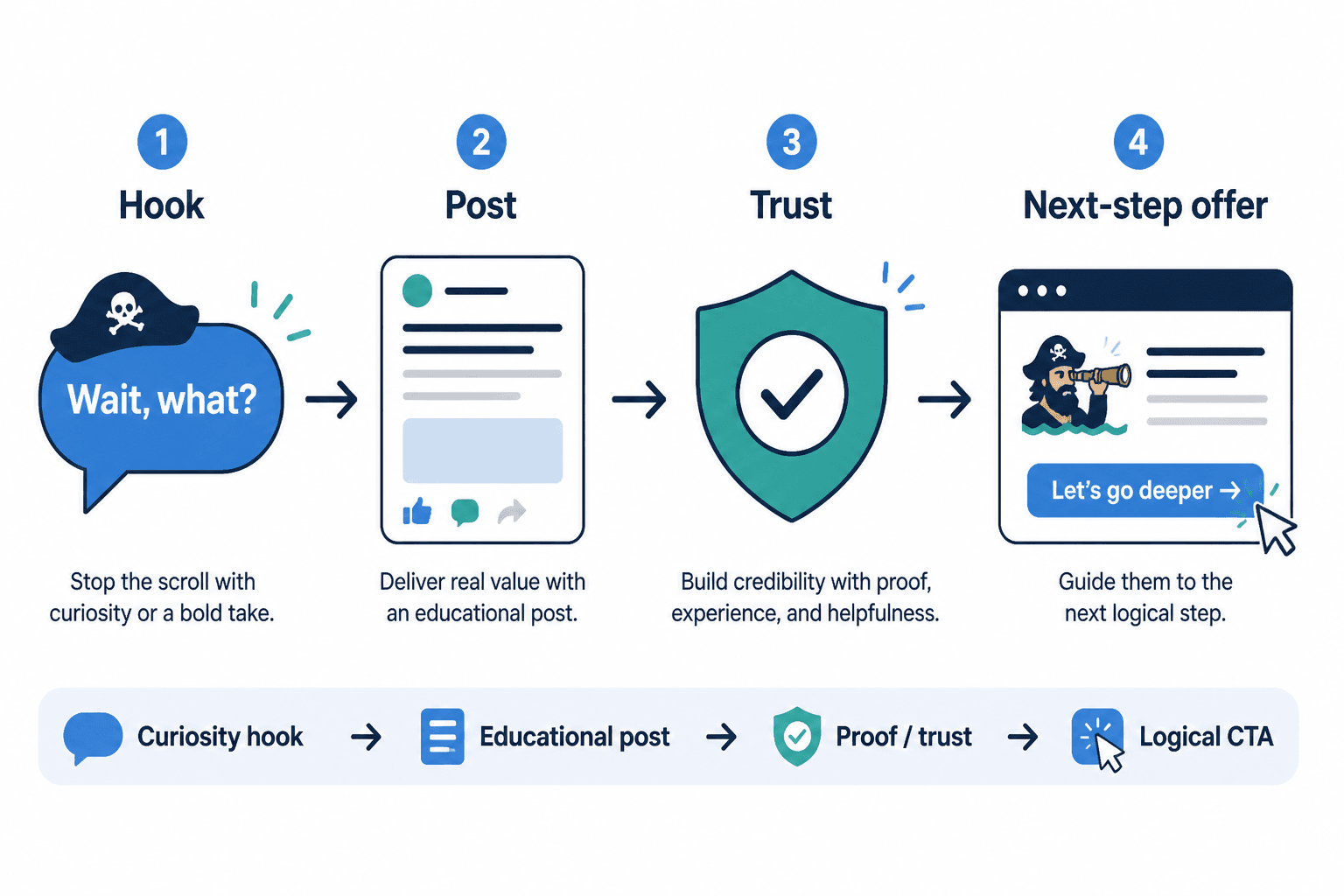
The simplest way to think about a LinkedIn funnel
You do not need a 14-step automation sequence to make LinkedIn useful. Most creators, consultants, coaches, and service businesses need a much simpler model.
Think in this order:
- Attention: the hook gets the right person interested.
- Engagement: the formatting and structure make the post easy to read.
- Trust: the content proves you understand the problem and have something useful to say.
- Next step: the CTA sends the reader to the most logical place.
That next step is the funnel. Not the software. Not the dashboard. Not the color-coded workflow screenshot someone posts to feel powerful. The actual next step.
On LinkedIn, the best funnels usually feel like a continuation of the conversation, not a trap door into a sales machine.
Best funnel ideas to pair with LinkedIn hooks and formatting
These are the funnel paths that make the most sense for most LinkedIn creators and service-based businesses. The key is choosing the one that fits the type of hook and post format you are using.
1. Post to profile to lead magnet
This is one of the safest and most effective LinkedIn funnels because it respects reader pace.
The post earns interest. The reader checks your profile. Your profile makes a clear promise and points to a useful free resource. That resource collects the lead.
This works well when your hook opens a practical problem and your post delivers enough value to make the reader want more.
Best matched with: educational hooks, tactical posts, mistake posts, mini-frameworks, and before/after breakdowns.
Example hook: “Most LinkedIn posts do not fail because the idea is bad. They fail because the first two lines are doing absolutely nothing.”
Good next step: a profile CTA offering a free hook template pack, post checklist, or messaging guide.
Bad next step: sending them straight to a consultation call before they know what you do well.
This funnel is especially useful if you are still building audience trust. If people are discovering you through one post, asking for a sale too early is usually clumsy. Asking them to grab something genuinely useful is a much cleaner move.
2. Post to newsletter
If your content has depth, nuance, or recurring ideas, a newsletter is often a better funnel than a generic lead magnet.
LinkedIn posts are good at earning attention in public. Newsletters are better at building repeated trust. That is a strong combination.
Best matched with: opinion-led hooks, deeper teaching posts, industry analysis, contrarian takes, and posts that hint at a broader body of work.
Example hook: “A lot of content advice is optimized for impressions, not clients. Those are not the same goal, and the writing shows it.”
Good next step: “If you want more breakdowns like this, my newsletter covers practical content strategy every week.”
This works because the CTA matches the mood of the post. If the post is thoughtful and strategic, the next step should feel like more thoughtful and strategic content, not an abrupt sales jump.
3. Post to soft DM conversation
This one gets abused constantly, but it can work if you do not make it weird.
A soft DM funnel works when the post naturally creates a need for something specific and the ask is low pressure. Not “Comment GUIDE and I’ll totally not shove you into a sequence.” More like a genuine offer to send something relevant.
Best matched with: template posts, checklists, teardown posts, process breakdowns, and highly specific problem-solution posts.
Example hook: “If your LinkedIn post sounds polished but gets no traction, your structure is probably too smooth and too vague.”
Good next step: “If you want the checklist I use to tighten hooks and post flow, send me ‘checklist’ and I’ll send it over.”
Why this works: the resource directly relates to the post, and the ask feels like a continuation of the topic. Why it fails: people use it as a lazy comment-bait machine and then follow with a sales script from the underworld.
If you use this funnel, keep the DM useful first. If the conversation naturally opens into a business discussion later, fine. If not, do not force it.
4. Post to booking page
This is a stronger ask, so it needs stronger post support.
A LinkedIn post should only point directly to a booking page when the reader has a clear reason to believe you can help and a clear reason to act now. That usually means the post includes proof, specificity, or a well-defined pain point tied to your service.
Best matched with: case study hooks, proof posts, myth-busting authority posts, service-specific problem posts, and posts that show a clear gap between bad and better outcomes.
Example hook: “Three landing page fixes helped this consultant turn profile traffic into qualified discovery calls. None of them were ‘post more often.’”
Good next step: “If your profile and content are bringing attention but not leads, book a call and I’ll show you where the handoff is breaking.”
Bad next step: using this CTA under every post, including fluffy mindset posts and generic writing tips.
Direct booking CTAs work best when the reader already sees the commercial relevance. If they have to mentally bridge the gap themselves, most will not bother.
5. Post to article to offer
This is a smart funnel for people with stronger ideas, layered services, or more expensive offers.
The post acts as the teaser or sharp entry point. The article does the deeper authority building. Then the article points toward the offer, resource, or consultation.
Best matched with: argument-based hooks, “here’s what people get wrong” posts, strategic content, nuanced educational posts, and anything that cannot be explained properly in one LinkedIn post.
Example hook: “Most LinkedIn content funnels are backward. They ask for action before they have earned enough trust to justify it.”
Good next step: linking to a deeper article that expands the concept and naturally introduces your service or framework.
This path is particularly useful for authority-based businesses. If you sell strategy, consulting, coaching, fractional work, or high-trust services, depth can convert better than speed.
You can support this with related internal reading like LinkedIn hooks and formatting ideas and examples for creators if your audience needs concrete posting models before they are ready for the next step.
6. Post to free resource to nurture sequence
This is a stronger version of the lead magnet funnel and works best when your buying process takes longer.
The LinkedIn post highlights a problem or missed opportunity. The free resource solves part of that problem. The nurture sequence continues the education, adds proof, and creates a more believable path toward your paid offer.
Best matched with: problem-aware hooks, educational post series, framework posts, and pain-point posts with clear business relevance.
Example hook: “If your LinkedIn posts get decent engagement but no qualified leads, the issue usually is not reach. It is the handoff.”
Good next step: a lead magnet on profile optimization, content-to-lead flow, or CTA strategy followed by a short email sequence that deepens the topic.
This funnel is not exciting. Good. Exciting funnels are often where people start making terrible decisions. This one is useful, scalable enough, and grounded in actual buyer behavior.
7. Post to comment conversation to profile CTA
Sometimes the funnel should stay public for one more step.
A post with a sharp opinion, practical lesson, or strong observation can generate comments from the right people. If you reply well, those readers often click your profile on their own. That profile then does the conversion work.
Best matched with: opinion hooks, conversation-starting posts, myth-busting posts, and useful contrarian takes.
Good next step: no hard CTA in the post at all, just a strong profile setup with a clear promise and next action.
This works especially well for smaller audiences. You do not need every post to force a lead. Sometimes the better move is to create enough interest that the right people investigate further.
If that sounds more realistic for where you are, read LinkedIn hooks and formatting for creators with small audiences. It is a better model than copying giant accounts with audiences full of lurkers and randoms.
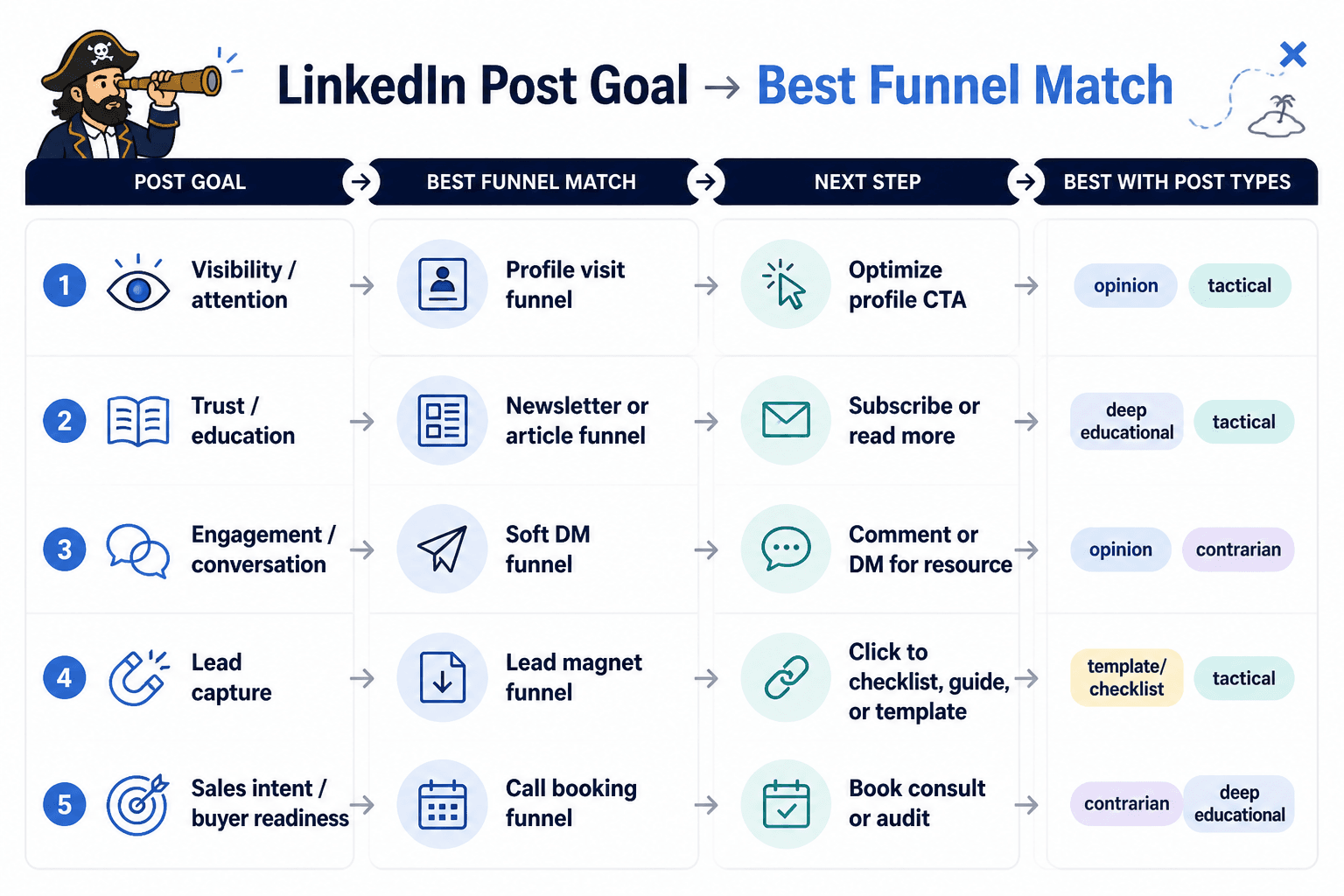
How to choose the right funnel for your LinkedIn post
If you want a practical rule, choose the funnel based on three things:
- How aware the reader is of their problem
- How much trust the post earns
- How much commitment the next step requires
Here is the simple version:
| Post type | Trust level | Best next step |
|---|---|---|
| Quick tactical post | Low to medium | Profile CTA or lead magnet |
| Deep educational post | Medium | Newsletter or article |
| Template or checklist post | Medium | Soft DM request |
| Case study or proof post | Medium to high | Booking page or consultation |
| Opinion-led post | Medium | Comment conversation to profile |
| Strategic argument post | High | Article to offer or newsletter |
The bigger the ask, the more proof and relevance you need before making it.
Formatting choices that support funnel performance
Formatting is not just about readability. It affects whether the funnel handoff works.
If your post is hard to scan, bloated, or visually annoying, fewer people stick around long enough to care about your CTA. If the post feels overly staged, the CTA feels less trustworthy. Good formatting supports momentum.
Use a first line that sets up the right kind of next step
Your hook should attract the kind of reader your funnel is meant to move.
- If the funnel is to a lead magnet, make the hook practical and problem-specific.
- If the funnel is to a booking page, make the hook commercially relevant and proof-aware.
- If the funnel is to a newsletter or article, make the hook idea-rich.
A fluffy hook creates weak intent. Weak intent creates weak funnel performance. Shocking development.
Keep paragraph rhythm tight
On LinkedIn, dense blocks kill momentum. But formatting every sentence on its own line like it is auditioning for a dramatic monologue is not much better.
A good rule is to keep the post easy to scan while letting related ideas breathe together. That helps the reader move naturally toward the CTA instead of feeling dragged through a choppy wall of line breaks.
Place the CTA where the reader has earned it
If the CTA comes too early, it feels premature. If it comes too late after too much padding, it feels tacked on.
The best LinkedIn CTAs usually appear after one of these moments:
- A clear lesson
- A useful contrast
- A proof point
- A framework recap
- A specific problem diagnosis
That is when the reader is most likely to think, “Okay, fair. What next?”
Examples of better post-to-funnel pairing
Example 1: Educational hook to lead magnet
Hook: “Most consultants do not need better content ideas. They need better content packaging.”
Post: Break down three packaging mistakes: weak hooks, vague proof, soft CTAs.
CTA: “I put my best post structure checklist in my profile if you want a faster way to tighten this up.”
Why it works: the CTA extends the lesson without jumping too far ahead.
Example 2: Case study hook to booking page
Hook: “This one profile change helped turn LinkedIn lurkers into qualified inquiries.”
Post: Show the profile problem, the adjustment, and the result.
CTA: “If your content gets views but your profile does not convert, book a strategy call and I’ll help you find the gap.”
Why it works: the commercial connection is obvious, and the post contains enough specificity to justify the ask.
Example 3: Opinion hook to newsletter
Hook: “A lot of LinkedIn writing advice is optimized for applause from peers, not trust from buyers.”
Post: Explain how audience misalignment weakens content strategy.
CTA: “I write about this every week in my newsletter if you want less vanity advice and more usable strategy.”
Why it works: the CTA fits the voice, the depth, and the audience intent.
Common funnel mistakes people make on LinkedIn
Using the same CTA on every post
If every post ends in “book a call,” your content starts to feel like a pitch with a thin educational costume.
Different posts create different levels of intent. Your CTA should reflect that.
Writing hooks for attention and CTAs for a different audience
A broad hook can attract lots of casual readers and still produce zero business movement if the offer is meant for a niche buyer. Reach without fit is not a funnel. It is a vanity detour.
Offering a lead magnet nobody actually wants
Your free resource should solve a real next problem, not exist because someone on the internet said you need a funnel asset. Generic PDFs full of recycled tips are not compelling. They are just inbox clutter with branding.
Forgetting the profile handoff
The bigger point is simple: clearer structure and clearer writing make the piece more useful. That is usually what makes the ending land better too.
The bigger point is simple: clearer structure and clearer writing make the piece more useful. That is usually what makes the ending land better too.