
Most people do not wreck trust on LinkedIn when they sell. They wreck it much earlier, in the hook and the formatting.
They open with fake drama, drag the reader through 19 tiny lines of vague buildup, then land on a CTA that was obviously the point all along. Technically, yes, that is monetization. In the same way a pop-up ad is technically communication.
If you want to know how to monetize LinkedIn hooks & formatting without wrecking trust, the answer is not “never sell.” It is to stop using your hook and structure like bait. Good monetization on LinkedIn comes from making the post useful first, making the relevance obvious second, and making the next step feel earned.
That means your first line, your pacing, your line breaks, your proof, and your CTA all need to work together. Not as a manipulation trick. As a trust-preserving path from attention to action.
Here’s how to do that without sounding like a webinar funnel escaped into the feed.
For the main guide behind this topic, visit the parent guide.
Why hooks and formatting matter more than most monetization advice admits
A lot of LinkedIn monetization advice focuses on offers, funnels, lead magnets, DM scripts, and CTAs. Fine. Those things matter. But readers decide how safe you feel long before they reach your CTA.
Your hook tells them if this post is likely to respect their time. Your formatting tells them if you are helping them think or just dragging them toward a pitch.
That is why two people can promote the same offer and get completely different reactions. One feels useful and credible. The other feels like they are trying to mug you with line breaks.
If your hook overpromises, if your formatting turns one simple point into a dramatic staircase, or if the payoff is obviously weaker than the setup, trust drops fast. Not always consciously. But people feel it. They remember it. And they become much less likely to read your next post, click your profile, or respond to anything you sell later.
So yes, hooks and formatting affect monetization. They also affect whether monetization is tolerated, welcomed, or quietly resented.
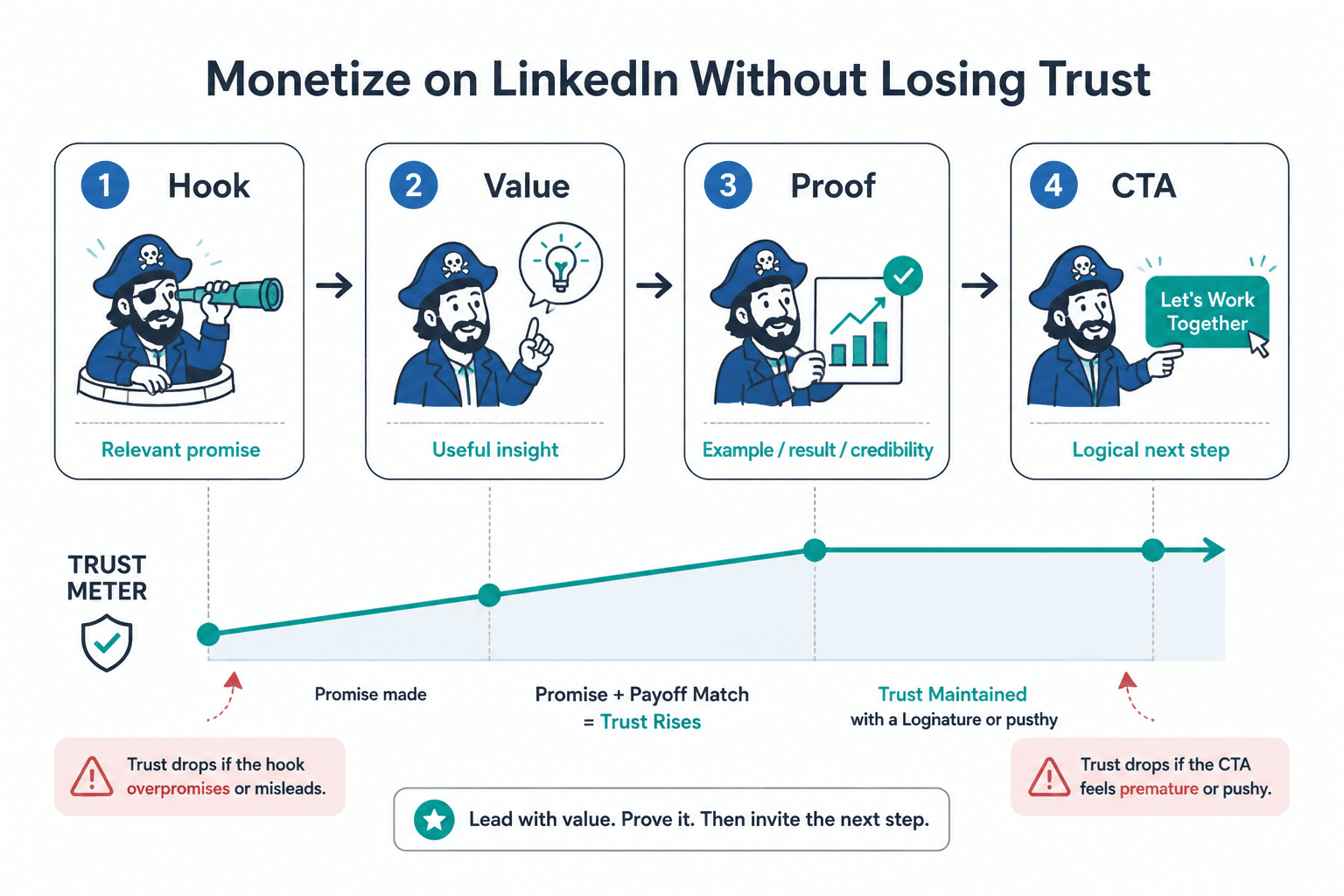
The real job of a monetized LinkedIn post
A monetized LinkedIn post does not need to close the sale. It usually should not try.
Its job is simpler than that:
- Earn attention with a relevant hook
- Build trust with a sharp idea, example, or proof
- Create alignment between the content and the offer
- Give the reader a logical next step
That is a very different approach from using the post as a disguised ad. When people feel tricked into a pitch, they do not think, “Ah yes, smart funnel architecture.” They think, “Right, unfollow.”
A post can absolutely lead to leads or sales. It just works better when the post itself delivers something worth reading. If you need help thinking through that larger path, this pairs well with how to turn LinkedIn hooks and formatting into more leads or sales.
What trust-wrecking monetization usually looks like
Before fixing the problem, it helps to name it properly. Most trust damage comes from a few repeat offenders.
1. The hook is bait, not relevance
Examples:
- “I almost quit my business yesterday.”
- “Nobody talks about this.”
- “This changed everything.”
- “I was doing it all wrong.”
These hooks are not always terrible. They are terrible when the payoff is mild, generic, or clearly just a setup for a pitch. Curiosity is fine. Vague melodrama is not.
2. The formatting creates fake tension
You have seen this one.
One line.
Then another.
Then a third.
And after ten screens of this, the “big insight” is basically “I made a checklist.”
Formatting should improve readability, not cosplay suspense.
3. The CTA was clearly the whole point
If the post gives a tiny surface-level thought and then swerves hard into “comment GUIDE and I’ll send you the framework,” readers notice. They are not stupid. They can tell when the useful part has been held hostage.
4. The post promises insight but delivers self-promotion
This is the “three lessons from my founder journey” post where the actual takeaway is that you should hire them. Again, people can smell this. Not because promotion is bad, but because mislabeling promotion as insight is lazy.
How to monetize LinkedIn hooks & formatting without wrecking trust
The clean version is this: make the post worth consuming even if the reader never buys. Then make the offer feel like a natural continuation, not a trapdoor.
Here are the principles that make that work.
Start with a hook that screens in the right people
A monetized hook should attract the people who are likely to care about the problem, not just inflate impressions with vague intrigue.
Weak:
I learned this lesson the hard way.
Better:
If your LinkedIn posts get polite likes but no leads, your hook may be attracting readers instead of buyers.
The second version does three useful things:
- Names a specific problem
- Signals the audience
- Hints at a business outcome
That is what you want. Relevance over spectacle.
If your openings tend to start soft, vague, or oddly apologetic, read how to start LinkedIn hooks and formatting without a weak opening. It will save you a lot of wasted first lines.
Make the post useful before the pitch appears
If the reader can predict the CTA by line three, you are probably pushing too soon.
A trust-friendly monetized post usually gives at least one of these before asking for anything:
- A sharp distinction the reader has not heard framed well
- A practical example
- A mistake diagnosis
- A small framework
- A before-and-after rewrite
- A useful opinion backed by real reasoning
This does not mean you need to empty your entire brain into every post. It means the post should stand on its own. Even if the CTA gets ignored, the reader should still feel they got something solid.
Use formatting to reduce friction, not manufacture drama
Good LinkedIn formatting is simple. It helps people scan, follow, and stay with the argument.
Useful formatting usually includes:
- Short paragraphs
- Clean transitions
- One idea per paragraph
- Lists when they actually clarify something
- Occasional contrast lines for emphasis
What it does not include is breaking every sentence into its own line because someone on the internet said whitespace increases dwell time. Maybe. It also increases annoyance when abused.
A good test: if your post would still make sense read aloud as a normal paragraph, the formatting is probably helping. If it only “works” because the suspense is doing all the labor, fix it.
Keep the payoff proportional to the hook
This matters more than people realize.
If your hook implies a major insight, your post needs a payoff that feels worth the click and the read. If your payoff is modest, your hook should be modest too. That balance protects trust.
Bad match:
Why most experts fail on LinkedIn
Payoff:
Use shorter paragraphs and post more often.
That is not a payoff. That is a shrug.
Better match:
Many smart LinkedIn posts fail for a boring reason: they read like essays when they should read like decisions.
Now the setup is tighter, more specific, and easier to support with practical advice.
Make the offer feel like the next step, not the hidden agenda
Trust stays intact when the CTA fits the content.
If the post is about weak hooks, the CTA can offer:
- A hook template
- A post audit
- A messaging guide
- A related article
- A call for people who want help with post positioning
If the post is about profile copy, do not suddenly pitch a webinar on pricing psychology unless the connection is genuinely clear. Misaligned CTAs feel opportunistic.
This is also where internal content paths help. If the reader needs more context before they are ready for an offer, send them to a useful next article like how to write LinkedIn hooks and formatting without sounding salesy or robotic or how to write better LinkedIn hooks and formatting. Not every post needs to force the sale right now.
A simple structure for monetized LinkedIn posts that still feel trustworthy
You do not need a 14-part persuasion formula. You need a structure that respects the reader.
Try this:
- Hook: Name a relevant problem, mistake, or tension
- Point: Explain what is actually going wrong
- Proof: Give an example, observation, breakdown, or mini framework
- Shift: Show what to do instead
- CTA: Offer the next step that logically fits
That is enough for most posts that want to earn attention and move someone one step closer to a lead or sale.
Here is what that can look like in practice.
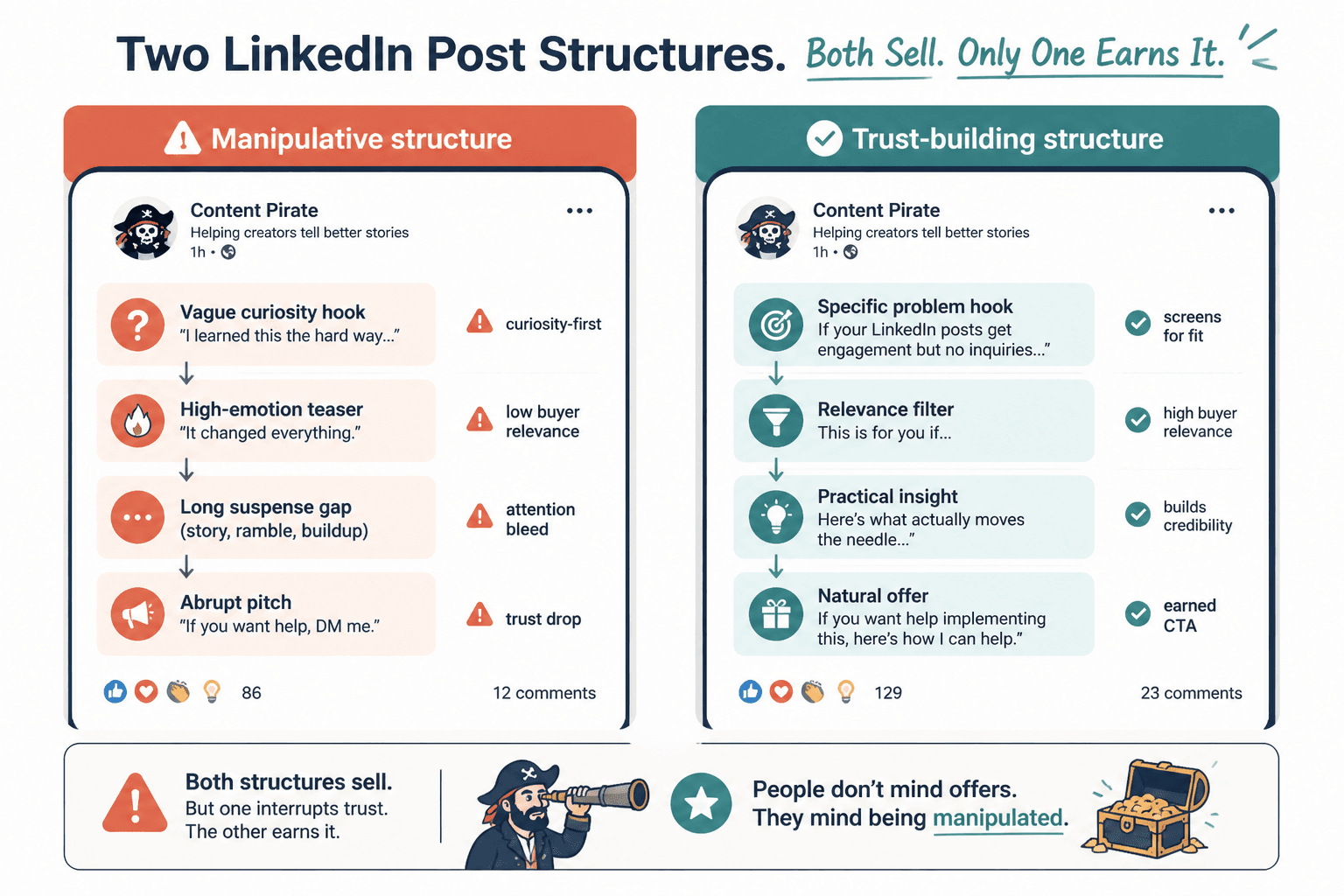
Example: weak version
I used to struggle with LinkedIn.
Then I discovered a better system.
Now my clients get more reach, engagement, and leads.
If you want my proven content framework, comment GROWTH.
Problems:
- Vague hook
- No real insight
- No proof
- Feels like a funnel trap
Example: stronger version
Many LinkedIn posts do not fail because the offer is weak.
They fail because the first line attracts curiosity, but not buyer relevance.
A hook like “I learned this the hard way” may get a few clicks.
It does not tell the right reader, “this post is for your problem.”
A better opening is something like:
“If your LinkedIn posts get engagement but no inquiries, your hook may be attracting readers instead of prospects.”
Same platform. Same topic. Better screening.
If you want help tightening hooks so your posts lead more naturally into offers, that is exactly what I help clients do.
This version still sells. It just earns the right to.
What kinds of hooks monetize well without feeling gross
Some hook types naturally create a cleaner path to monetization because they are rooted in relevance and credibility, not tricks.
Problem-diagnosis hooks
If your LinkedIn posts sound smart but still do nothing for the business, the problem may be packaging, not expertise.
Why it works: it speaks to a business pain and sets up a practical solution.
Contrast hooks
More reach is nice. Better-fit readers are usually more profitable.
Why it works: it reframes a common assumption and can lead naturally to a service, offer, or audit.
Mistake hooks
The fastest way to make a LinkedIn post feel salesy is to hide the sales intent behind fake vulnerability.
Why it works: it calls out a recognizable issue and creates room for useful guidance.
Specific outcome hooks
If you want LinkedIn posts that lead to inquiries, your formatting has to guide action, not just improve readability.
Why it works: it links content structure to a business result without overpromising.
Formatting choices that help conversion instead of hurting trust
Formatting is not decoration. It shapes how people experience your intent.
Here is a practical breakdown.
| Formatting choice | Trust-friendly use | Trust-killing use |
|---|---|---|
| Short paragraphs | Make ideas easy to scan | Stretch one thought into fake suspense |
| Line breaks | Separate shifts in logic | Make every sentence feel dramatic |
| Lists | Clarify steps, mistakes, or examples | Pad thin advice into “frameworks” |
| Bold claims | Use when you can support them | Use as bait for weak content |
| CTA placement | After delivering value | Teased from the opening like a prize |
The goal is not to write plain, lifeless blocks of text. The goal is to make your post easy to read without making the reader feel managed.
That distinction matters. A lot.
How to write CTAs that monetize without setting off alarm bells
Your CTA is where many decent posts suddenly become weird.
Usually because the voice changes. The post sounds thoughtful and grounded, then the CTA arrives wearing a funnel headset.
Bad CTA patterns:
- “Comment YES if you are ready to transform your content”
- “DM me the word SCALE”
- “Spots are filling fast” when nobody asked
- “Grab my secret framework” after a post that said almost nothing
Better CTA patterns:
- Invite the next logical conversation
- Offer a relevant resource
- Point to a deeper article
- State clearly who your service is for
- Make the ask sound like a human wrote it
Examples:
If your posts are getting attention but not conversations, I help clients fix the gap between content and conversion.
If this is the part of LinkedIn you keep overcomplicating, start with this guide on LinkedIn hooks and formatting.
If you want a cleaner way to connect content to leads, read this next article.
Notice the tone. No drama. No fake urgency. No needy lunging. Just a clear next step.
Three monetization models that fit LinkedIn posts best
If your hooks and formatting are solid, here are the cleanest ways to monetize them without pushing too hard.
1. Post to profile to offer
The post builds trust. The profile does the heavier selling. This works well when you do not want every post ending in a direct pitch.
That is one reason profile clarity matters. If people click through and find vague positioning, the chain breaks.
2. Post to related article to service
A short post surfaces the problem. The article goes deeper. The offer appears once enough trust has been earned.
The bigger point is simple: clearer structure and clearer writing make the piece more useful. That is usually what makes the ending land better too.