
Most people do not have a content creation problem. They have a content reuse problem.
They keep trying to come up with fresh Facebook posts from scratch while sitting on old newsletters, client emails, podcast notes, half-decent LinkedIn posts, past threads, workshop recordings, sales calls, and Google Docs full of perfectly usable material. Then they wonder why posting feels like unpaid admin with emotional side effects.
If you want to learn How to Turn Old Content Into Better Facebook Posts, the trick is not copying and pasting your old stuff into Facebook and hoping people suddenly care. Facebook rewards posts that feel conversational, human, and worth responding to. That means your old content needs to be translated, not dumped.
Here’s how to pull stronger Facebook posts out of content you already made, without making them sound recycled, overpolished, or weirdly corporate.
For the main guide behind this topic, visit the parent guide.
Why old content usually becomes bad Facebook posts
The issue is rarely the original idea. It is the format mismatch.
A blog post can be structured and search-friendly. A LinkedIn post can be neat and authority-driven. An email can be direct and slightly salesy. A client call can be messy but insightful. Facebook is different. People are not usually there looking for polished thought leadership in a blazer.
They want something that feels like a person saying something interesting, useful, honest, or annoyingly true.
So when old content flops on Facebook, it is usually because people do one of these:
- They post a trimmed blog intro that still sounds like an article
- They copy a LinkedIn post that feels too stiff
- They paste educational content without a point of view
- They over-explain instead of starting where the tension is
- They remove all personality in the name of “repurposing”
- They end with a CTA that sounds like it escaped from a funnel template
Old content is raw material. Not a finished Facebook post.
What makes a Facebook post better in the first place
Before you reuse anything, you need to know what you are aiming for.
Better Facebook posts tend to have a few things in common:
- A clear point, fast
- A voice that sounds human, not staged
- A strong opinion, observation, lesson, or story
- Enough specificity to feel real
- A shape people can follow without effort
- An ending that invites thought, response, or action without begging
This matters because Facebook is more social than performative. Not always, obviously. But compared with some other platforms, posts usually work better when they feel like they belong in a conversation, not a keynote.
If you want broader Facebook writing help, this pairs well with how to write better Facebook posts and the broader Facebook posts hub.
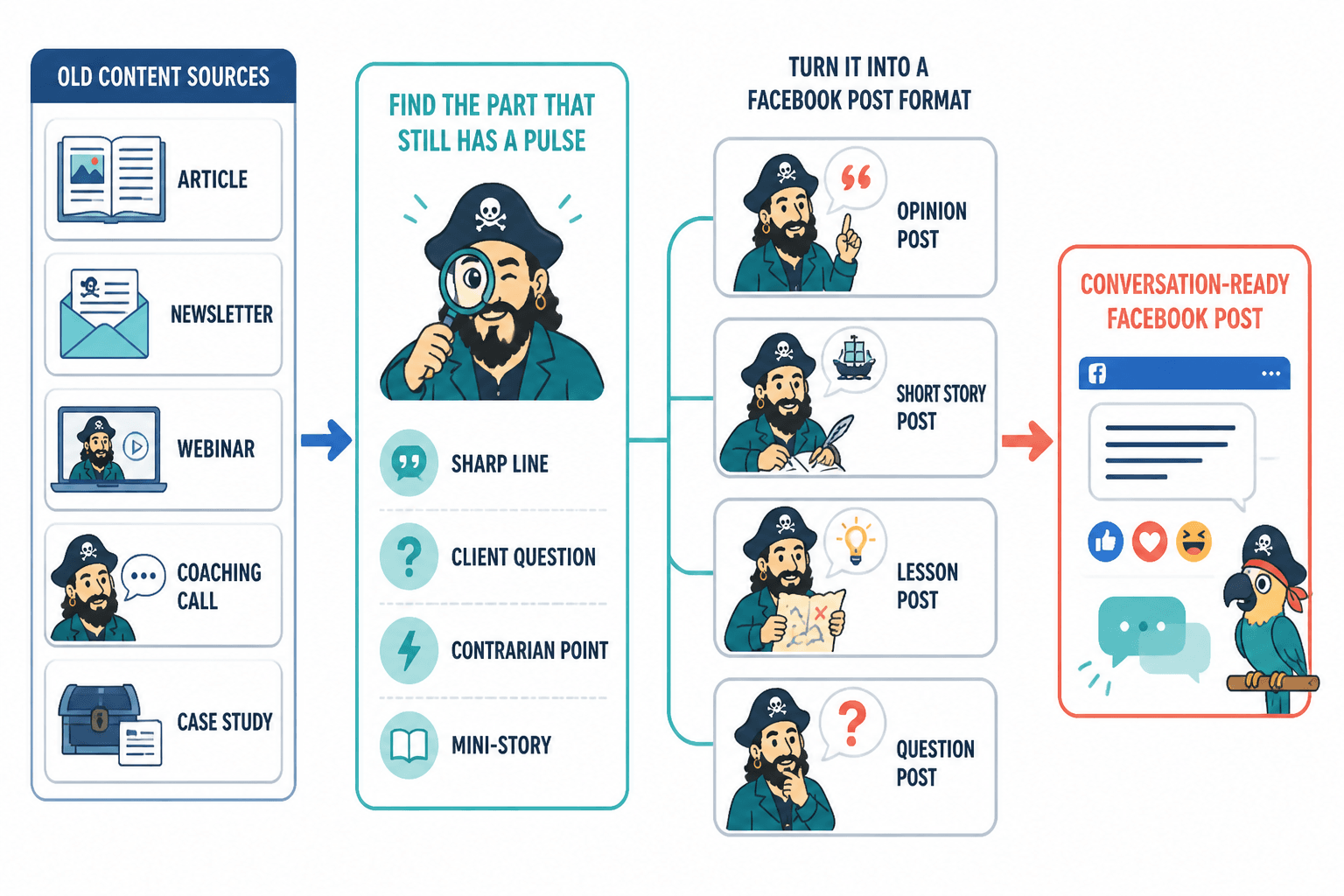
Start by finding the part that still has a pulse
Do not repurpose the whole piece. Find the one part worth saving.
That might be:
- A sharp line from an article
- A client question from a coaching call
- A contrarian point from a webinar
- A mistake you called out in a newsletter
- A mini-story buried halfway through a long post
- A lesson from a case study
- A ranty note from your drafts folder that still makes you nod
This is where a lot of repurposing goes wrong. People try to preserve everything. They keep the full explanation, the context, the setup, the educational sequence, and all the caveats. Then the Facebook post reads like a struggling article abstract.
Facebook posts usually get stronger when you identify the live wire in the old content and build around that. One clear takeaway beats seven decent ones crammed into one post.
A simple extraction filter
When looking at old content, ask:
- What is the most surprising or useful point here?
- What part would I say out loud to a client or friend?
- What line would make someone stop and think, “Yep, that’s true”?
- What part creates a reaction, not just agreement?
- What can stand on its own without the full original piece?
If you cannot find a clean answer, the content may not be worth reusing yet. Not every old draft deserves resurrection.
Use the right source material
Some old content adapts to Facebook beautifully. Some does not. Here is a practical way to think about it.
| Old content type | Best Facebook angle | Watch out for |
|---|---|---|
| Blog post | One takeaway, one strong opinion, one example | Sounding too formal or bloated |
| Email newsletter | Direct lesson, observation, or story | Leaving in sales-email phrasing |
| LinkedIn post | Looser, warmer, more conversational rewrite | Corporate polish and humblebrag residue |
| X thread | One compressed point expanded with context | Thread fragments with no flow |
| Client call notes | Problem-solution post or myth-busting post | Jargon and messy structure |
| Webinar or podcast transcript | Pull quote, argument, story, or objection-handling post | Verbal filler and rambling |
| Case study | Lesson, mistake, or result with specifics | Turning it into a sterile testimonial |
The best source material usually contains either tension, specificity, or proof. Ideally all three.
How to Turn Old Content Into Better Facebook Posts without sounding recycled
This is the actual process. You do not need a 19-step content repurposing system built in Notion by someone who enjoys making simple things look expensive.
1. Strip out the original format
Take the old content and remove what only made sense in the original platform.
- Delete intro fluff from articles
- Remove list numbering if the Facebook post does not need it
- Cut webinar-style transitions
- Drop email-only lines like “I wanted to send this because…”
- Remove platform-specific references from LinkedIn or X
What you want left is the core idea in plain language.
2. Rewrite the opening for conversation, not content packaging
Your first line matters a lot more than your repurposing workflow.
Weak reused openings tend to sound like this:
In my recent article, I discussed three key strategies for improving your content repurposing process.
That is technically correct and spiritually dead.
Better Facebook openings sound more like this:
- Most people are sitting on months of usable content and still posting like they have nothing to say.
- If your Facebook posts feel harder than they should, the problem may be that you keep starting from zero.
- One of the easiest ways to write better Facebook posts is to stop treating old content like archived homework.
- I think creators overcomplicate repurposing because they are trying to preserve the format instead of the point.
Notice the difference. The second set sounds like a person with a view, not a content manager filing a report.
3. Add a Facebook-native angle
This is the part that makes the post feel fresh instead of reused.
You can do that by adding one of these:
- A quick opinion
- A story beat
- A client pattern you keep seeing
- A mistake people make
- A more personal framing
- A direct question with actual stakes
Example:
Old blog takeaway: Content repurposing saves time and improves consistency.
Better Facebook post angle: I think people make repurposing harder than it needs to be because they assume reuse means reposting. It usually works better when you take one useful idea from an old piece and say it like you would in a real conversation.
Same topic. Much better entry point.
4. Keep one idea per post
If your original content had five sections, that is not one Facebook post. That is probably five posts, maybe more.
Trying to squeeze an article into one post usually creates that familiar “valuable but weirdly exhausting” effect. People can feel when a post has not decided what it is.
Break old content into smaller units:
- One lesson
- One misconception
- One example
- One mistake
- One framework
- One strong sentence expanded into a short post
5. Make the middle sound lived-in
A lot of repurposed posts fail in the middle. The opening gets attention, then the rest slides into generic explanation mode.
Fix that by adding texture. That can mean:
- A real example
- A small contrast
- A specific phrasing choice
- A tiny story
- A sentence that reveals what you actually think
For example, compare these:
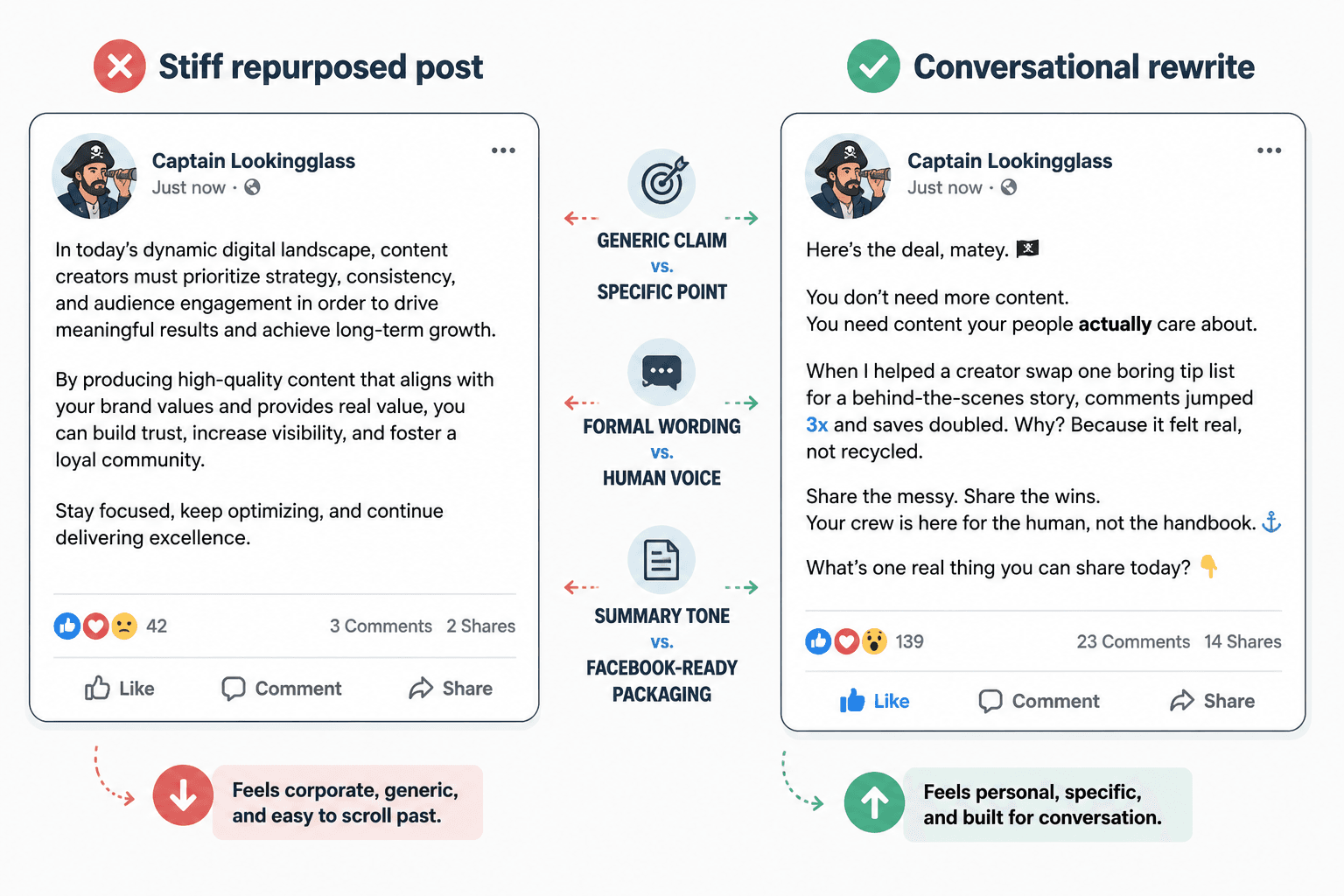
Bland: Repurposing content helps increase efficiency and maximize your content efforts.
Better: If you already explained something clearly in an email, article, or client call, you probably do not need a brand new idea. You need a better way to package the one you already had.
The second version sounds like something a person might actually write on Facebook without needing a lanyard.
6. End with a real Facebook ending
A lot of old content ends badly when moved to Facebook.
The original piece might end with a newsletter pitch, article summary, webinar CTA, or hard sell. That often needs reworking.
Better Facebook endings usually do one of four things:
- Invite a response
- Land the point cleanly
- Bridge to a relevant next step
- Open a conversation without acting desperate for comments
Examples:
- Curious how you reuse old content without making it feel stale.
- This is one of those small changes that makes posting feel much less annoying.
- If your posts feel flat, start by rewriting one old piece instead of creating a new one.
- If you want the lead-gen version of this, read how to turn Facebook posts into more leads or sales.
If you want more help specifically on endings, read better Facebook posts CTA endings for personal brands.
Three strong ways to repurpose old content into Facebook posts
The lesson post
Take one useful point from an article, email, or video and turn it into a single lesson with a point of view.
Template:
I keep seeing people do [common thing].
The problem is [what goes wrong].
What works better is [clear shift].
That matters because [practical result].
Example:
I keep seeing people treat content repurposing like content recycling.
They grab an old post, trim a few lines, and repost it unchanged.
What works better is taking the core idea and rewriting it for the room you are in.
Facebook usually wants more humanity, more texture, and less polished “content strategy” voice.
The story-post-from-a-point
If your old content has a strong claim but feels dry, attach it to a moment.
That moment does not need to be dramatic. In fact, please spare everyone the fake vulnerability arc. A tiny, believable setup is enough.
The bigger point is simple: clearer structure and clearer writing make the piece more useful. That is usually what makes the ending land better too.