
The draft is open, the hook is trying too hard, and the last line has clearly been rescued from a previous idea and shoved into the thread out of habit. That is usually where X threads start to wobble: not at the topic, but at the shape. Good examples matter because they show the shape before the polish goes on. They make it easier to see what a strong hook looks like, how a thread should move, and where the payoff actually lands.
That is the point of this page. Not a gallery of cleverness for its own sake. A useful set of X thread examples you can adapt without pretending every post needs to sound like a manifesto written during a caffeine emergency. For broader structure and planning, the X threads guide covers the system behind the formats.
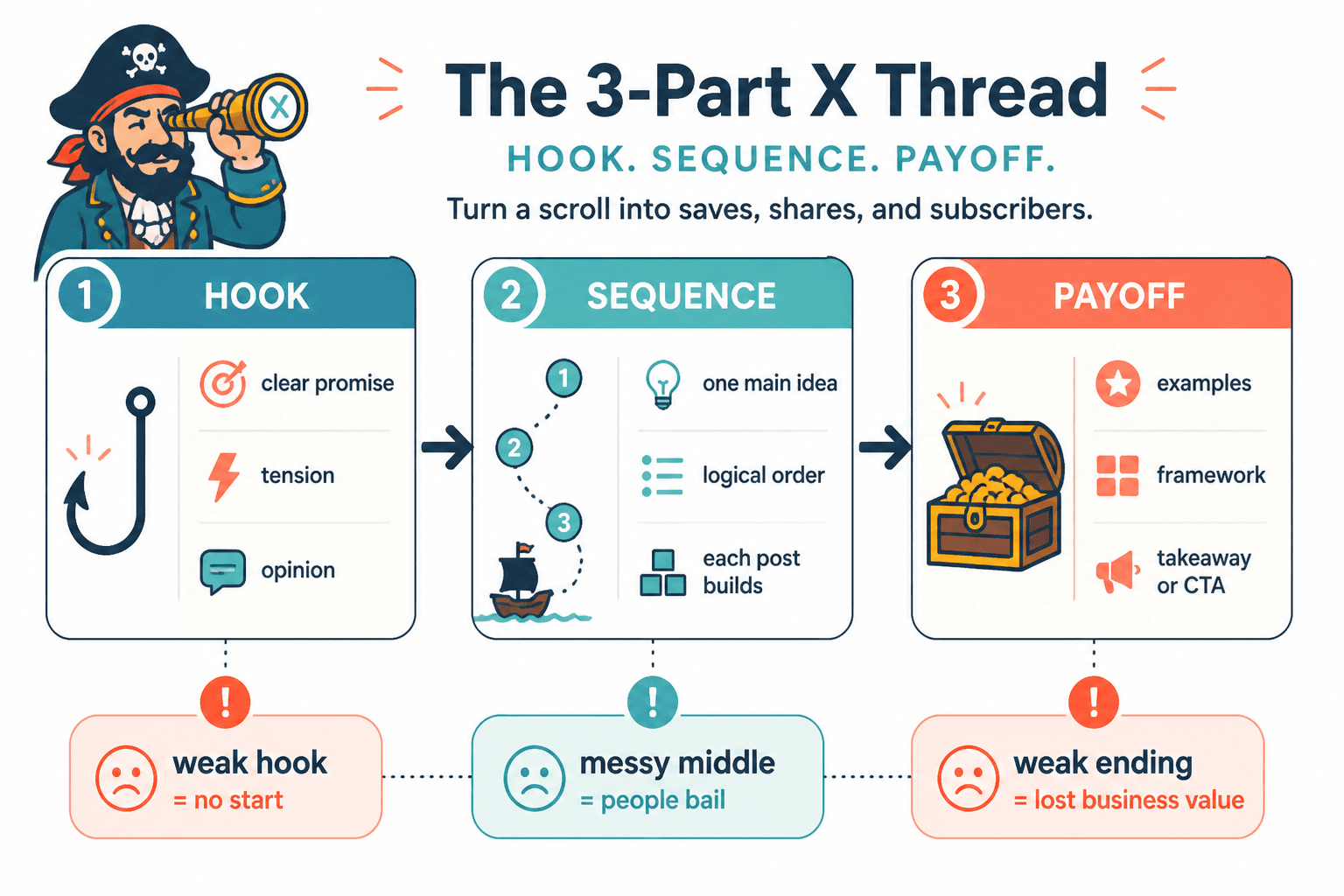
What a good X thread example should actually show
A useful X thread example does more than sound polished. It shows how the thread earns attention and keeps it. That usually means three things:
- A hook with a clear reason to keep reading – not just a dramatic sentence, but a specific promise, tension, or useful insight.
- A sequence that moves – each post should do one job instead of circling the same point like it lost the map.
- A payoff that feels earned – the ending should resolve the idea, deepen the lesson, or point to a next step.
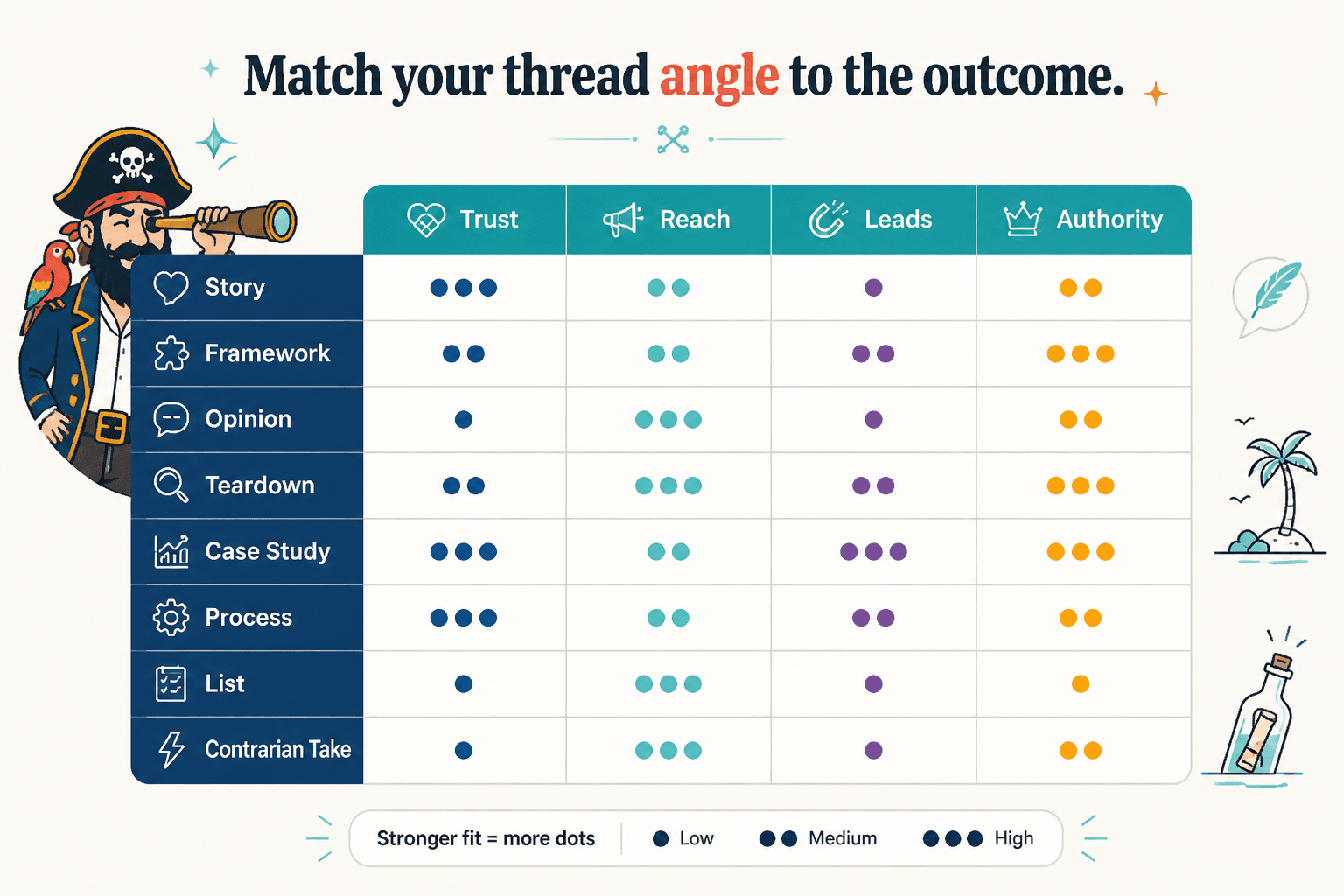
The best examples also match the goal. A thread built for reach will look different from one built for trust, leads, or authority. That is why a clean format often beats a flashy one. A thread is not a tiny novel. It is a controlled path.
The biggest mistakes X thread examples help fix
Examples are most useful when the writing has started drifting into one of the classic traps:
- The hook promises too much and says too little. People are curious for about half a second, then annoyed.
- The thread repeats one point too many times. Clarity is good. Echoes are not a personality.
- The payoff is hidden behind filler. If the useful part arrives too late, the reader has already wandered off.
- The CTA sounds pasted on. “Follow for more” is not a strategy. It is a shrug.
This is where examples earn their keep. They give you a way to compare a draft against something concrete instead of asking whether it “feels strong,” which is one of the least reliable editing methods ever invented.
X thread hook examples that work
Most threads do not fail because the topic is weak. They fail because the first post gives people no reason to care. A strong hook usually does four things: it makes a promise, it gets specific, it introduces some tension, and it hints at a payoff worth the scroll.
Here are hook patterns that work well for creator threads.
1. The clear promise hook
Example: “Here are 7 X thread structures you can use when you want a post to feel sharp instead of scattered.”
Why it works: the reader knows exactly what they are getting, and the promise is narrow enough to feel usable.
2. The mistake hook
Example: “Your thread may be losing people because the opening line is doing all the talking and none of the work.”
Why it works: it names a problem the reader can immediately test against their own draft.
3. The contrast hook
Example: “A thread that gets ignored is not always a bad thread. Sometimes it is just a decent idea with no shape.”
Why it works: contrast creates friction, and friction keeps the eye moving.
4. The proof-led hook
Example: “Threads that open with a specific result tend to feel more useful than threads that open with vague enthusiasm.”
Why it works: it signals credibility without turning into a miniature lecture.
5. The opinion hook
Example: “A thread does not need more wit. It needs a better path.”
Why it works: it takes a position quickly, which can be useful when the point is simple and the audience is skimming.
If you want a deeper breakdown of hook types and why they work, the companion guide on X threads is the better place to live with that material.
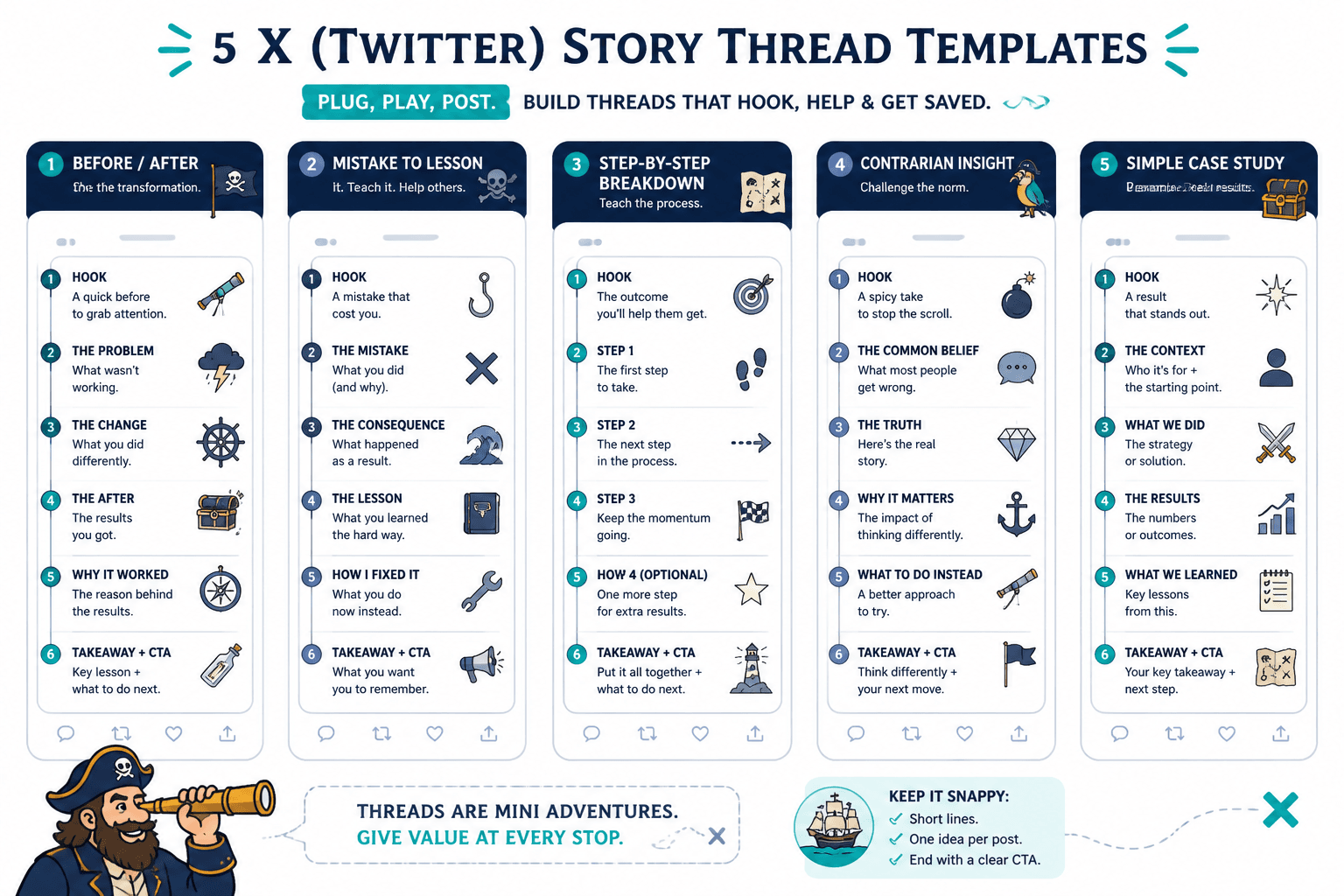
Simple X story thread templates for busy creators
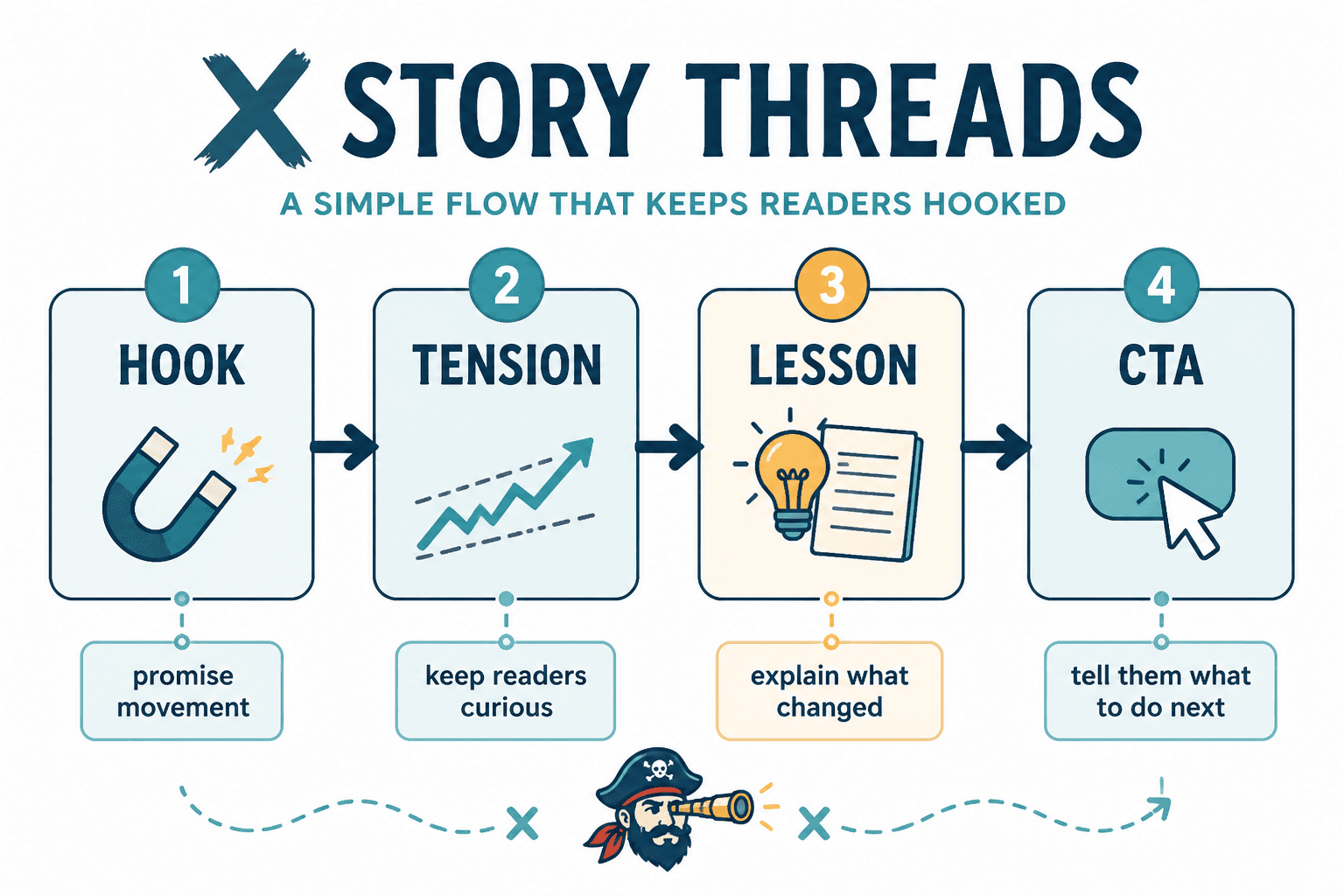
Story threads work when they have movement. The point is not to turn every post into a literary event. It is to give the reader a clean path through a beginning, a bit of tension, a useful turn, and a finish that lands.
The basic pattern below works surprisingly well when you need structure fast.
- Hook – open with the reason to keep reading.
- Tension – show the problem, mistake, or complication.
- Shift – reveal what changed, what mattered, or what was learned.
- Payoff – end with the takeaway or the next useful step.
That sequence is simple on purpose. Simple is easier to finish, and finished is usually better than ambitious and abandoned.
Template 1: The mistake-to-lesson thread
Use when: you want to show a useful lesson without sounding preachy.
Structure:
- Open with the mistake.
- Show what happened because of it.
- Explain what changed.
- End with the lesson the reader can borrow.
Example shape: “I kept making this content mistake. It looked small at first. Then it kept hurting the thread’s clarity. The fix was simpler than I expected.”
Template 2: The before-and-after thread
Use when: you want to show transformation, not just theory.
Structure:
- Describe the before state.
- Show what was not working.
- Introduce the adjustment.
- Show the better result.
Template 3: The process thread
Use when: you want to teach a repeatable workflow.
Structure:
- State the outcome.
- Break the process into steps.
- Explain the logic behind each step.
- End with a practical takeaway.
Template 4: The breakdown thread
Use when: you want to analyze something that worked or failed.
Structure:
- Present the thing.
- Explain what made it effective or weak.
- Show the pattern underneath it.
- Extract the lesson.
Template 5: The advice-with-examples thread
Use when: you want to make guidance feel concrete.
Structure:
- State the principle.
- Show a weak version.
- Show a stronger version.
- Explain the difference.
X thread examples for coaches, consultants, and personal brands
Service-based creators usually need threads that do two things at once: demonstrate useful thinking and build enough trust that someone might actually click, reply, or inquire. That means the thread should feel valuable before it feels promotional.
1. The mistake breakdown thread
Example shape: “A lot of weak results come from one small positioning mistake. Here is what it looks like, why it matters, and how to fix it.”
This works because it teaches while quietly showing judgment. The reader learns something practical and also sees how you think.
2. The client-pattern thread
Example shape: “When people come to me with this problem, the pattern is usually the same.”
This is useful because it connects your experience to a repeatable pattern. Just keep it grounded. No fake namedropping, no imaginary case study theatre.
3. The myth-busting thread
Example shape: “The common advice around this topic sounds neat, but it skips the part that actually matters.”
This works when the correction is specific and not just contrarian for sport.
4. The framework thread
Example shape: “Here is a simple 3-part way to think about this problem.”
Framework threads perform well when the structure is genuinely useful and easy to reuse. If the framework needs a whiteboard and a prayer, it is probably not ready.
5. The teardown thread
Example shape: “Here is why this thread works, where it could be better, and what to copy from the structure.”
This format is especially useful for creators who want to teach through analysis instead of broad advice.
How to adapt X thread examples without copying them
The point of examples is not to imitate them line for line. It is to notice the structure underneath them and reuse that structure with your own material.
- Keep the shape. Hook, sequence, payoff. That part matters more than style flourishes.
- Swap the proof. Use your own observations, your own examples, your own angle.
- Trim the extra words. If a sentence does not move the thread forward, it is decoration wearing work clothes.
- Match the goal. A reach thread and a trust thread are not the same beast.
For a thread to work, the reader has to feel momentum. That means every post should do one job, and the ending should feel like the thread arrived somewhere on purpose.
Quick X thread checklist before you post
- Does the hook create a real reason to continue?
- Does each post move the idea forward?
- Is there one clear takeaway?
- Did you avoid repeating the same point in slightly different clothes?
- Does the ending feel earned, not bolted on?
- Would this still work if the reader only skimmed two-thirds of it?
If the answer to that last one is no, the thread may need another pass. That is not failure. That is editing doing its actual job.
Use examples to sharpen the thread, not replace the thinking
Strong X thread examples help because they make structure visible. They show how to open cleanly, how to keep momentum, and how to end with something useful instead of a dramatic fade-out into the void.
Use them as scaffolding. Then write the version that fits your topic, your voice, and the result you want from the post. If you need the broader strategy behind the formats, go back to the X threads guide and build from there.